
If the half-life of carbon-14 is about 5730 years, then a fossil that has one-sixteenth the
normal proportion of carbon-14 to carbon-12 should be about how many years old?
A) 2800
B) 11,200
C) 16,800
D) 22,900
Scientists believe that the direction birds go when migrating is guided in part by _____.
I) the stars in the night sky
II) the Sun during the day
III) the magnetic field of the Earth
A) only I
B) only II
C) only III
D) I, II, and III

As an undergraduate research assistant, your duties involve measuring water potential
in experimental soil-plant-atmosphere systems. Assume you make a series of
measurements in a system under normal daylight conditions, with stomata open and
photosynthesis occurring. Which of the following correctly depicts the trend your
measurement data should follow if the cohesion-tension mechanism is operating?
A) ψsoil < ψroots = ψleaves < ψatmosphere
B) ψatmosphere < ψleaves = ψroots < ψsoil
C) ψsoil < ψroots < ψleaves < ψatmosphere
D) ψatmosphere < ψleaves < ψroots < ψsoil
If you were writing an essay, the part(s) of your brain that would be actively involved in
this task is/are the _____.
A) frontal lobes
B) parietal lobe
C) Broca’s area
D) occipital lobe
A terrestrial animal species is discovered with the following larval characteristics:
exoskeleton, system of tubes for gas exchange, and modified segmentation. A

knowledgeable zoologist should predict that the adults of this species would also
feature _____.
A) eight legs
B) two pairs of antennae
C) a sessile lifestyle
D) an open circulatory system
Excretory organs known as Malpighian tubules are present in _____.
A) flatworms
B) insects
C) jellyfish
D) sea stars
Photorespiration _____.
A) generates carbon dioxide and consumes ATP and oxygen
B) generates ATP and sugars and consumes oxygen and carbon dioxide
C) generates oxygen and consumes ATP, carbon dioxide, and sugars
D) consumes carbon dioxide and generates ATP, sugars, and oxygen
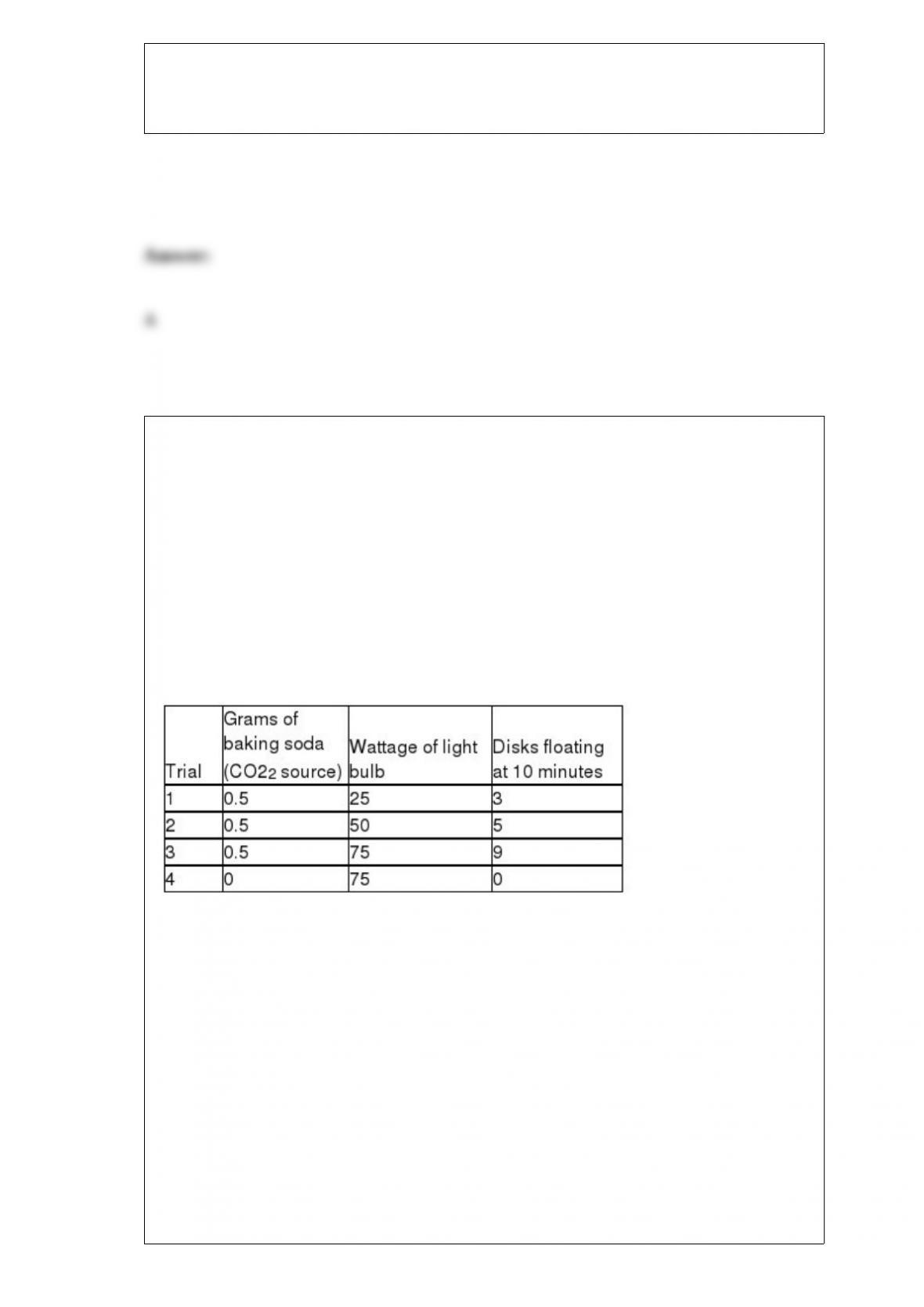
Students conducted an experiment to determine the effect of light intensity on the rate
of photosynthesis. They punched 40 leaf disks from spinach leaves and used a syringe
partially filled with water to pull the gases from the leaf disks so that all leaf disks sunk
to the bottom of the syringe. Ten (10) leaf disks from the syringe were placed in each of
four cups and covered with 50 ml of the solutions as indicated below. All leaf disks
were resting on the bottom of the cups when the experiment began. The volume of
liquid in each cup and the temperature of the solutions were held constant. All cups
were placed 0.5 meters from the designated light source. A large beaker of water was
placed between the light and the cups to act as a heat sink to prevent a change in
temperature. At the end of 10 minutes, the number of disks floating in each cup was
recorded.
Use your knowledge of the mechanism of photosynthesis and the data presented in the
chart to determine which of the statements below is a correct explanation for the
student’s data.
A) Cup 1 had a low rate of photosynthesis because 0.5 grams of baking soda did not
provide a sufficient amount of CO2.
B) Cup 2 had the highest rate of photosynthesis because 5 disks were floating at the end
of 10 minutes using a 50 watt light bulb.
C) Cup 3 had the same rate of photosynthesis as Cup 1 because they had the same ratio
of disks floating to wattage of light.

D) Cup 4 had the slowest rate of photosynthesis because it had the least baking soda.
Use the following information to answer the question(s) below.
Paulinella chromatophora is one of the few cercozoans that is autotrophic, carrying out
aerobic photosynthesis with its two elongated “chromatophores.” The chromatophores
are contained within vesicles of the host cell, and each is derived from a
cyanobacterium, though not the same type of cyanobacterium that gave rise to the
chloroplasts of algae and plants.
If true, which of the following would be most important in determining whether P.
chromatophora‘s chromatophore is still an endosymbiont, or is an organelle, as the term
chromatophore implies?
A) if P. chromatophora is less fit without its chromatophore than with it
B) if the chromatophore is less fit without the host cercozoan than with it
C) if there is ongoing metabolic cooperation between the chromatophore and the host
cercozoan
D) if there has been movement of genes from the chromatophore genome to the nuclear
genome, such that these genes are no longer present in the chromatophore genome
The taller a Brazil nut tree is, _____.
1. the more valuable it is as a source of lumber

2. the less useful it is to harpy eagles
3. the greater its photosynthetic rate relative to neighboring plants
A) 1 only
B) 1 and 2
C) 1 and 3
D) 2 and 3
Inflammatory responses typically include _____.
A) increased activity of phagocytes in an inflamed area
B) reduced permeability of blood vessels to conserve plasma
C) release of substances to decrease the blood supply to an inflamed area
D) inhibiting the release of white blood cells from bone marrow
HIV is inactivated in the laboratory after a few minutes of sitting at room temperature,
but the flu virus is still active after sitting for several hours. What are the practical
consequences of these findings?
A) HIV can be transmitted more easily from person to person than the flu virus

B) The flu virus can be transmitted more easily from person to person than HIV
C) This property of HIV makes it more likely to be a pandemic than the flu virus
D) Disinfecting surfaces is more important to reduce the spread of HIV than the flu
Listed below are several examples of types of animal behavior. Choose the letter of the
correct term (A-E) that matches each example in the following question(s).
A. operant conditioning
B. agonistic behavior
C. innate behavior
D. imprinting
E. altruistic behavior
Through trial and error, a rat learns to run a maze without mistakes to receive a food
reward.
A) A
B) B
C) C
D) D

A behavioral physiologist is studying the homeostatic control of blood pH. In a trial, a
lizard runs on a treadmill for a set amount of time and the blood pH is measured. The
blood pH drops as carbon dioxide is released into the bloodstream. Which component
of the homeostatic feedback system is responsible for deciding if the blood pH is far
enough from normal that a response is necessary?
A) effector
B) sensor
C) integrator
D) assimilator
Which of the following viruses would most likely have reverse transcriptase?
A) an RNA-based lytic virus
B) an RNA-based lysogenic virus
C) a DNA-based lytic virus
D) a DNA-based lysogenic virus
Which statement represents the best explanation for the observation that the nuclear

DNA of wolves and domestic dogs has a very high degree of sequence homology?
Dogs and wolves _____.
A) have very similar morphologies
B) belong to the same order
C) are both members of the order Carnivora
D) share a very recent common ancestor
Use the following description to answer the question(s) below.
On the volcanic, equatorial West African island of Sao Tom, two species of fruit fly
exist. Drosophila yakuba inhabits the island’s lowlands, and is also found on the African
mainland, located about two hundred miles away. At higher elevations, and only on Sao
Tom, is found the very closely related Drosophila santomea. The two species can
hybridize, though male hybrids are sterile. A hybrid zone exists at middle elevations,
though hybrids there are greatly outnumbered by D. santomea. Studies of the two
species’ nuclear genomes reveal that D. yakuba on the island is more closely related to
mainland D. yakuba than to D. santomea (2n = 4 in both species). Sao Tom rose from
the Atlantic Ocean about fourteen million years ago.
The observation that island D. yakuba are more closely related to mainland D. yakuba
than island D. yakuba are to D. santomea is best explained by proposing that D.
santomea _____.
A) descended from a now-extinct, non-African fruit fly
B) arrived on the island before D. yakuba
C) descended from a single colony of D. yakuba, which had been introduced from
elsewhere, with no subsequent colonization events
D) descended from an original colony of D. yakuba, of which there are no surviving
members. The current island D. yakuba represent a second colonization event from
elsewhere.
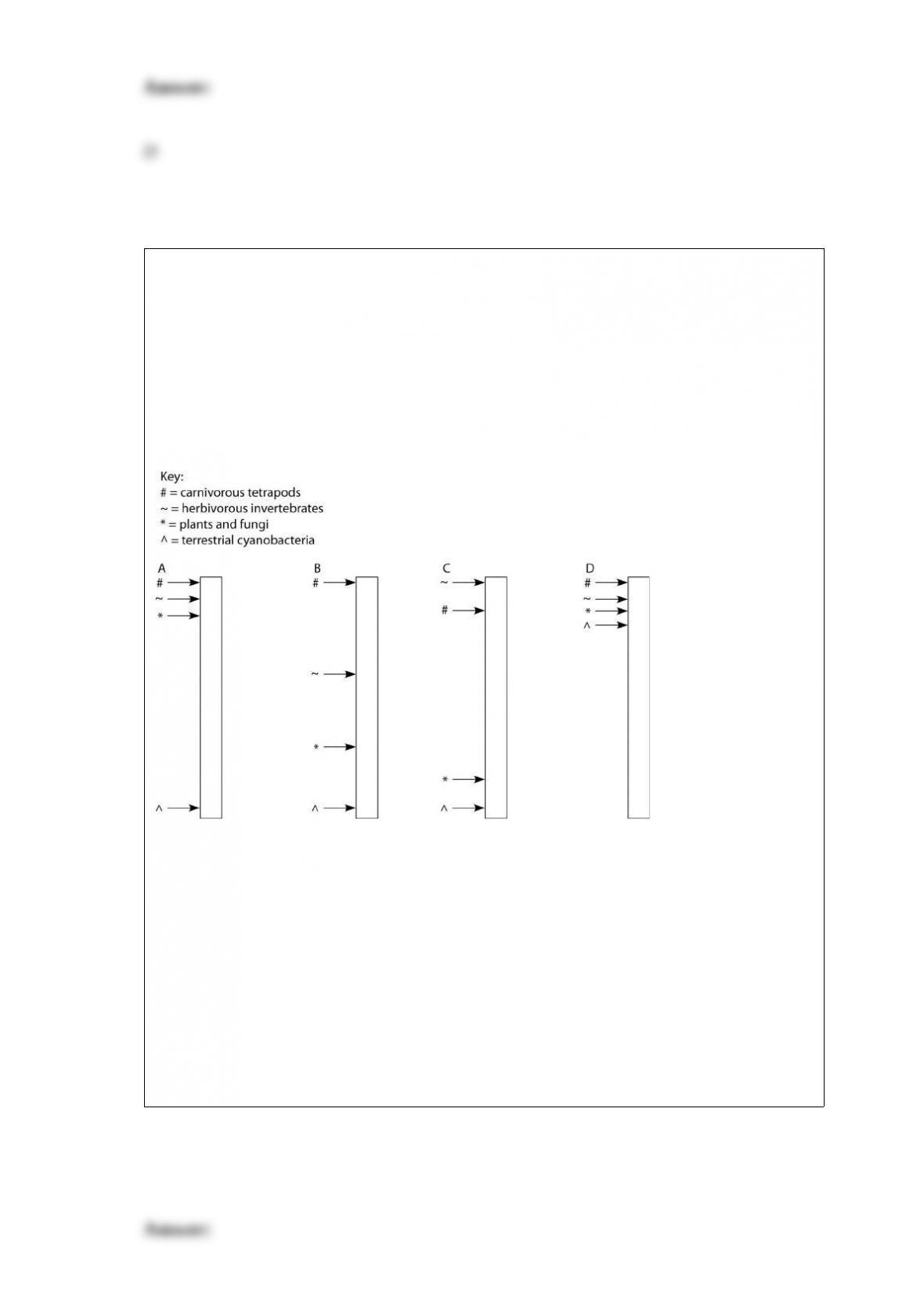
The questions below refer to the following paragraph.
A sediment core is removed from the floor of an inland sea. The sea has been in
existence, off and on, throughout the entire time that terrestrial life has existed.
Researchers wish to locate and study the terrestrial organisms fossilized in this core.
The core is illustrated as a vertical column, with the top of the column representing the
most recent strata and the bottom representing the time when land was first colonized
by life.
If arrows indicate locations in the column where fossils of a particular type (see key
above) first appear, then which core in the figure above has the most accurate
arrangement of fossils?
A) core A
B) core B
C) core C
D) core D

Gaucher disease is the most common of lipid storage diseases in humans. It is
caused by a deficiency of an enzyme necessary for lipid metabolism. This leads to a
collection of fatty material in organs of the body including the spleen, liver, kidneys,
lungs, brain, and bone marrow.
Using your knowledge of the structure of eukaryotic cells, identify the statement
below that best explains how internal membranes and the organelles of cells would be
involved in Gaucher disease.
A) The mitochondria are most likely defective and do not produce adequate amounts
of ATP needed for cellular respiration.
B) The rough endoplasmic reticulum contains too many ribosomes which results in
an overproduction of the enzyme involved in carbohydrate catalysis.
C) The lysosomes lack sufficient amounts of enzymes necessary for the metabolism
of lipids.
D) The Golgi apparatus produces vesicles with faulty membranes that leak their
contents into the cytoplasm of the cell.
A rabbit taken from a meadow near sea level and moved to a meadow high on a
mountainside would have some trouble breathing. Why?
A) The percentage of oxygen in the air at high elevations is lower than at sea level.
B) The percentage of oxygen in the air at high elevations is higher than at sea level.
C) The partial pressure of oxygen in the air at high elevations is lower than at sea level.
D) The partial pressure of oxygen in the air at high elevations is higher than at sea level.

Use the following information to answer the question(s) below.
About 3 million years ago, the Isthmus of Panama (a narrow strip of land connecting
North and South America) formed, dividing marine organisms into Pacific and
Caribbean populations. Researchers have examined species of snapping shrimp on both
sides of the isthmus. Based on the morphological species concept, there appeared to be
seven pairs of species, with one species of each pair in the Pacific and the other in the
Caribbean. The different species pairs live at somewhat different depths in the ocean.
Using mitochondrial DNA sequences, the researchers estimated phylogenies and found
that each of these species pairs, separated by the isthmus, were indeed each other’s
closest relatives. The researchers investigated mating in the lab and found that many
species pairs were not very interested in courting with each other, and any that did mate
almost never produced fertile offspring. (N. Knowlton, L. A. Weigt, L. A. Solorzano, D.
K. Mills, and E. Bermingham. 1993. Divergence in proteins, mitochondrial DNA, and
reproductive incompatibility across the Isthmus of Panama. Science 260:1629-32.)
Refer to the paragraph about the formation of the Isthmus of Panama. If the isthmus
formed gradually rather than suddenly, what pattern of genetic divergence would you
expect to find in these species pairs?
A) similar percentages of difference in DNA sequence between all pairs of sister
species
B) greater percentage of difference in DNA sequence between species that inhabit deep
water than between species that inhabit shallow water
C) greater percentage of difference in DNA sequence between species that inhabit
shallow water than between species that inhabit deep water
If the apical ectodermal ridge is surgically removed from an embryo, it will lose _____.

A) positional information for limb-bud pattern formation
B) guidance signals needed for correct gastrulation
C) unequal cytokinesis of blastomeres
D) the developmental substrate for the kidneys
Acidity in human sweat is an example of _____.
A) cell-mediated immune responses
B) acquired immunity
C) adaptive immunity
D) innate immunity
The outer-to-inner sequence of tissue layers in a post-gastrulation vertebrate embryo is
_____.
A) endoderm → ectoderm → mesoderm
B) mesoderm → endoderm → ectoderm
C) ectoderm → mesoderm → endoderm

D) ectoderm → endoderm → mesoderm
According to the fluid mosaic model of cell membranes, phospholipids _____.
A) can move laterally along the plane of the membrane
B) frequently flip-flop from one side of the membrane to the other
C) occur in an uninterrupted bilayer, with membrane proteins restricted to the surface of
the membrane
D) have hydrophilic tails in the interior of the membrane
Which structure or compartment is separate from the apoplastic route?
A) the lumen of a xylem vessel
B) the lumen of a sieve tube
C) the cell wall of a mesophyll cell
D) the cell wall of a root hair

Which of the following is an example of Mllerian mimicry?
A) two species of unpalatable butterfly that have the same color pattern
B) a day-flying hawkmoth that looks like a wasp
C) a chameleon that changes its color to look like a dead leaf
D) two species of rattlesnakes that both rattle their tails
Which of the following is a direct result of depolarizing the presynaptic membrane of
an axon terminal?
A) Voltage-gated calcium channels in the membrane open.
B) Synaptic vesicles fuse with the membrane.
C) The postsynaptic cell produces an action potential.
D) Ligand-gated channels open, allowing neurotransmitters to enter the synaptic cleft.

Which structure is the site of the synthesis of proteins that may be exported from the
cell?
A) rough ER
B) plasmodesmata
C) Golgi vesicles
D) free cytoplasmic ribosomes
Where are the proteins of the electron transport chain located?
A) mitochondrial outer membrane
B) mitochondrial inner membrane
C) mitochondrial intermembrane space
D) mitochondrial matrix
Use the following description to answer the question(s) below.
The cycads, a mostly tropical phylum of gymnosperms, evolved about 300 million
years ago and were dominant forms during the Age of the Dinosaurs. Though their
sperm are flagellated, their ovules are pollinated by beetles. These beetles get nutrition
(they eat pollen) and shelter from the microsporophylls. Upon visiting

megasporophylls, the beetles transfer pollen to the exposed ovules. In cycads, pollen
cones and seed cones are borne on different plants. Cycads synthesize neurotoxins,
especially in the seeds, that are effective against most animals, including humans.
On the Pacific island of Guam, large herbivorous bats called “flying foxes” commonly
feed on cycad seeds, a potent source of neurotoxins. The flying foxes do not visit male
cones. Consequently, what should be true?
A) The flying foxes are attracted to cycad fruit and eat the enclosed seeds only by
accident.
B) Flying foxes are highly susceptible to the effects of the neurotoxins.
C) The flying foxes assist the beetles as important pollinating agents of the cycads.
D) Flying foxes can be dispersal agents of cycad seeds if the seeds sometimes get
swallowed whole (in other words, without getting chewed).
Use the following information to answer the question(s) below.
An elementary school science teacher decided to liven up the classroom with a
saltwater aquarium. Knowing that saltwater aquaria can be quite a hassle, the teacher
proceeded stepwise. First, the teacher conditioned the water. Next, the teacher decided
to stock the tank with various marine invertebrates, including a polychaete, a siliceous
sponge, several bivalves, a shrimp, several sea anemones of different types, a colonial
hydra, a few coral species, an ectoproct, a sea star, and several herbivorous gastropod
varieties. Lastly, she added some vertebratesa parrotfish and a clownfish. She arranged
for daily feedings of copepods and feeder fish.
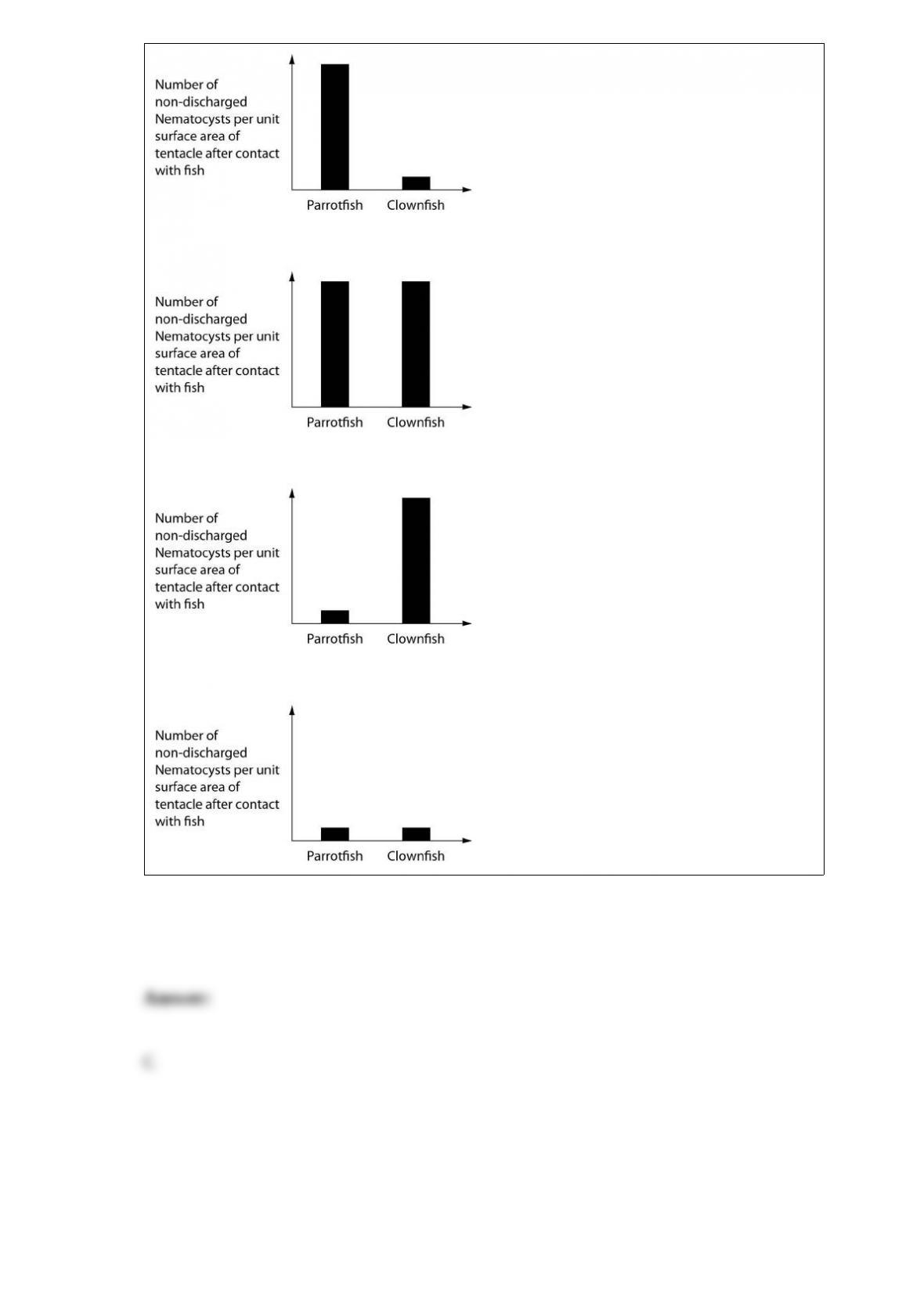
The clownfish readily swims among the tentacles of the sea anemones; the parrotfish
avoids them. One hypothesis for the clownfish’s apparent immunity is that they slowly
build a tolerance to the sea anemone’s toxin. A second hypothesis is that a chemical in
the mucus that coats the clownfish prevents the nematocysts from being triggered.
Which of the following graphs supports the second, but not the first, of these
hypotheses?
A)
B)
C)
D)