
A particular triplet of bases in the coding sequence of DNA is AAA. The anticodon on
the tRNA that binds the mRNA codon is _____.
A) TTT
B) UUA
C) UUU
D) AAA
Which of the following defines a genome?
A) the complete set of an organism’s polypeptides
B) the complete set of a species’ polypeptides
C) a karyotype
D) the complete set of an organism’s genes and other DNA sequences
Bacteria perform each of the following ecological roles. Which role typically does NOT
involve symbiosis?
A) skin commensalist
B) decomposer
C) aggregates with methane-consuming archaea
D) gut mutualist
The following question(s) are based on information in Hopi E. Hoekstra, Kristen E.
Drumm, and Michael W. Nachman, “Ecological Genetics of Adaptive Color
Polymorphism in Pocket Mice: Geographic Variation in Selected and Neutral Genes,”
Evolution 58(6), 2004: 1329-41.
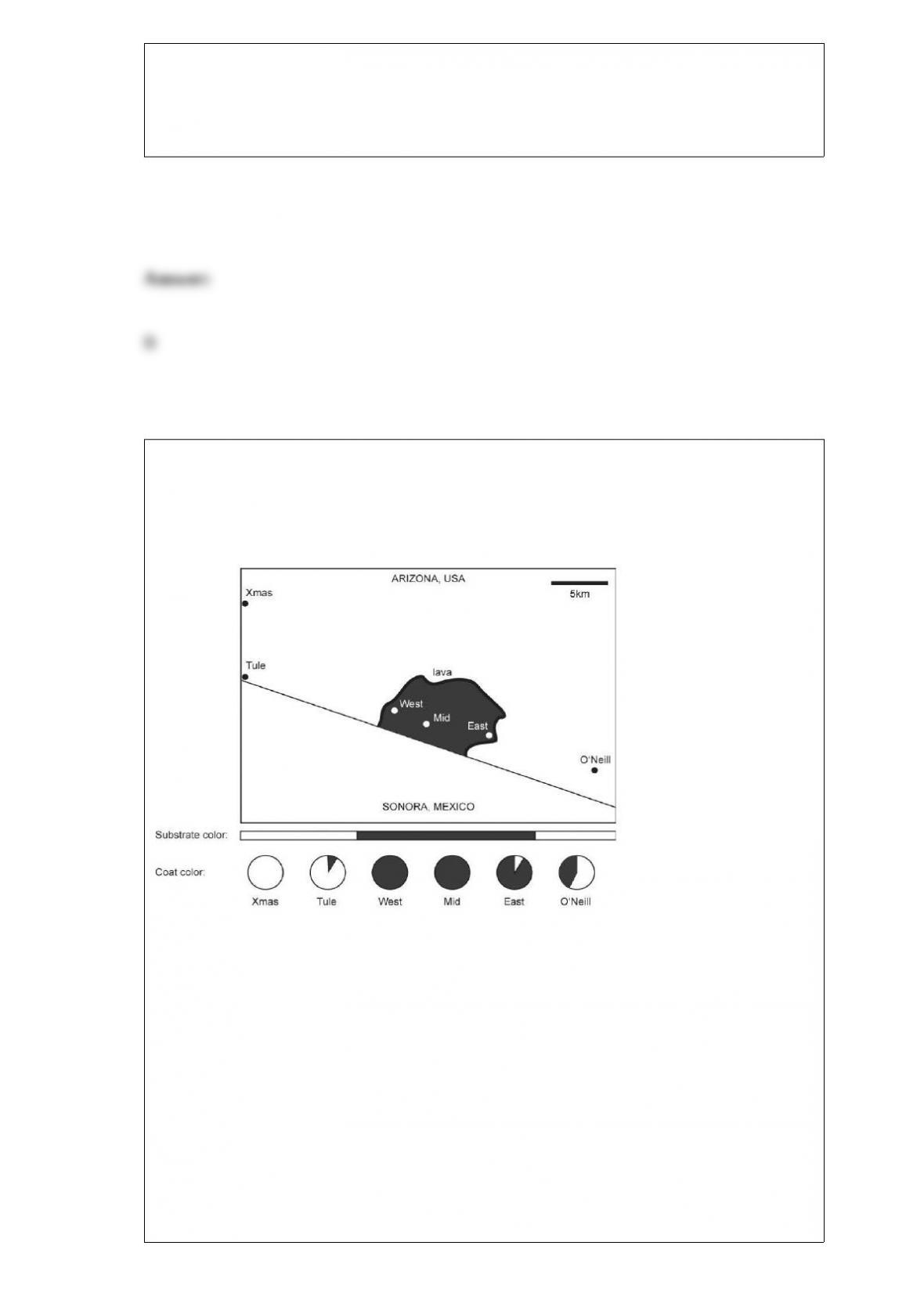
The figure above shows the distribution of pocket-mouse coat colors in several Arizona
populations found either on light-colored granite substrate or on dark volcanic rock
(dark substrate). The Melanocortin-1 receptor (Mc1r) alleles, D and d, differ by four
amino acids. Mice with DD and Dd genotypes have dark coats, whereas mice with the
dd genotype are light colored. What sort of genotype frequencies might you expect to
find in the Xmas, Mid, and O’Neill populations?
A) Xmas-high DD frequency; Mid-high Dd frequency, O’Neill-high dd frequency
B) Xmas-high Dd frequency; Mid-high DD frequency, O’Neill-high dd frequency
C) Xmas-high dd frequency; Mid-high Dd frequency, O’Neill-high DD frequency
D) Xmas-high dd frequency; Mid-high DD frequency, O’Neill-high Dd frequency
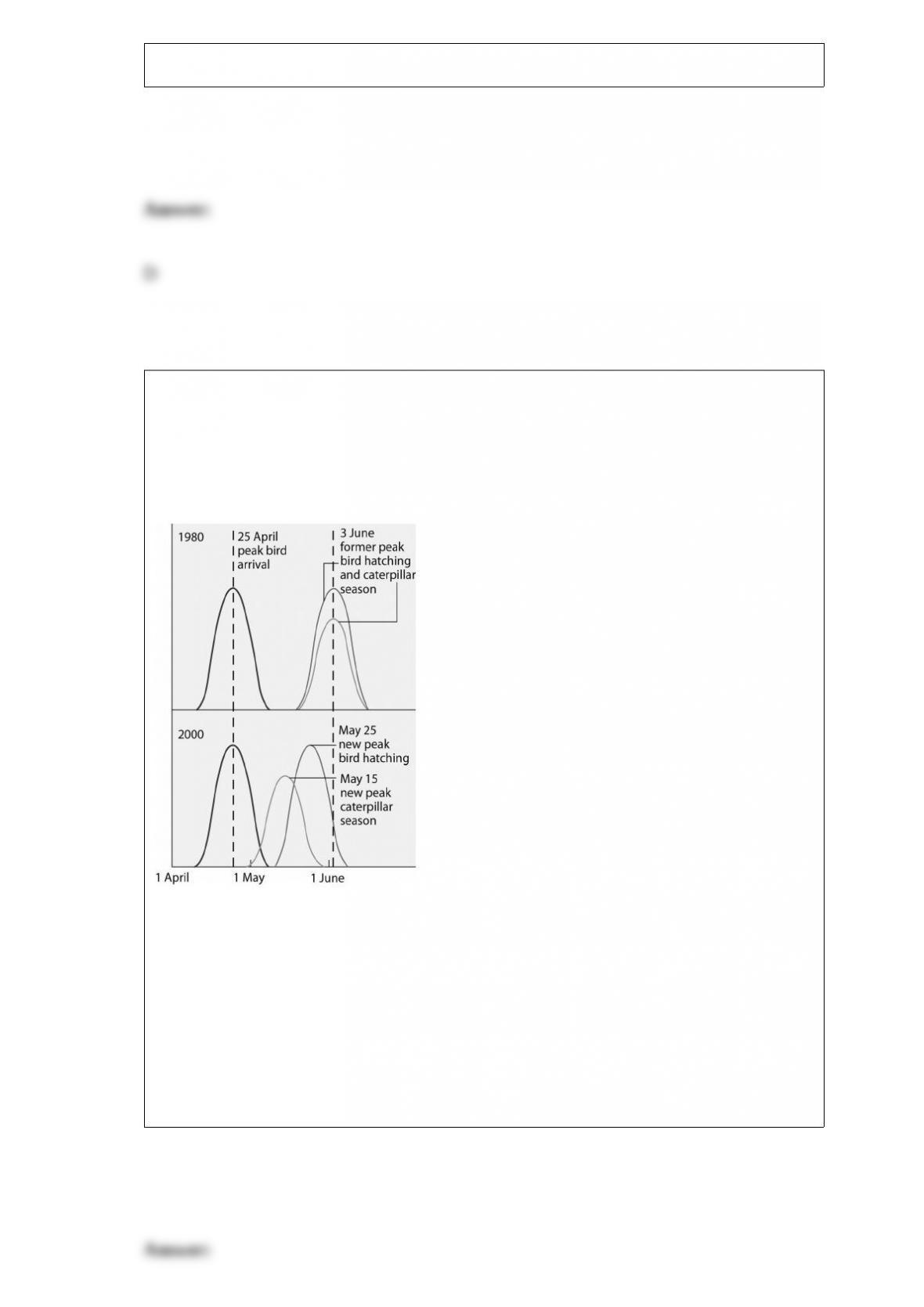
Use the following graph and information to answer the question below.
Flycatcher birds that migrate from Africa to Europe feed their nestlings a diet that is
almost exclusively moth caterpillars. The graph below shows the mean dates of arrival,
bird hatching, and peak caterpillar season for the years 1980 and 2000.
The shift in the peak of caterpillar season is most likely due to _____.
A) earlier migration returns of flycatchers
B) an innate change in the biological clock of the caterpillars
C) global warming
D) acid precipitation in Europe

In testing a hypothesis that “territorial defense in European robins is a fixed action
pattern that is released by the sight of orange feathers,” researchers found that robins
defended their territory by attacking anything that was of similar size and had an orange
patch. What experiment would you perform next to determine that the color initiated the
defense response?
A) Repeat the experiment using a blue patch instead of an orange patch.
B) Repeat the experiment by removing the patch completely.
C) Repeat the experiment by using a model of a robin that was twice the size of a
normal robin but with a small orange patch.
D) Repeat the experiment by using a model of a robin that had an orange patch that was
twice the size of a normal patch.
If you were shipping green bananas to a supermarket thousands of miles away, which of
the following chemicals would you want to eliminate from the plants’ environment?
A) carbon dioxide
B) cytokinins
C) ethylene
D) auxin

Changing a single amino acid in a protein consisting of 325 amino acids would _____.
A) alter the primary structure of the protein but not its tertiary structure or function
B) cause the tertiary structure of the protein to unfold
C) always alter the biological activity or function of the protein
D) always alter the primary structure of the protein, sometimes alter the tertiary
structure of the protein, and sometimes affect its biological activity
The detector of light during de-etiolation (greening) of a tomato plant is (are)_____.
A) carotenoids
B) xanthophylls
C) phytochrome
D) auxin
Use the following information to answer the question(s) below.
The most recently discovered phylum in the animal kingdom (1995) is the phylum
Cycliophora. It includes three species of tiny organisms that live in large numbers on
the outsides of the mouthparts and appendages of lobsters. The feeding stage
permanently attaches to the lobster via an adhesive disk and collects scraps of food
from its host’s feeding by capturing the scraps in a current created by a ring of cilia. The
body is sac-like and has a U-shaped intestine that brings the anus close to the mouth.
Cycliophorans are coelomates, do not molt (though their host does), and their embryos
undergo spiral cleavage.
Cycliophorans have two types of larvae. One type of larva is produced when the
digestive system of a female is impregnated by a male. The digestive system then
collapses and develops into a larva, which swims away in search of a new host after the
surrounding female dies. Which is the embryonic tissue that is apparently most
important in forming this type of larva?
A) mesohyl
B) mesoderm
C) ectoderm
D) endoderm
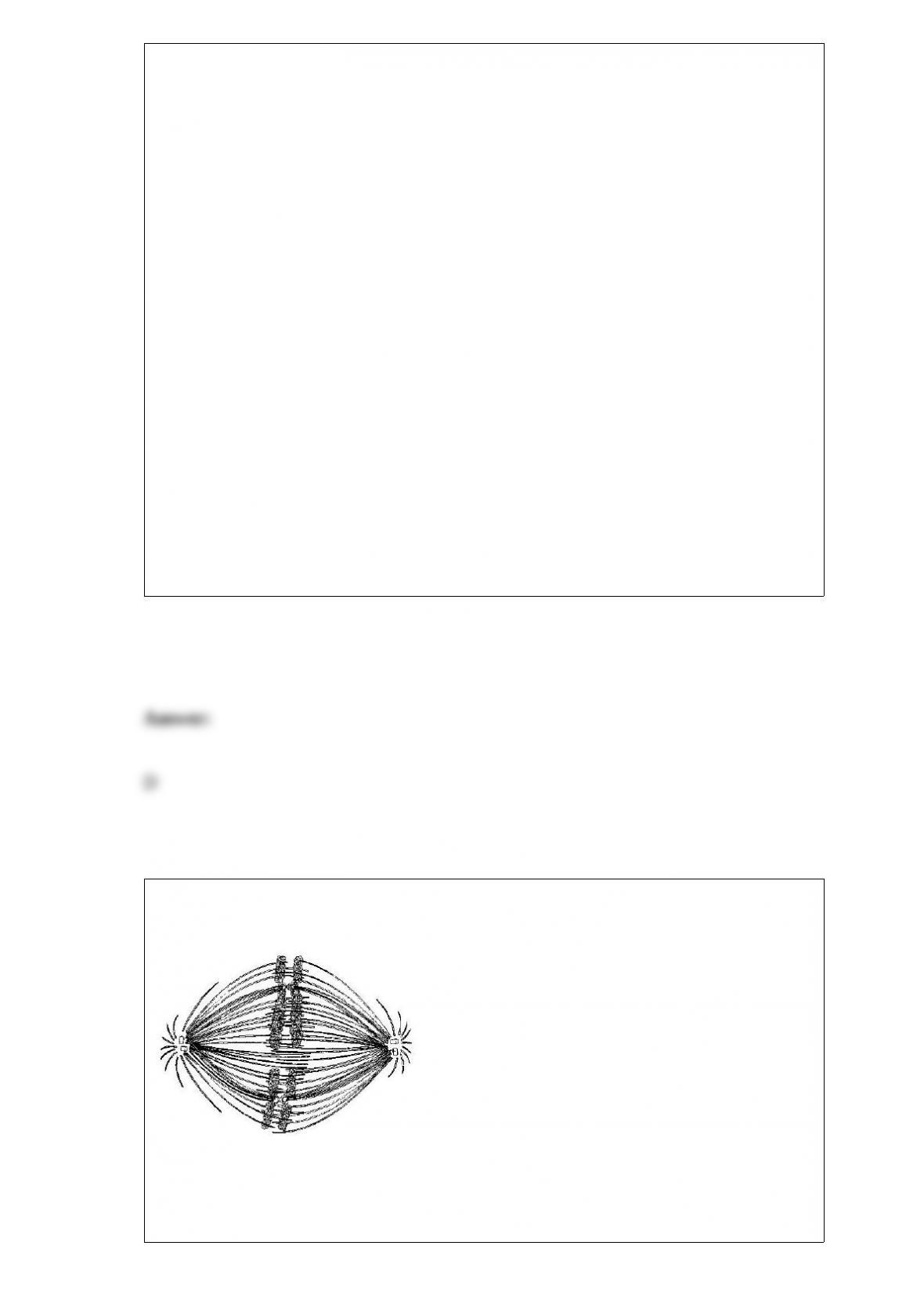
If the cell whose nuclear material is shown in the accompanying figure continues
toward completion of mitosis, which of the following events would occur next?

A) spindle fiber formation
B) nuclear envelope breakdown
C) formation of telophase nuclei
D) synthesis of chromatids
In E. coli replication the enzyme primase is used to attach a 5 to 10 base ribonucleotide
strand complementary to the parental DNA strand. The RNA strand serves as a starting
point for the DNA
polymerase that replicates the DNA. If a mutation occurred in the primase gene, which
of the following would you expect?
A) Replication would only occur on the leading strand.
B) Replication would only occur on the lagging strand.
C) Replication would not occur on either the leading or lagging strand.
D) Replication would not be affected as the enzyme primase in involved with RNA
synthesis.
Umami perception would be stimulated by _____.
A) chocolate milk

B) a slice or roast beef
C) acidic orange juice
D) salt water
If the sex ratio in a population is significantly different from 50:50, then which of the
following will always betrue?
A) The population will enter the extinction vortex.
B) The genetic variation in the population will increase over time.
C) The effective population size will be greater than the actual population size.
D) The effective population size will be less than the actual population size.
Which of the following is required to make complementary DNA (cDNA) from RNA?
A) restriction enzymes (endonucleases)
B) gene cloning
C) DNA ligase
D) reverse transcriptase

A cell with an extensive area of smooth endoplasmic reticulum is specialized to _____.
A) play a role in storage
B) synthesize large quantities of lipids
C) actively export protein molecules
D) import and export protein molecules
For a repressible operon to be transcribed, which of the following must occur?
A) A corepressor must be present.
B) RNA polymerase and the active repressor must be present.
C) RNA polymerase must bind to the promoter, and the repressor must be inactive.
D) RNA polymerase must not occupy the promoter, and the repressor must be inactive.

Which term most precisely describes the cellular process of breaking down large
molecules into smaller ones?
A) catabolism (catabolic pathways)
B) metabolism
C) anabolism (anabolic pathways)
D) dehydration
Which level of protein structure do the α-helix and the β-pleated sheet represent?
A) primary
B) secondary
C) tertiary
D) quaternary

Which of the groups above is an acidic functional group that can dissociate and release
H+ into a solution?
A) A
B) B
C) C
D) D
In order for an ovule (egg cell) in a flower to be fertilized and form a viable seed,
pollination must occur. In this process, a sperm cell is delivered to the ovule when the
pollen grain lands on the stigma and grows a tube, which enters the ovary and
discharges the sperm cell to form a diploid zygote when it fuses with the egg cell.
Although it only takes one pollen grain to successfully deliver sperm to the egg,
numerous pollen grains are generally transferred to the stigma during insect pollination
of flowering plants. Which phenotypic traits of pollen would you predict to be selected
upon to promote survival and fitness within an insect-pollinated flowering plant?
A) High pollen tube growth rate and ability to detect chemicals from cells surrounding
the egg.
B) Ability to produce the most cells during mitotic growth of the pollen tube.
C) Elaborate and striking UV “nectary guides” on the petals to guide an insect to the
stigma.
D) Larger pollen in order to carry the tube that is necessary for delivery of the sperm
cells.

The relationship between the insect hormones ecdysteroid and PTTH is an example of
_____.
A) an interaction of the endocrine and nervous systems
B) competitive inhibition of a hormone receptor
C) how peptide-derived hormones have more widespread effects than steroid hormones
D) homeostasis maintained by antagonistic hormones
Which of the following genetic processes may be most helpful in accounting for the
Cambrian explosion?
A) binary fission
B) random segregation
C) gene duplication
D) chromosomal condensation

In what sense are studies by nineteenth-century naturalists and those by early
twenty-first-century genomic biologists similar?
A) Both focused on cellular evolution.
B) Both worked to understand how genes evolved.
C) Both took a reductionist approach by studying only one small part of a complex
system.
D) Both focused on observing and describing what exists in their realms of
investigation.
Once a peptide has been formed between the amino acid attached to the tRNA in the P
site and the amino acid associated with the tRNA in the A site, what occurs next?
A) translocation
B) reading of the next codon of mRNA
C) initiation
D) The codon-anticodon hydrogen bonds holding the tRNA in the A site are broken.
Which of the following, if discovered, could refute our current understanding of the
pattern of evolution?

A) no fossils of soft-bodied animals
B) a modern bird having reptile-like scales on its legs
C) radioactive dating of rocks showing that rocks closer to the Earth’s surface are
younger than lower rock strata
D) diverse fossils of mammals in Precambrian rock
A trend first observed in the evolution of the earliest tetrapods was _____.
A) the appearance of jaws
B) feet with digits
C) the mineralization of the endoskeleton
D) the amniotic egg
Use the following information to answer the question(s) below.
An elementary school science teacher decided to liven up the classroom with a
saltwater aquarium. Knowing that saltwater aquaria can be quite a hassle, the teacher
proceeded stepwise. First, the teacher conditioned the water. Next, the teacher decided
to stock the tank with various marine invertebrates, including a polychaete, a siliceous
sponge, several bivalves, a shrimp, several sea anemones of different types, a colonial
hydra, a few coral species, an ectoproct, a sea star, and several herbivorous gastropod

varieties. Lastly, she added some vertebratesa parrotfish and a clownfish. She arranged
for daily feedings of copepods and feeder fish.
If the teacher wanted to show the students what a lophophore is and how it works, the
teacher would point out a feeding _____.
A) hydra
B) sponge
C) gastropod
D) ectoproct
Once researchers identified DNA as the unit of inheritance, they asked how information
was transferred from the DNA in the nucleus to the site of protein synthesis in the
cytoplasm. What is the mechanism of information transfer in eukarotes?
A) DNA from a single gene is replicated and transferred to the cytoplasm, where it
serves as a template for protein synthesis.
B) Messenger RNA is transcribed from a single gene and transfers information from the
DNA in the nucleus to the cytoplasm, where protein synthesis takes place.
C) Proteins transfer information from the nucleus to the ribosome, where protein
synthesis takes place.
D) Transfer RNA takes information from DNA directly to a ribosome, where protein
synthesis takes place.

Consider two solutions: solution X has a pH of 4; solution Y has a pH of 7. From this
information, we can reasonably conclude that _____.
A) solution Y has no free hydrogen ions (H+)
B) the concentration of hydrogen ions in solution Y is 1000 times as great as the
concentration of hydrogen ions in solution X
C) the concentration of hydrogen ions in solution X is 3 times as great as the
concentration of hydrogen ions in solution Y
D) the concentration of hydrogen ions in solution X is 1000 times as great as the
concentration of hydrogen ions in solution Y
A cell has enough available ATP to meet its needs for about 30 seconds. What is likely
to happen when an athlete exhausts his or her ATP supply?
A) He or she has to sit down and rest.
B) Catabolic processes are activated that generate more ATP.
C) ATP is transported into the cell from the circulatory system.
D) Other cells take over, and the muscle cells that have used up their ATP cease to
function.

What are prions?
A) mobile segments of DNA
B) tiny circular molecules of RNA that can infect plants
C) viral DNA that attaches itself to the host genome and causes disease
D) misfolded versions of normal protein that can cause disease
Organic molecules with only hydrogens and five carbon atoms cannot _____.
A) have a branching carbon skeleton
B) have different combinations of double bonds between carbon atoms
C) have different positions of double bonds between carbon atoms
D) form enantiomers