
Recent genetic studies of the structure of microsporidian genomes, as well as the
sequences of their tubulin genes and the gene for RNA polymerase II, indicate that
microsporidians are closely related to the fungi. Microsporidians lack flagella,
centrioles, peroxisomes, and mitochondria (although they do have degenerate
mitochondria, called mitosomes). They have the smallest genome of any eukaryote, and
it is a genome that changes quickly. The genome is contained within two haploid nuclei.
All microsporidians are obligate intracellular parasites. They use a unique organelle
called a polar filament to gain access to the cells of their hosts. One species causes
chronic diarrhea in AIDS patients. Another parasitizes Anopheles gambiae, the
mosquito that transmits a fatal form of malaria to humans.
It has been hypothesized that fungi and plants have a mutualistic relationship because
plants make sugars available for the fungi’s use. What is the best evidence in support of
this hypothesis?
A) Fungi survive better when they are associated with plants.
B) Radioactively labeled sugars produced by plants eventually show up in the fungi
with which they are associated.
C) Fungi associated with plants have the ability to undergo photosynthesis and produce
their own sugars, while those not associated with plants do not produce their own
sugars.
D) Radioactive labeling experiments show that plants pass crucial raw materials to the
fungus for manufacturing sugars.
Which of the following sex and generation combinations directly produces the pollen
tube of angiosperms?
A) male gametophyte
B) female gametophyte
C) male sporophyte
D) female sporophyte

The complexity and variety of organic molecules is due to _____.
A) the chemical versatility of carbon atoms
B) the variety of rare elements in organic molecules
C) the diverse bonding patterns of nitrogen
D) their interaction with water
The switch of one B cell from producing one class of antibody to another class of
antibody that is responsive to the same antigen is due to _____.
A) the rearrangement of V region genes in that clone of responsive B cells
B) a switch in the kind of antigen-presenting cell that is involved in the immune
response
C) a patient’s reaction to the first kind of antibody made by the plasma cells
D) the rearrangement of immunoglobulin heavy-chain C region DNA

Native peoples traditionally use Brazil nuts to treat stomach ache, inflammation,
hypersensitivity, and hepatitis. Consequently, a scientist should be interested in
promoting _____.
A) better education for the native peoples so that they will overcome their old ways
B) clear-cutting forests containing Brazil nut trees to make way for crops with proven
medical benefits
C) an increase in the living standards of the native peoples so that they might be able to
purchase modern pharmaceuticals
D) the evaluation of Brazil nut chemicals for use as potential drugs
In correct chronological order, the three phases of the human uterine cycle are _____.
A) follicular → luteal → secretory
B) menstrual → proliferative → secretory
C) follicular → ovulation → luteal
D) proliferative → luteal → ovulation
A researcher notices that in a certain moth species, some females prefer to feed and lay

eggs on domesticated solanaceous plants like potatoes and tomatoes. Other females
prefer to feed and lay eggs on wild solanaceous plants like Datura. Both male and
female moths primarily use scent to find these plants from afar. Females tend to mate
where they feed, and the researcher finds a genetic basis for scent preference in these
moths. Based on the above information, what might be occurring in this moth species?
A) divergence in sympatry
B) divergence due to habitat fragmentation
C) postzygotic isolation
D) polyploidization
Which of the following statements comparing respiration in fish and in mammals is
correct?
A) The respiratory medium for fish carries more oxygen than the respiratory medium of
mammals.
B) A countercurrent exchange mechanism between the respiratory medium and blood
flow is seen in mammals but not in fish.
C) The movement of the respiratory medium in mammals is bidirectional, but in fish it
is unidirectional.
D) In blood, oxygen is primarily transported by plasma in fish, but by red blood cells in
mammals.

Based upon the figure above, the phylogenetic tree _____.
1. depicts uncertainty about whether the bryophytes or the vascular plants evolved first
2. depicts an evolutionary hypothesis
3. includes polytomies
4. shows that members of the phylum Pterophyta are the closest living relatives to the
seed plants
5. indicates that seeds are a shared ancestral character of all vascular plants
A) 1 and 2
B) 2 and 3
C) 1, 2, and 3
D) 1, 2, and 4
In humans, identical twins are possible because _____.
A) cytoplasmic determinants are distributed unevenly in unfertilized eggs
B) extraembryonic cells interact with the zygote nucleus
C) early blastomeres can form a complete embryo if isolated
D) the gray crescent divides the dorsal-ventral axis into new cells

In a meristematic region, the cell plate during mitosis is perpendicular to the side of the
stem. In what direction will the stem grow?
A) laterally in width
B) vertically in height
C) at a 45-degree angle from the ground
D) away from the sun
Use the following information to answer the questions below.
Succinate dehydrogenase catalyzes the conversion of succinate to fumarate. The
reaction is inhibited by malonic acid, which resembles succinate but cannot be acted
upon by succinate dehydrogenase. Increasing the ratio of succinate to malonic acid
reduces the inhibitory effect of malonic acid.
Based on this information, which of the following is correct?
A) Succinate dehydrogenase is the enzyme, and fumarate is the substrate.
B) Succinate dehydrogenase is the enzyme, and malonic acid is the substrate.
C) Succinate is the substrate, and fumarate is the product.
D) Fumarate is the product, and malonic acid is a noncompetitive inhibitor.

Within a differentiated B cell, the rearrangement of DNA sequences between variable
regions and joining regions is accomplished by a(n)_____.
A) RNA polymerase
B) reverse transcriptase
C) epitopase
D) recombinase
Use the following information to answer the question(s) below.
The mechanism of cell crawling in protist species is not well defined. Pseudopodia
extension involves interactions between actin and myosin (the same molecules that are
involved in vertebrate muscle contraction). However, prior to the study described
below, no one had provided convincing data that actin and myosin were actually
involved in cell crawling in protists. Anatomical studies had identified the cytoskeletal
protein actin just below the surface of the cell membrane in several species of protist,
but physiological studies had failed to show a functional link between actin, myosin,
and cell crawling.
In a study by N. Poulsen et al. (Diatom gliding is the result of an actin-myosin motility
system, Cell Motility and the Cytoskeleton 44 (1999):23-22), researchers tested whether
motility in a particular species of diatom involves interactions between actin and
myosin.
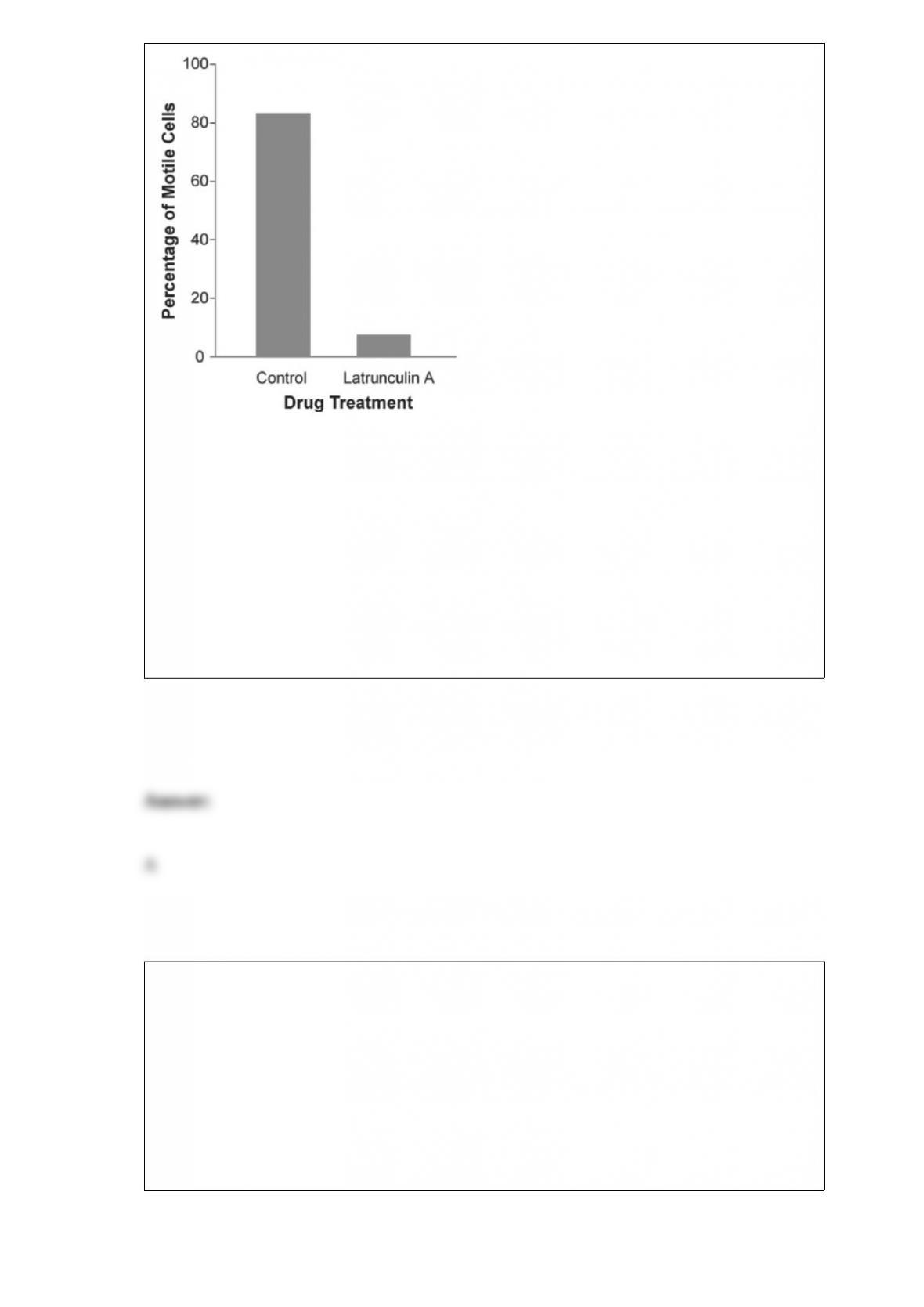
Refer to the study by Poulsen et al. and the figure above. Cultures of a species of
diatom were treated with BDM, a reversible inhibitor of myosin function. Which of the
following predictions is consistent with the hypothesis that an actin-myosin interaction
is necessary for motility?
A) BDM will significantly decrease motility of the cells in culture.
B) BDM will not significantly alter motility of the cells in culture.
C) BDM will significantly increase motility of the cells in culture.
What was an early selective advantage of a coelom in animals? A coelom _____.
A) contributed to a hydrostatic skeleton, allowing greater range of motion
B) was a more efficient digestive system
C) allowed cephalization and the formation of a cerebral ganglion
D) allowed asexual and sexual reproduction

The partial negative charge at one end of a water molecule is attracted to the partial
positive charge of another water molecule. What is this attraction called?
A) a covalent bond
B) a hydrogen bond
C) an ionic bond
D) a van der Waals interaction
The symbols +, -, and o are to be used to show the results of interactions between
individuals and groups of individuals in the examples that follow. The symbol + denotes
a positive interaction, – denotes a negative interaction, and o denotes where individuals
are not affected by interacting. The first symbol refers to the first organism mentioned.
What interactions exist between a lion pride and a hyena pack?
A) +/+
B) +/-
C) o/o
D) -/-

The most commonly occurring mutation in people with cystic fibrosis is a deletion of a
single codon. This results in _____.
A) a base-pair substitution
B) a frameshift mutation
C) a polypeptide missing an amino acid
D) a nonsense mutation
Which of the following are the only extant animals that descended directly from
dinosaurs?
A) lizards
B) crocodiles
C) birds
D) tuataras

What is the primary limiting factor that determines why no female animal can produce
a very large number of very large eggs?
A) Time is limited.
B) There are energy constraints.
C) Temperature constraints will prevent females from carrying too many eggs.
D) There will be an increase in predation pressure if the females carry too many large
eggs.
Hummingbirds are small birds that require a regular food supply. When hummingbirds
are faced with a situation that decreases their food supply, such as a storm, which of the
following adaptations would be most useful for the bird to survive such an
unpredictable and short-term absence of food resources?
A) shivering
B) torpor
C) hibernation
D) burrowing into soil
A physician finds that a nine-year-old male patient is entering puberty much earlier than
is usual. Such a condition is most likely the result of a tumor in the _____.

A) hypothalamus, producing elevated levels of testosterone
B) anterior pituitary, producing elevated levels of testosterone
C) testes, producing elevated levels of estrogen
D) anterior pituitary, producing elevated levels of gonadotropin-stimulating hormone
Which of the following soil minerals is most likely leached away during a hard rain?
A) Na+
B) K+
C) Ca++
D) NO3
–
A molecule with the chemical formula C6H12O6 is probably a _____.
A) fatty acid
B) polysaccharide
C) nucleic acid

D) monosaccharide
Excitatory postsynaptic potentials (EPSPs) produced nearly simultaneously by different
synapses on the same postsynaptic neuron can also add together, creating _____.
A) a temporal summation
B) a spatial summation
C) a tetanus
D) the refractory state
Which of the following is (are) unique to animals?
A) the structural carbohydrate, chitin
B) nervous system signal conduction and muscular movement
C) heterotrophy
D) flagellated gametes

The force driving simple diffusion is _____, while the energy source for active transport
is _____.
A) the concentration gradient; ADP
B) the concentration gradient; ATP
C) transmembrane pumps; electron transport
D) phosphorylated protein carriers; ATP
Which of the following statements is consistent with the principle of competitive
exclusion?
A) The random distribution of one competing species will have a positive impact on the
population growth of the other competing species.
B) Two species with the same fundamental niche will exclude other competing species.
C) Even a slight reproductive advantage will eventually lead to the elimination of the
less well adapted of two competing species.
D) Natural selection tends to increase competition between related species.
Which of the following is correctly paired with its structure and function?
A) sclerenchyma supporting cells with thick secondary walls
B) ground meristem protective coat of woody stems and roots
C) guard cells waterproof ring of cells surrounding the central stele in roots
D) periderm parenchyma cells functioning in photosynthesis in leaves
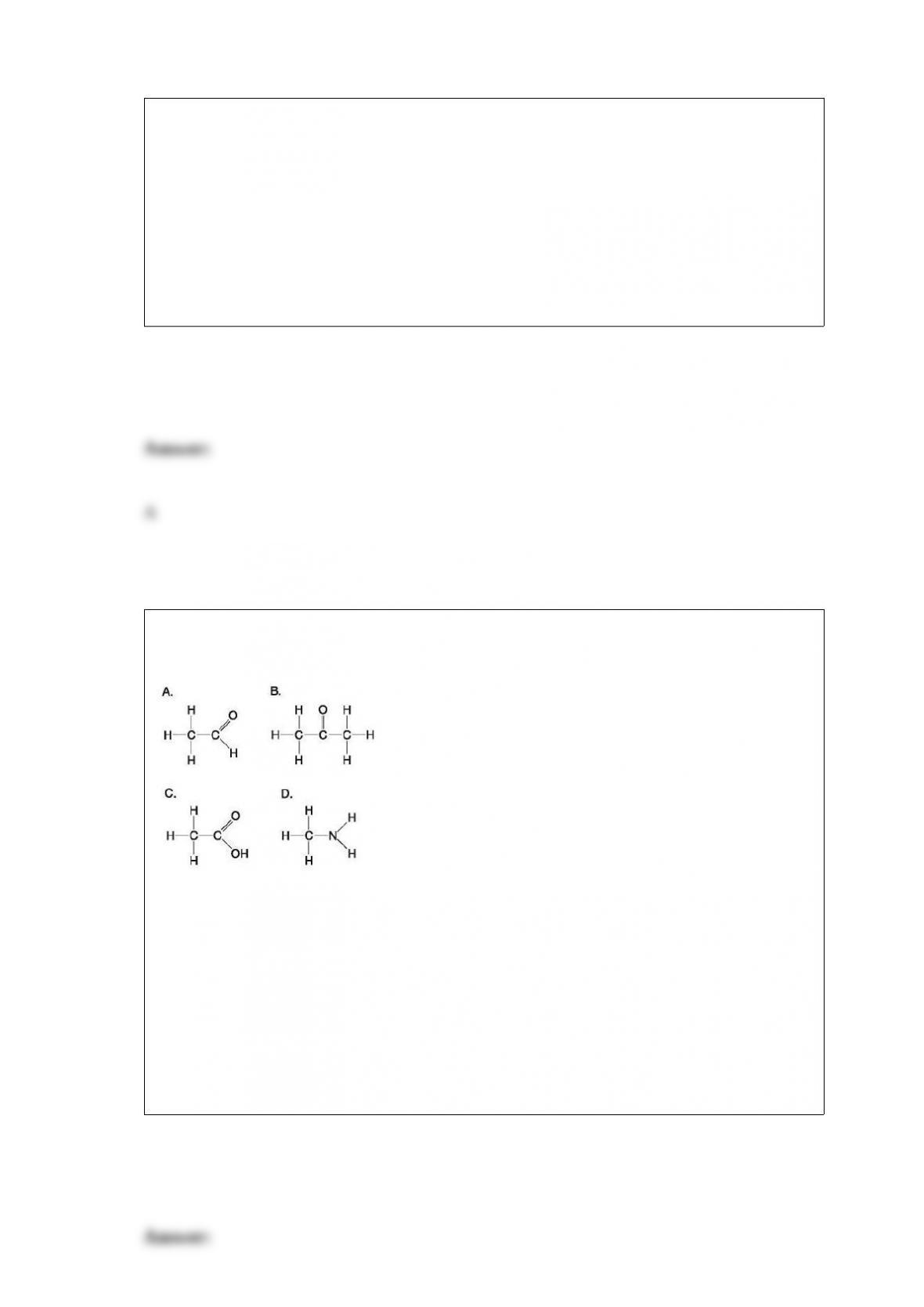
Which molecule shown above has a carbonyl functional group in the form of a ketone?
A) A
B) B
C) C
D) D

What do researchers typically focus on when they study a particular biogeochemical
cycle?
I) the nature and size of the reservoirs
II) the rate of element movement between reservoirs
III) interaction of the current cycle with other cycles
A) only I
B) only II
C) only III
D) only II and III