
In a simple synapse, neurotransmitter chemicals are released by _____.
A) the dendritic membrane
B) the presynaptic membrane
C) axon hillocks
D) cell bodies
The amino acid that operates at most inhibitory synapses in the brain is _____.
A) acetylcholine
B) endorphin
C) nitric oxide
D) gamma-aminobutyric acid (GABA)
Fire suppression by humans _____.
A) can change the species composition within biological communities.
B) will result ultimately in sustainable production of increased amounts of forest
products for human use.

C) is necessary for the protection of threatened and endangered forest species.
D) is a management goal of conservation biologists to maintain the healthy condition of
forest communities.
Interstitial fluid is _____.
A) the internal environment inside animal cells
B) identical to the composition of blood
C) a common site of exchange between blood and body cells
D) found only in the lumen of the small intestine
Which statement about the domain Archaea is true?
A) Genetic prospecting has recently revealed the existence of many previously
unknown archaean species.
B) The genomes of archaeans are unique, containing no genes that originated within
bacteria.
C) No archaeans can inhabit solutions that are nearly 30% salt.
D) No archaeans are adapted to waters with temperatures above the boiling point.

The toxin of Vibrio cholerae causes profuse diarrhea because it _____.
A) modifies a G protein involved in regulating salt and water secretion
B) binds with adenylyl cyclase and triggers the formation of cAMP
C) signals IP3 to act as a second messenger for the release of calcium
D) modifies calmodulin and activates a cascade of protein kinases
Which nitrogenous waste has the greatest number of nitrogen atoms?
A) ammonia
B) ammonium ions
C) urea
D) uric acid

The cochlea _____.
I) amplifies sound vibrations
II) collects sound pressure waves
III) detects the frequency of sounds
A) only I
B) only II
C) only III
D) only II and III
Nitrogen (N) is more electronegative than hydrogen (H). Which of the following is a
correct statement about the atoms in ammonia (NH3)?
A) Each hydrogen atom has a partial positive charge; the nitrogen atom has a partial
negative charge.
B) Ammonia has an overall positive charge.
C) Ammonia has an overall negative charge.
D) The nitrogen atom has a partial positive charge; each hydrogen atom has a partial
negative charge.
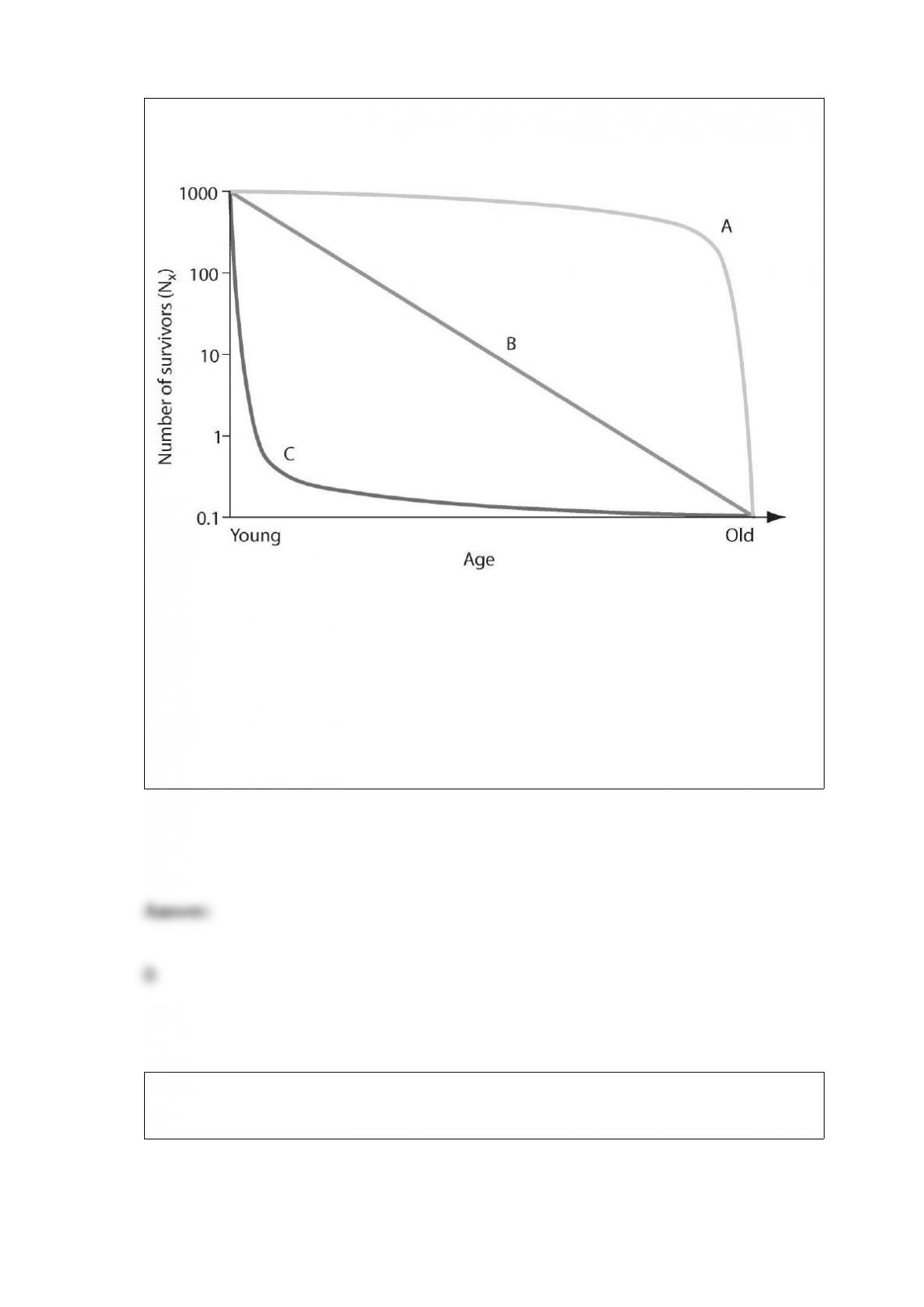
In the figure above, which of the following survivorship curves implies that an animal
may lay many eggs, of which a regular number die each year on a logarithmic scale?
A) curve A
B) curve B
C) curve C
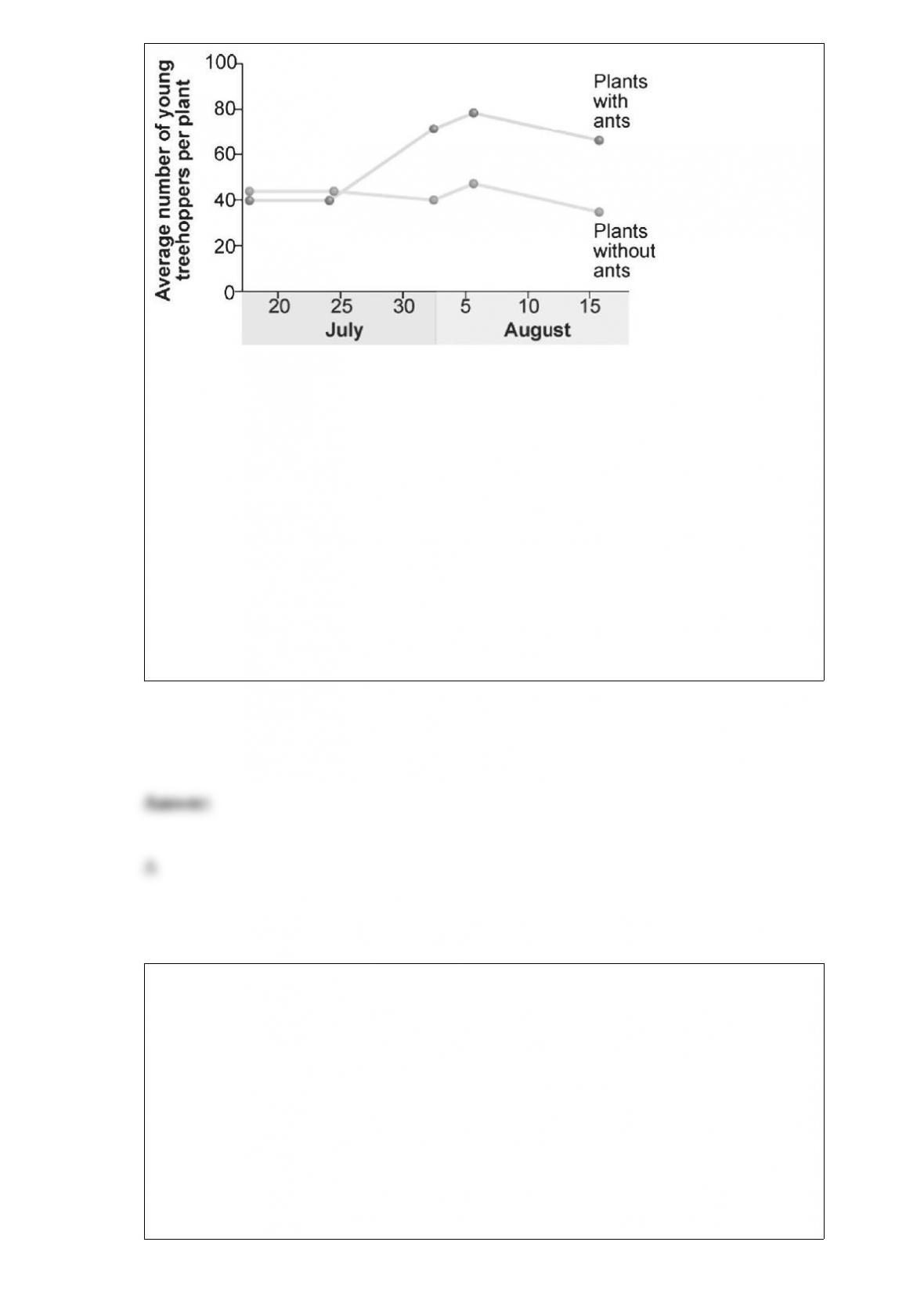
Treehoppers (a type of insect) produce honeydew, which ants use for food. Treehoppers
have a major predator, the jumping spider. Researchers hypothesized that the ants
would protect the treehoppers from the spiders. In an experiment, researchers followed
study plots with ants removed from the system and compared them to a control plot. In
the figure above, what can you conclude?
A) Ants do somehow protect the treehoppers from spiders.
B) Ants eat the honeydew produced by treehoppers
C) Ants reduce the numbers of treehoppers.
D) No specific conclusions can be drawn from this figure.
What is the reason that a modern transmission electron microscope (TEM) can resolve
biological images to the subnanometer level, as opposed to tens of nanometers
achievable for the best super-resolution light microscope?
A) The focal length of the electron microscope is significantly longer.
B) Contrast is enhanced by staining with atoms of heavy metal.
C) Electron beams have much shorter wavelengths than visible light.
D) The electron microscope has a much greater ratio of image size to real size.

According to the induced fit hypothesis of enzyme catalysis, _____.
A) the binding of the substrate depends on the shape of the active site
B) some enzymes change their structure when activators bind to the enzyme
C) the binding of the substrate changes the shape of the enzyme’s active site
D) the active site creates a microenvironment ideal for the reaction
Food and water appetites are under the regulatory influence of the _____.
A) cerebrum
B) thalamus
C) hypothalamus
D) medulla oblongata

Cilia and flagella bend because of _____.
A) conformational changes in ATP that thrust microtubules laterally
B) a motor protein called radial spokes
C) the quick inward movements of water by osmosis.
D) a motor protein called dynein
Subtropical plants are commonplace in Land’s End, England, whose latitude is the
equivalent of Labrador in coastal Canada, where the local flora is subarctic. Which
statement best explains why this apparent anomaly exists between North America and
Europe?
A) Labrador does not get enough rainfall to support the subtropical flora found in
Land’s End.
B) Warm ocean currents interact with England, whereas cold ocean currents interact
with Labrador.
C) Rainfall fluctuates greatly in England; rainfall is consistently high in Labrador.
D) Labrador receives sunlight of lower duration and intensity than does Land’s End.
The DNA of telomeres has been highly conserved throughout the evolution of
eukaryotes. This most likely reflects _____.
A) the low frequency of mutations occurring in this DNA
B) continued evolution of telomeres
C) that new mutations in telomeres have been advantageous
D) a critical function of telomeres
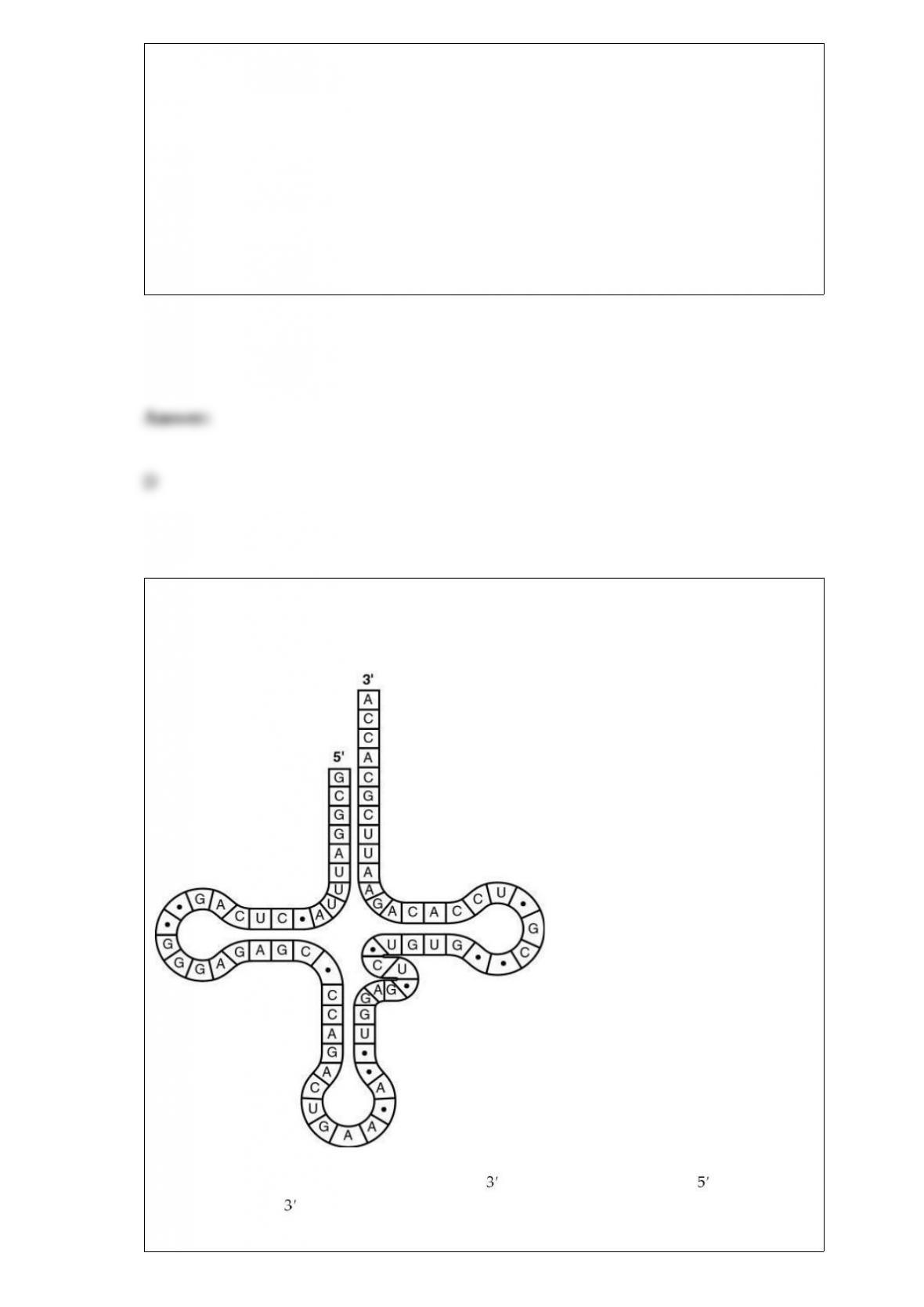
The tRNA shown in the figure above has its end projecting beyond its end. What
will occur at this end?

A) The amino acid binds covalently.
B) The excess nucleotides (ACCA) will be cleaved off at the ribosome.
C) The small and large subunits of the ribosome will attach to it.
D) The cap of the mRNA will become covalently bound.
How do altruistic behaviors arise through natural selection?
A) By his/her actions, the altruist increases the likelihood that some of its genes will be
passed on to the next generation.
B) The altruist is appreciated by other members of the population because its
survivability has been enhanced by virtue of its risky behavior.
C) Animals that perform altruistic acts are allowed by their population to breed more,
thereby passing on their behavior genes to future generations.
D) Altruistic behaviors lower stress in populations, which increases the survivability of
all the members of the population.
The leaflike appendages of moss gametophytes may be one to two cell layers thick.
Consequently, which of the following is LEAST likely to be found associated with such
appendages?
A) cuticle

B) phenolics
C) stomata
D) peroxisomes
Cyanide binds with at least one molecule involved in producing ATP. If a cell is
exposed to cyanide, most of the cyanide will be found within the _____.
A) mitochondria
B) peroxisomes
C) lysosomes
D) endoplasmic reticulum
The nematocysts of sea slugs should be most effective at protecting individual sea slugs
from predation if the predators _____.
A) remove small bites of flesh from sea slugs and have long-term memory
B) remove small bites of flesh from sea slugs and have no long-term memory
C) consume entire sea slugs in one gulp and have no long-term memory

D) consume entire sea slugs in one gulp and have long-term memory
Studying species transplants is a way that ecologists _____.
A) determine the distribution of a species in a specified area
B) develop mathematical models for distribution and abundance of organisms
C) determine if dispersal is a key factor in limiting distribution of organisms
D) consolidate a landscape region into a single ecosystem
Cotton-topped tamarins are small primates with tufts of long white hair on their heads.
While studying these creatures, you notice that males with longer hair get more
opportunities to mate and father more offspring. To test the hypothesis that having
longer hair is adaptive in these males, you should _____.
A) test whether other traits in these males are also adaptive
B) look for evidence of hair in ancestors of tamarins
C) determine if hair length is heritable
D) test whether males with shaved heads are still able to mate

Constipation can result from the consumption of a substance that _____.
A) promotes water reabsorption in the large intestine
B) speeds up movement of material in the large intestine
C) decreases water reabsorption in the small intestine
D) stimulates peristalsis
The first class of drugs developed to treat AIDS, such as AZT, were known as reverse
transcriptase inhibitors. They worked because they _____.
A) targeted and destroyed the viral genome before it could be reverse transcribed into
DNA
B) bonded to the dsDNA genome of the virus in such a way that it could not separate
for replication to occur
C) bonded to the viral reverse transcriptase enzyme, thus preventing the virus from
making a DNA copy of its RNA genome
D) prevented host cells from producing the enzymes used by the virus to replicate its
genome

Radish flowers may be red, purple, or white. A cross between a red-flowered plant and
a white-flowered plant yields all-purple offspring. The flower color trait in radishes is
an example of which of the following?
A) a multiple allelic system
B) sex linkage
C) codominance
D) incomplete dominance
A chemical reaction that has a positive ΔG is best described as _____.
A) endergonic
B) enthalpic
C) spontaneous
D) exergonic
Use the following information to answer the question(s) below.
A part of an mRNA molecule with the following sequence is being read by a ribosome:
CCG-ACG (mRNA). The following charged transfer RNA molecules (with their
anticodons shown in the to direction) are available. Two of them can correctly
match the mRNA so that a dipeptide can form.
The anticodon loop of the first tRNA that will complement this mRNA is
A) GGC
B) GGC
C) UGC
D) UGC
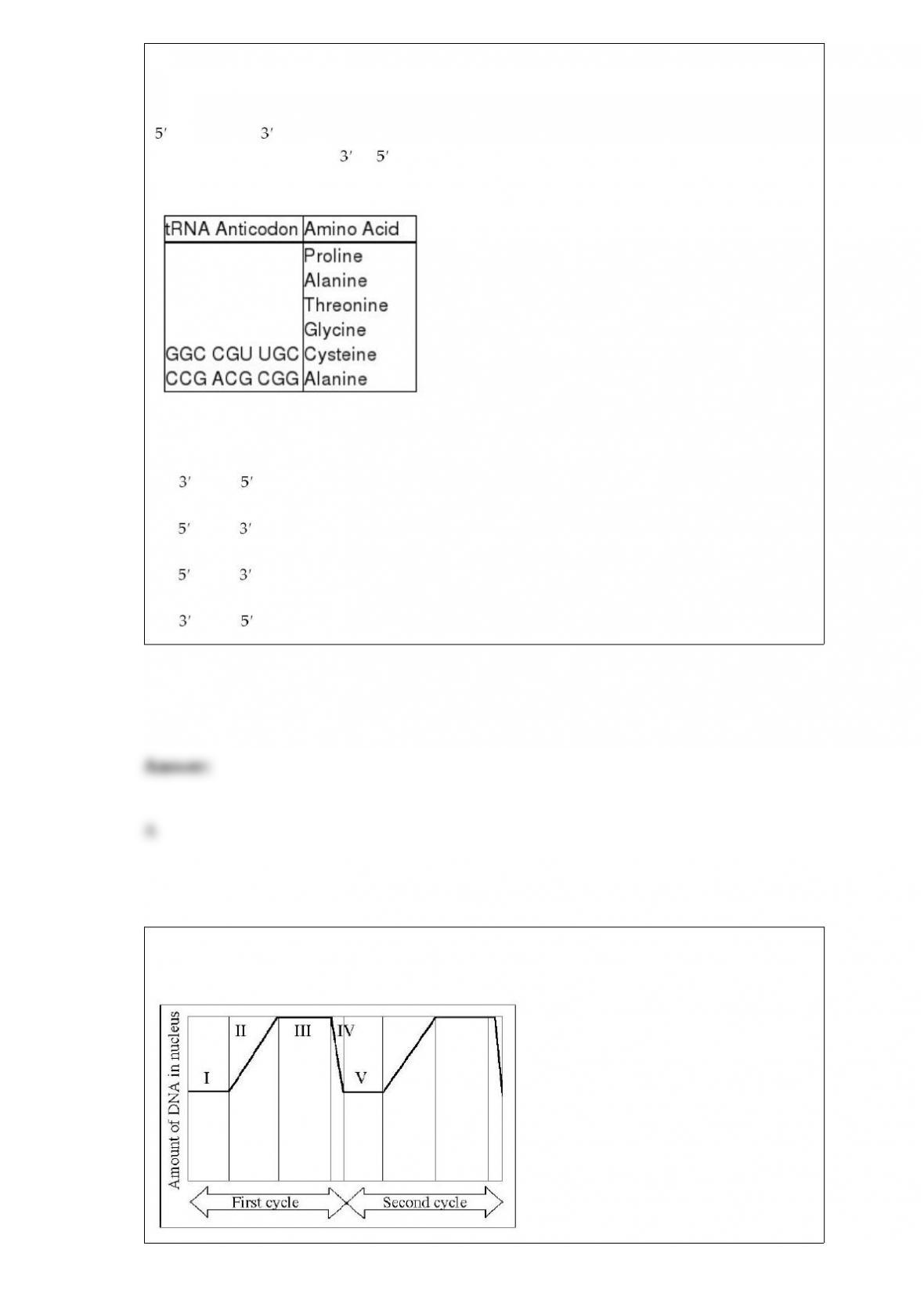
The following questions are based on the accompanying figure.

In the figure above, at which of the numbered regions would you expect to find cells at
metaphase?
A) I and IV
B) II only
C) III only
D) IV only
Which of the following investigators was (were) responsible for the following
discovery?
In DNA from any species, the amount of adenine equals the amount of thymine, and the
amount of guanine equals the amount of cytosine.
A) Alfred Hershey and Martha Chase
B) Oswald Avery, Maclyn McCarty, and Colin MacLeod
C) Erwin Chargaff
D) Matthew Meselson and Franklin Stahl
Which of the following types of mutation, resulting in an error in the mRNA just after

the AUG start of translation, is likely to have the most serious effect on the polypeptide
product?
A) a deletion of a codon
B) a deletion of two nucleotides
C) a substitution of the third nucleotide in an ACC codon
D) a substitution of the first nucleotide of a GGG codon
You find a green organism in a pond near your house and believe it is a plant, not an
alga. The mystery organism is most likely a plant and not an alga if it _____.
A) contains chloroplasts
B) is surrounded by a cuticle
C) does not contain vascular tissue
D) has cell walls that are comprised largely of cellulose
What is the most logical sequence of steps for splicing foreign DNA into a plasmid and
inserting the plasmid into a bacterium?
I. Transform bacteria with a recombinant DNA molecule.

II. Cut the plasmid DNA using restriction enzymes (endonucleases).
III. Extract plasmid DNA from bacterial cells.
IV. Hydrogen-bond the plasmid DNA to nonplasmid DNA fragments.
V. Use ligase to seal plasmid DNA to nonplasmid DNA.
A) II, III, V, IV, I
B) III, II, IV, V, I
C) III, IV, V, I, II
D) IV, V, I, II, III