
A vascular cambium cell divides to produce an inner and an outer daughter cell. Which
of the following represents the probable fate of these cells?
A) Both cells continue to divide to produce wood.
B) The inner cell will differentiate into xylem, and the outer cell will divide again.
C) The inner cell will differentiate into phloem, and the outer cell will differentiate into
xylem.
D) Both cells will continue to divide without differentiating into specialized cells.
The tree in your backyard is home to two cardinals, a colony of ants, a wasp’s nest, two
squirrels, and millions of bacteria. Together, all of these organisms represent
A) a species.
B) a community.
C) a population.
D) an ecosystem.
Which part of this figure shows the thorax segment of the lobster?
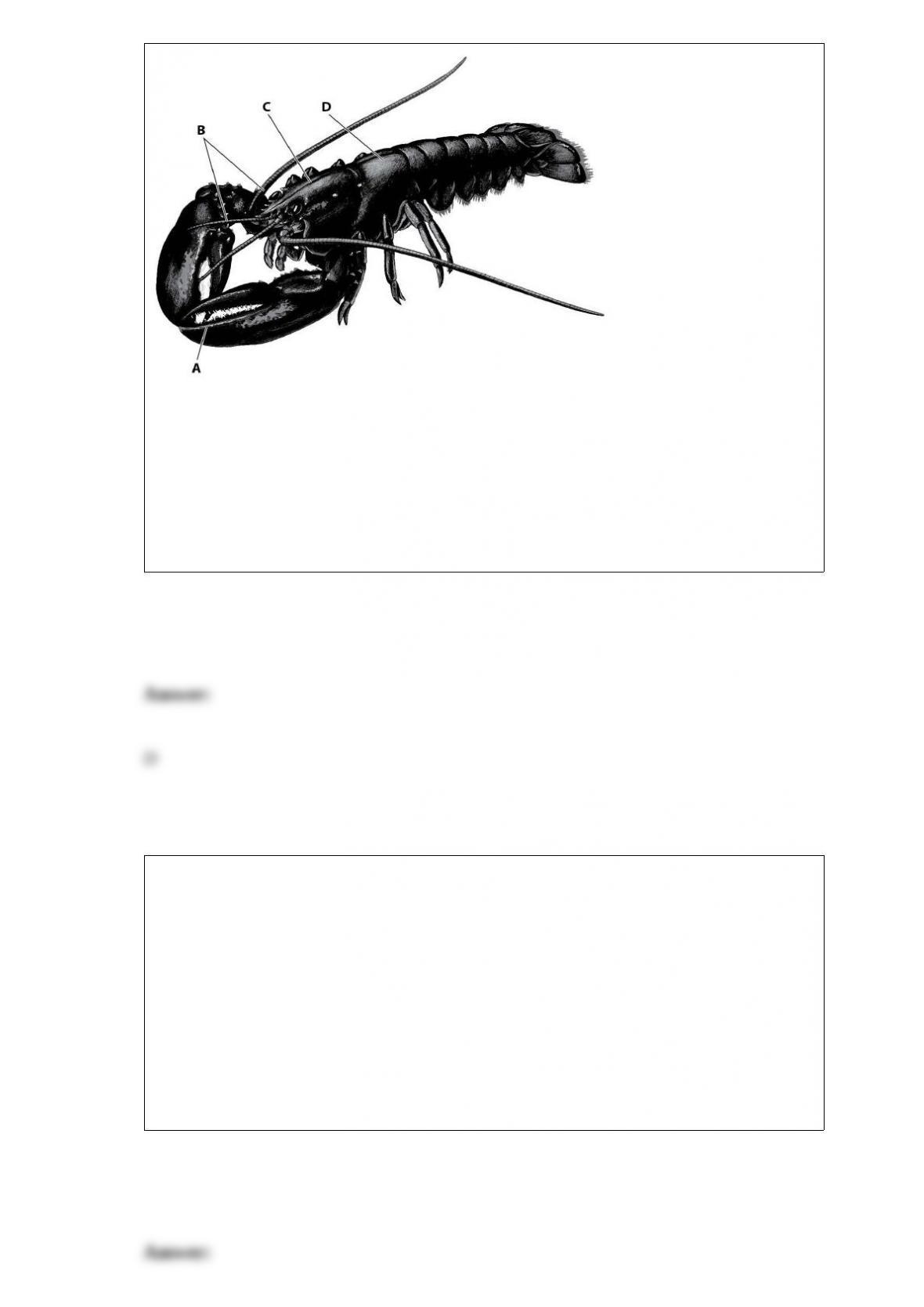
A) structure A
B) structure B
C) structure C
D) structure D
When a dolphin consumes a large volume of water and electrolytes, it must be able to
get rid of large volumes of water via urine and feces. This is an example of the process
of
A) osmoregulation.
B) convection.
C) thermoregulation.
D) countercurrent heat exchange.

Scientists evaluating the Cretaceous mass extinction have concluded that
A) an asteroid impact was probably the triggering event for the extinction.
B) only an extraterrestrial impact could have caused such a big extinction event.
C) climate change would not have been involved in producing the extinctions.
D) ecological factors such as disease and competition probably caused the dinosaurs to
go extinct.
Which of the following accurately represents a food chain in the grasslands of Africa?
A) grass, giraffes, lions, vultures, fungi
B) grass, fungi, giraffes, vultures, lions
C) grass, lions, giraffes, fungi, vultures
D) grass, fungi, lions, vultures, giraffes

Viral DNA incorporated into host cell DNA is known as a(n)
A) capsid.
B) prophage.
C) envelope.
D) phage.
According to ________, energy cannot be created or destroyed.
A) Aristotle’s first principle
B) the first law of thermodynamics
C) the second law of thermodynamics
D) the third law of thermodynamics
The bacteria Pseudomonas aeruginosa produces a protein that is secreted into its
environment. The protein inhibits synthesis of elongation factor 2 (another protein) in
humans. This effect may sound dangerous, but it has been considered as a possible
treatment for hepatitis B. The protein produced by P. aeruginosa is a/an ________.
A) endotoxin

B) exotoxin
C) biological weapon
D) biofilm
Which of the following is an example of a photoautotroph?
A) algae in freshwater and marine ecosystems
B) grizzly bears in Alaska
C) bacteria in our mouth
D) mushrooms growing on the side of a dead tree
When a cell is deprived of oxygen, its lysosomes tend to burst and release their contents
into the cell. As a result of this, that cell will
A) recycle damaged organelles.
B) undergo cell division.
C) produce replacement lysosomes.
D) undergo self-digestion and die.

A man with a dirty cut on his hand appears at the emergency department for treatment.
In order to clean the wound, the health-care provider should use
A) a solution of very low pH to help kill any bacteria present.
B) a solution of sterilized tap water.
C) a weak (low concentration) solution of salt water.
D) distilled water.
Genome sequence analysis suggests that Neanderthals
A) never interbred with humans.
B) are more closely related to chimpanzees than humans.
C) at least sometimes had pale skin and red hair.
D) could not speak.

Which of the following hormones stimulates the growth of an ovarian follicle?
A) LH
B) FSH
C) estrogen
D) progesterone
Where do transcription and translation occur in prokaryotic cells?
A) on the plasma membrane
B) in the nucleus
C) in the cytoplasm
D) in chromatophores
The part of corn that is used for fuel or food is the
A) fruit.
B) root.

C) zygote.
D) flower.
Which of the following options correctly lists the sequence in which most animals
develop?
A) zygote, cleavage, blastula, gastrula, organ formation
B) cleavage, zygote, gastrula, blastula, organ formation
C) zygote, cleavage, gastrula, blastula, organ formation
D) zygote, cleavage, organ formation, blastula, gastrula
Suppose that an adult black bear adds 50 pounds of fat in order to survive while
hibernating through the winter. How much glycogen would a bear have to add to
achieve a similar feat?
A) 25 pounds
B) 50 pounds
C) 75 pounds
D) 100 pounds
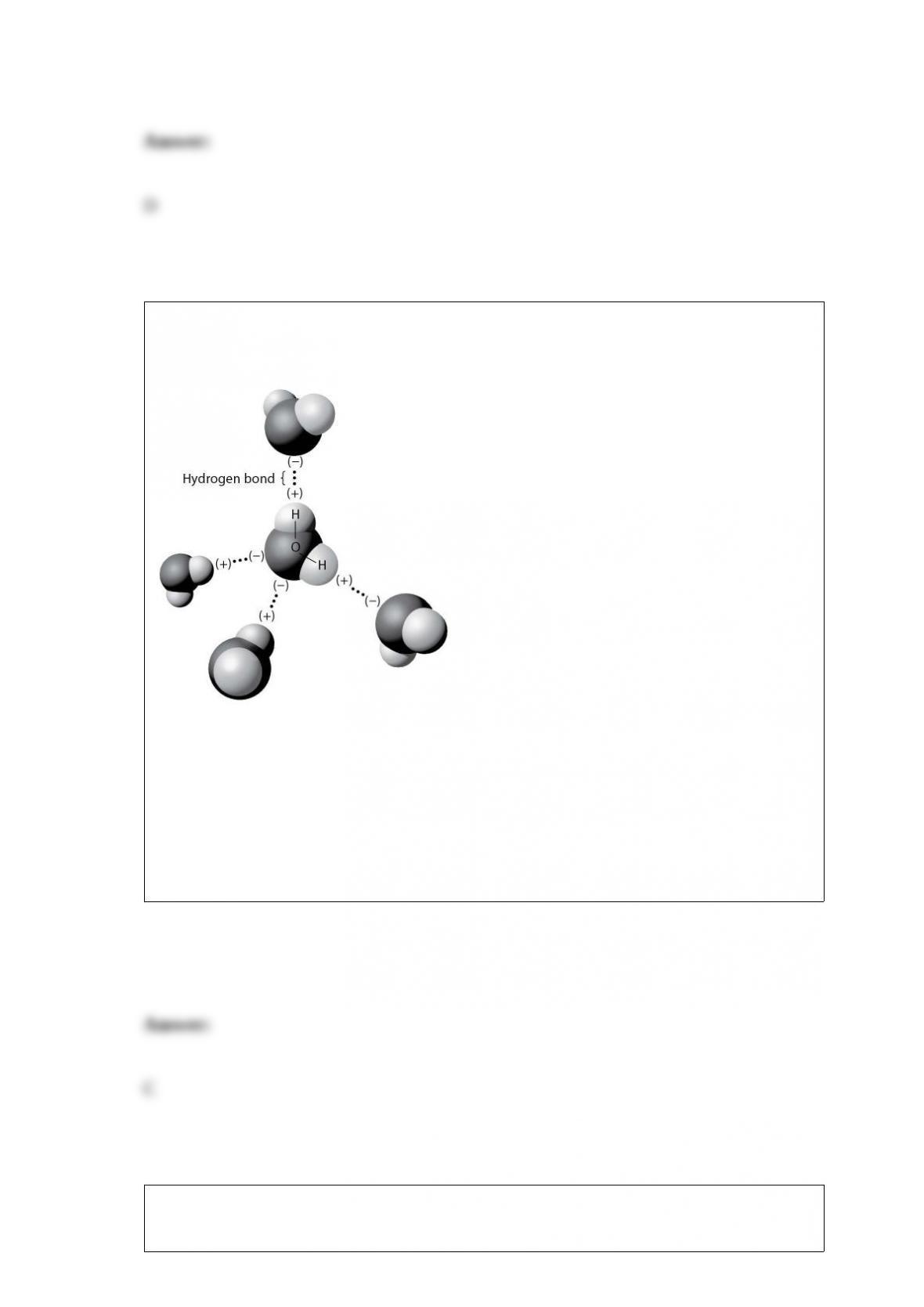
The figure below shows five water molecules. The hydrogen bonds shown in this figure
are each
A) between two hydrogen atoms.
B) between an oxygen and a hydrogen atom of the same water molecule.
C) between an oxygen and a hydrogen atom of different water molecules.
D) between two atoms with the same charge.
Functionally, the muscle fiber’s fundamental unit of contraction is the

A) thick filament.
B) myofibril.
C) sarcomere.
D) Z line.
The Golgi apparatus
A) is composed of stacks of membranous vesicles that are continuous with one another.
B) stores, modifies, and packages proteins.
C) strings together amino acids to produce proteins.
D) is the site of carbohydrate breakdown.
Which of the following is an endocrine gland that raises blood calcium levels?
A) parathyroid
B) thyroid gland
C) pituitary gland
D) testes

After reading the paragraph below, answer the questions that follow.
Americans spend up to $100 billion annually for bottled water (41 billion gallons). The
only beverages with higher sales are carbonated soft drinks. Recent news stories have
highlighted the fact that most bottled water comes from municipal water supplies (the
same source as your tap water), although it may undergo an extra purification step
called reverse osmosis.
Imagine two tanks that are separated by a membrane that’s permeable to water, but not
to the dissolved minerals present in the water. Tank A contains tap water and tank B
contains the purified water. Under normal conditions, the purified water would cross the
membrane to dilute the more concentrated tap water solution. In the reverse osmosis
process, pressure is applied to the tap water tank to force the water molecules across the
membrane into the pure water tank.
After the reverse osmosis system has been operating for 30 minutes, the solution in tank
A would
A) be hypotonic to tank B.
B) be isotonic to tank B.
C) be hypertonic to tank B.
D) move by passive transport to tank B.

Like humans, cats can experience kidney failure. Unlike humans, however, cat kidney
dialysis as a treatment option is not widely available and used. Rather, efforts are made
to treat any complications that arise from failing kidneys such as low potassium or high
phosphate levels. When low potassium levels are identified, potassium supplements are
given to return cells to a balanced potassium-water level. This is an example of an effort
to maintain
A) osmoregulation.
B) thermoregulation.
C) convection.
D) evaporation.
Which of the following options correctly pairs a structure in prokaryote cells with its
function?
A) fimbriae, help prokaryotes stick to each other and to surfaces
B) capsule, rigid protective structure enclosing cell
C) flagella, feeding appendages
D) endospore, food digestion vacuole
Lactose intolerance is the inability to

A) produce milk proteins.
B) produce lactose.
C) digest cellulose.
D) digest lactose.
How much blood is ejected from the left ventricle during one contraction?
A) 35 mL
B) 65 mL
C) 70 mL
D) 135 mL
Hominin fossil footprints that are obviously bipedal date to about ________ years ago.
A) 50,000
B) 100,000
C) 3.6 million

D) 12 million
Which type of reproduction is typical in molds?
A) sexual reproduction through mating of two diploid parent mycelia
B) sexual reproduction through fusion of two haploid parent mycelia and subsequent
production of haploid spores
C) asexual reproduction through budding
D) asexual reproduction through the production of spores
TPOX is one of the STRs that is used to compare DNA between different people. Why
is TPOX useful for comparing DNA between different people?
A) TPOX varies in the number of repeats between different people.
B) TPOX varies in sequence between different people.
C) TPOX is only present in some people’s genomes.
D) TPOX is present in different places in different people’s genomes.