
On the back of your skull you can feel a small bump, below which is an opening where
the spinal cord enters the skull. The location of this opening toward the bottom of the
skull is significant in evolutionary biology for what reason?
A) It allowed for the hominin brain to grow much larger than other primates.
B) It provided greater protection for the spinal cord.
C) It occurred as a result of the change to a bipedal stance.
D) This change was necessary for the increase in size from prosimian forms to
anthropoid forms.
Big Bend National Park in Texas is mostly Chihuahuan desert, where rainfall averages
about 10 inches per year. Yet, it is not uncommon when hiking in this bone-dry desert to
encounter mosses and ferns. One such plant is called “flower of stone.” It is not a
flowering plant, nor does it produce seeds. Under arid conditions, its leaflike structures
curl up. However, when it rains, it unfurls its leaves, which form a bright green rosette
on the desert floor. Consequently, it is sometimes called the “resurrection plant.” At first
glance, it could be a fern, a true moss, or a spike moss.
Which of the following features is most important for true mosses and ferns to
reproduce in the desert?
A) that the sporophytes occupy only permanently shady, north-facing habitats
B) that the sporophytes hug the ground, growing no taller than a couple of inches
C) either that their gametophytes grow close together, or that they be hermaphroditic
D) that the sporophytes have highly lignified vascular tissues

To act as an effective coolant in a car’s radiator, a substance has to have the capacity to
absorb a great deal of heat. You have a reference book with tables listing the physical
properties of many liquids. In choosing a coolant for your car, which table would you
check first?
A) pH
B) density at room temperature
C) heat of vaporization
D) specific heat
The following question is based on information from Frank M. Frey, “Opposing Natural
Selection from Herbivores and Pathogens May Maintain Floral-Color Variation in
Claytonia virginica (Portulacaceae),” Evolution 58(11), 2004: 2426-37.
Claytonia virginica is a woodland spring herb with flowers that vary from white to pale
pink to bright pink. Slugs prefer to eat pink-flowering over white-flowering plants (due
to chemical differences between the two), and plants experiencing severe herbivory are
more likely to die. The bees that pollinate this plant also prefer pink to white flowers, so
that Claytonia with pink flowers have greater relative fruit set than Claytonia with
white flowers. A researcher observes that the percentage of different flower colors
remains stable in the study population from year to year. Given no other information, if
the researcher removes all slugs from the study population, what do you expect to
happen to the distribution of flower colors in the population over time?
A) The percentage of pink flowers should increase over time.
B) The percentage of white flowers should increase over time.
C) The distribution of flower colors should not change.
D) The distribution of flower colors should randomly fluctuate over time.

Countercurrent exchange in the fish gill helps to maximize _____.
A) blood pressure
B) diffusion
C) active transport
D) osmosis
If all fungi in an environment that perform decomposition were to suddenly die, then
which group of organisms should benefit most, due to the fact that their fungal
competitors have been removed?
A) flowering plants
B) protists
C) prokaryotes
D) grasses
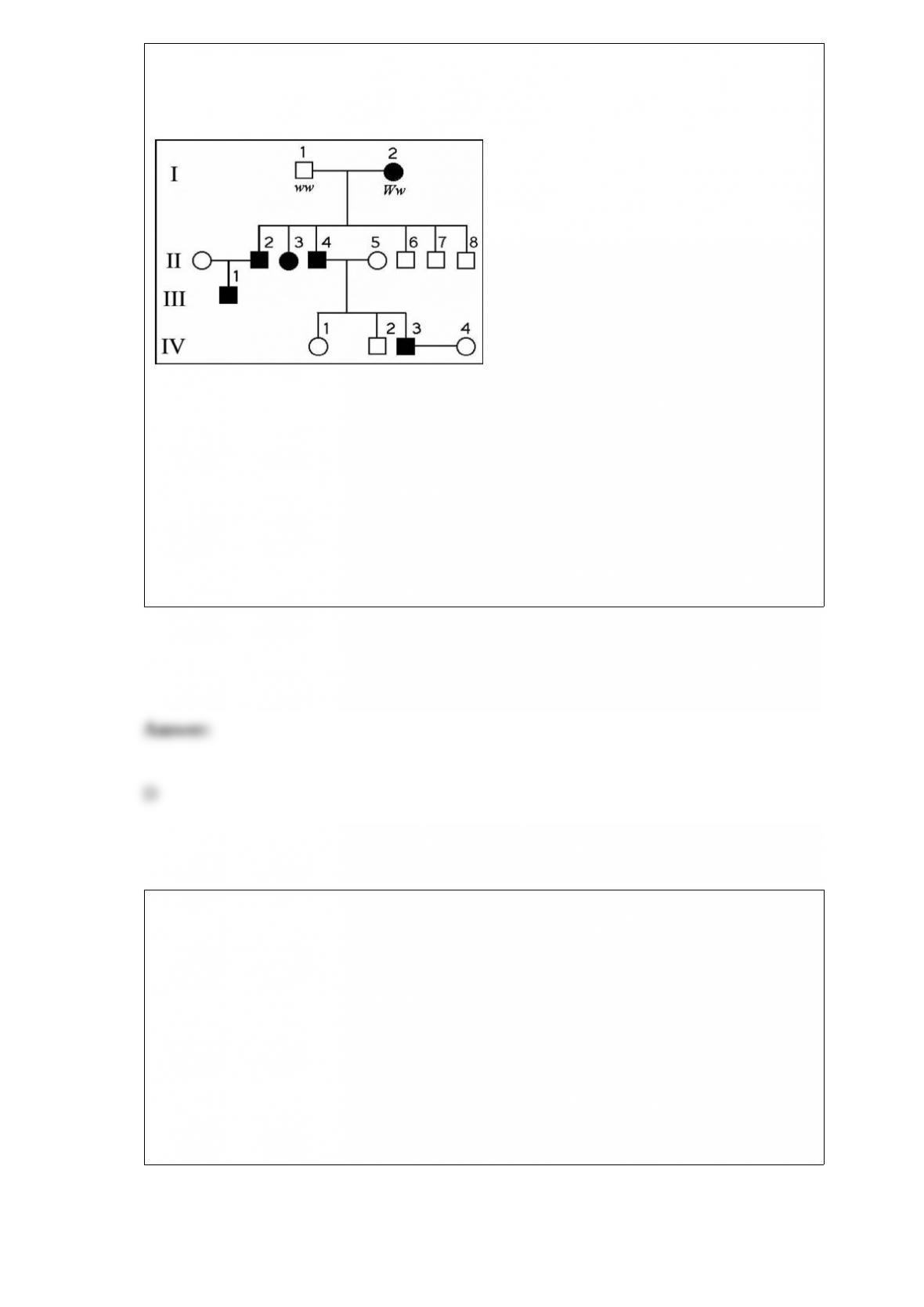
The following questions refer to the pedigree chart in the figure below for a family,
some of whose members exhibit the dominant trait, W. Affected individuals are
indicated by a dark square or circle.
What is the probability that individual III-1 is Ww?
A) 3/4
B) 1/4
C) 2/4
D) 1
When a virus infects a bacterial cell, often new viruses are assembled and released
when the host bacterial cell is lysed. If these new viruses go on to infect new bacterial
cells the host cells may not be lysed. What is the most plausible explanation for this?
A) The bacterial cell must be resistant to infection by the virus.
B) The virus carries genes that confer resistance to the host bacterial cell.
C) The host bacterium couples the viral infection with transformation.
D) The virus has entered the genome of the bacterial cell and is in the lysogenic stage.

An immunoglobulin (Ig) molecule, of whatever class, with regions symbolized as C or
V, H or L, has a light chain made up of _____.
A) one C region and one V region
B) one H region and one L region
C) three H regions and one L region
D) two C regions and two V regions
The cow Bos primigenius (which is bred for meat and milk) has a smaller brain and
larger eyes than closely related wild species of ungulates. These traits most likely arose
by _____.
A) natural selection, because these traits evolved in the population over time
B) natural selection, because these traits were not consciously selected by humans
C) artificial selection, because changes in these traits co-occurred with human selection
for high milk output and high muscle content
D) artificial selection, because these animals differ from their close relatives and
common ancestor

Pax-6 is a gene that is involved in eye formation in many invertebrates, such as
Drosophila. Pax-6 is also found in vertebrates. A Pax-6 gene from a mouse can be
expressed in a fly and the protein (PAX-6) leads to a compound fly eye. This
information suggests which of the following?
A) Pax-6 genes are identical in nucleotide sequence.
B) PAX-6 proteins have identical amino acid sequences.
C) Pax-6 is highly conserved and shows shared evolutionary ancestry.
D) PAX-6 proteins are different for formation of different kinds of eyes.
The following experiment is used for the corresponding question(s).
A researcher discovered a species of moth that lays its eggs on oak trees. Eggs are laid
at two distinct times of the year: early in spring when the oak trees are flowering and in
midsummer when flowering is past. Caterpillars from eggs that hatch in spring feed on
oak flowers and look like oak flowers. But caterpillars that hatch in summer feed on
oak leaves and look like oak twigs.
How does the same population of moths produce such different-looking caterpillars on
the same trees? To answer this question, the biologist caught many female moths from
the same population and collected their eggs. He put at least one egg from each female
into eight identical cups. The eggs hatched, and at least two larvae from each female
were maintained in one of the four temperature and light conditions listed below.

In each of the four environments, one of the caterpillars was fed oak flowers, the other
oak leaves. Thus, there were a total of eight treatment groups (4 environmentsx2 diets).
Refer to the accompanying figure. Which one of the following is NOT a plausible
hypothesis to explain the differences in caterpillar appearance observed in this
population?
A) The longer day lengths of summer trigger the development of twig-like caterpillars.
B) The cooler temperatures of spring trigger the development of flowerlike caterpillars.
C) Differences in air pressure, due to differences in elevation, trigger the development
of different types of caterpillars.
D) Differences in diet trigger the development of different types of caterpillars.
Which of the following is an example of Batesian mimicry?
A) a butterfly that resembles a leaf
B) a nonvenomous snake that looks like a venomous snake
C) a fawn with fur coloring that camouflages it in the forest environment
D) a snapping turtle that uses its tongue to mimic a worm, thus attracting fish

An enlarged cecum is typical of _____.
A) rabbits, horses, and herbivorous bears
B) carnivorous animals
C) tubeworms that digest via symbionts
D) humans and other primates
If you were shipping green bananas to a supermarket thousands of miles away, which of
the following chemicals would you want to eliminate from the plants’ environment?
A) carbon dioxide
B) cytokinins
C) ethylene
D) auxin
The loss of water from a plant by transpiration cools the leaf. Movement of water in
transpiration requires both adhesion to the conducting walls and wood fibers of the
plant and cohesion of the molecules to each other. A scientist wanted to increase the rate
of transpiration of a crop species to extend its range into warmer climates. The scientist
substituted a nonpolar solution with an atomic mass similar to that of water for
hydrating the plants. What do you expect the scientist’s data will indicate from this
experiment?
A) The rate of transpiration will be the same for both water and the nonpolar substance.
B) The rate of transpiration will be slightly lower with the nonpolar substance as the
plant will not have evolved with the nonpolar compound.
C) Transpiration rates will fall to zero as nonpolar compounds do not have the
properties necessary for adhesion and cohesion.
D) Transpiration rates will increase as nonpolar compounds undergo adhesion and
cohesion with wood fibers more readily than water.
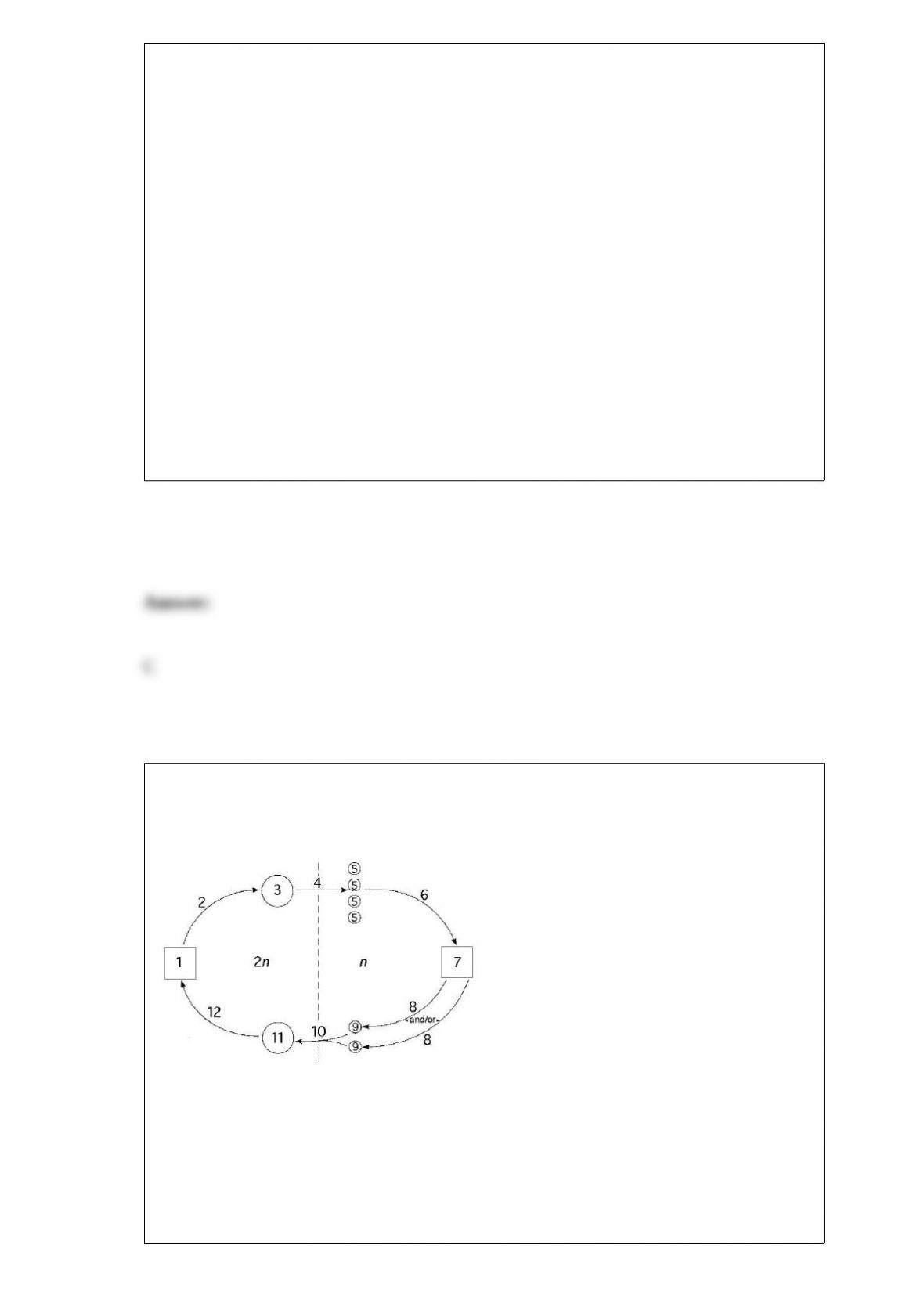
The following questions refer to the generalized life cycle for land plants shown in the
figure below. Each number within a circle or square represents a specific plant or plant
part, and each number over an arrow represents either meiosis, mitosis, or fertilization.
In the figure above, which number represents the mature gametophyte?
A) 1
B) 3

C) 7
D) 11
While on an intersession course in tropical ecology, Kris pulls a large, snakelike
organism from a burrow (the class was granted a collecting permit). The 1-meter-long
organism has smooth skin, which appears to be segmented. It has two tiny eyes that are
hard to see because they seem to be covered by skin. Kris brings it back to the lab at the
field station, where it is a source of puzzlement to the class. Kris says that it is a giant
oligochaete worm; Shaun suggests it is a legless amphibian; Kelly proposes it belongs
to a snake species that is purely fossorial (lives in a burrow).
The class decided to humanely euthanize the organism and subsequently dissect it.
Having decided that it was probably not a reptile, two of their original hypotheses
regarding its identity remained. Which of the following, if observed, should help them
arrive at a conclusive answer?
A) presence of moist, highly vascularized skin
B) presence of lungs
C) presence of a nerve cord
D) presence of a digestive system with two openings
Cardiac muscle cells are both _____.

A) striated and interconnected by intercalated disks
B) smooth and under voluntary control
C) striated and under voluntary control
D) smooth and under involuntary control
The diploid number of a roundworm species is 4. Assuming there is no crossover, and
random segregation of homologues during meiosis, how many different possible
combinations of chromosomes might there be in the offspring (not including variety
generated by crossing over)?
A) 4
B) 8
C) 16
D) 64
During a study session about evolution, one of your fellow students remarks, “The
giraffe stretched its neck while reaching for higher leaves; its offspring inherited longer
necks as a result.” Which statement is most likely to be helpful in correcting this
student’s misconception?
A) Characteristics acquired during an organism’s life are generally not passed on
through genes.
B) Spontaneous mutations can result in the appearance of new traits.
C) Only favorable adaptations have survival value.
D) Disuse of an organ may lead to its eventual disappearance.
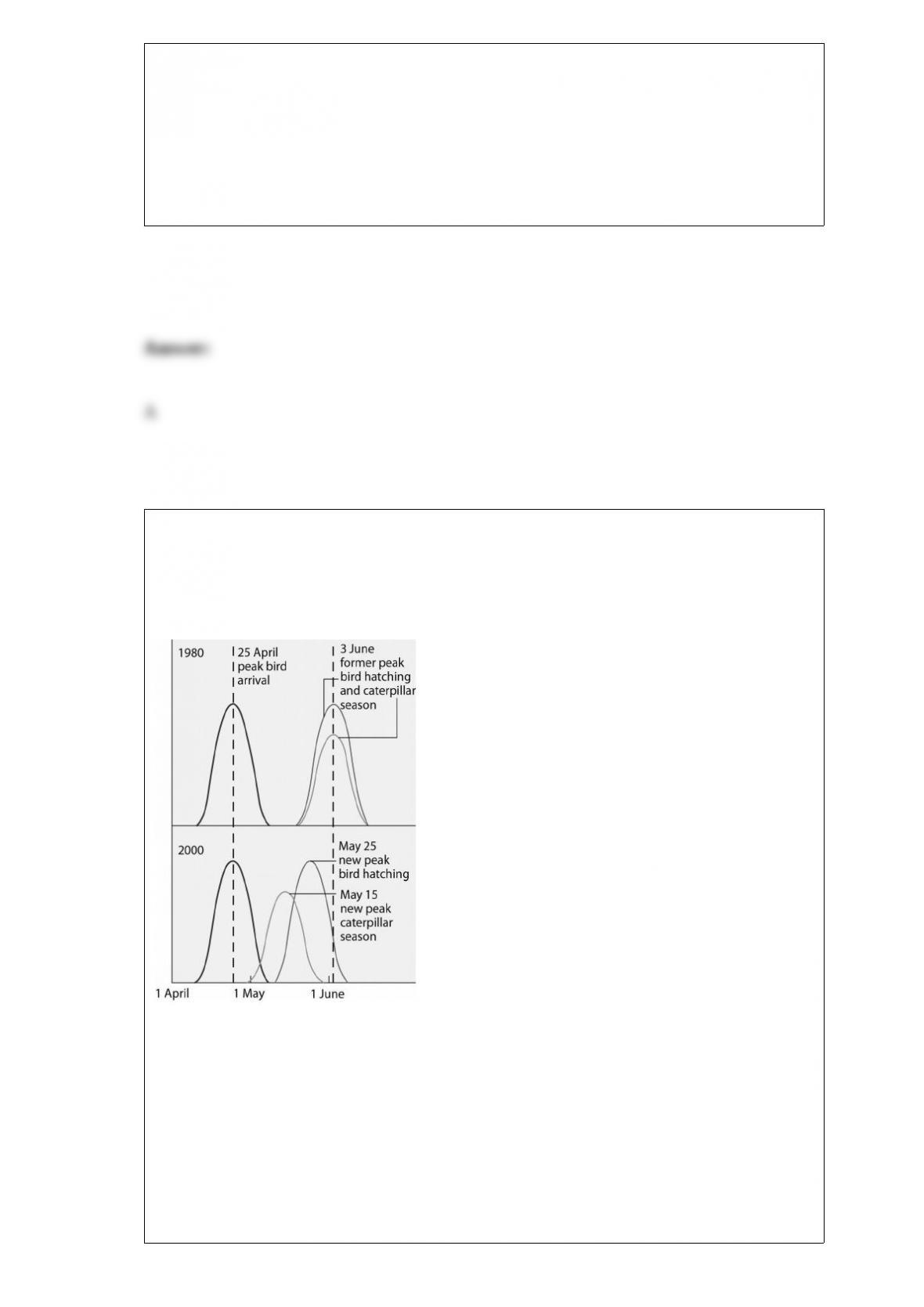
Flycatcher birds that migrate from Africa to Europe feed their nestlings a diet that is
almost exclusively moth caterpillars. The graph below shows the mean dates of arrival,
bird hatching, and peak caterpillar season for the years 1980 and 2000.
The shift in the peak of caterpillar season is most likely due to _____.
A) earlier migration returns of flycatchers
B) an innate change in the biological clock of the caterpillars
C) global warming
D) acid precipitation in Europe
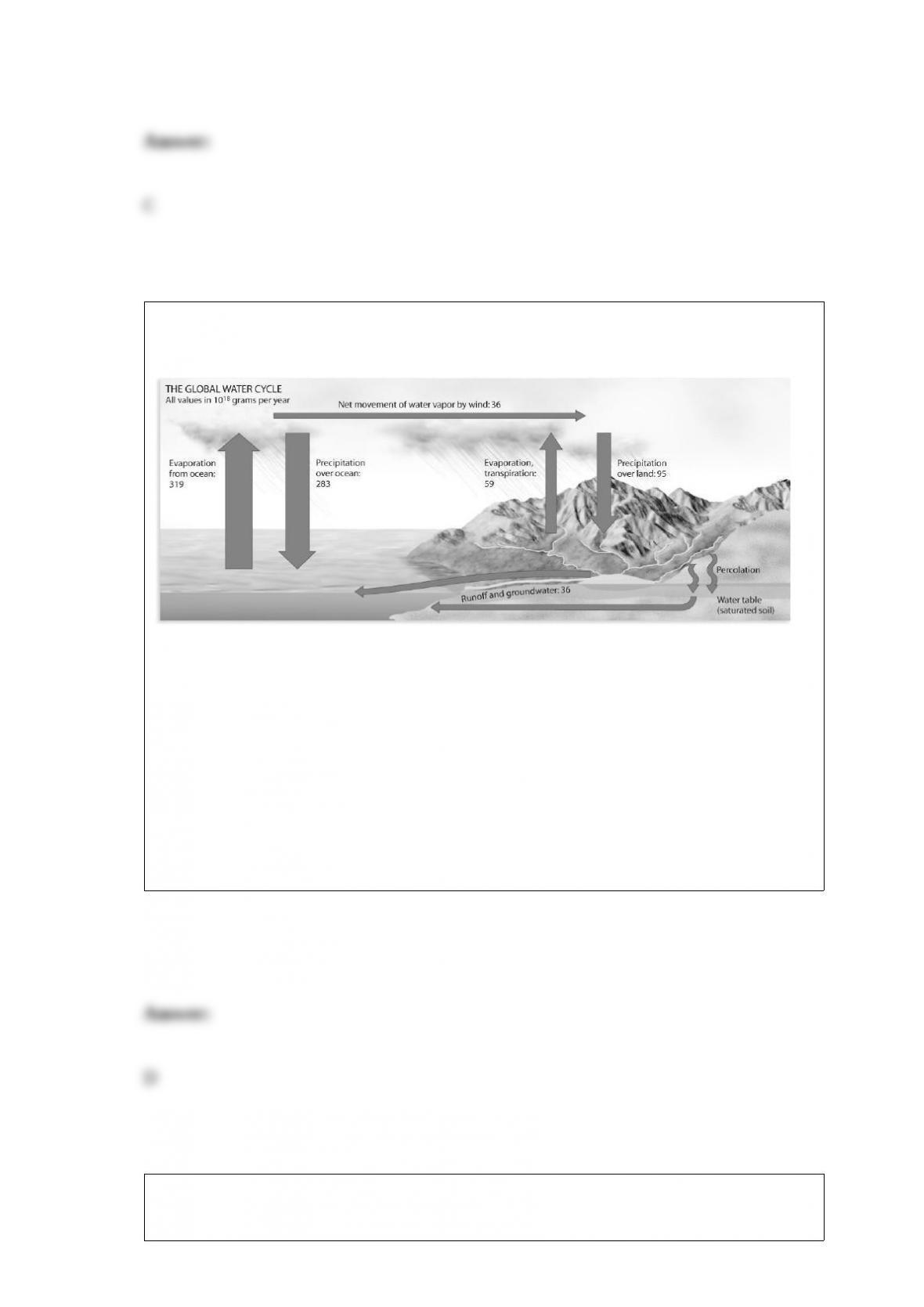
Consider the global water cycle depicted in the figure above. Which one of the reserves
contains the smallest percentage of global water?
A) rivers and lakes
B) polar ice caps
C) glaciers
D) atmosphere
Positive feedback differs from negative feedback in that _____.

A) positive feedback benefits the organism, whereas negative feedback is detrimental
B) the positive feedback’s effector responses are in the same direction as the initiating
stimulus rather than opposite of it
C) the effector’s response increases some parameter (such as body temperature),
whereas in negative feedback it can only decrease the parameter
D) positive feedback systems have only effectors, whereas negative feedback systems
have only receptors
As climate changes because of global warming, plant species’ ranges in the northern
hemisphere may move northward. The trees that are most likely to avoid extinction in
such an environment are those that _____.
A) have seeds that are easily dispersed by wind or animals
B) produce well-provisioned seeds
C) have seeds that become viable only after a forest fire
D) disperse many seeds in close proximity to the parent tree
Use the following information to answer the question(s) below.
The herpes viruses are important enveloped DNA viruses that cause disease in
vertebrates and in some invertebrates such as oysters. Some of the human forms are

herpes simplex virus (HSV) types I and II, causing facial and genital lesions, and the
varicella zoster virus (VSV), causing chicken pox and shingles. Each of these three
actively infects nervous tissue. Primary infections are fairly mild, but the virus is not
then cleared from the host; rather, viral genomes are maintained in cells in a latent
phase. The virus can later reactivate, replicate again, and infect others.
If scientists are trying to use what they know about HSV to devise a means of
protecting other people from being infected, which of the following would have the best
chance of lowering the number of new cases of infection?
A) vaccinate of all persons with preexisting cases of HSV
B) interfere with new viral replication in preexisting cases of HSV
C) treat HSV lesions to shorten the breakout
D) educate people about avoiding sources of infection
At the summit of a high mountain, the atmospheric pressure is 380 mm Hg. If the
atmosphere is still composed of 21percent oxygen, then the partial pressure of oxygen
at this altitude is about _____.
A) 80 mm Hg
B) 160 mm Hg
C) 380 mm Hg
D) 760 mm Hg

Abnormal chromosomes are frequently found in malignant tumors. Errors such as
translocations may place a gene in close proximity to different control regions. Which
of the following might then occur to make the cancer worse?
A) an increase in nondisjunction
B) expression of inappropriate gene products
C) a decrease in mitotic frequency
D) failure of the cancer cells to multiply
Countercurrent exchange is evident in the flow of _____.
A) water across the gills of a fish and the blood within those gills
B) blood in the dorsal vessel of an insect and that of air within its tracheae
C) air within the primary bronchi of a human and the blood within the pulmonary veins
D) water across the skin of a frog and the blood flow within the ventricle of its heart
In the absence of oxygen, yeast cells can obtain energy by fermentation, resulting in the
production of _____.

A) ATP, CO2, and ethanol (ethyl alcohol)
B) ATP, CO2, and lactate
C) ATP, NADH, and pyruvate
D) ATP, pyruvate, and acetyl CoA
A group of ten tomato plants are germinated and maintained in a large tray with no
drainage. After several weeks they all begin to wilt and die despite repeated watering
and fertilization. The most likely cause of this die-off is_____.
A) competition for resources
B) a lack of oxygen for the roots
C) organic nutrient depletion
D) no room left for root growth