
What evidence do paleobotanists look for that indicates the movement of plants from
water to land?
A) waxy cuticle to decrease evaporation from leaves
B) loss of structures that produce spores
C) sporopollenin to inhibit evaporation from leaves
D) remnants of chloroplasts from photosynthesizing cells
Forming new long-term memories is strikingly disrupted after damage to the _____.
A) thalamus
B) cerebral cortex
C) somatosensory cortex
D) primary motor cortex
A mutation that disrupts the ability of an animal cell to add polysaccharide
modifications to proteins would most likely cause defects in its _____.
A) nuclear matrix and extracellular matrix
B) mitochondria and Golgi apparatus

C) Golgi apparatus and extracellular matrix
D) nuclear pores and secretory vesicles
“Golden Rice”_____.
A) is resistant to various herbicides, making it practical to weed rice fields with those
herbicides
B) includes bacterial genes that produce a toxin that reduces damage from insect pests
C) produces larger, golden grains that increase crop yields
D) contains daffodil genes that increase vitamin A content

Within a double-stranded DNA molecule, adenine forms hydrogen bonds with thymine
and cytosine forms hydrogen bonds with guanine. This arrangement _____.
A) allows variable width of the double helix
B) permits complementary base pairing
C) determines the tertiary structure of a DNA molecule
D) determines the type of protein produced
The evolution of eukaryotic cells most likely involved _____.
A) endosymbiosis of an aerobic bacterium in a larger host cellthe endosymbiont
evolved into mitochondria
B) anaerobic archaea taking up residence inside a larger bacterial host cell to escape
toxic oxygenthe anaerobic bacterium evolved into chloroplasts
C) an endosymbiotic fungal cell evolving into the nucleus
D) acquisition of an endomembrane system and subsequent evolution of mitochondria
from a portion of the Golgi
Why does the 2009 U.S. population continue to grow even though the United States has
essentially established a zero population growth (ZPG)?

A) emigration
B) immigration
C) baby boomer reproduction
D) the 2007-2009 economic recession
Suppose that the cells of seed plants, like the skin cells of humans, produce a pigment
upon increased exposure to ultraviolet radiation. Rank the following cells, from greatest
to least, in terms of the likelihood of producing this pigment.
1. cells of sporangium
2. cells in the interior of a subterranean root
3. epidermal cells of sporophyte megaphylls
4. cells of a gametophyte
A) 3, 4, 1, 2
B) 3, 4, 2, 1
C) 3, 1, 4, 2
D) 3, 2, 1, 4

An inhibitor of which of the following could be used to block the release of calcium
from the endoplasmic reticulum?
A) serine/threonine kinases
B) phosphodiesterase
C) phospholipase C
D) adenylyl cyclase
Countercurrent exchange in the fish gill helps to maximize _____.
A) blood pressure
B) diffusion
C) active transport
D) osmosis
Water potential is generally most negative in which of the following parts of a plant?
A) mesophyll cells of the leaf
B) xylem vessels in leaves

C) xylem vessels in roots
D) cells of the root cortex
Which of the following experimental procedures would most likely reduce transpiration
while allowing the normal growth of a plant?
A) subjecting the leaves of the plant to a partial vacuum
B) increasing the level of carbon dioxide around the plant
C) putting the plant in drier soil
D) decreasing the relative humidity around the plant
Male frogs give calls that attract female frogs to approach and mate. Researchers
examined mating calls of closely related tree frogs in South America. If reinforcement
is occurring, what would you expect if you compare the calls of the two species in
zones of sympatry versus zones of allopatry?
A) Calls would be about the same in both areas.
B) Calls would be more similar in areas of sympatry.
C) Calls would be more different in areas of sympatry.
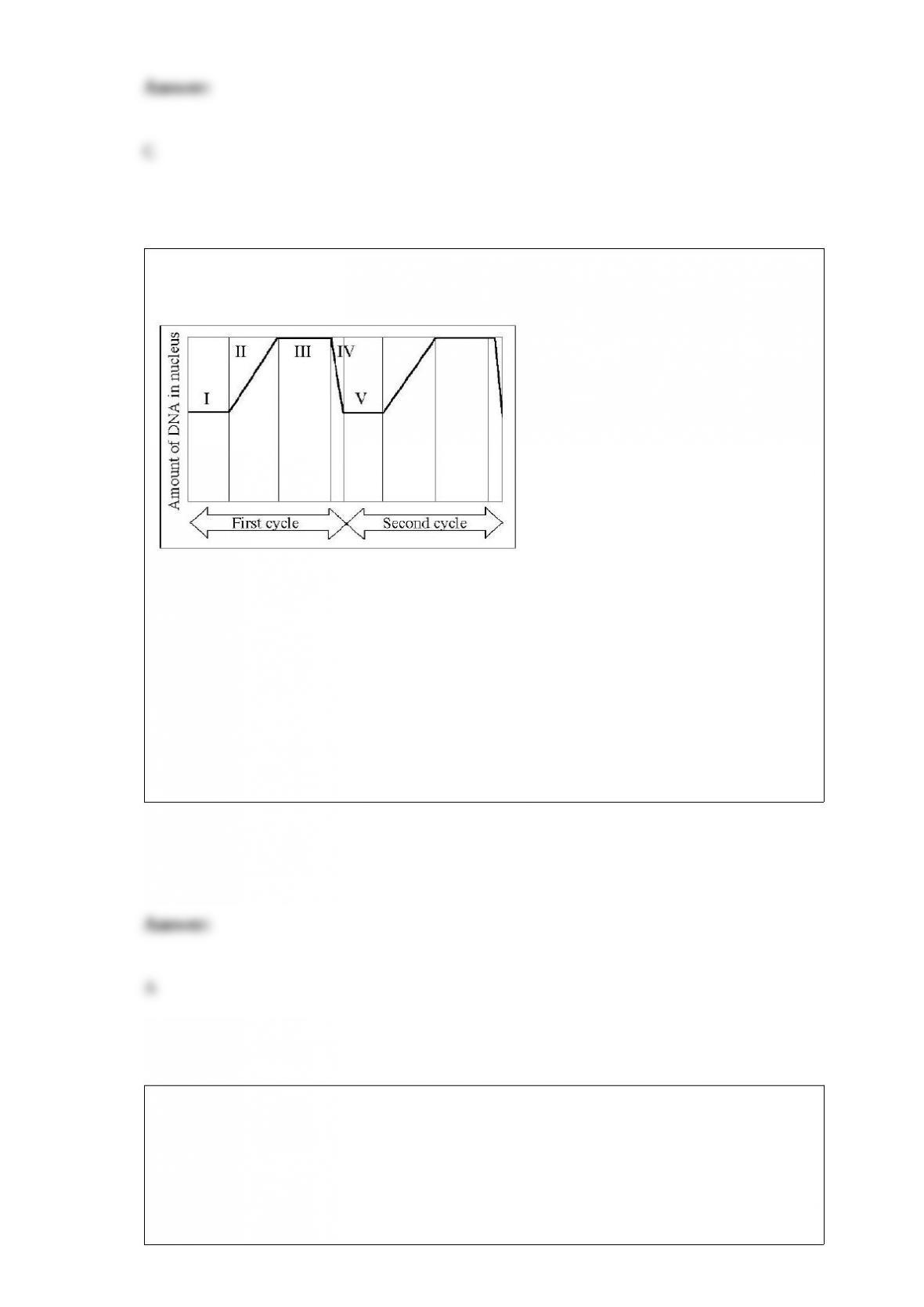
The following questions are based on the accompanying figure.
In the figure above, G1 is represented by which numbered part(s) of the cycle?
A) I or V
B) II or IV
C) III only
D) V only
The difference between geographic isolation and habitat differentiation (isolation) is the
_____.
A) relative locations of two populations as speciation occurs
B) speed (tempo) at which two populations undergo speciation

C) amount of genetic variation that occurs among two gene pools as speciation occurs
D) identity of the phylogenetic kingdom or domain in which these phenomena occur
Use the following information to answer the question(s) below.
The Brazil nut tree, Bertholletia excels (n = 17), is native to tropical rain forests of
South America. It is a hardwood tree that can grow to over 50 meters tall, is a source of
high-quality lumber, and is a favorite nesting site for harpy eagles. As the rainy season
ends, tough-walled fruits, each containing 8-25 seeds (Brazil nuts), fall to the forest
floor. Brazil nuts are composed primarily of endosperm. About $50 million worth of
nuts are harvested each year. Scientists have discovered that the pale yellow flowers of
Brazil nut trees cannot fertilize themselves and admit only female orchid bees as
pollinators. The agouti (Dasyprocta spp.), a cat-sized rodent, is the only animal with
teeth strong enough to crack the hard wall of Brazil nut fruits. It typically eats some of
the seeds, buries others, and leaves still others inside the fruit, which moisture can now
enter. The uneaten seeds may subsequently germinate.
Entrepreneurs attempted, but failed, to harvest nuts from plantations grown in Southeast
Asia. Attempts to grow Brazil nut trees in South American plantations also failed. In
both cases, the trees grew vigorously, produced healthy flowers in profusion, but set no
fruit. Consequently, what is the likely source of the problem?
A) poor sporophyte viability
B) failure to produce fertile ovules
C) failure to produce pollen
D) pollination failure

For most terrestrial ecosystems, pyramids composed of species abundances, biomass,
and energy are similar in that they have a broad base and a narrow top. The primary
reason for this pattern is that _____.
A) secondary consumers and top carnivores require less energy than producers
B) at each step, energy is lost from the system
C) biomagnification of toxic materials limits the secondary consumers and top
carnivores
D) top carnivores and secondary consumers have a more general diet than primary
producers
You disrupt all hydrogen bonds in a protein. What level of structure will be preserved?
A) primary structure
B) secondary structure
C) tertiary structure
D) quaternary structure
The Hubbard Brook watershed deforestation experiment revealed that _____.

I) deforestation increased water runoff
II) nitrate concentration in waters draining the deforested area became dangerously high
III) calcium levels remained high in the soil of deforested areas
A) only I
B) only II
C) only III
D) only I and II
An immune response to a tissue graft will differ from an immune response to a
bacterium because _____.
A) MHC molecules of the donor may stimulate rejection of the graft tissue, but bacteria
lack MHC molecules
B) the tissue graft, unlike the bacterium, is isolated from the circulation and will not
enter into an immune response
C) a bacterium cannot escape the immune system by replicating inside normal body
cells
D) the graft will stimulate an autoimmune response in the recipient

Stimuli alter the activity of excitable sensory cells and generate action potentials via
_____.
A) integration
B) transmission
C) transduction
D) amplification
In sea urchins, the “fast block” and the longer lasting ‘slow block” to polyspermy,
respectively, are _____.
A) the acrosomal reaction and the formation of egg white
B) the cortical reaction and the formation of yolk protein
C) the jelly coat of the egg and the vitelline membrane
D) membrane depolarization and the cortical reaction
A plant scientist was hired by a greenhouse operator to devise a way to force iris plants
to bloom in the short days of winter. Iris normally blooms as long-day (short-night)
plants. Which of the following has the best chance of creating iris blooms in winter?
A) Artificially increase the period of darkness in the greenhouse.

B) Increase the temperature to more closely follow summer temperatures.
C) Alternate four hours of darkness with four hours of light repeatedly over each
24-hour period.
D) Interrupt the long winter nights with a brief period of light.
Why is apoptosis potentially threatening to the healthy “neighbors” of a dying cell?
A) Cell death would usually spread from one cell to the next via paracrine signals.
B) Lysosomal enzymes exiting the dying cell would damage surrounding cells.
C) Bits of membrane from the dying cell could merge with neighboring cells and bring
in foreign receptors.
D) Neighboring cells would activate immunological responses.
Which of the following can be duplicated in a genome?
A) only DNA sequences
B) only entire sets of chromosomes
C) only entire chromosomes

D) DNA sequences, chromosomes, or sets of chromosomes
Females are typically larger and more ornamented than males where _____ occurs.
A) monogamy
B) polyandry
C) polygamy
D) polygyny
Use the following figure and description to answer the question(s) below.

Humans, chimpanzees, gorillas, and orangutans are members of a clade called the great
apes, which shared a common ancestor about fifteen million years ago. Gibbons and
siamangs comprise a clade called the lesser apes. Tree-branch lengths indicate elapsed
time.
Assuming chimps and gorillas are humans’ closest relatives, removing humans from the
great ape clade and placing them in a different clade has the effect of making the
phylogenetic tree of the great apes _____.
A) polyphyletic
B) paraphyletic
C) monophyletic
D) into a new order
Connective tissues typically have _____.
A) little space between the membranes of adjacent cells
B) the ability to transmit electrochemical impulses
C) the ability to shorten upon stimulation
D) relatively few cells and a large amount of extracellular matrix

You cut your finger, and after putting pressure on the wound for several minutes, you
notice that it is still bleeding profusely. What may be the problem?
A) Platelets are not functioning properly, or there are too few to be effective.
B) Mast cells are not releasing their chemical messengers.
C) There are too many antigens to allow clotting.
D) Hemoglobin levels are too high to allow clotting.
In the fractionation of homogenized cells using centrifugation, the primary factor that
determines whether a specific cellular component ends up in the supernatant or the
pellet is the _____.
A) relative solubility of the component
B) size and weight of the component
C) percentage of carbohydrates in the component
D) presence or absence of lipids in the component
Two contraceptive methods that are generally irreversible and which block the gametes
from moving to a site where fertilization can occur are _____.
A) the male condom and female condom

B) the male condom and oral contraceptives
C) vasectomy and tubal ligation
D) the diaphragm and subcutaneous progesterone implant
Which structure of the amniotic egg most closely surrounds the embryo?
A) the chorion
B) the yolk sac
C) the allantois
D) the amnion
Cells produced by lateral meristems are known as _____.
A) dermal and ground tissue
B) lateral tissues
C) pith
D) secondary tissues

What technique would be most appropriate to use to observe the movements of
condensed chromosomes during cell division?
A) standard light microscopy
B) scanning electron microscopy
C) transmission electron microscopy
The various taxonomic levels (for example, phyla, genera, classes) of the hierarchical
classification system differ from each other on the basis of _____.
A) how widely the organisms assigned to each are distributed throughout the
environment
B) their inclusiveness
C) the relative genome sizes of the organisms assigned to each
D) morphological characters that are applicable to all organisms