
Planarians lack dedicated respiratory and circulatory systems because _____.
A) none of their cells are far removed from the gastrovascular cavity or from the
external environment
B) they lack mesoderm as embryos and, therefore, lack the adult tissues derived from
mesoderm
C) their flame bulbs can carry out respiratory and circulatory functions
D) their body cavity, a pseudocoelom, carries out these functions
The limbic system in the central nervous system sustains many vegetative functions in
mammals and is closely associated with structures that process cues about _____.
A) olfaction
B) vision
C) audition
D) mechanosensation
Villi and microvilli in the small intestine _____.
A) neutralize stomach acid

B) activate trypsinogen
C) increase the surface area to increase the efficiency of nutrient absorption
D) emulsify lipid molecules
The inability of organisms to evolve anything that could be an advantage reflects
_____.
A) the limits of historical constraints
B) the inability to compromise
C) the consequences of random mutations
D) the consequences of inbreeding
What is true about the genus Sphagnum?
A) It is an economically important liverwort.
B) It grows in extensive mats in grassland areas.
C) It accumulates to form coal and is burned as a fuel.
D) It is an important carbon sink, reducing atmospheric carbon dioxide.

What is the difference between an aldose sugar and a ketose sugar?
A) the number of carbons
B) the position of the hydroxyl groups
C) the position of the carbonyl group
D) One is a ring form, the other is a linear chain/
Dwarf mistletoes are flowering plants that grow on certain forest trees. They obtain
nutrients and water from the vascular tissues of the trees. The trees derive no known
benefits from the dwarf mistletoes. Which of the following best describes the
interactions between dwarf mistletoes and trees?
A) mutualism
B) parasitism
C) competition
D) facilitation

Which of the following statements about human evolution is correct?
A) Modern humans are the only human species to have evolved on Earth.
B) Human ancestors were virtually identical to extant chimpanzees.
C) Human evolution has occurred within an unbranched lineage.
D) The upright posture and enlarged brain of humans evolved separately.
Suzanne Simard and colleagues knew that the same mycorrhizal fungal species could
colonize multiple types of trees. They wondered if the same fungal individual would
colonize different trees, forming an underground network that potentially could
transport carbon and nutrients from one tree to another (S. Simard et al. 1997. Net
transfer of carbon between mycorrhizal tree species in the field. Nature 388:579-82).
Figure A illustrates the team’s experimental setup. Pots containing seedlings of three
different tree species were set up and grown under natural conditions for three years;
two of the three species (Douglas fir, birch) formed ectomycorrhizae and the other
(cedar) formed arbuscular mycorrhizae. For the experiment, the researchers placed
airtight bags over the Douglas fir and birch seedlings; into each bag, they injected either
carbon dioxide made from carbon-13 or carbon-14 (13CO2 and 14CO2, isotopes of
carbon). As the seedlings photosynthesized, the radioactive carbon dioxide was
converted into radioactively labeled sugars that could be tracked and measured by the
researchers.
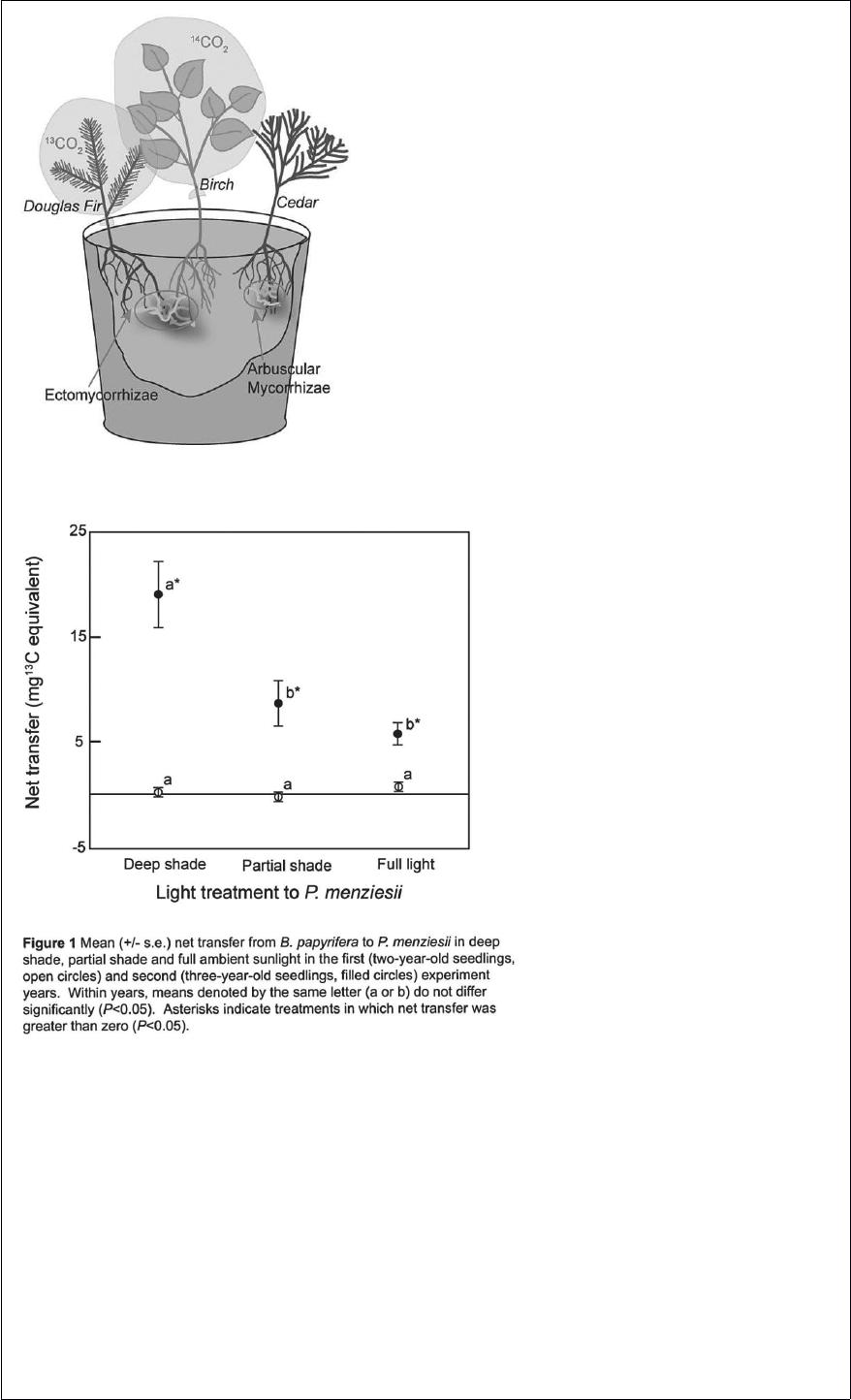
Figure A
Figure B
Referring to Simard et al. (1997), which design element is the control in this experiment
and why?
A) the bags over the seedlings to contain the different types of carbon dioxide
B) the fact that all the seedlings are different species
C) the cedar seedling, because it is not bagged
D) the cedar seedling, because it forms arbuscular mycorrhizae

To prepare flight muscles for use on a cool morning, hawkmoths _____.
A) relax the muscles completely until after they launch themselves into the air
B) decrease their standard metabolic rate
C) rapidly contract and relax these muscles to generate metabolic warmth
D) reduce the metabolic rate of the muscles to rest them before flight
Central coordination of vertebrate biological rhythms in physiology and behavior reside
in the _____.
A) pituitary gland
B) hypothalamus
C) cerebrum
D) thalamus

Use the following information to answer the question(s) below.
In 1983 a population of dark-eyed junco birds became established on the campus of the
University of California, San Diego (UCSD), which is located many miles from the
junco’s normal habitat in the mixed-coniferous temperate forests in the mountains.
Juncos have white outer tail feathers that the males display during aggressive
interactions and during courtship displays. Males with more white in their tail are more
likely to win aggressive interactions, and females prefer to mate with males with more
white in their tails. Females have less white in their tails than do males, and display it
less often. (Pamela J. Yeh. 2004. Rapid evolution of a sexually selected trait following
population establishment in a novel habitat. Evolution 58[1]:166-74.)
Refer to the paragraph on dark-eyed junco birds. The UCSD campus male junco
population tails were, on average, 36% white, whereas the tails of males from nearby
mountain populations averaged 40-45% white. If this observed trait difference were due
to a difference in the original colonizing population, it would most likely be due to
_____.
A) mutations in the UCSD population
B) gene flow between populations
C) a genetic bottleneck
D) a founder effect
This nudibranch, a type of sea slug, has many reddish cerata on its dorsal surface, as
well as two white-tipped rhinophores located on the head.
The nontaxonomic term sea slug encompasses a wide variety of marine gastropods.
One feature they share as adults is the lack of a shell. We might think, therefore, that
they represent defenseless morsels for predators. In fact, sea slugs have multiple
defenses. Some sea slugs prey on sponges and concentrate sponge toxins in their

tissues. Others feed on cnidarians, digesting everything except the nematocysts, which
they then transfer to their own skins. Whereas the most brightly colored sea slugs are
often highly toxic, others are nontoxic and mimic the coloration of the toxic species.
Their colors are mostly derived from pigments in their prey. There are also sea slugs
that use their coloration to blend into their environments.
The nematocysts most likely reach the skin of sea slugs through branches of the _____.
A) intestine
B) excurrent siphon
C) nephridium
D) pseudocoelom
Cells require which of the following to form cilia or flagella?
A) tubulin
B) laminin
C) actin
D) intermediate filaments
The same bees that pollinate the flowers of the Brazil nut trees also pollinate orchids,

which are epiphytes (in other words, plants that grow on other plants); however, orchids
cannot grow on Brazil nut trees. These observations explain _____.
A) the coevolution of Brazil nut trees and orchids
B) why Brazil nut trees do not set fruit in monoculture plantations
C) why male orchid bees do not pollinate Brazil nut tree flowers
D) why male orchid bees are smaller than female orchid bees
Assuming that each of these possesses a cell wall, which prokaryotes should be
expected to be most strongly resistant to plasmolysis in hypertonic environments?
A) extreme halophiles
B) extreme thermophiles
C) methanogens
D) cyanobacteria
What is a major difference between eukaryotic DNA replication and prokaryotic DNA
replication?
A) Prokaryotic replication does not require a primer.

B) Prokaryotic chromosomes have a single origin of replication, while eukaryotic
chromosomes have multiple origins of replication.
C) DNA replication in prokaryotic cells is conservative. DNA replication in eukaryotic
cells is semi-conservative.
D) DNA polymerases of prokaryotes can add nucleotides to both and ends of DNA
strands, while those of eukaryotes function only in the → direction.
The phosphate transport system in bacteria imports phosphate into the cell even when
the concentration of phosphate outside the cell is much lower than the cytoplasmic
phosphate concentration. Phosphate import depends on a pH gradient across the
membranemore acidic outside the cell than inside the cell. Phosphate transport is an
example of _____.
A) passive diffusion
B) facilitated diffusion
C) active transport
D) cotransport
Swine are vulnerable to infection by bird flu virus and human flu virus, which can both
be present in an individual pig at the same time. When this occurs, it is possible for
genes from bird flu virus and human flu virus to be combined. If the human flu virus
contributes a gene for Tamiflu resistance (Tamiflu is an antiviral drug) to the new virus,

and if the new virus is introduced to an environment lacking Tamiflu, then what is most
likely to occur?
A) The new virus will maintain its Tamiflu-resistance gene, in case of future exposure
to Tamiflu.
B) The Tamiflu-resistance gene will undergo mutations that convert it into a gene that
has a useful function in this environment.
C) If the Tamiflu-resistance gene involves a cost, it will experience directional selection
leading to reduction in its frequency.
D) If the Tamiflu-resistance gene confers no benefit in the current environment, and has
no cost, the virus will increase in frequency.
How are the bryophytes and seedless vascular plants alike?
A) Plants in both groups have vascular tissue.
B) In both groups, sperm swim from antheridia to archegonia.
C) The dominant generation in both groups is the sporophyte.
D) Plants in both groups have true roots, stems, and leaves.
You are hiking in a forest and come upon a mysterious plant, which you determine is
either a lycophyte sporophyte or a pterophyte sporophyte. Which of the following

would be most helpful in determining the correct classification of the plant?
A) whether or not it has true leaves
B) whether it has microphylls or megaphylls
C) whether or not it has seeds
D) its height
Why is a scientific topic best discussed by people of varying points of view, from
different subdisciplines, and representing diverse cultures?
A) Robust and critical discussion between diverse groups improves scientific thinking.
B) Scientists can coordinate with others to conduct experiments in similar ways.
C) This is a way of ensuring that everyone gets the same results.
D) People need to exchange their ideas with other disciplines and cultures because
everyone has a right to an opinion in science.
Linnaeus believed that species remained fixed in the form in which they had been
created. Linnaeus would have been uncomfortable with _____.
A) a hierarchical classification scheme

B) taxonomy
C) phylogenies
D) nested, increasingly inclusive categories of organisms
A covalent chemical bond is one in which _____.
A) electrons are removed from one atom and transferred to another atom so that the two
atoms become oppositely charged
B) protons and neutrons are shared by two atoms so as to satisfy the requirements of
both atoms
C) outer-shell electrons of two atoms are shared so as to satisfactorily fill their
respective orbitals
D) outer-shell electrons of one atom are transferred to fill the inner electron shell of
another atom
Which of Darwin’s ideas had the strongest connection to his reading of Malthus’s essay
on human population growth?
A) descent with modification
B) variation among individuals in a population

C) struggle for existence
D) that the ancestors of the Galpagos finches had come from the South American
mainland
The DNA of telomeres has been highly conserved throughout the evolution of
eukaryotes. This most likely reflects _____.
A) the low frequency of mutations occurring in this DNA
B) continued evolution of telomeres
C) that new mutations in telomeres have been advantageous
D) a critical function of telomeres
Compared to C3 plants, C4 plants _____.
A) can continue to fix CO2 even at lower CO2 concentrations and higher oxygen
concentrations
B) have higher rates of photorespiration
C) do not use rubisco for carbon fixation
D) make a four-carbon compound, oxaloacetate, which is then delivered to the citric

acid cycle in mitochondria
Neurotransmitters categorized as inhibitory are expected to _____.
A) act independently of their receptor proteins
B) close potassium channels
C) open sodium channels
D) hyperpolarize the membrane
Aspirin and ibuprofen both _____.
A) inhibit the synthesis of prostaglandins
B) inhibit the release of nitric oxide, a potent vasodilator
C) activate the paracrine signaling pathways that form blood clots
D) stimulate vasoconstriction in the kidneys

Which of the following represents the order of increasingly higher levels of
organization of chromatin?
A) nucleosome, 30-nm chromatin fiber, looped domain
B) looped domain, 30-nm chromatin fiber, nucleosome
C) nucleosome, looped domain, 30-nm chromatin fiber
D) 30-nm chromatin fiber, nucleosome, looped domain