
Which of the following statements regarding freshwater fish is true?
A) Freshwater fish frequently drink to obtain salt ions.
B) Freshwater fish use their gills to actively take up salt ions.
C) Freshwater fish lose water through their gills by osmosis.
D) Freshwater fish do not produce urine.
Geological evidence indicates that two landmasses became separated by a deep ocean
channel 45 million years ago and have been moving apart ever since. You are studying a
group of organisms that is widespread as a native part of the biota on both of the
landmasses. What can you conclude about the group’s evolutionary history?
A) The group’s ancestors were definitely present on the original landmass.
B) The group’s ancestors cannot have been present on the original landmass.
C) If the group’s ancestors could not move across the open ocean, it is very likely that
they were present on the original landmass.
D) The group’s ancestors must have independently colonized each of the landmasses
from a third location within the past 45 million years.
Why is the runoff from fertilized agricultural fields, even if free of pesticides, often
harmful to the ecosystems of temperate lakes?

A) Fertilizer compounds are toxic to fish.
B) The runoff causes heavy growth of algae, which eventually die and decompose,
causing oxygen depletion.
C) Runoff water pools at the lake’s bottom, where the fertilizer compounds react with
materials in the sediment to form toxic substances.
D) The runoff is acid, and acidification kills key lake organisms.
Sucrose is formed
A) from two glucose molecules.
B) from two monosaccharides through dehydration synthesis.
C) when ionic bonds link two monosaccharides.
D) when glucose and lactose are combined.
Which of the following statements about the cells of the mucous membrane lining your
air tubes is false?
A) They manufacture secretory products.
B) They are stratified squamous epithelial cells.

C) They are cuboidal or columnar in shape.
D) They carry cilia that sweep mucus up and out of the respiratory system.
When bar-headed geese fly at very high altitudes (possibly over Mount Everest!), they
breathe very thin air where the partial pressure of oxygen is very low compared to that
at sea level. Which of the following adaptions would help the geese efficiently
exchange gases when flying at high altitudes?
A) hemoglobin that has a high affinity for oxygen
B) hemoglobin that has a low affinity for oxygen
C) hemoglobin that has a high affinity for carbon dioxide
D) hemoglobin that has a low affinity for carbon dioxide
Gel electrophoresis is normally set up with the negative electrode at the top of the gel
and the positive electrode at the bottom of the gel. The DNA products are loaded at the
top of the gel, and then a current is applied to separate them. However, when preparing
to run a gel, you accidentally switched the locations of the negative and positive
electrodes such that the positive electrode is at the top and the negative electrode is at
the bottom. You still loaded the DNA products at the top of the gel as normal. What
result are you most likely to observe if you apply an electric current to this gel setup?
A) All DNA molecules will migrate up the gel toward the positive electrode.

B) All DNA molecules will migrate down the gel toward the negative electrode.
C) Shorter DNA molecules will move up the gel, and longer DNA molecules will move
down the gel.
D) Longer DNA molecules will move up the gel, and shorter DNA molecules will move
down the gel.
Which of the following statements about genetics is true?
A) Genes are proteins that produce DNA.
B) DNA is made up of six different kinds of nucleotides.
C) Differences among organisms reflect different nucleotide sequences in their DNA.
D) Each DNA molecule is a single strand of nucleotides.
The primary structure of a protein is
A) an alpha helix or a pleated sheet.
B) the amino acid sequence of the polypeptide chain.
C) composed of two or more polypeptide chains.

D) maintained by hydrogen bonds.
Suppose you have three water baths in front of you. The temperature of the one on the
left is 22oC (cold), the one in the middle is 25oC (room temperature,) and the one on the
right is 44oC (warm). At the same time, you place the index finger of your right hand
into the warm water bath and the index finger of your left hand into the cold water bath,
and you leave them there for 2 minutes. After 2 minutes, why would you no longer feel
a difference in temperature between the two water baths?
A) The sensory receptors in your index fingers speed up the conversion of the stimulus
(water) to a chemical signal.
B) The sensory receptors in your index fingers diminish the conversion of the stimulus
(water) to an electrical signal.
C) The sensory receptors in your index fingers become less sensitive over time as they
are stimulated repeatedly.
D) Receptor potentials in the sensory receptors in your index fingers start off weak and
then become stronger.

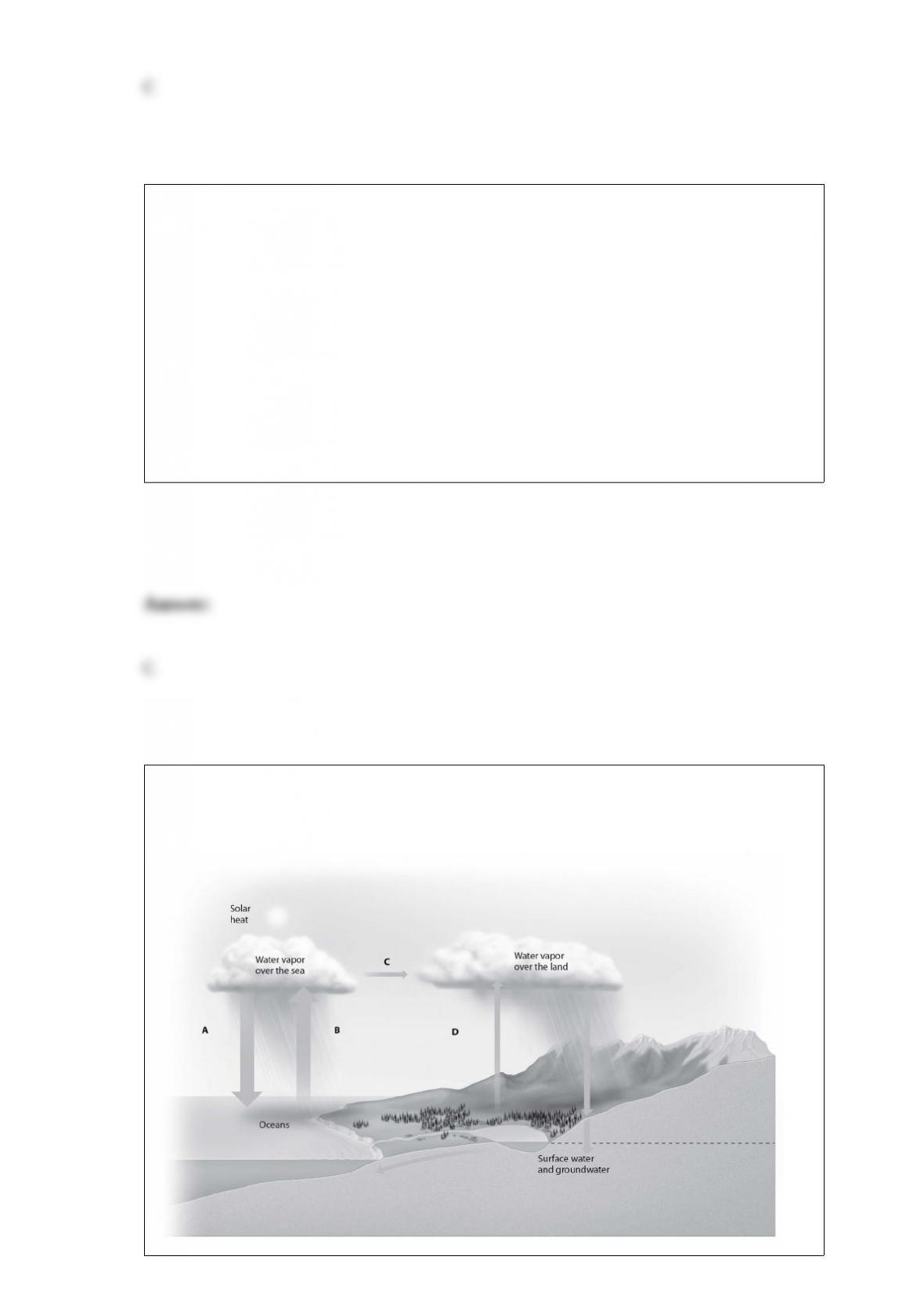
If process D is decreased, what impact will that likely have on the surrounding area?
A) Increased precipitation will increase erosion.
B) Lack of vegetation will increase the probability of drought.
C) Areas covered by ocean will increase.
D) More moisture will move over land from the ocean.
Which of the following options best depicts the flow of information when a gene directs
the synthesis of a cellular component?
A) RNA → DNA → RNA → protein
B) DNA → RNA → protein
C) protein → RNA → DNA
D) DNA → tRNA → mRNA → protein

Which of the following factors is fundamentally responsible for the character of arctic
tundra soils?
A) secretion of acid by lichens and plant roots
B) permafrost
C) summer aridity
D) abundant winter snow
The addition of oxygen instead of carbon dioxide to RuBP results in
A) cellular respiration.
B) photorespiration.
C) photophosphorylation.
D) aerobic respiration.

Intermediate filaments
A) guide the movements of chromosomes.
B) surround the nucleus.
C) guide the movements of organelles.
D) support the inner mitochondrial membrane.
Which gland requires the element iodine to produce its hormones?
A) adrenal medulla
B) thyroid
C) pineal
D) ovary
The human wrist is very agile, but because of this agility it is also very prone to injuries
involving the tissue connecting the wrist bones. This statement illustrates
A) that animal structures are not perfect.
B) that connective tissue can be damaged.
C) that muscle tissue can be damaged.
D) both A and B
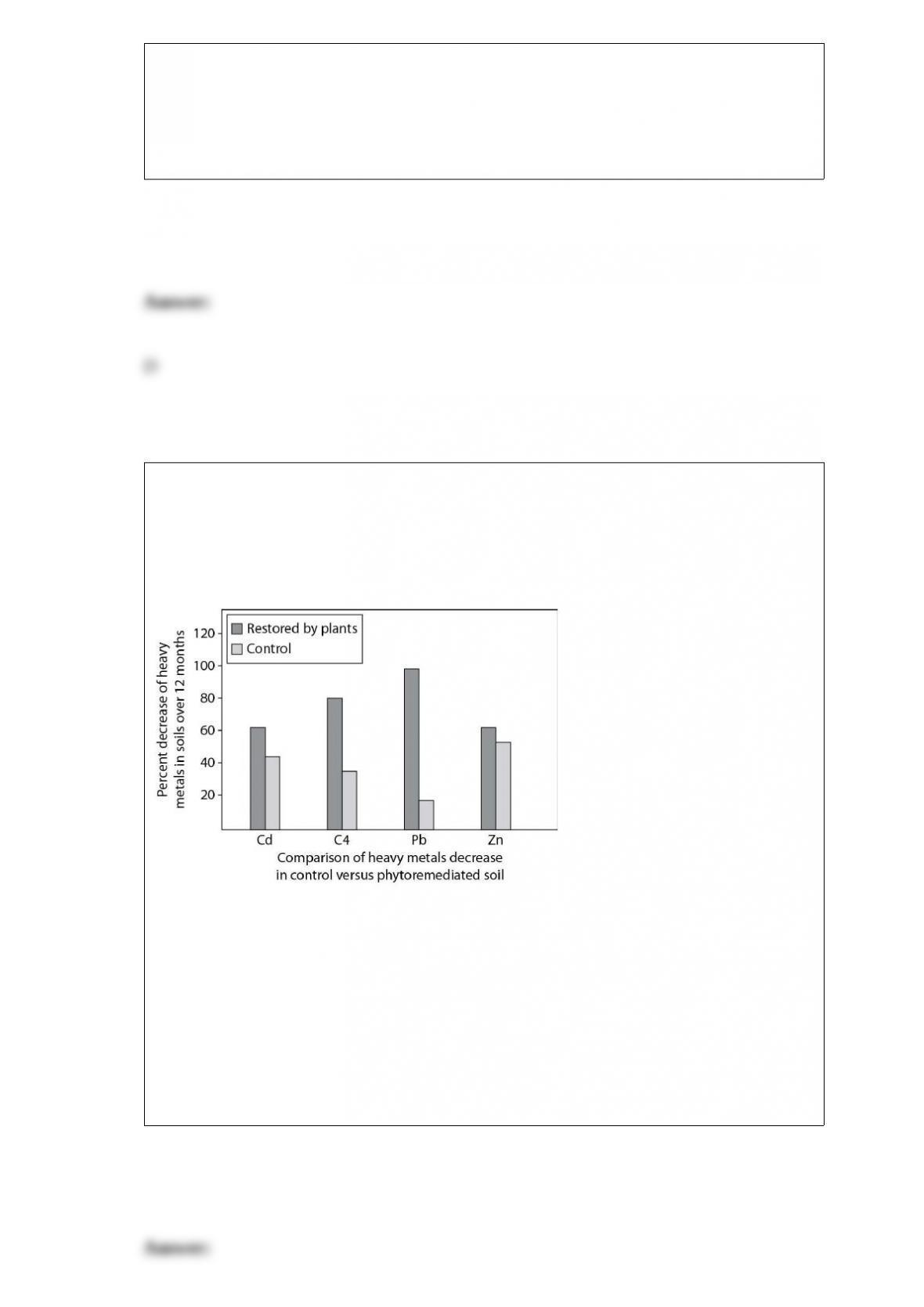
Plants are sometimes used for phytoremediation in areas where the soil has been
contaminated with heavy metals. Suppose the Acme Remediation Company is
proposing to remediate a contaminated area that you wish to restore. Acme presents you
with the following data as evidence of their company’s ability to remediate soil.
According to the data, this remediation plan is most effective with which element?
A) cadmium (Cd)
B) copper (Cu)
C) lead (Pb)
D) zinc (Zn)
A common knee injury in athletes involves the anterior cruciate ligament, or ACL. The
ACL consists of tissue that connects the bones of the femur (upper leg bone) and tibia
(lower leg bone). What kind of tissue would you expect to be damaged in an ACL
injury?
A) bone tissue
B) striated muscle tissue
C) fibrous connective tissue
D) cartilage

Forest destruction would have the greatest impact on which arrow?
A) arrow A
B) arrow B
C) arrow C
D) arrow D
Given the sex determination system in bees, we can expect that
A) female bees will produce eggs by meiosis, whereas male bees will produce sperm by
mitosis.
B) female bees will produce eggs by mitosis, whereas male bees will produce sperm by
meiosis.
C) male and female bees will produce sperm and eggs by meiosis.
D) male and female bees will produce sperm and eggs by mitosis.
A red blood cell is in an artery in the right leg. How many capillary beds will it pass
through before it returns to the left atrium of the heart?
A) none
B) one
C) two
D) three
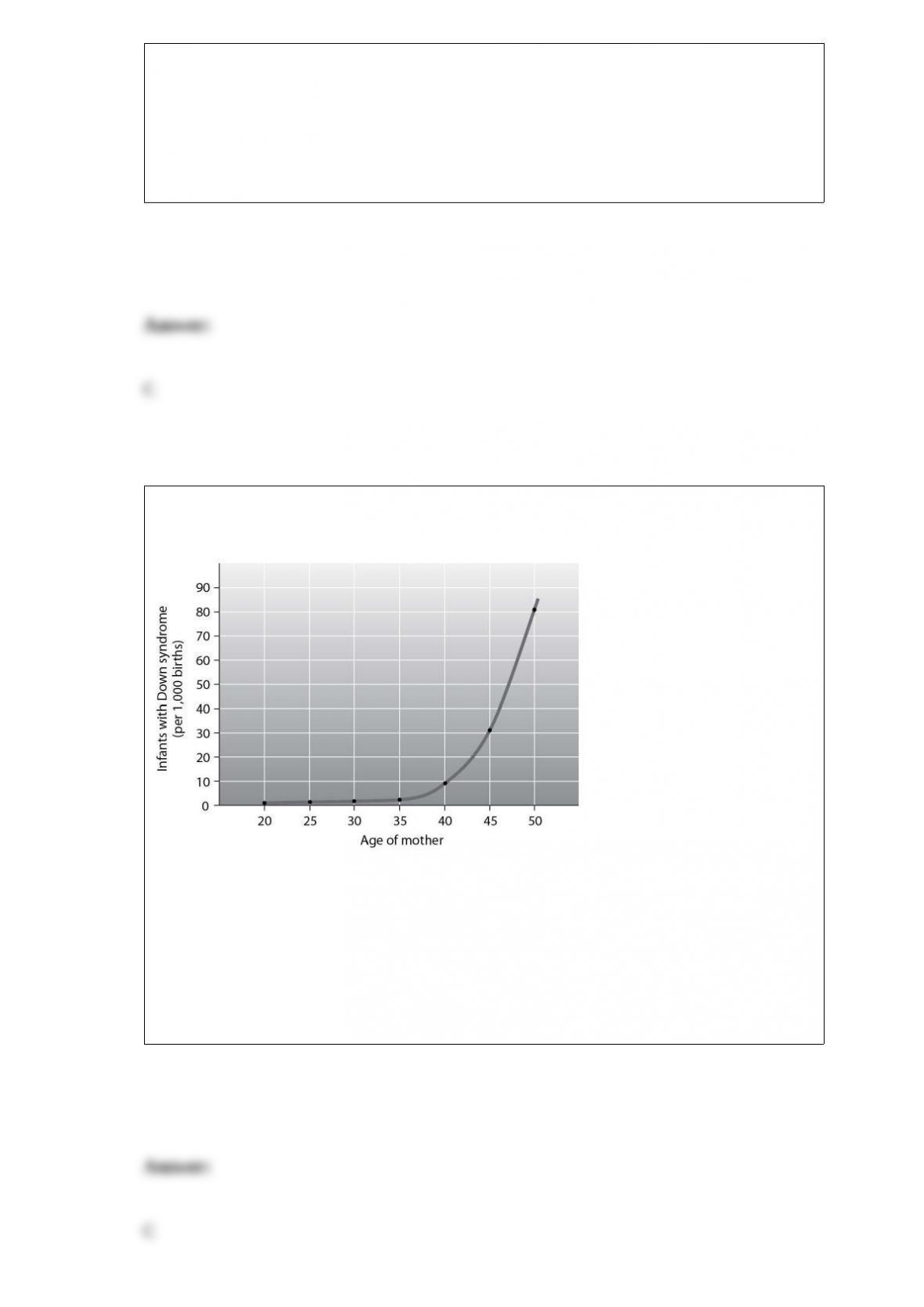
According to the graph, at what maternal age is the incidence of Down syndrome equal
to five times the incidence at age 40?
A) about 29 or 30
B) about 35 or 36
C) about 44 or 45
D) about 46 or 47

The contacting surfaces of a moving joint, such as your hip joint, consist of
A) red bone marrow.
B) cartilage.
C) spongy bone.
D) compact bone.
Inhalation in humans is achieved by
A) contraction of muscles in the lungs.
B) relaxation of muscles in the lungs.
C) relaxation of the diaphragm and chest muscles.
D) contraction of the diaphragm and chest muscles.
Potassium-40 can be used to date ________ that are ________ old.
A) fossils; thousands of years
B) volcanic rocks and associated fossils; hundreds of millions of years

C) potassium-rich fossils; millions of years
D) carbon-containing materials; up to 75,000 years
Mr. and Mrs. Smith have three sons in elementary school. Two of their children are
progressing normally, but their youngest son, Charles, has been much slower than his
siblings in developing speech and language skills. His parents are concerned that he has
a learning disability and decide to investigate further. Since some learning disabilities
can be genetically based, their pediatrician recommends a chromosomal analysis.
The results show that Charles has a trisomy of the sex chromosomes, diagnosed as
XYY, which is caused by nondisjunction in the formation of the father’s sperm. The
nondisjunction resulted in an extra copy of the Y chromosome. The extra copy was
passed on to Charles during fertilization. Most often, this chromosomal change causes
no unusual physical features or medical problems, but those with trisomy of the sex
chromosomes do have a higher than normal risk of delays in learning development.
If Charles gets married and starts a family, which of the following chromosomal
abnormalities has an increased chance of occurring in his children?
A) YO
B) YY
C) XO
D) XXY
Which of the following statements best describes the current scientific view of birds?
A) a group of feathered, endothermic dinosaurs
B) a group of feathered, ectothermic lizards that lack teeth
C) a group of flying, endothermic reptiles that have lost teeth, the amniotic egg, and
other heavy body features as an adaptation for flight
D) a group of flying mammals that are derived from monotremes, which also lay
amniotic eggs
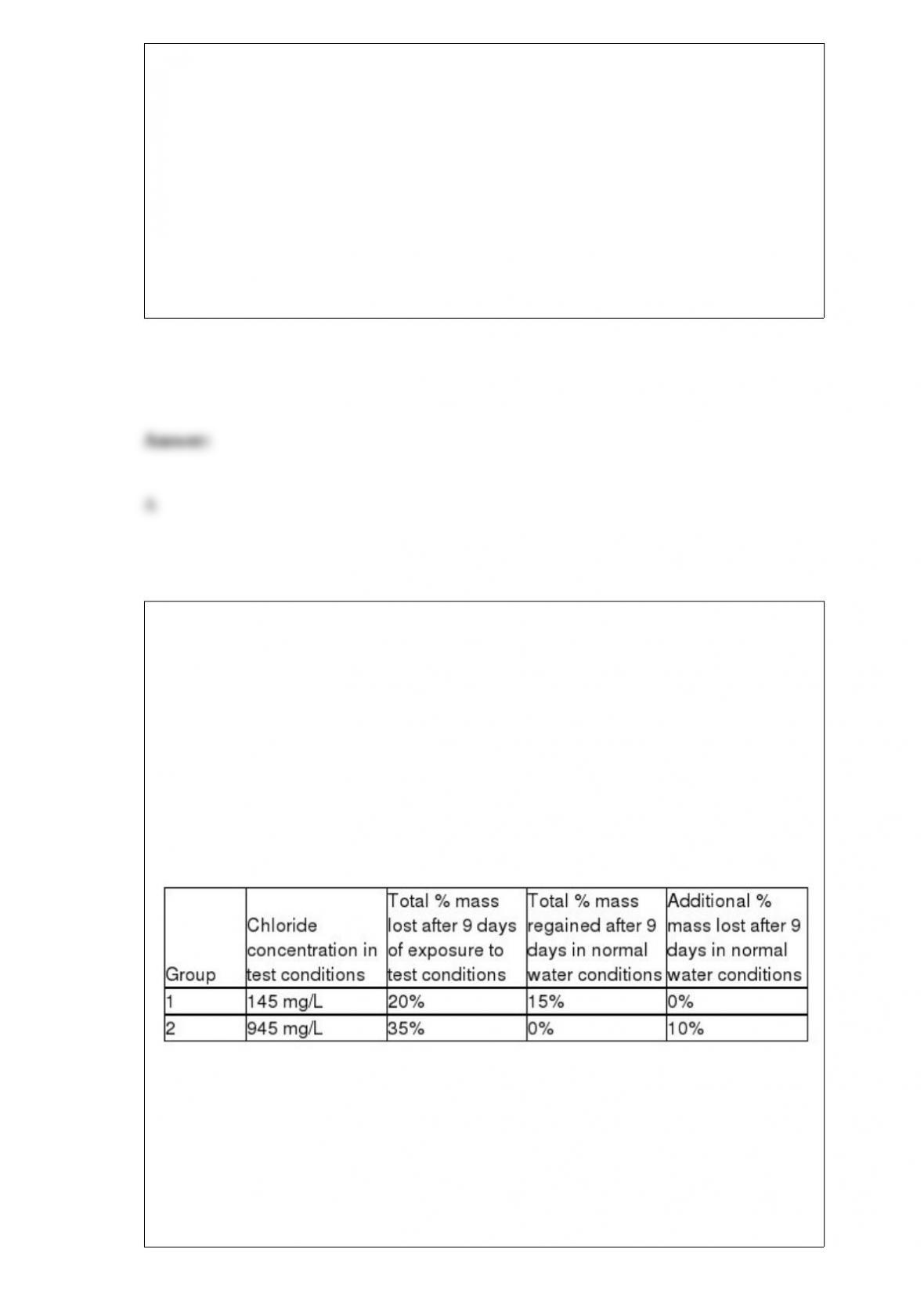
In 2011, scientists investigated whether the salts that are spread on icy roads to melt the
ice are diluted enough by spring rainfall so that they do not have negative effects on
amphibian species that breed in nearby areas. They exposed clutches (groups of eggs)
of salamanders to three test conditions with varying salt concentrations (road salts
mixed with dechlorinated tap water) to simulate salt concentrations of small pools of
water located near highways that are typically fed by rainareas where salamanders often
lay their eggs. After 9 days, the scientists placed the three groups in “normal” water and
measured how much body mass the salamanders lost every 3 days for 9 days. They
chose to measure change in mass because salamanders are able to take in water, which
helps lower the chances of salamander embryos dying from freezing, disease, or
predation. The table below provides partial results of this study.
There was a third group (group 3) in this study that experienced the same test
conditions as groups 1 and 2 except that the water to which group 3 was exposed
always had a chloride concentration (mg/L) that salamander clutches would normally
experience (that is, with no road salts in the water). How would you describe this
group?
A) an experimental group

B) a control group
C) a dependent variable
D) an independent variable
Which of the following variations of the sentence “Where is the cat?” is most like a
chromosomal deletion?
A) Where is cat?
B) Where is the the cat?
C) Where the is cat?
D) Where is cat the the cat?