
Broad-spectrum antibiotics inhibit the growth of most intestinal bacteria. Consequently,
assuming that nothing is done to counter the reduction of intestinal bacteria, a hospital
patient who is receiving broad-spectrum antibiotics is most likely to become _____.
A) unable to fix carbon dioxide
B) antibiotic resistant
C) unable to synthesize peptidoglycan
D) deficient in certain vitamins and nutrients
Healthy individuals of Paramecium bursaria contain photosynthetic algal
endosymbionts of the genus Chlorella. When within their hosts, the algae are referred to
as zoochlorellae. In aquaria with light coming from only one side, P. bursaria gather at
the well-lit side, whereas other species of Paramecium gather at the opposite side. The
zoochlorellae provide their hosts with glucose and oxygen, and P. bursaria provides its
zoochlorellae with protection and motility. P. bursaria can lose its zoochlorellae in two
ways: (1) if kept in darkness, the algae will die; and (2) if prey items (mostly bacteria)
are absent from its habitat, P. bursaria will digest its zoochlorellae.
Which term most accurately describes the nutritional mode of healthy P. bursaria?
A) photoautotroph
B) photoheterotroph
C) chemoautotroph
D) mixotroph

Rhizobia, actinomycetes, and cyanobacteria all share the common feature that they
can_____.
A) increase water uptake in plants
B) kill parasites in the soil
C) exist in extreme environments
D) fix atmospheric nitrogen
What information is critical to the success of polymerase chain reaction (PCR) itself?
A) The DNA sequence of the ends of the DNA to be amplified must be known.
B) The complete DNA sequence of the DNA to be amplified must be known.
C) The sequence of restriction-enzyme recognition sites in the DNA to be amplified
must be known.
D) The sequence of restriction-enzyme recognition sites in the DNA to be amplified and
in the plasmid where the amplified DNA fragment will be cloned must be known.
Which of the following has both endocrine and exocrine activity?

A) the pituitary gland
B) parathyroid glands
C) salivary glands
D) the pancreas
A man who carries an allele of an X-linked gene will pass it on to _____.
A) all of his daughters
B) half of his daughters
C) all of his sons
D) all of his children
Upon closer inspection of the leaves of “flower of stone,” one can observe tiny,
cone-like structures. Each cone-like structure emits spores of two different sizes.
Further investigation also reveals that the roots of “flower of stone” branch only at the
growing tip of the root, forming a Y-shaped structure. Consequently, which of the
following is the closest living relative of “flower of stone”?
A) true moss
B) club moss

C) liverwort
D) fern
Why do scientists consider HIV to be an emerging virus?
A) HIV infected humans long before the 1980s, but it has now mutated to a more
deadly form.
B) HIV mutates rapidly making the virus very different from HIV in the early 1980s.
C) HIV suddenly became apparent and widespread in the 1980s.
D) HIV is now starting to cause diseases other than AIDS, such as rare types of cancers
and pneumonias.
Nudibranchs, a type of predatory sea slug, can have various protuberances (that is,
extensions) on their dorsal surfaces. Rhinophores are paired structures, located close to
the head, which bear many chemoreceptors. Dorsal plummules, usually located
posteriorly, perform respiratory gas exchange. Cerata usually cover much of the dorsal
surface and contain nematocysts at their tips.
The stingers of honeybees have a function most similar to that of _____.
A) rhinophores

B) dorsal plummules
C) cerata
D) chemoreceptors
Regarding these sequence homology data, the principle of maximum parsimony would
be applicable in _____.
A) distinguishing introns from exons
B) determining degree of sequence homology
C) selecting appropriate genes for comparison among species
D) inferring evolutionary relatedness from the number of sequence differences
A proficient engineer can easily design skeletal structures that are more functional than
those currently found in the forelimbs of such diverse mammals as horses, whales, and
bats. The actual forelimbs of these mammals do not seem to be optimally arranged
because _____.
A) natural selection has not had sufficient time to create the optimal design in each
case, but will do so given enough time
B) in many cases, phenotype is determined by genotype and the environment

C) though we may not consider the fit between the current skeletal arrangements and
their functions excellent, we should not doubt that natural selection ultimately produces
the best design
D) natural selection is generally limited to modifying structures that were present in
previous generations and in previous species
Which of the following choices includes all of the others in creating global terrestrial
climates?
A) differential heating of Earth’s surface
B) ocean currents
C) global wind patterns
D) Earth’s rotation on its axis
A mutation that disrupts the ability of an animal cell to add polysaccharide
modifications to proteins would most likely cause defects in its _____.
A) nuclear matrix and extracellular matrix
B) mitochondria and Golgi apparatus
C) Golgi apparatus and extracellular matrix

D) nuclear pores and secretory vesicles
Compared to viewing a distant object, a human viewing an object held within five
centimeters of the eye requires a lens that _____.
A) has been flattened, as a result of contraction of the ciliary muscles
B) has been made more spherical, as a result of contraction of the ciliary muscles
C) has been flattened, as a result of relaxation of the ciliary muscles
D) has been made more spherical, as a result of relaxation of the ciliary muscles
A major group of G protein-coupled receptors contains seven transmembrane α helices.
The amino end of the protein lies at the exterior of the plasma membrane. Loops of
amino acids connect the helices either at the exterior face or on the cytosol face of the
membrane. The loop on the cytosol side between helices 5 and 6 is usually substantially
longer than the others.
The coupled G protein most likely interacts with this receptor _____.
A) at the NH3 end
B) at the COO” end
C) along the exterior margin

D) at the loop between H5 and H6
Which of these is a major trend in land plant evolution?
A) the trend toward smaller size
B) the trend toward a gametophyte-dominated life cycle
C) the trend toward a sporophyte-dominated life cycle
D) the trend toward larger gametophytes
What kind of evidence has recently made it necessary to assign the prokaryotes to either
of two different domains, rather than assigning all prokaryotes to the same kingdom?
A) mtDNA
B) rRNA genes
C) morphological
D) ecological

Which of the following traits do archaeans and bacteria share?
A) composition of the cell wall
B) composition of the cell wall and lack of a nuclear envelope
C) lack of a nuclear envelope and presence of plasma membrane
D) presence of plasma membrane and composition of the cell wall
What is the goal of bioremediation?
A) to improve human health with the help of living organisms such as bacteria
B) to clean up areas polluted with toxic compounds by using bacteria
C) to improve soil quality for plant growth by using bacteria
D) to improve bacteria for production of useful chemicals

The presence of a lophophore in a newly discovered species would suggest that the
species _____.
A) has an exoskeleton
B) grows by shedding its external covering
C) is motile
D) is a suspension feeder
If you experimentally reduce the concentration of K+ in the extracellular fluid
surrounding hair cells in the inner ear, the result would be like which of the following?
A) decreasing the volume of sound reaching the hair cells
B) increasing the volume of sound reaching the hair cells
C) decreasing the frequency of sound reaching the hair cells
D) increasing the frequency of sound reaching the hair cells
Use this model of a eukaryotic transcript to answer the following question(s).
E = exon and I = intron
UTR E1 I1 E2 I2 E3 I3 E4 UTR

Which components of the previous molecule will also be found in mRNA in the
cytosol?
A) UTR I1 I2 I3 UTR
B) E1 E2 E3 E4
C) UTR E1 E2 E3 E4 UTR
D) E1 I1 E2 I2 E3 I3 E4
Which of the following statements regarding flowering plants is correct?
A) The gametophyte is the dominant generation.
B) Female gametophytes develop from megaspores within the anthers.
C) Pollination is the delivery of pollen to the stigma of a carpel.
D) The food-storing endosperm is derived from the cell that contains one polar nucleus
and two sperm nuclei.
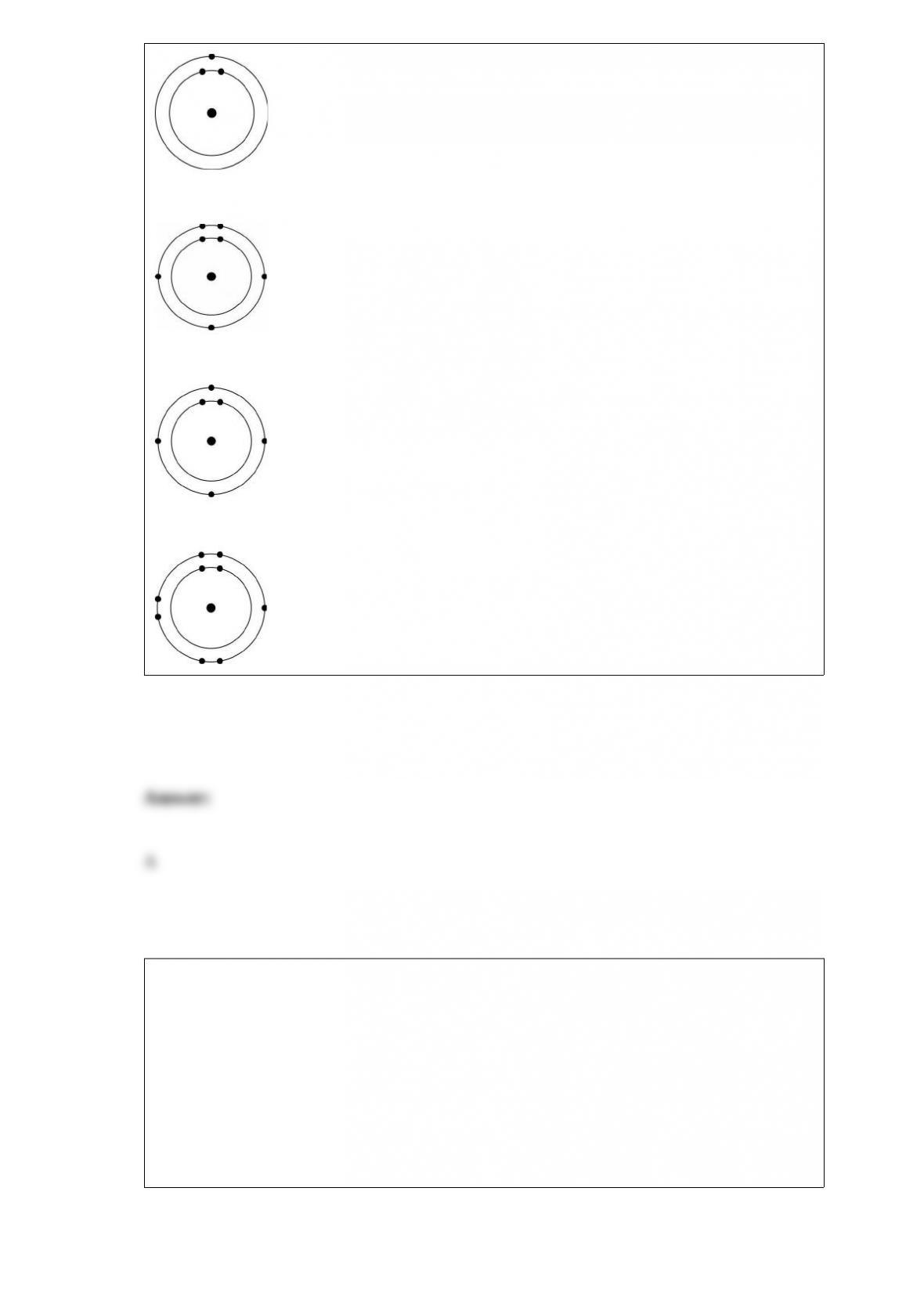
Which one of the atoms shown would be most likely to form a cation with a charge of
+1?
A)
B)
C)
D)
Photosynthesis ceases when leaves wilt, mainly because _____.
A) the chlorophyll in wilting leaves is degraded
B) flaccid mesophyll cells are incapable of photosynthesis
C) stomata close, preventing carbon dioxide from entering the leaf
D) accumulation of carbon dioxide in the leaf inhibits enzymes

Which one of the following statements about RNA processing is true?
A) Exons are cut out before mRNA leaves the nucleus.
B) Ribozymes may function in RNA splicing.
C) RNA splicing can be catalyzed by tRNA.
D) A primary transcript is often much shorter than the final RNA molecule that leaves
the nucleus.
A newborn who is accidentally given a drug that destroys the thymus would most likely
_____.
A) lack innate immunity
B) be unable to genetically rearrange antigen receptors
C) be unable to differentiate and mature T cells
D) have a reduced number of B cells and be unable to form antibodies

About 3 million years ago, the Isthmus of Panama (a narrow strip of land connecting
North and South America) formed, dividing marine organisms into Pacific and
Caribbean populations. Researchers have examined species of snapping shrimp on both
sides of the isthmus. Based on the morphological species concept, there appeared to be
seven pairs of species, with one species of each pair in the Pacific and the other in the
Caribbean. The different species pairs live at somewhat different depths in the ocean.
Using mitochondrial DNA sequences, the researchers estimated phylogenies and found
that each of these species pairs, separated by the isthmus, were indeed each other’s
closest relatives. The researchers investigated mating in the lab and found that many
species pairs were not very interested in courting with each other, and any that did mate
almost never produced fertile offspring. (N. Knowlton, L. A. Weigt, L. A. Solorzano, D.
K. Mills, and E. Bermingham. 1993. Divergence in proteins, mitochondrial DNA, and
reproductive incompatibility across the Isthmus of Panama. Science 260:1629-32.)
Refer to the paragraph about the formation of the Isthmus of Panama. If the isthmus
formed gradually rather than suddenly, what pattern of genetic divergence would you
expect to find in these species pairs?
A) similar percentages of difference in DNA sequence between all pairs of sister
species
B) greater percentage of difference in DNA sequence between species that inhabit deep
water than between species that inhabit shallow water
C) greater percentage of difference in DNA sequence between species that inhabit
shallow water than between species that inhabit deep water
Which of the following is crucial to activation of the adaptive immune response?
A) memory cells
B) presentation of MHC (major histocompatibility complex)-antigen complex on a cell
surface
C) somatic hypermutation
D) phagocytosis of antibody-antigen complex by macrophages in the blood (the

humoral response)
Substrate-level phosphorylation accounts for approximately what percentage of the ATP
formed by the reactions of glycolysis?
A) 0%
B) 2%
C) 38%
D) 100%
Zinc, an essential trace element for most organisms, is present in the active site of the
enzyme carboxypeptidase. The zinc most likely functions as _____.
A) a noncompetitive inhibitor of the enzyme
B) an allosteric activator of the enzyme
C) a cofactor necessary for enzyme activity
D) a coenzyme derived from a vitamin
All chordates studied to date, except tunicates, share a set of _____.
A) 13 Hox genes
B) 5 Dlx genes
C) 9 Otx genes
D) 7 FOXP2 genes
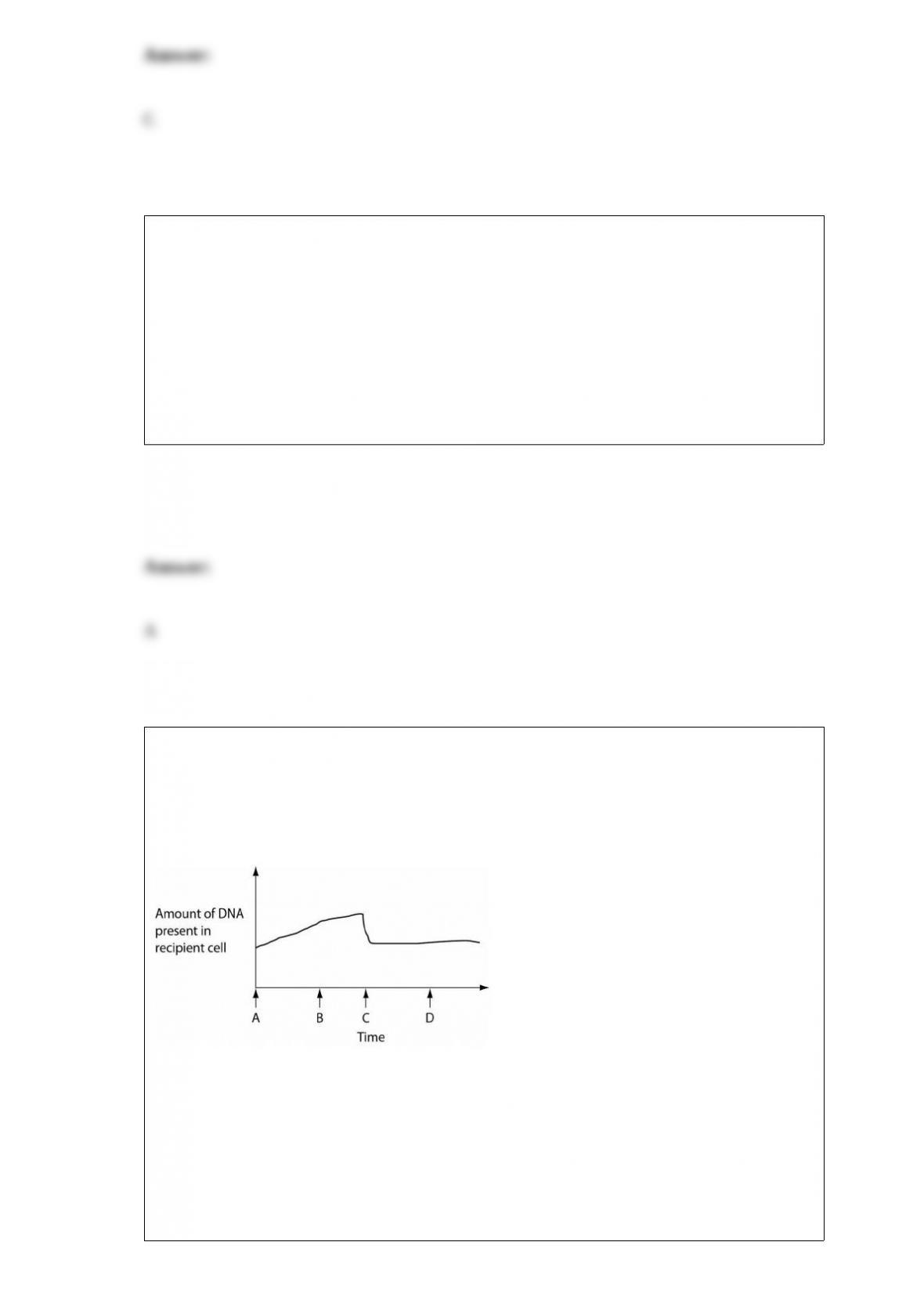
The figure below depicts changes to the amount of DNA present in a recipient cell that
is engaged in conjugation with an Hfr cell. Hfr cell DNA begins entering the recipient
cell at Time A. Assume that reciprocal crossing over occurs (in other words, a fragment
of the recipient’s chromosome is exchanged for a homologous fragment from the Hfr
cell’s DNA).
How is the recipient cell different at Time D than it was at Time A?
A) It has a greater number of genes.
B) It has a greater mass of DNA.
C) It has a different sequence of base pairs.

D) It contains bacteriophage DNA.
When a person drinks alcohol, the rate of urination increases. This suggests that
antidiuretic hormone (ADH) may be affected by alcohol consumption in some way.
Which of the following best accounts for the increase in urination?
A) Alcohol stimulates the release of ADH.
B) Alcohol inhibits the release of ADH.
C) Alcohol inhibits the binding of ADH to receptors in the nephron.
D) Alcohol could inhibit ADH release or the binding of ADH to receptors in the
nephron.