
In liver cells, the inner mitochondrial membranes are about five times the area of the
outer mitochondrial membranes. What purpose must this serve?
A) It allows for an increased rate of glycolysis.
B) It allows for an increased rate of the citric acid cycle.
C) It increases the surface for oxidative phosphorylation.
D) It increases the surface for substrate-level phosphorylation.
Viruses _____.
A) manufacture their own ATP, proteins, and nucleic acids
B) use the host cell to copy themselves and make viral proteins
C) use the host cell to copy themselves and then viruses synthesize their own proteins
D) metabolize food and produce their own ATP
Which of the following is most likely associated with the evolution of mating systems?
A) population density
B) territoriality

C) certainty of paternity
D) sexual dimorphism
What results from the chemical reaction illustrated above? The reactants have no
charge.
A) a cation with a net charge of +1 and an anion with a net charge of +1
B) a cation with a net charge of -1 and an anion with a net charge of -1
C) a cation with a net charge of -1 and an anion with a net charge of +1
D) a cation with a net charge of +1 and an anion with a net charge of -1
Which tissue type, or organ, is NOT correctly matched with its germ layer tissue?
A) nervous mesoderm
B) muscular mesoderm
C) stomach endoderm

D) skin ectoderm
Sex determination in mammals is due to the SRY gene. Which of the following could
allow a person with an XX karyotype to develop a male phenotype?
A) the loss of the SRY gene from an autosome
B) translocation of SRY to a X chromosome
C) a person with an extra autosomal chromosome
D) a person with one normal and one shortened (deleted) X
Coral reefs can be found on the southeast coast of the United States but not at similar
latitudes on the southwest coast. Differences in which of the following most likely
account for this?
A) precipitation
B) day length
C) ocean currents
D) salinity

A number of systems for pumping ions across membranes are powered by ATP. Such
ATP-powered pumps are often called ATPases, although they do not often hydrolyze
ATP unless they are simultaneously transporting ions. Because small increases in
calcium ions in the cytosol can trigger a number of different intracellular reactions, cells
keep the cytosolic calcium concentration quite low under normal conditions, using
ATP-powered calcium pumps. For example, muscle cells transport calcium from the
cytosol into the membranous system called the sarcoplasmic reticulum (SR). If a resting
muscle cell’s cytosol has a free calcium ion concentration of 10-7 while the
concentration in the SR is 10-2, then how is the ATPase acting?
A) ATPase activity must be powering an inflow of calcium from the outside of the cell
into the SR.
B) ATPase activity must be transferring i to the SR to enable this to occur.
C) ATPase activity must be pumping calcium from the cytosol to the SR against the
concentration gradient.
D) ATPase activity must be opening a channel for the calcium ions to diffuse back into
the SR along the concentration gradient.
Mitotic activity by the apical meristem of a root makes which of the following more
possible?
A) increased delivery of water to the aboveground stem
B) decreased absorption of mineral nutrients
C) increased absorption of carbon dioxide.

D) effective lateral growth of the stem
To measure the population of lake trout in a 250-hectare lake, 400 individual trout were
netted and marked with a fin clip, then returned to the lake. The next week, the lake was
netted again, and out of the 200 lake trout that were caught, 50 had fin clips. Using the
mark-recapture estimate, the lake trout population size could be closest to which of the
following?
A) 200
B) 400
C) 1,600
D) 80,000
Mammals have Toll-like receptors (TLRs) that can recognize a kind of macromolecule
that is absent from vertebrates but present in or on certain groups of pathogens, such as
viral _____.
A) double-stranded DNA
B) double-stranded RNA
C) glycoproteins
D) phospholipids

The unconscious control of respiration and circulation are associated with the _____.
A) thalamus
B) cerebellum
C) medulla oblongata
D) cerebrum
How would you classify the genetic basis for most behavioral traits in the animal
kingdom?
A) One gene typically codes for one behavior.
B) One gene typically codes for many behaviors.
C) Many genes typically code for one behavior.
D) Behaviors are learned, not coded by genes.

Use the following information to answer the question(s) below.
Paulinella chromatophora is one of the few cercozoans that is autotrophic, carrying out
aerobic photosynthesis with its two elongated “chromatophores.” The chromatophores
are contained within vesicles of the host cell, and each is derived from a
cyanobacterium, though not the same type of cyanobacterium that gave rise to the
chloroplasts of algae and plants.
Super cells characteristic of plasmodial slime molds result when which one of the
following common cellular processes does not occur?
A) mitosis
B) cytokinesis
C) aerobic metabolism
D) endocytosis
Fossil fungi date back to the origin and early evolution of plants. What combination of
environmental and morphological change is similar in the evolution of both fungi and
plants?
A) presence of “coal forests” and change in mode of nutrition
B) periods of drought and presence of filamentous body shape
C) predominance in swamps and presence of cellulose in cell walls
D) colonization of land and loss of flagellated cells

An individual who has been bitten by a poisonous snake that has a fast-acting toxin
would likely benefit from _____.
A) vaccination with a weakened form of the toxin
B) injection of antibodies to the toxin
C) injection of interleukin-1
D) injection of interferon
When pathogenic fungi are found growing on the roots of grape vines, grape farmers
sometimes respond by covering the ground around their vines with plastic sheeting and
pumping a gaseous fungicide into the soil. The most important concern of grape farmers
who engage in this practice should be that the _____.
A) fungicide might also kill the native yeasts residing on the surfaces of the grapes
B) lichens growing on the vines’ branches are not harmed
C) fungicide might also kill mycorrhizae
D) sheeting is transparent so that photosynthesis can continue

Which of these are NOT embedded in the hydrophobic portion of the lipid bilayer at
all?
A) transmembrane proteins
B) integral proteins
C) peripheral proteins
D) All of these are embedded in the hydrophobic portion of the lipid bilayer.
Which of the following mechanisms is (are) used to coordinate the expression of
multiple, related genes in eukaryotic cells?
A) Environmental signals enter the cell and bind directly to promoters.
B) The genes share a single common enhancer, which allows appropriate activators to
turn on their transcription at the same time.
C) The genes are organized into a large operon, allowing them to be coordinately
controlled as a single unit.
D) A single repressor is able to turn off several related genes.
Use the following information to answer the question(s) below.
Paulinella chromatophora is one of the few cercozoans that is autotrophic, carrying out
aerobic photosynthesis with its two elongated “chromatophores.” The chromatophores

are contained within vesicles of the host cell, and each is derived from a
cyanobacterium, though not the same type of cyanobacterium that gave rise to the
chloroplasts of algae and plants.
Branching points at the root of the eukaryotic phylogenetic tree
A) reveal that unikonts are derived from the SAR clade
B) suggest that Archaeplastids were the first eukaryotes
C) strongly suggest that fungi are more closely related to plants than animals
D) are presently unclear
Which of the following structures or regions is correctly paired with its function?
A) limbic system motor control of speech
B) medulla oblongata emotional memory
C) cerebellum homeostatic control
D) corpus callosum communication between the left and right cerebral cortices
Why is a scientific topic best discussed by people of varying points of view, from
different subdisciplines, and representing diverse cultures?

A) Robust and critical discussion between diverse groups improves scientific thinking.
B) Scientists can coordinate with others to conduct experiments in similar ways.
C) This is a way of ensuring that everyone gets the same results.
D) People need to exchange their ideas with other disciplines and cultures because
everyone has a right to an opinion in science.
Which of these traits is most strongly associated with the adoption of bipedalism?
A) enhanced depth perception
B) shortened hind limbs
C) opposable big toe
D) repositioning of foramen magnum
Which of the following cell types retains the ability to undergo cell division?
A) a parenchyma cell near the root tip
B) a functional sieve tube element
C) a tracheid
D) a stem fiber
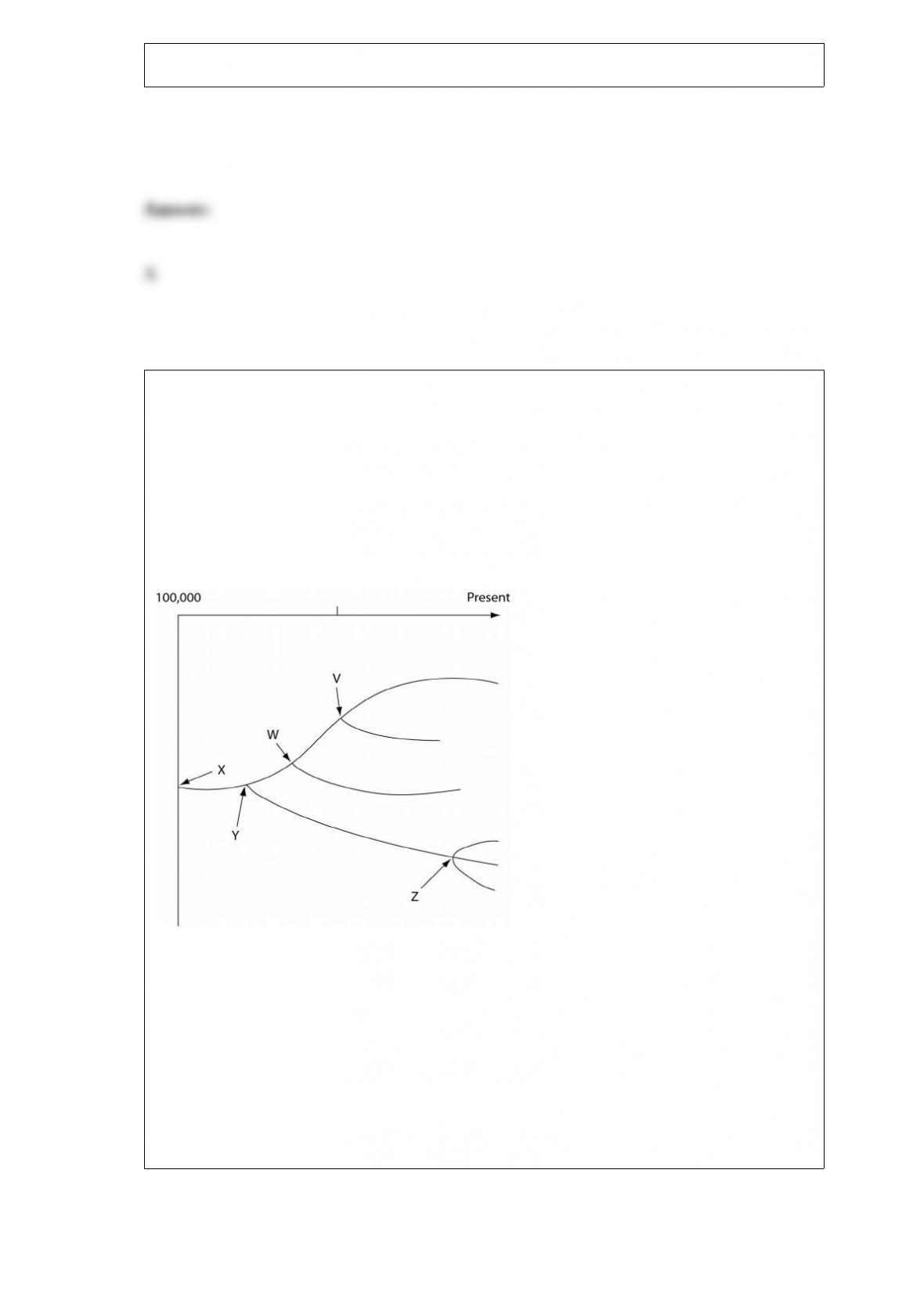
The following questions refer to the evolutionary tree in the figure below.
The horizontal axis of the cladogram depicted below is a timeline that extends from
100,000 years ago to the present; the vertical axis represents nothing in particular. The
labeled branch points on the tree (V-Z) represent various common ancestors. Let’s say
that only since 50,000 years ago has there been enough variation between the lineages
depicted here to separate them into distinct species, and only the tips of the lineages on
this tree represent distinct species.
How many distinct species, both living and extinct, are depicted in this tree?
A) five
B) six
C) nine
D) eleven

Humans have twenty-three pairs of chromosomes and chimps have twenty-four pairs of
chromosomes. What is the most likely explanation for these differences in human and
chimp genomes?
A) The common ancestor of humans and chimps had twenty-four pairs of
chromosomes. After the two groups evolved, two human chromosomes fused end to
end
B) In the evolution of chimps, new adaptations resulted from additional chromosomal
material.
C) At some point in evolution, human and chimp ancestors reproduced with each other.
D) Errors in mitosis resulted in an additional pair of chromosomes in chimps.
Living diatoms contain brownish plastids. If global warming causes blooms of diatoms
in the surface waters of Earth’s oceans, how might this be harmful to the animals that
build coral reefs?
A) The coral animals, which capture planktonic organisms, may be outcompeted by the
diatoms.
B) The coral animals’ endosymbiotic dinoflagellates may get ‘shaded out” by the
diatoms.
C) The coral animals may die from overeating the plentiful diatoms with their cases of
silica.
D) The diatoms’ photosynthetic output may over-oxygenate the water.

The type of muscle tissue surrounding the intestines and blood vessels is _____.
A) skeletal muscle
B) cardiac muscle
C) intercalated cells
D) smooth muscle
Biological systems use free energy based on empirical data that all organisms require a
constant energy input. The first law of thermodynamics states that energy can be neither
created nor destroyed. For living organisms, which of the following statements is an
important consequence of this first law?
A) The energy content of an organism is constant except for when its cells are dividing.
B) The organism must ultimately obtain all the necessary energy for life from its
environment.
C) The entropy of an organism decreases with time as the organism grows in
complexity.
D) Organisms are unable to transform energy from the different states in which it can
exist.

Tubal ligation _____.
A) reduces the incidence of ovulation
B) prevents fertilization by preventing sperm from entering the uterus
C) prevents sperm from exiting the male urethra
D) prevents oocytes from entering the uterus
In the pressure-flow mechanism, loading of sucrose from companion cells to sieve-tube
elements takes place through _____.
A) plasmodesmata
B) facilitated diffusion
C) sucrose-H+ symporters
D) sucrose-H+ antiporters

With which of the following statements would a biologist be most inclined to agree?
A) Humans and other apes represent divergent lines of evolution from a common
ancestor.
B) Humans represent the pinnacle of evolution and have escaped from being affected
by natural selection.
C) Humans evolved from chimpanzees.
D) Humans and other apes are the result of disruptive selection in a species of
chimpanzee.
Use the following information to answer the question(s) below.
Rose-picker’s disease is caused by the yeast Sporothrix schenkii (S. schenkii). The yeast
grows on the exteriors of rose-bush thorns. If a human gets pricked by such a thorn, the
yeasts can be introduced under the skin. The yeasts then assume a hyphal morphology
and grow along the interiors of lymphatic vessels until they reach a lymph node. This
often results in the accumulation of pus in the lymph node, which subsequently
ulcerates through the skin surface and then drains.
If haustoria from the fungal partner were to appear within the photosynthetic partner of
a lichen, and if the growth rate of the photosynthetic partner consequently slowed
substantially, then this would support the claim that _____.
A) algae and cyanobacteria are autotrophic
B) lichens are not purely mutualistic relationships
C) algae require maximal contact with the fungal partner in order to grow at optimal
rates
D) soredia are asexual reproductive structures combining both the fungal and
photosynthetic partners