
Which group is most closely related to fungi?
a. radiolarians
b. stramenopiles
c. alveolates
d. choanoflagellates
e. oomycotes
Respond to the following statements with reference to the five biomes listed below.
a. tundra
b. grassland
c. desert
d. taiga
e. savanna
Variable daily temperatures and plants that are highly resistant to desiccation
characterize this biome.

Respond to the following statements with reference to the five plant micronutrients
listed below.
a.iron
b.boron
c.manganese
d.zinc
e.copper
Deficiency of this nutrient results in chlorosis and yellow, green striping in leaves of
grasses.
Promoters
Choose the best matching element.
a. deciphered the mRNA code words
b. RNA-directed synthesis of polypeptide chains
c. sites at which RNA polymerases can bind and initiate transcription
d. binds to small subunit platform of a ribosome
e. guided and catalyzed by RNA polymerases
f. polypeptide chain elongation proceeds independently at each body in this cluster
g. discovered transposons
h. a tRNA triplet opposite a codon
i. a set of three nucleotides

2pq
Choose the most appropriate letter for each.
a. a reference point that implies stability of gene frequencies through generations
b. encompasses all of those actually or potentially interbreeding populations that are
reproductively isolated from other such groups
c. the genes of an entire population
d. the frequency of homozygous dominants in a population
e. the frequencies of dominant and recessive alleles in a population
f. the frequency of heterozygotes in a population
g. the frequency of homozygous recessives in a population
h. heterozygote advantage in regions where malaria is found
i. pesticide-resistant pests
Which of the following is a correct description of a prokaryote shape?
a. A coccus is corkscrew shaped.
b. An archaean is arch shaped.
c. A bacillus is rod shaped.

d. A spirillum is shperical.
e. All of these are correct.
species
Choose the most appropriate letter for each.
a. a reference point that implies stability of gene frequencies through generations
b. encompasses all of those actually or potentially interbreeding populations that are
reproductively isolated from other such groups
c. the genes of an entire population
d. the frequency of homozygous dominants in a population
e. the frequencies of dominant and recessive alleles in a population
f. the frequency of heterozygotes in a population
g. the frequency of homozygous recessives in a population
h. heterozygote advantage in regions where malaria is found
i. pesticide-resistant pests

For Mendel’s explanation of inheritance to be correct,
a. the genes for the traits he studied have to be located on the same chromosome.
b. the combination of gametes at fertilization has to be due to chance.
c. genes cannot be transmitted independently of each other.
d. only diploid organisms demonstrate inheritance patterns.
e. none of these apply.
Most of the oxygen in the blood is transported by
a. plasma.
b. megakaryocytes.
c. platelets.
d. hemoglobin.
e. leukocytes.
Which of the following gives rise to the embryo during human development?
a. trophoblast

b. amnion
c. inner cell mass
d. chorion
e. placenta
The number of DNA molecules in a duplicated chromosome is
a. one.
b. undetermined.
c. half that of an unduplicated chromosome.
d. two.
e. four.
A linear stretch of DNA that specifies the sequence of amino acids in a polypeptide is
called a(n)
a. codon.
b. intron.

c. messenger.
d. gene.
e. enzyme.
In plants, which of the following cells is(are) diploid?
a. egg
b. sperm
c. spore
d. leaf cell
e. spore and leaf cell
Miescher
Choose the one most appropriate answer for each.
a. discovered that the hereditary system of one strain of bacteria could be transformed
by the hereditary system from another strain of bacteria
b. first to discover DNA and isolate it from fish sperm

c. discovered that DNA-digesting enzymes prevented bacterial transformation
d. the first to build an accurate model of DNA and to describe it explicitly in a
publication
e. the first to demonstrate, through the use of radioactive isotopes, that DNA, not
protein, is the genetic material
f. provided two important clues to the structure of DNA; one clue is that A = T and the
other is that C = G
g. discovered the structure of collagen
h. obtained excellent X-ray diffraction photographs that suggested that DNA was a
long, thin molecule with regularly repeating units
The unique feature of HeLa cells that make them important for research is that
a. they are identical to all other human cells.
b. they are immortal cells and will grow in culture.
c. they are limited in growth cycles.
d. they are like stem cells.
e. all of these make them important.
Answer the following questions using the five groups listed below:
a. halophiles
b. cyanobacteria
c. thermophiles
d. proteobacteria
e. methanogens
These bacteria live in temperatures that are not usually conducive to life.
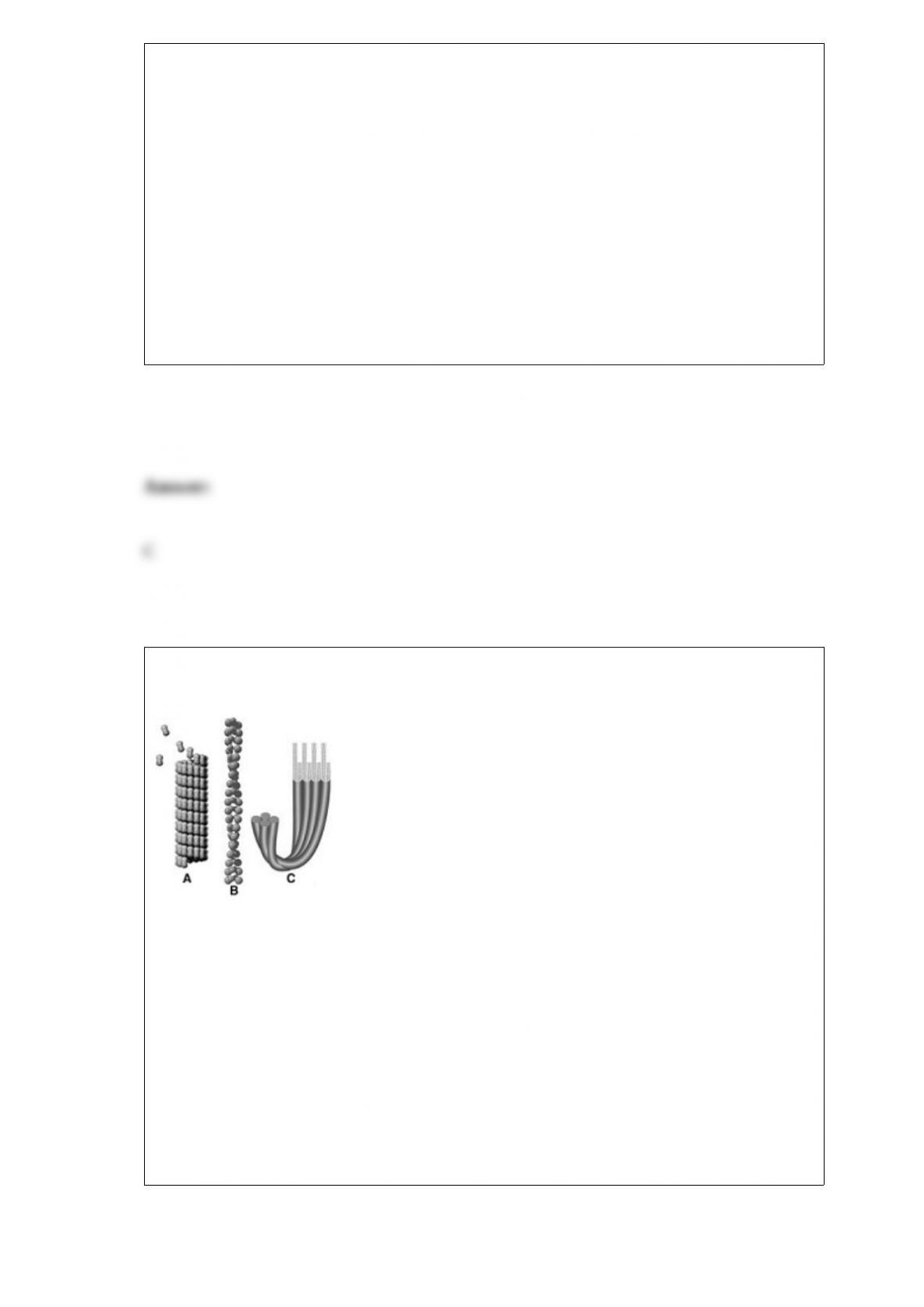
Which of the following is true of the structure labeled “B”?
a. It is composed of tubulin subunits.
b. It is composed of actin subunits.
c. It is a microtubule.
d. It is an intermediate filament.
e. It is found in cells that give rise to nails and hair.
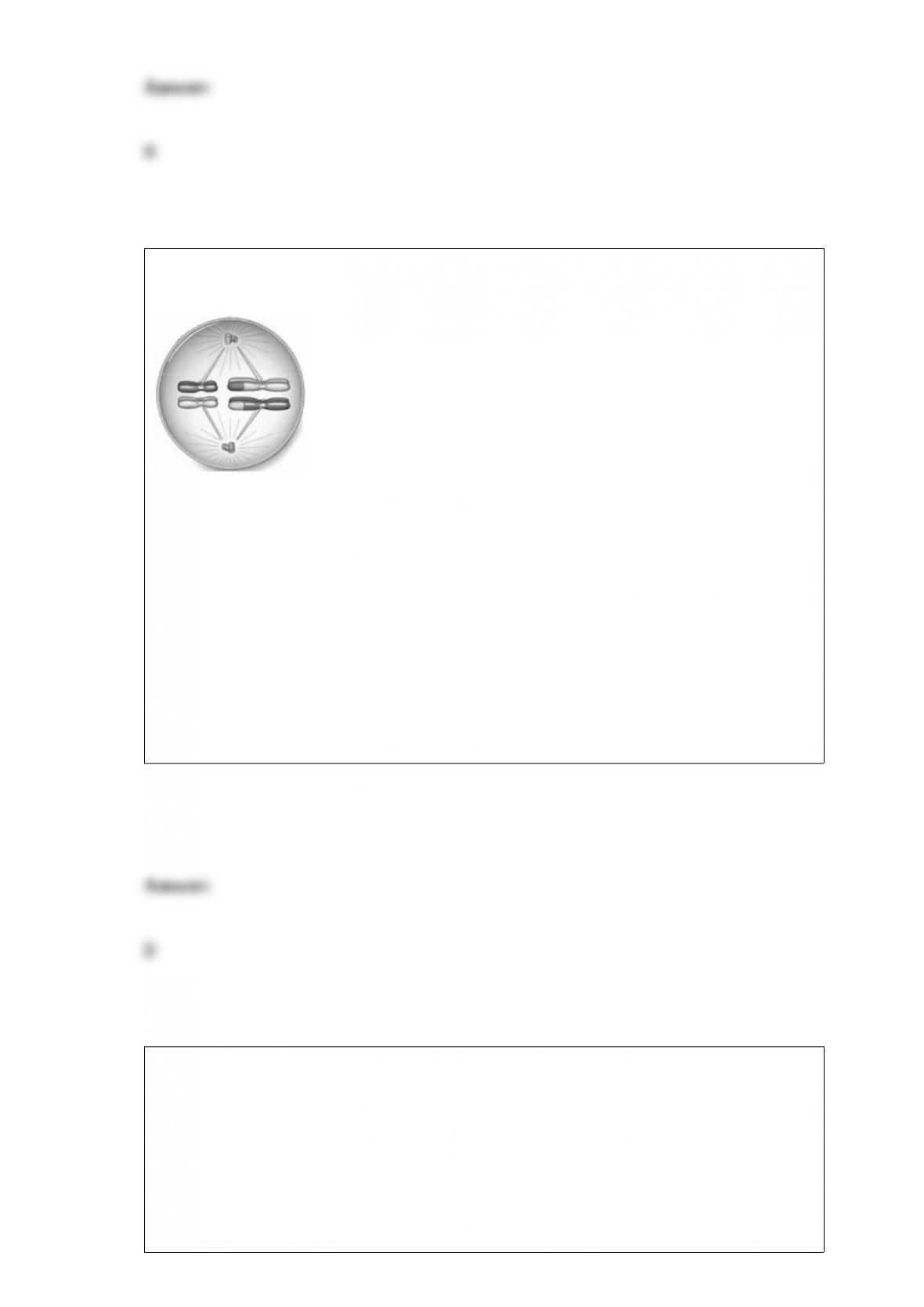
During meiosis II,
a. cytokinesis results in the formation of a total of two cells.
b. sister chromatids of each chromosome are separated from each other.
c. homologous chromosomes pair.
d. homologous chromosomes separate.
e. sister chromatids exchange parts.
Lorenz
Choose the one most appropriate response for each. Some letters may not be used.
a. studied nest decorating behavior in birds
b. imprinting in goslings

c. capacity of an animal to complete complex, stereotyped responses to first-time
encounters with key stimuli
d. problem solving without trial-and-error
e. behavior is modified by experience
f. voluntary behavior is modified in response to consequences of that behavior
g. communal display ground
h. occurs during a sensitive period in which a following response or social attachment
becomes fixed on a particular moving object
i. self-sacrificing behavior
Respond to the following statements in reference to the four kinds of reception listed
below that are used by social animals.
a. tactile
b. auditory
c. visual
d. chemical
The alarm signal one snail sends to another is most likely to be this.

Match the following descriptions with the most appropriate group listed below.
a. Bacteria
b. Protista
c. Plantae
d. Fungi
e. Animalia
based on fossils, oldest, still living organisms
In the human systemic circuit, blood passes through all EXCEPT which of the
following?
a. liver
b. limbs
c. lungs
d. digestive organs
e. brain

Would a calcium deficiency be more likely to cause excess water loss or a carbon
dioxide shortage for a plant (hint: think of the stoma)?
Respond to the following statements in reference to the five regions of the vertebrate
brain listed below.
a. cerebrum
b. hypothalamus
c. pons
d. cerebellum
e. medulla oblongata
This region connects to parasympathetic neurons that innervate the heart and lungs.
Annual
Choose the one most appropriate answer for each. Some letters may not be used.
a. flower each successive year or after several years of vegetative growth

b. promotes cell elongation in stems
c. has receptor sites for a particular hormonal message
d. a hollow, cylindrical organ that protects young leaves growing within it
e. blue-green pigment that absorbs light energy
f. low-temperature stimulation of flowering
g. stimulates stomata closure and might be involved in root geotropism
h. stimulates fruit ripening
i. reproduces in spring
j. produces only roots, stems, and leaves the first growing season and produces flowers
the second year
k. occurring on a 24-hour cycle
l. flowers in autumn
m. a nonhormonal plant growth regulator
n. lives for only one growing season
o. promotes stem elongation in plants
p. pigment involved in flowering process
Select the best choice for the following statements in reference to the four groups of
protists listed below.
a. stramenopiles
b. amoebozoans

c. alveolates
d. parabasalids and diplomonads
The malarial parasite Plasmodium is a member of this group.
Which of the following is NOT a fungal disease?
a. Ergotism
b. Ringworm
c. Athlete’s foot
d. Vaginal yeast infection
e. Tuberculosis
Which of the following is(are) false regarding B cells with antigen-MHC complexes?
a. They are stimulated by helper T cells to secrete cytokines.
b. Helper T cells signal them to divide and differentiate.
c. On signals from the helper T cells, they produce clones with identical receptors.
d. Once activated by signals from helper T cells, they produce IgG, IgA, or IgE

immunoglobulins instead of membrane-bound IgM.
e. All of these are true.
The seed develops from the
a. gametophyte.
b. ovary.
c. ovule.
d. pollen grain.
e. zygote.
Probes for cloned genes use
a. complementary nucleotide sequences tagged with a detectable label.
b. specific antibodies that kill all the cells except those that have incorporated the genes.
c. specific enzymes that lyse all the cells except those that have incorporated the genes.
d. certain bacteria that glow when they take up the genes.
e. all of these.