
The relationship between spinal nerves and the spinal cord is most like the relationship
between
A) the hairs on a person’s head.
B) the vertical and horizontal threads woven together to form a piece of cloth.
C) an interstate highway and the many roads that intersect with it via on- and off-ramps.
D) a bowl of spaghetti and the sauce that is poured onto it.
Golden Rice is golden in color because it is rich in
A) vitamin A.
B) vitamin C.
C) beta-carotene.
D) chromium picolinate.
To view the path of blood flow through the heart and body, scientists and physicians
perform an angiogram by injecting a dye into the blood and monitoring its movement.
Imagine that this dye was injected into the pulmonary vein. Which of the following is
the correct order of structures that the dye will flow through?
A) lungs, pulmonary artery, left atrium, left ventricle

B) left atrium, left ventricle, aorta, body arteries
C) right atrium, right ventricle, aorta, body arteries
D) lungs, pulmonary artery, right atrium, right ventricle
What is the difference between a tissue and an organ system?
A) The tissue level of organization is more inclusive than the organ system level.
B) Tissues are not composed of cells; organ systems are composed of cells.
C) A tissue cannot exist unless it is a component of an organ system, whereas an organ
system can exist independently of tissues.
D) An organ system includes tissues.
All humans alive today have inherited their mitochondrial DNA from some individual
female common ancestor. Studies indicate this woman probably lived about ________
years ago, when fossil evidence indicates that Homo sapiens was restricted to
________.
A) 20,000; Africa
B) 50,000; Africa and Asia

C) 180,000; Africa
D) 500,000; Africa, Asia, and Europe
The cloning of Dolly the sheep
A) demonstrated that the nuclei from differentiated mammalian cells can retain their
full genetic potential.
B) demonstrated that differentiated cells contain only a fraction of their full genetic
potential.
C) demonstrated, for the first time, that eggs are haploid and body cells are diploid.
D) revealed that cloned mammals most resemble the egg donor.
Plasma proteins are involved in all of the following activities except
A) fighting infection.
B) maintaining osmotic balance.
C) carrying oxygen.
D) blood clotting.

If current trends in global warming continue for the next 50 years, where will the
greatest effects of global warming likely be felt?
A) the continental United States
B) the Pacific Ocean
C) the Mississippi River
D) Russia
Human saliva performs all of the following functions except
A) neutralizing food acids.
B) controlling bacterial populations.
C) hydrolyzing starch.
D) hydrolyzing proteins.

The processes of photosynthesis and cellular respiration are complementary. During
these energy conversions, some energy is
A) lost in the form of heat.
B) used to create light.
C) destroyed when the chemical bonds of glucose are made.
D) saved in the chemical bonds of water, CO2 and O2.
A redox reaction involves the transfer of
A) oxygen.
B) water.
C) an electron.
D) carbon dioxide.
The tortoiseshell pattern on a cat
A) usually occurs in males.
B) is the result of a homozygous recessive condition.

C) results from X chromosome inactivation.
D) is a result of alleles on the Y chromosome.
Nutrients absorbed by the intestines move directly to the liver, which
A) converts the nutrients into monomers.
B) converts excess glucose to glycogen.
C) manages the amount of glucose that is converted to amylase.
D) converts glucose to alcohol.
The teeth of grain-eating animals (such as horses) are usually broad and ridged. This
makes the teeth suitable for grinding and chewing. Meat-eating animals (such as lions)
have pointed teeth that are good for puncturing and ripping flesh. This illustrates
A) a result of natural selection only.
B) the connection between form and function only.
C) a food web.
D) a result of natural selection as well as the connection between form and function.

After DNA fragments with matching sticky ends are temporarily joined by
complementary base pairing, the union can be made permanent by the “pasting”
enzyme
A) DNA ligase.
B) DNA polymerase.
C) DNA helicase.
D) ATP methylase.
Similar to vertebrates, some invertebrate species such as earthworms and some
crustaceans have a layer of insulation used for increasing the speed of electrical impulse
transmission. This commonly shared physical feature is called the
A) basal ganglia and hippocampus.
B) cerebellum and cerebrum.
C) thalamus and hypothalamus.
D) medulla oblongata and pons.
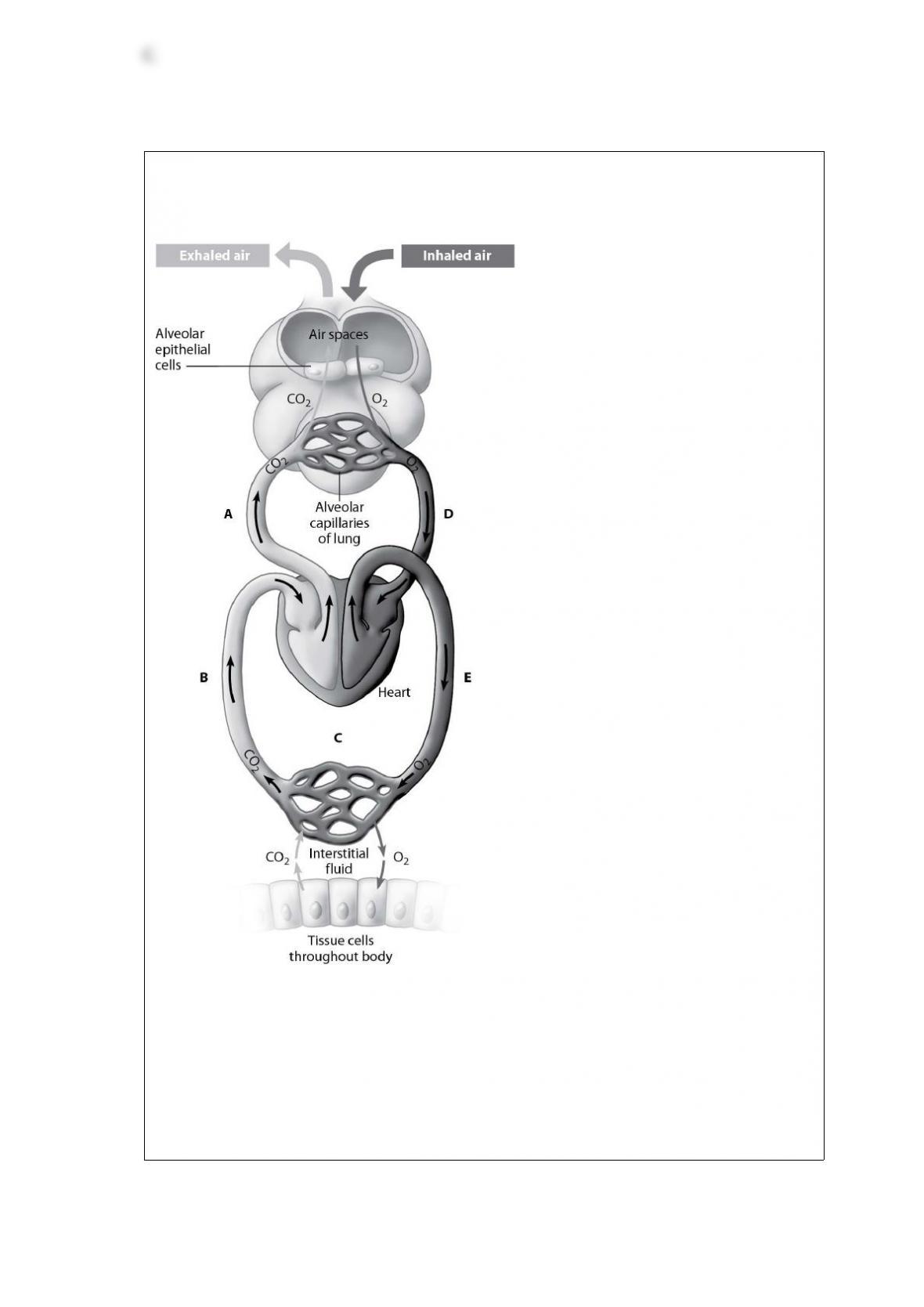
At which point(s) in the figure is blood oxygen-rich?
A) points A and B
B) points A and D
C) point C only
D) points D and E

Which of the following processes is endergonic?
A) the burning of wood
B) the synthesis of glucose from carbon dioxide and water
C) the breakdown of glucose
D) cellular respiration
Which of the following is part of the light reaction?
A) carbon fixation
B) reduction of carbon
C) regeneration of NADP+
D) formation of waste products in the form of O2

The human cerebral cortex accounts for what percentage of the total mass of the brain?
A) 20%
B) 40%
C) 60%
D) 80%
Which of the following statements about treatment or prevention of a prion infection is
true?
A) Antibiotic therapies such as penicillin are very effective cures.
B) High doses of anti-inflammatory drugs such as ibuprofen reduce the symptoms of
prion infections.
C) Preventative vaccines have recently been shown to be effective in preventing prion
infections.
D) There is no known treatment or cure for prion infections.
The human egg is swept through the oviduct toward the uterus by
A) the beating of the egg’s cilia.

B) rhythmic contractions of the oviduct.
C) rhythmic contractions of the uterus.
D) the beating of cilia in the oviduct.
Mosses belong to the group of plants known as the
A) angiosperms.
B) gymnosperms.
C) bryophytes.
D) vascular plants.
The Yellowstone to Yukon Conservation Initiative is a plan to
A) connect all of the national parks in the western United States.
B) connect all of the national parks in the United States.
C) connect parks in the United States and Canada with protected corridors where
wildlife can travel safely.
D) create a giant, fenced private land area between the national parks in the United
States to create a protected zone for wildlife.

Gangrene, hallucinations, temporary insanity, and even death can result when humans
consume grain infested with
A) corn smut.
B) chytrids.
C) coccidioidomycosis.
D) ergots.
According to recent genetic research, the complexity of an organism
A) is directly correlated with the number of protein-coding genes in its genome.
B) is inversely related to the number of protein-coding genes in its genome.
C) has more to do with how genes are used than with which genes are present.
D) is not related to genes or development, so it must have another source.

The transfer of a phosphate group to a molecule or compound is called
A) carboxylation.
B) ionization.
C) phosphorylation.
D) hydrogenation.
Two species that occasionally mate and produce zygotes, but that have incompatible
genes that prevent the resulting embryo from developing, are affected by
A) gametic isolation.
B) reduced hybrid fertility.
C) reduced hybrid viability.
D) hybrid breakdown.
Using a stethoscope, you listen to a beating heart and hear “lub-dup, lub-dup.” These
sounds are created by
A) muscles in the left ventricle.

B) blood flowing through the aorta.
C) blood pressure differentials from chamber to chamber.
D) blood recoiling against the closed valves.
As the climate warms, organisms will shift their population ranges to different areas
that are cooler. However, as humans continue to fragment large tracts of land, species
will face increasing challenges in adapting their ranges to new climates. For example,
movement corridors may not be able to be built if the amount of land needed for a
species’ range is fragmented due to cities and roads. One alternative to creating
movement corridors is called managed relocation. This requires physically moving
species to cooler climates.
Which of the following is a disadvantage of using managed relocation?
A) Many vehicles will be needed to transport the species, so CO2 emissions from the
vehicles will cause an increase in global greenhouse gas levels.
B) Governments will face long-term high fuel costs for the many vehicles that will be
needed to move the species.
C) Scientists may move the species to ranges where they will become invasive.
D) Local economies will see an increase in jobs as many individuals will need to be
hired to help move the species.

Which of the following statements about hydrostatic skeletons is true?
A) Hydrostatic skeletons are nonflexible.
B) Hydrostatic skeletons provide little support for muscle action.
C) Hydrostatic skeletons produce rigid animals that maintain one shape.
D) Hydrostatic skeletons can protect internal organs.
Which of the following statements about animal cell lipids is false?
A) Fats are a form of lipid that function to store energy.
B) Phospholipids are important components of cell membranes.
C) Many lipids function as enzymes.
D) Cholesterol is a type of lipid that is a component of cell membranes and steroid
hormones.