
Trisomy 21, or Down syndrome, occurs when there is a normal diploid chromosomal
complement but one (extra) chromosome 21. Although fertility is reduced in both sexes,
females have higher fertility rates than males. Van Dyke et al. (1995; Down Syndrome
Research and Practice 3(2): 65-69) summarize data involving children born of Down
syndrome individuals. Assume that children are born to a female with Down syndrome
and a normal 46-chromosome male. What proportion of the offspring would be
expected to have Down syndrome?
A) One-third of the offspring would be expected to have Down syndrome.
B) Two-thirds of the offspring would be expected to have Down syndrome.
C) All the children would be expected to have Down syndrome.
D) None of the offspring would be expected to have Down syndrome.
E) One-half of the offspring would be expected to have Down syndrome.
Comb shape in chickens represents one of the classic examples of gene interaction. Two
gene pairs interact to influence the shape of the comb. The genes for rose comb (R) and
pea comb (P) together produce walnut comb. The fully homozygous recessive condition
(rrpp) produces the single comb. Assume that a rose-comb chicken is crossed with a
walnut-comb chicken and the following offspring are produced: 17 walnut, 16 rose, 7
pea, 6 single.
a) What are the probable genotypes of the parents?
b) Give the genotypes of each of the offspring classes.
Describe each of the following parameters that relate to the structure and function of
tRNA:
(a) four functional domains
(b) Wobble hypothesis
To which of the following does the term heteroplasmy refer?
A) cells with a variable mixture of normal and abnormal organelles
B) heterozygous individuals with more than one gene pair involved
C) conditions in which the germ plasm is a mixture of dominant and recessive genes
D) a circumstance that is homologous to incomplete dominance
E) various stages of development of mitochondria and chloroplasts
What relatively recent scientific advancement has made mapping by linkage or classical
genetic mapping approaches virtually obsolete?
A) the genome sequence of a species

B) the inclusion of the X and Y chromosome in SNP experiments
C) the use of synteny
D) positive interference
E) negative interference
Recent research using gene expression profiles indicates that schizophrenia and autism
spectrum disorders are ________.
A) like opposite sides of the same coin
B) identical at the molecular level
C) completely unrelated
D) likely to be caused by the same dominant gene
E) likely to be caused by the same recessive gene
The phenomenon in which one crossover decreases the likelihood of crossovers in
nearby regions is called
A) chiasma.

B) negative interference.
C) reciprocal genetic exchange.
D) positive interference.
E) mitotic recombination.
Side groups of amino acids are typically classified under which of the following?
A) polar, nonpolar
B) linear, circular
C) alpha, omega
D) long, short
E) primary, secondary
Albinism is an autosomal recessive trait in humans. Assume that there are 100 albinos
(aa) in a population of 1 million. How many individuals would be expected to be
homozygous normal (AA) under equilibrium conditions?
A) 100
B) 10,000

C) 19,800
D) 980,100
E) 999,900
What is the name of the protein that combines with cyclins to exert local control of the
cell cycle?
A) cyclin-dependent kinase
B) phosphatase
C) ATPase
D) integrase
E) hexokinase
RFLPs are commonly used in recombinant DNA technology to ________.
A) cleave DNA of interest
B) generate pharmaceutical products of interest
C) serve as recombinant DNA vectors

D) map genes and construct DNA fingerprints
E) substitute for oligonucleotides
Which general genetic process is believed to account for the variety of cellular
structures and functions in eukaryotic cells?
A) variable gene activity
B) negative control exclusively
C) maternal environmental activities
D) intron processing
E) RNA processing
One of the oldest recorded behavior mutants is the waltzer mutation in the mouse.
Mutant mice can be observed “dancing” and “head shaking”; some are also deaf. Mice
must be homozygous for a mutation to express the trait. Based on this information, the
genetic cause of this trait is most likely a(n) ________.
A) simple recessive pattern of inheritance
B) multifactor, polygenic pattern of inheritance

C) dominant/recessive pattern typical of other behavioral traits
D) epistatic pattern with incomplete dominance
E) variable gene activity pattern with overdominance causing deafness
What is the outcome of synapsis, a significant event in meiosis?
A) side-by-side alignment of nonhomologous chromosomes
B) dyad formation
C) monad movement to opposite poles
D) side-by-side alignment of homologous chromosomes
E) chiasma segregation
Assume that investigators crossed a strain of flies carrying the dominant eye mutation
Lobe on the second chromosome with a strain homozygous for the second chromosome
recessive mutations smooth abdomen and straw body. The F1 Lobe females were then
backcrossed with homozygous smooth abdomen, straw body males, and the following
phenotypes were observed:
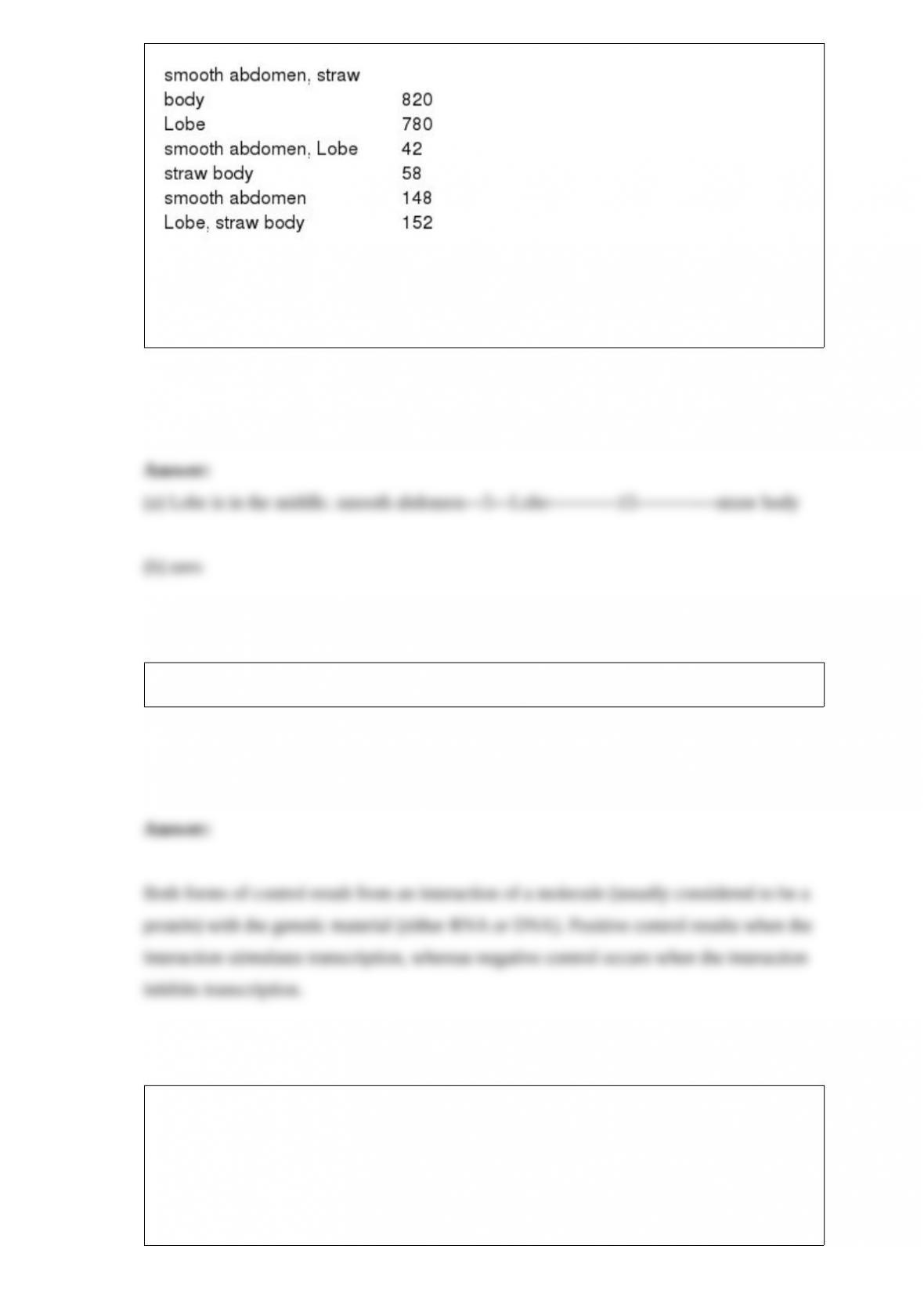
a) Give the gene order and map units between these three loci.
b) What is the coefficient of coincidence?
Compare and contrast positive and negative control of gene expression in bacteria.
Which process seems to be the most similar between eukaryotic and prokaryotic genetic
regulation?
A) transcriptional regulation
B) RNA splicing regulation

C) intron/exon shuffling
D) 5″-capping regulation
E) poly(A) tail addition
(a) Describe by labeled diagram the structural components of thelac operon in E. coli.
(b) State the function of the lac regulator gene.
(c) State the function of β-galactosidase in the lac system.
(d) Show by diagram the manner in which lactose brings about transcription of the three
structural genes of the lac operon.
(e) Explain why certain mutations in the regulator gene (I) of the lac system result in
maximal synthesis of β-galactosidase, permease, and transacetylase even in the absence
of the inducer (lactose).
Conditional mutations are more likely to result from a mutation caused by which of the
following alterations to the coding region of a gene?
A) four bases added within a short region of a gene
B) base addition
C) X-rays
D) deletion
E) tautomeric shift
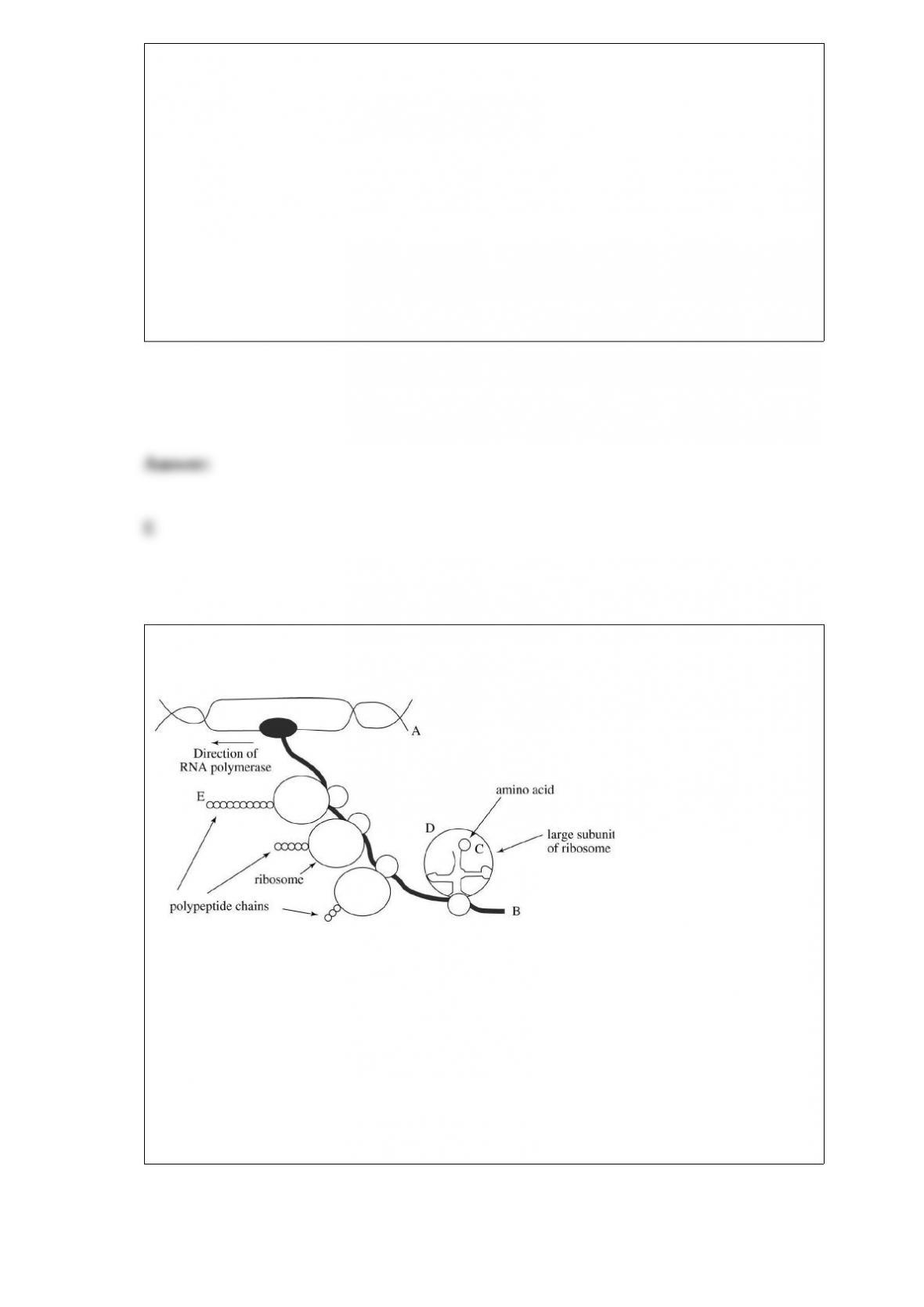
The accompanying drawing represents simultaneous transcription and translation in E.
coli. The direction of the RNA polymerase is given by the arrow.
(a) Is the letter A nearer the 5″ or the 3″ end of the molecule?
(b) Is the letter B nearer the 5″ or the 3″‘ end of the molecule?
(c) Is the letter C nearer the 5″ or the 3″‘ end of the tRNA molecule?
(d) What is the “S” value for the large rRNA that is closest to the letter D?
(e) Which terminus (N or C) of the growing polypeptide chain is nearer to the letter E?

Assume that a plasmid (circular) is 3200 base pairs in length and has restriction sites at
the following locations: 400, 700, 1400, 2600. Give the expected sizes of the restriction
fragments following complete digestion.
A) 400, 800, 1000 (2 of these)
B) 400, 1200, 1600
C) 300, 700, 2200
D) 700, 400, 1400, 2600
E) 300, 700, 1000, 1200
What would be a typical phenotypic monohybrid ratio in which a lethal allele is
involved?
A) 2:1
B) 9:3:3:1
C) 6:2:3:1
D) 13:5
E) 3:1

What is the blood type of individuals who cannot add the terminal sugar to the H
substance?
A) O
B) B
C) A
D) AB
E) Bombay phenotype
Assume that you were growing cells in culture and had determined the cell-cycle time
to be 24 hours. You introduce 3H thymidine and prepare autoradiographs of metaphase
chromosomes after 48 hours. Of the chromosomes that are labeled, you expect two
classes: one class that had completed one S phase in the label, and a second class that
had completed a cellular division and an additional S phase in the label. Draw the DNA
(double-stranded) labeling pattern for each chromosome that you would expect to find
in these two types of metaphase chromosomes. (Use a broken line {- – -} for labeled
single strands of DNA and a solid line for unlabeled single strands of DNA.)
(a) metaphase chromosome having replicated once in label
(b) metaphase chromosome having gone through two S phases in label
Compared with eukaryotic chromosomes, bacterial chromosomes are ________.
A) large, mainly organized in single gene transcription units without introns
B) small, mainly organized in single gene transcription units with introns
C) large, mainly organized in polygenic transcription units without introns
D) small, with high gene density
E) large, triple-helix, Z-DNA, organized in single gene units with introns

A genomic condition that may be responsible for some forms of fragile X syndrome, as
well as Huntington disease, involves ________.
A) plasmids inserted into the FMR-1 gene
B) various lengths of trinucleotide repeats
C) multiple breakpoints fairly evenly dispersed along the X chromosome
D) multiple inversions in the X chromosome
E) single translocations in the X chromosome
List in order of occurrence the phases of (a) mitosis and (b) prophase I of meiosis.
Humans are relatively unavailable as experimental subjects in genetic investigations,
yet considerable interest surrounds intelligence, language, personality, and emotional
behaviors. One difficulty in studying such behaviors is the high likelihood that they
________.
A) are strongly influenced by birth order and diet
B) are affected by the environment

C) follow non-Mendelian patterns of inheritance
D) follow extranuclear patterns of inheritance
E) have no likely genetic influence
Who was the Augustinian monk that conducted a decade of experiments on the garden
pea, eventually showing that traits are passed from parents to offspring in predictable
ways?
A) Francis Crick
B) Alfred Wallace
C) Hippocrates
D) Aristotle
E) Gregor Mendel
Archaea (formerly known as archaebacteria) is one of the three major divisions of
living organisms; the other two are eubacteria and eukaryotes. Speculate on how an
organism such as Nanoarchaeum equitans with one of the smallest genomes known,
about 0.5 Mb, can complete its life cycle with so little genetic material?

Words such as level, civic, and kayak have something in common compared to the
fundamental tool of recombinant DNA technology. In the context of recombinant DNA
technology, which term would be used to describe such words?
A) lysogenic
B) prototrophic
C) palindromic
D) conjugation
E) insertion
Assuming a normal number of autosomes, what would be the sex of the following:
XXY mouse, XXY Drosophila?

What is the consequence of a mutation in the recA gene in bacteria?
Describe the general relationship that may exist between mutations and cancer.
Dosage compensation leads to a variety of interesting coat color patterns in certain
mammals. For instance, a female cat that is heterozygous for two coat color alleles, say
black and orange, will usually have the “calico” or mosaic phenotype. Describe the
chromosomal basis for the mosaicism (calico) in the female. Explain why
chromosomally normal male cats do not show the mosaic phenotype, but XXY male
cats can be calico.

The coefficient of coincidence reflects the frequency of observed double crossovers
compared to the frequency of expected double crossovers. What is the relationship
between the coefficient of coincidence and interference?
The Meselson and Stahl experiment provided conclusive evidence for the
semiconservative replication of DNA in E. coli. What pattern of bands would occur in a
CsCl gradient for conservative replication?
Name two of the classes of proteins that combine to directly control progression

through the cell cycle.
If interference is complete, what would be the frequency of double crossovers?
As used in twin studies in mammals, distinguish between the terms concordant and
discordant.
Which three stages or transitions in the cell cycle seem to serve as points of control
(checkpoints)?

List at least three factors that change gene frequencies in populations.
Describe the organization of the α-globin gene in humans.
Distinguish the functions of DNA and RNA in a eukaryote.

How does determination relate temporally to differentiation?
List at least three areas of research that deal with the genetics of behavior in humans.
In studies of human genetics, usually a single individual brings the condition to the
attention of a scientist or physician. When pedigrees are developed to illustrate
transmission of the trait, what term does one use to refer to this individual?
List three major structural classifications of DNA-binding domains that are found in
eukaryotic transcription factors.

Determining the genetic influence on two fairly common human behavioral disorders
has eluded researchers for many years. One involves passive deficits in thinking,
language, feelings, and social skills; the other includes a variety of psychotic symptoms,
perceptual disorders (hearing voices), and withdrawal from reality. Evidence from
pedigrees and twins indicates that these two behaviors have a genetic component.
Which behaviors are being described here?
Which two relatively recent extensions to QTL mapping center on molecular definitions
of phenotypes with quantitative traits?
The human genome sequence was reported in 2003 by two groups, the publicly funded
________ and ________.