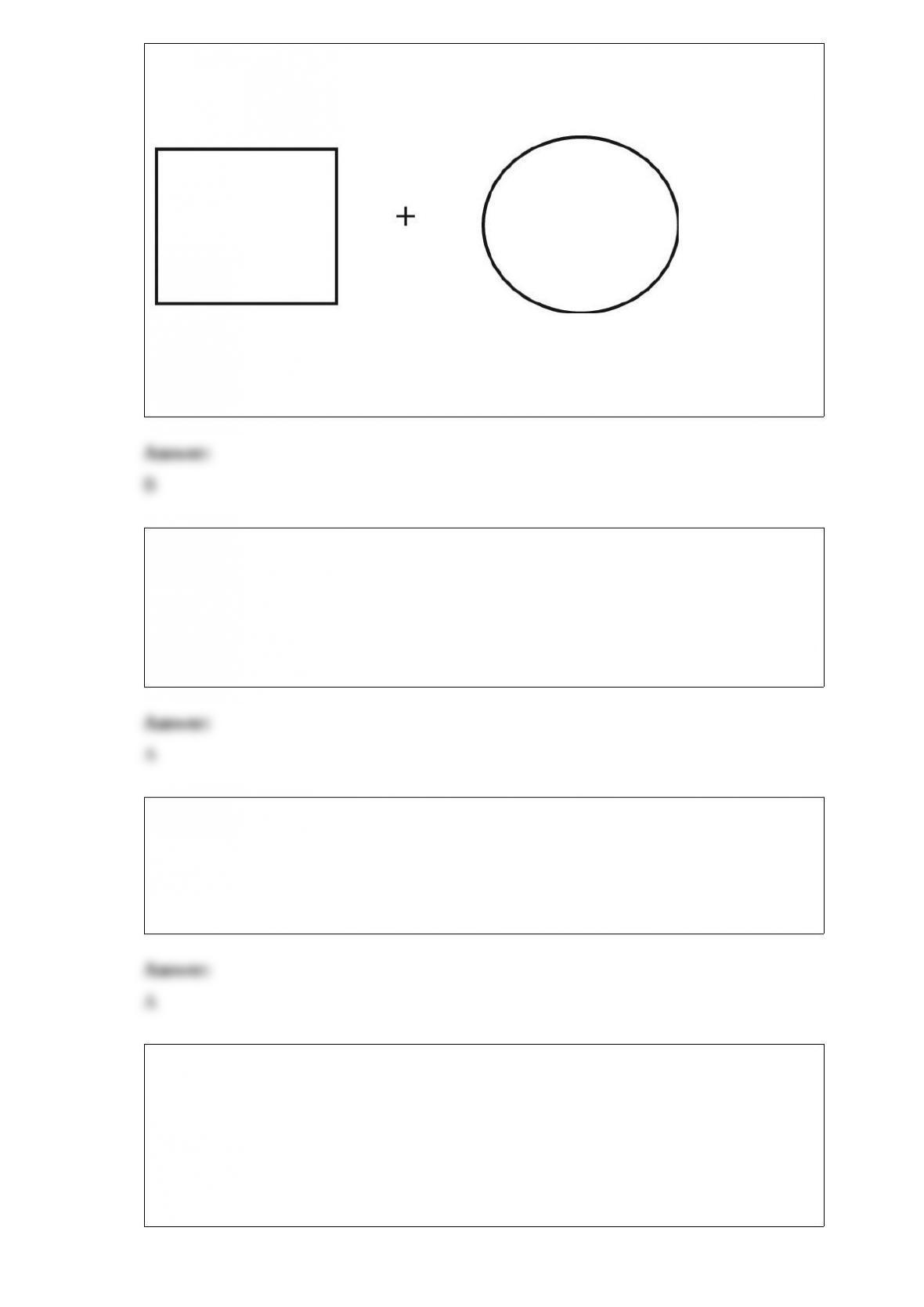
1) The following is a sample stimulus shown briefly to a split-brain patient who has the
typical pattern of language dominance. If you ask her to name the XOAect she sees,
what will her answer probably be?
a.Square.
b. Circle.
c. Square and circle.
d. Nothing.
2) Visual sensory memory is to __________ as auditory sensory memory is to
__________.
a. iconic memory ; echoic memory
b. partial report ; whole report
c. echoic memory ; iconic memory
d. whole report ; partial report
3) Prosopagnosia is to alexia as __________ is to __________.
a. face recognition ; reading
b. reading ; face recognition
c. writing ; reading
d. reading ; writing
4) The term_______refers to the collective store of information about the semantics,
syntax,
orthography, and phonology of words.
a.word form
b. acquired dyslexia
c.mental lexicon
d. prosody

5) A traumatic brain injury in which impact causes the brain to bounce against the back
of the skull and then rebound is known as a___________injury.
a.coup de foudre
b. coup de main
c.coup-contra-coup
d. coup doeil
6) A patient suffering from a progressive neurological disorder is brought to a
neurologist for diagnosis.The neurologist notes that the patients MRI reveals a great
deal of cortical atrophy and suspects that the problem may be Alzheimers disease.
Which of the following symptoms, if also discovered, would confirm this diagnosis?
a. tremors and difficulty in initiating movement
b. double vision
c. loss of dopaminergic neurons in the basal ganglia
d. presence of amyloid plaques during postmortem examination of the brain
7) A general function that is associated with right-hemisphere activity in most people is
a.language production and comprehension.
b. comprehension and memory for meaningful gestures.
c.the word superiority effect.
d. visuospatial processing.
8) __________ is to __________ as face recognition is to object recognition.
a. Agnosia ; prosopagnosia
b. Prosopagnosia ; agnosia
c. Alexia ; agnosia
d. Agnosia ; alexia
9) Tasks involving thinking about mental states often engage which region of the brain,
in comparison to thinking about social background or life events?
a.the left inferior frontal lobe
b. the left precentral gyrus
c.the right temporoparietal junction
d. the right anterior cingulate
10) Both early- and late-selection models of attention share the idea that
a. a large proportion of incoming sensory information is filtered from further analysis
before meaning is extracted.
b. information is excluded from higher-level processing only after stimuli have been
identified.
c. the human information processing system cannot fully process every piece of
information it receives.
d. semantic encoding and analysis precede selection in information processing.
11) Animal calls were thought to be purely emotional. Which of the following findings
with monkey calls does NOT contradict this view?
a.A call in presence of a snake led to monkeys looking down.
b. A call in presence of a leopard led monkeys to flee into the trees.
c.A call is seldom made when a monkey is alone.
d. Calls can be strung together in predictable orders.
12) Which brain area seems to be the most important for selectively attending to
positive self-relevant information, as opposed to negative self-relevant information?
a.the anterior cingulate cortex
b. the medial prefrontal cortex
c.the orbitofrontal cortex
d. the dorsolateral prefrontal cortex
13) During audition, sound vibrations are encoded as neural signals in the basilar
membrane of the cochlea.
14) The observation that we can understand the speech of different speakers, regardless
of variations in the pitches of the speakers voices, the speakers rates of speech, and the
speakers dialects, indicates that
a.the prosodic components of speech have little functional significance in speech
comprehension.
b. the recognition of spoken words depends on orthography rather than other aspects of
language.
c.speech comprehension involves semantic analysis of words rather than phonological
analysis of words.
d. speech recognition cannot rely on the direct matching of specific sounds to language
representations in memory.
15) What is the earliest age at which humans can typically succeed at mirror
self-recognition (MSR)?
a.from birth
b. 2 years
c.5 years
d. 10 years
16) Studies of people with autism have suggested that they do not significantly
deactivate the______when performing non-self-referential tasks. This is consistent with
the observation that many people with autism have an unusual focus
on_________rather than__________
a. medial prefrontal cortex ; the external world ; internal states
b. internal states ; the external world
c.temporoparietal junction ; their own mental states ; the mental states of others
d. temporoparietal junction ; the mental states of others ; their own mental states
17) The trolley problem and footbridge problem are ethical thought experiments
involving life-or-death situations. Which of the following is true?
a.Both situations involve sacrificing one life to save multiple other lives.
b. The death in the trolley problem has greater perceived personal involvement.
c.Most people agree that it is unacceptable to act in either dilemma.
d. Thinking about the trolley problem results in greater emotional processing.
18) Core consciousness is turned off by lesioning which intralaminar nuclei (ILN) of
the thalamus?
a.left
b. right
c.both
d. neither
19) You encounter a bear that triggers an emotional response. Which of the following
areas would not show increased dopamine in the mesolimbic pathway?
a.amygdala
b. hippocampus
c.anterior cingulate cortex
d. dorsolateral prefrontal cortex