
1) if macroevolution was goal oriented then organisms would be perfect in form and not
have any flaws.
2) only lycophytes have true roots, stems, and leaves.
3) lenticels are small openings on the underside of eudicot leaves where gaseous
exchange occurs.
4) an unhealthy diet can lead to obesity in individuals which can result in
cardiovascular disease and type 2 diabetes.
5) in muscle innervation motor nerve fibers signal muscle movement from the region
called the neuromuscular junction.
6) cystic fibrosis and niemann-pick disease are common autosomal dominant disorders.
7) glycolysis occurs before fermentation.
8) an environmental change, such as exposure to ultraviolet light, may cause a

lysogenic bacterium to enter a lytic cycle.
9) aneuploidy is a change in the number of chromosomes resulting from nondisjunction
during meiosis.
10) the principle of parsimony states that a cladogram produces the best hypothesis
about relationships of organisms when the maximum number of assumptions are
considered.
11) the reason biologists believe that green algae and land plants, both members of the
supergroup archaeplastida,are related is because both of them possess chlorophyll a & b
as well as cell walls made of starch.
12) can be unleashed by internal or external signals.
13) a reproductive isolation mechanism includes any structural, functional, or
behavioral characteristic that blocks reproductive ability.
14) a taxon is the general name for a group of organisms that exhibit a set of shared
traits.

15) the largest and oldest treesin the world that are pollinated by animalsare conifers.
16) which of the following would be an indication of kidney failure?
a. urea in the urine
b. salts in the urine
c. uric acid in the urine
d. large amount of protein in the urine
e. dilute urine
17) which of the following is not true after a man has had a vasectomy?
a. bulbourethral glands are not affected by the operation.
b. the vas deferens still transports sperm to the urethra.
c. the interstitial cells can still release hormones.
d. the semen will not contain sperm.
e. the oviduct will not be affected.
18) the grasshopper is a terrestrial animal that uses its ________ in respiration.
a. parapodia
b. tracheae
c. body surface
d. gills
e. lungs
19) how are hormone levels regulated?

a. an endocrine gland can respond to the blood level of the hormone it produces.
b. a hormone can trigger a second gland to secrete a hormone that dampens production
of the first hormone.
c. a second contrary hormone can counteract the effect of the first hormone.
d. a product can trigger hormone production; the hormone can then reduce the amount
of product which in turn reduces the level of hormone.
e. all of the choices are correct.
20) how does auxin actually cause stems to curve towards the light?
a. in the presence of blue light, auxin triggers additional photosynthesis and growth.
b. in the presence of light, auxin increases the turgor pressure of the cell and accelerates
growth.
c. in the presence of light, auxin increases the formation of hydrolytic enzymes that
release energy needed for growth purposes.
d. in the presence of light, auxin moves toward the light source and activates a protein
that binds to dna and starts enzyme production.
e. in the presence of unidirectional light, auxin moves to the shady side and activates an
atp-driven proton pump that results in weakened cell walls and eventual elongation.
21) which statement is not true about dna replication in prokaryotes?
a. replication begins at a single origin of replication.
b. replication is bidirectional from the origin(s).
c. replication occurs at about 1 million base pairs per minute.
d. since bacterial cells replicate so rapidly, a second round of replication may begin
before the first has been completed.
e. there are many bacterial chromosomes, with replication occurring in each at the same
time.
22) in deuterostomes,
a. cleavage is radial and the fate of the cells is indeterminate.
b. spiral cleavage occurs.
c. the fate of cells is fixed and determinate.
d. the mouth appears at or near the blastopore.
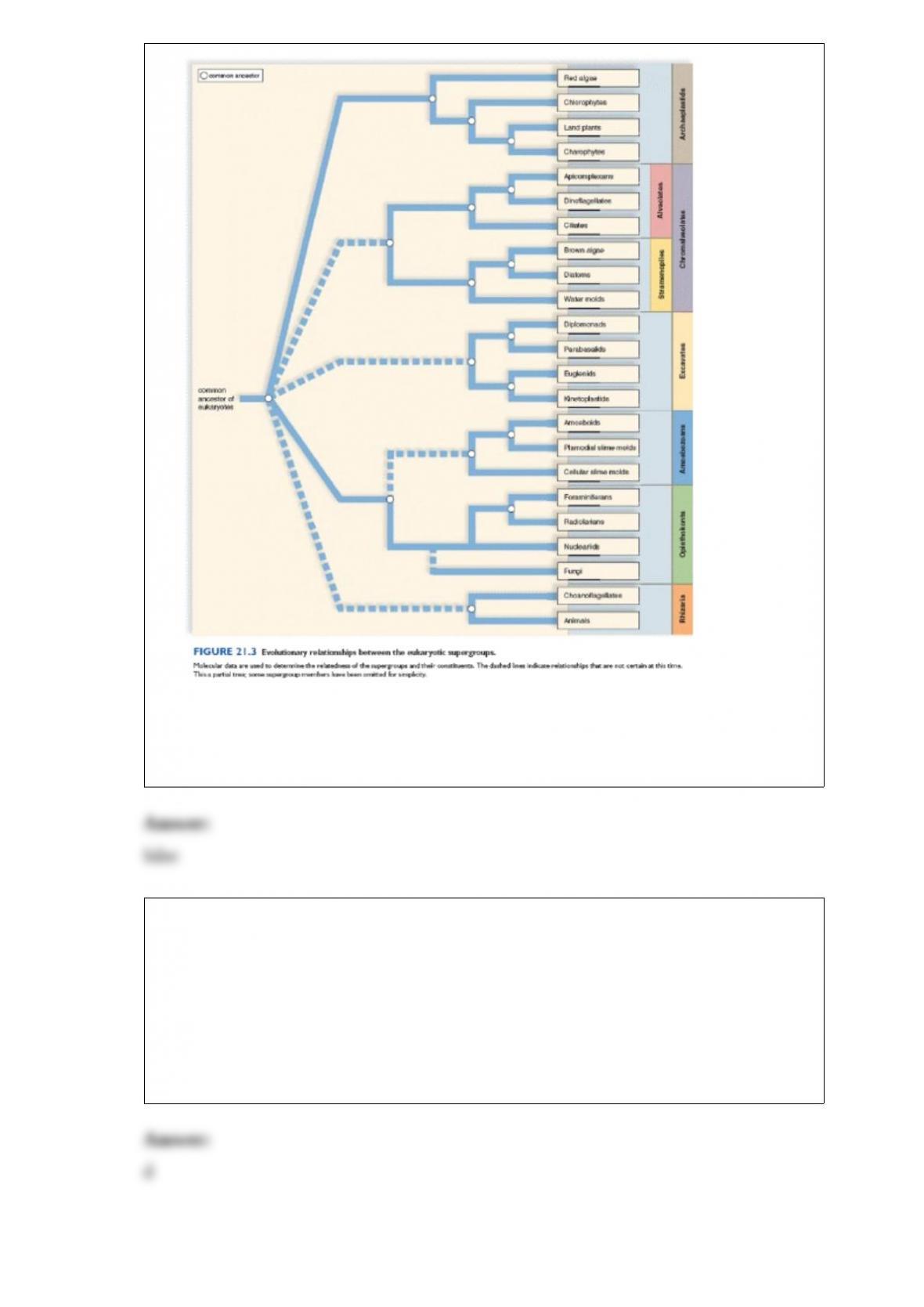
23)
the evolutionary relationships between the eukaryotic supergroups are depicted in the
diagram
diatoms share a more recent common ancestor with dinoflagellates than with water
molds.
24) which statement is not true about photoperiodism?
a. a short-day plant flowers when the day length is shorter than a critical length.
b. a day-neutral plant flowers according to some form of regulation other than
photoperiodism.
c. a long-day plant will flower when the day length is longer than a critical length.
d. the phytochrome form pfr is converted to pr in daylight, producing the active form
that induces flowering in long-day plants.
incorrect

25) which allele combination represents a recessive individual?
a. aa
b. aa
c. aa
d. none of these represent a recessive individual
26) which of the following plant defense mechanisms is used in the commercial product
asprin?
a. abscisic acid
b. auxin
c. jasmonic acid
d. salicylic acid
e. systemin