1) types of skin cancers include
a) squamous cell carcinoma.
b) malignant melanoma.
c) basal cell carcinoma.
d) actinic keratosis.
e) a, b, and c
2) the pituitary hormone that promotes ovarian secretion of progesterone and testicular
secretion of testosterone is
a) tsh.
b) acth.
c) fsh.
d) lh.
e) gh.
3) damage to the phrenic nerves would
a) increase respiratory rate.
b) increase the tidal volume.
c) force reliance on costal breathing.
d) result in greater pressure differences between the lungs and the outside air.
e) have little effect on ventilation.
4) match the term with its key characteristics.
1. lunate a) pea-shaped
2. triquetrum b) comma-shaped
3. pisiform c) pyramid-shaped
5) ________ are arranged within a lobule of the liver into a series of plates converging
toward a central vein.
a) kupffer cells
b) hepatocytes

c) bile canaliculi
d) portal areas
e) hepatic ducts
6) the space between the cornea and the iris is the
a) anterior chamber.
b) posterior chamber.
c) canal of schlemm.
d) aqueous humor.
e) pupil.
7) which organelle is most prominent in cells that make large amounts of protein?
a) nucleus
b) nucleolus
c) chromosome
d) proteasome
e) mitochondria
8) most mammals, including humans and giraffes, have ________ cervical vertebrae.
a) 11
b) 6
c) 7
d) 19
e) 10
9) the facial nerve (n. vii) passes through internal acoustic meatus and then through the
a) mastoid foramen.
b) stylomastoid foramen.
c) jugular foramen.
d) carotid foramen.
e) foramen lacerum.
10) a person who is standing facing forward with hands at the sides and palms facing
forward is in the
a) supine position.
b) prone position.
c) anatomical position.
d) frontal position.
e) sagittal position.
11) determination of blood gases includes testing an arterial sample for
a) ph.
b) po2.
c) pco2.
d) po2 and pco2 only.
e) ph, po2, and pco2.
12)
figure 17-2 the ear
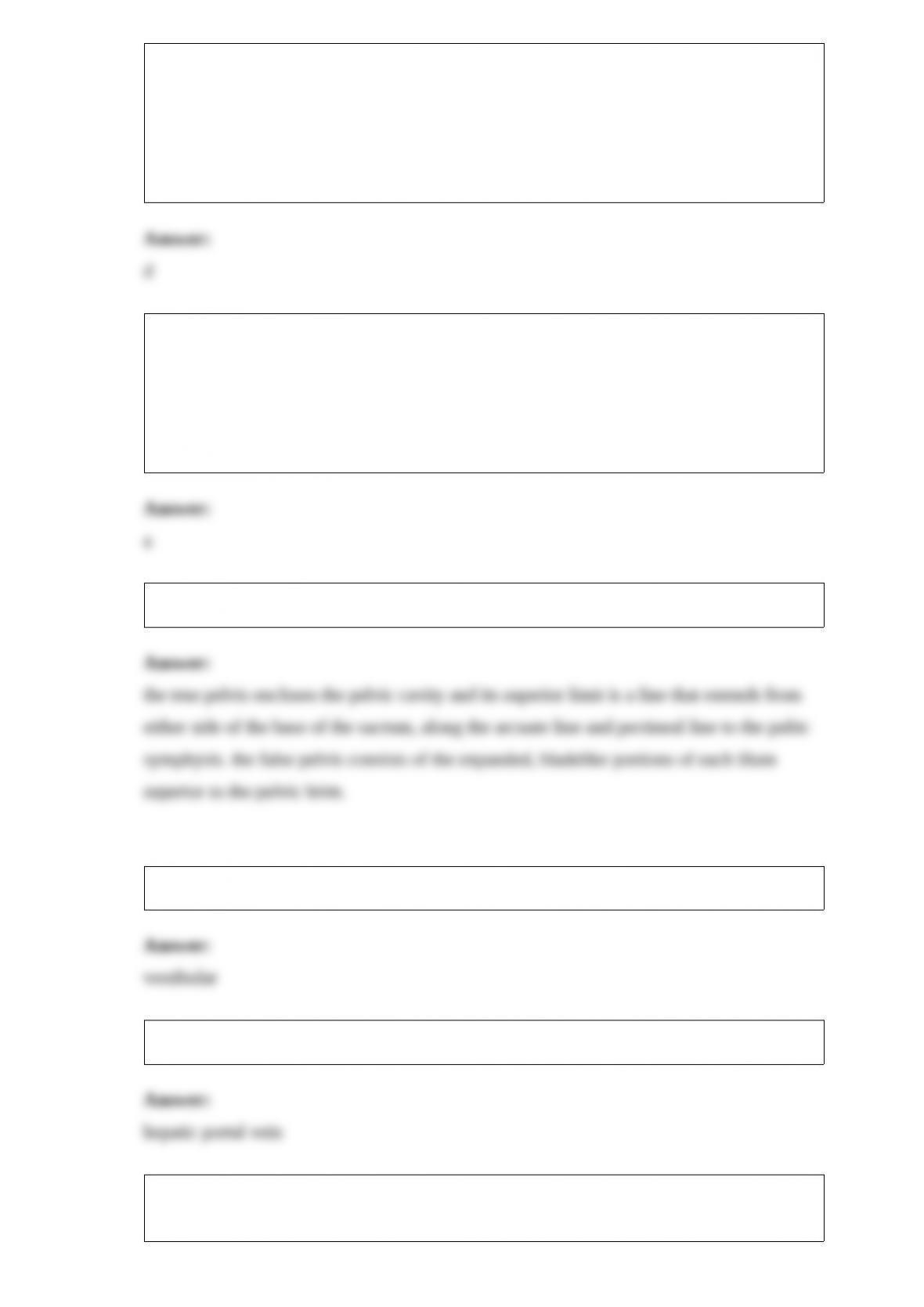
identify the structures labeled “3”
a) cochlea
b) semicircular canals
c) auricle
d) tympanic membrane
e) vestibule
13) the highest levels of information processing occur in the
a) cerebrum.
b) diencephalon.
c) cerebellum.
d) medulla oblongata.
e) corpus callosum.
14) what is the distinction between the false pelvis and the true pelvis?
15) the formal term for the sense of balance and equilibrium is the ________ sense.
16) the blood vessel that supplies venous blood to the liver is the ________.
17) a(n) ________ reflex has at least one interneuron placed between the sensory and
motor neurons.
18) as the heart rate slows, ________ gets longer.
19) describe a motor unit. how many fibers does a muscle unit contain?
20) megan wants to enter a weight-lifting competition and consults you as to what type
of muscle fibers she needs to develop and how she should go about it. what would you
suggest to her?
21) the transmembrane potential in an undisturbed cell is called its ________.
22) the portion of the urethra that passes through the prostate is called the ________.
23) a(n) ________ is an antigen with at least two antigenic determinant sites.