
We should care about loss in biodiversity in other species because of _____.
I) potential loss of medicines and other products yet undiscovered from threatened
species
II) potential loss of genes, some of which may code for proteins useful to humans
III) the risk to global ecological stability
A) only I
B) only II
C) only II and III
D) I, II, and III
Use the following information to answer the question(s) below.
For several decades now, amphibian species worldwide have been in decline. A
significant proportion of the decline seems to be due to the spread of the chytrid fungus,
Batrachochytrium dendrobatidis (Bd). Chytrid sporangia reside within the epidermal
cells of infected animals, animals that consequently show areas of sloughed skin. They
can also be lethargic, which is expressed through failure to hide and failure to flee. The
infection cycle typically takes four to five days, at the end of which zoospores are
released from sporangia into the environment. In some amphibian species, mortality
rates approach 100%; other species seem able to survive the infection.
Apart from direct amphibian-to-amphibian contact, what is the most likely means by
which the zoospores spread from one free-living amphibian to another?
A) by wind-blown spores
B) by flagella
C) by cilia
D) by hyphae

Duchenne muscular dystrophy is a serious condition caused by a recessive allele of a
gene on the human X chromosome. The patients have muscles that weaken over time
because they have absent or decreased dystrophin, a muscle protein. They rarely live
past their twenties. How likely is it for a woman to have this condition?
A) Women can never have this condition.
B) One-fourth of the daughters of an affected man would have this condition.
C) One-half of the daughters of an affected father and a carrier mother could have this
condition.
D) Only if a woman is XXX could she have this condition.
Calculation, contemplation, and cognition are human activities associated with
increased activity in the _____.
A) hypothalamus
B) cerebrum
C) cerebellum
D) spinal cord

Hydrangea plants of the same genotype are planted in a large flower garden. Some of
the plants produce blue flowers and others pink flowers. This can be best explained by
which of the following?
A) the knowledge that multiple alleles are involved
B) the allele for blue hydrangea being completely dominant
C) the alleles being codominant
D) environmental factors such as soil pH
Use the following information to answer the question(s) below.
Paulinella chromatophora is one of the few cercozoans that is autotrophic, carrying out
aerobic photosynthesis with its two elongated “chromatophores.” The chromatophores
are contained within vesicles of the host cell, and each is derived from a
cyanobacterium, though not the same type of cyanobacterium that gave rise to the
chloroplasts of algae and plants.
The closest living relative of P. chromatophora is the heterotroph P. ovalis. P. ovalis
uses threadlike pseudopods to capture its prey, which it digests internally. Which of the
following, if observed, would be the best reason for relabeling P. chromatophora as a
mixotroph instead of an autotroph?
A) a pigmented central vacuole, surrounded by a tonoplast
B) a vacuole with food inside
C) a secretory vesicle
D) a contractile vacuole
Human sperm cells first arise in the _____.
A) prostate gland
B) vas deferens
C) seminiferous tubules
D) epididymis
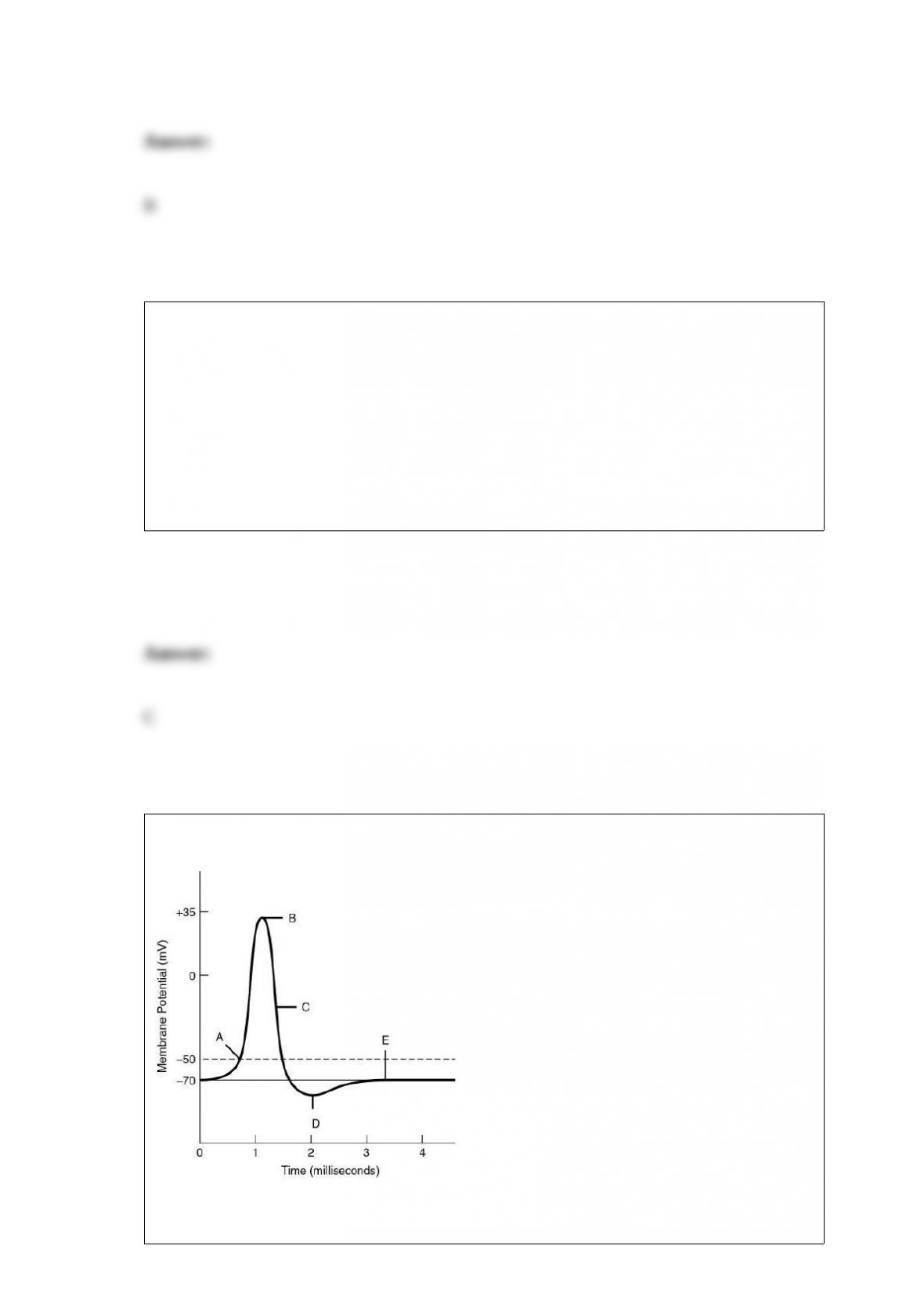
Refer to the following graph of an action potential to answer the question(s) below.
The membrane’s permeability to sodium ions is at its maximum at label _____.

A) A
B) B
C) C
D) D
Which of the following statements about bulk flow are correct?
I) Bulk flow is driven primarily by pressure potential.
II) Bulk flow depends on a difference in pressure potential at the source and sink.
III) Bulk flow depends on the force of gravity on a column of water.
IV) Bulk flow may be the result of either positive or negative pressure potential.
A) I and III
B) II and III
C) I, II, and IV
D) I, II, III, and IV

The driving force that pushes the root tip through the soil is primarily _____.
A) continuous cell division in the root cap at the tip of the root
B) continuous cell division just behind the root cap in the center of the apical meristem
C) elongation of cells behind the root apical meristem
D) continuous cell division of root cap cells
Which of the following organisms would be most likely to fossilize?
A) a rare worm
B) a common worm
C) a rare squirrel
D) a common squirrel
In a human karyotype, chromosomes are arranged in 23 pairs. If we choose one of these
pairs, such as pair 14, which of the following do the two chromosomes of the pair have
in common?
A) length and position of the centromere only
B) length, centromere position, and staining pattern only

C) length, centromere position, staining pattern, and traits coded for by their genes
D) They have nothing in common except that they are X-shaped.
Artificial electrical stimulation of a human’s menthol-sensitive neurons would likely
produce the sensation of _____.
A) cold temperature
B) hot temperature
C) odor of pepper
D) deep pressure
The following table depicts characteristics of five prokaryotic species (A-E). Use the
information in the table to answer the question(s) below
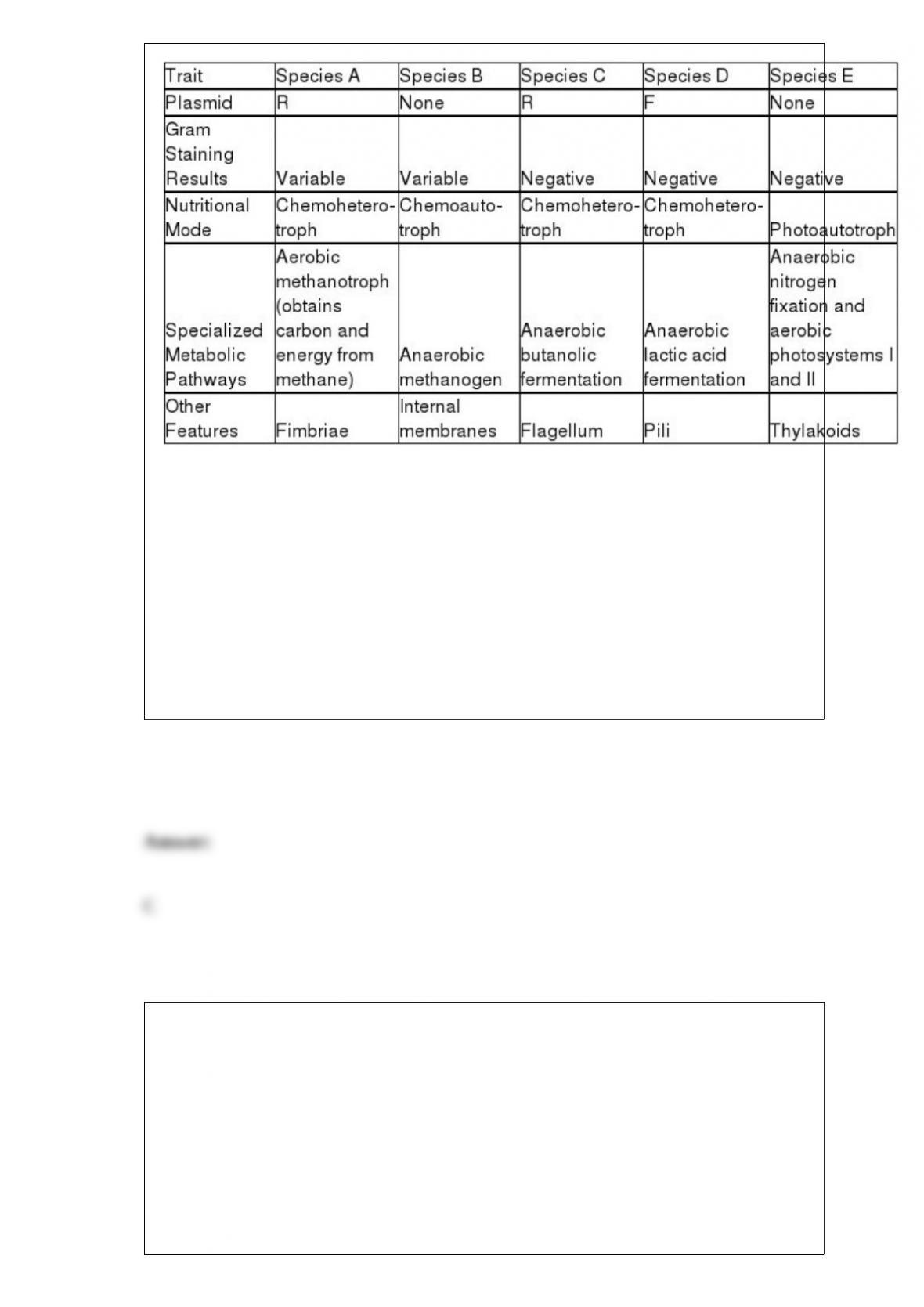
Which of the following extremophiles might researchers most likely use as a model for
the earliest organisms on Earth?
A) a bacterium found on another planet or moon
B) an archaean capable of surviving in the polar ice caps
C) an anaerobic archaean species
D) a bacterium that thrives in a highly acidic environment
Chemiosmotic ATP synthesis (oxidative phosphorylation) occurs in _____.
A) all cells, but only in the presence of oxygen
B) only eukaryotic cells, in the presence of oxygen
C) only in mitochondria, using either oxygen or other electron acceptors
D) all respiring cells, both prokaryotic and eukaryotic, using either oxygen or other
electron acceptors

Which of the following statements is true of linkage?
A) The closer two genes are on a chromosome, the lower the probability that a
crossover will occur between them.
B) The observed frequency of recombination of two genes that are far apart from each
other has a maximum value of 100%.
C) All of the traits that Mendel studiedseed color, pod shape, flower color, and othersare
due to genes linked on the same chromosome.
D) Linked genes are found on different chromosomes.
Amoebae move by crawling over a surface (cell crawling), which involves _____.
A) growth of actin filaments to form bulges in the plasma membrane
B) setting up microtubule extensions that vesicles can follow in the movement of
cytoplasm
C) reinforcing the pseudopod with intermediate filaments
D) cytoplasmic streaming
A particular species of virus carries a gene for salicylate hydroxylase, an enzyme that
breaks down salicylic acid. Will this virus be more or less virulent to plants than other
viruses?
A) more
B) less
C) This will not make the virus more or less virulent.
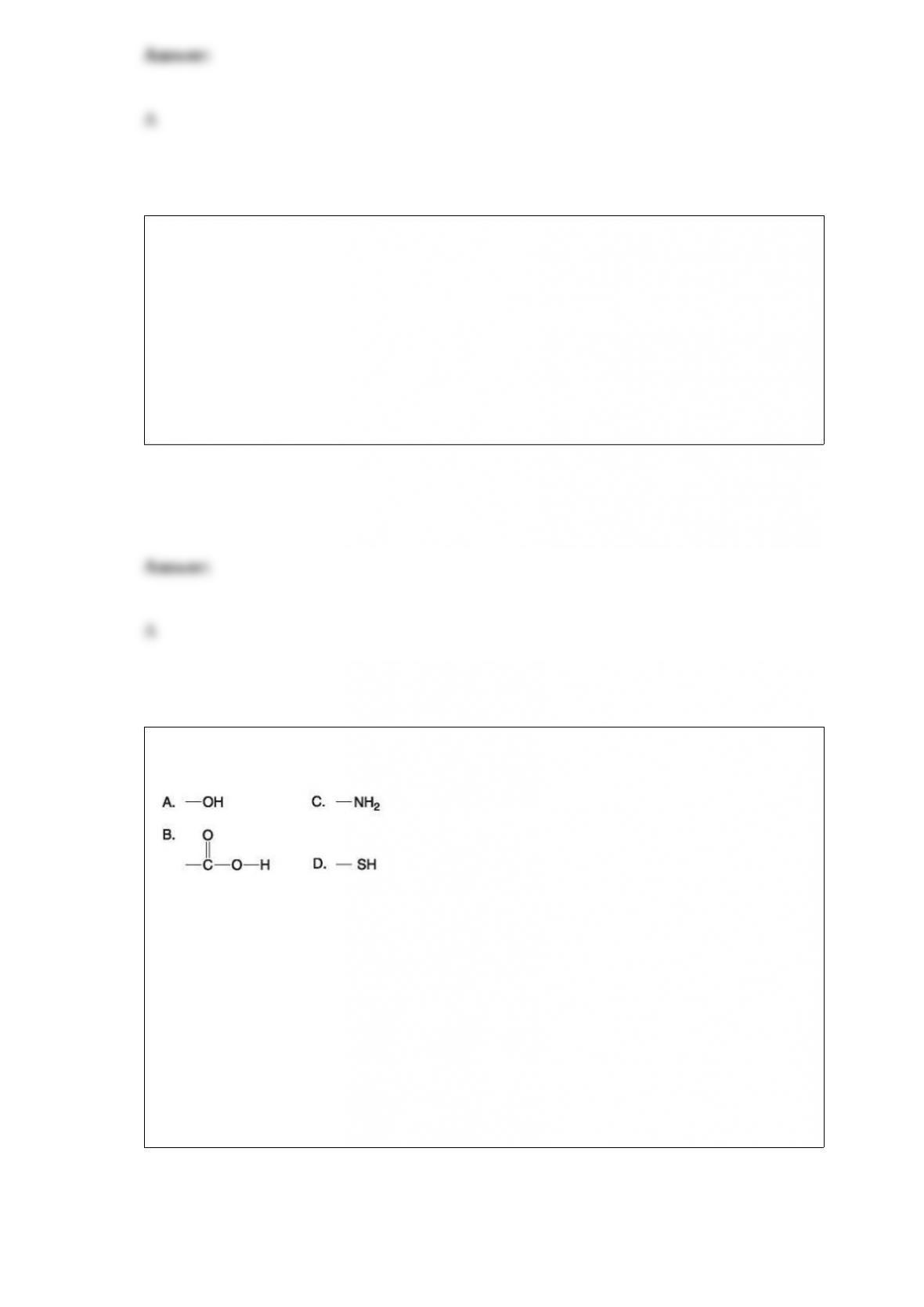
Which of the groups above is a basic functional group that can accept H+ and become
positively charged?
A) A
B) B
C) C
D) D

Use this information to answer the question(s) below.
Suppose an experimenter becomes proficient with a technique that allows her to move
DNA sequences within a prokaryotic genome.
If she moves the promoter for the lac operon to the region between the beta
galactosidase (lacZ) gene and the permease (lacY) gene, which of the following would
be likely?
A) The three structural genes will be expressed normally.
B) RNA polymerase will no longer transcribe permease.
C) The operon will still transcribe the lacZ and lacY genes, but the mRNA will not be
translated.
D) Beta galactosidase will not be produced.
The production of sterile mules by interbreeding between female horses (mares) and
male donkeys (jacks) is an example of _____.
A) reduced hybrid viability
B) hybrid breakdown
C) reduced hybrid fertility
D) mechanical isolation

Starting from the wild mustard Brassica oleracea, breeders have created the strains
known as Brussels sprouts, broccoli, kale, and cabbage. Therefore, which of the
following statements is correct?
A) In this wild mustard, there is enough heritable variation to permit these different
varieties.
B) Heritable variation is low in wild mustardotherwise this wild strain would have
different characteristics.
C) Natural selection is rare in wild populations of wild mustard.
D) In wild mustard, most of the variation is due to differences in soil or other aspects of
the environment.
Use the data in the accompanying table to answer the following questions.
The data were obtained from a study of the length of time spent in each phase of the
cell cycle by cells of three eukaryotic organisms designated beta, delta, and gamma.
Minutes Spent in Cell Cycle Phases
Of the following, the best conclusion concerning the difference between the S phases
for beta and gamma is that _____.
A) gamma contains more DNA than beta

B) beta and gamma contain the same amount of DNA
C) beta cells reproduce asexually
D) beta is a plant cell and gamma is an animal cell
What is the term used for a protein molecule that assists in the proper folding of other
proteins?
A) tertiary protein
B) chaperonin
C) renaturing protein
D) denaturing protein

In an experiment, rats’ ovaries were removed immediately after impregnation and then
the rats were divided into two groups. Treatments and results are summarized in the
table above. The results most likely occurred because progesterone exerts an effect on
the _____.
A) general health of the rat
B) metabolism of the uterus
C) gestation period of rats
D) number of eggs fertilized
In a hypothetical situation, a bacterium lives on the surface of a leaf, where it obtains
nutrition from the leaf’s nonliving, waxy covering while inhibiting the growth of other
microbes that are plant pathogens. If this bacterium gains access to the inside of a leaf,
however, it causes a fatal disease in the plant. Once the plant dies, the bacterium and its
offspring decompose the plant. What is the correct sequence of ecological roles played
by the bacterium in the situation described here?
1. nutrient recycler
2. mutualist
3. commensal
4. pathogen
5. primary producer
A) 1, 3, 4
B) 2, 3, 4
C) 2, 4, 1
D) 1, 2, 5

Genetic mutations in asexually reproducing organisms lead to more evolutionary
change than do genetic mutations in sexually reproducing ones because _____.
A) asexually reproducing organisms, but not sexually reproducing organisms, pass all
mutations on to their offspring
B) sexually reproducing organisms can produce more offspring in a given time than can
asexually reproducing organisms
C) more genetic variation is present in organisms that reproduce asexually than is
present in those that reproduce sexually
D) asexually reproducing organisms have more dominant genes than organisms that
reproduce sexually
Elephants hear sounds that are too low for humans to hear. This sensitivity is primarily
due to the differences in the _____.
A) arrangement and shape of the ossicles
B) flexibility of the basilar membrane in the cochlea
C) size and flexibility of the tympanic membrane (eardrum)
D) size and shape of the outer ear

What is the main force by which most of the water within xylem vessels moves toward
the top of a tree?
A) active transport of ions into the stele
B) evaporation of water through stoma
C) the force of root pressure
D) osmosis in the root
Which of the following represents the order of increasingly higher levels of
organization of chromatin?
A) nucleosome, 30-nm chromatin fiber, looped domain
B) looped domain, 30-nm chromatin fiber, nucleosome
C) nucleosome, looped domain, 30-nm chromatin fiber
D) 30-nm chromatin fiber, nucleosome, looped domain

Glucose-6-phosphate dehydrogenase deficiency (G6PD) is inherited as a recessive
allele of an X-linked gene in humans. A woman whose father suffered from G6PD
marries a normal man.
(a) What proportion of their sons is expected to be G6PD?
(b) If the husband was not normal but was G6PD deficient, would you change your
answer in part (a)?
A) (a) 100%; (b) no
B) (a) 1/2; (b) yes
C) (a) 1/2; (b) no
D) (a) zero; (b) no
You are given four test tubes, each containing an unknown protist, and your task is to
read the following description and match these four protists to the correct test tube.
When light, especially red and blue light, is shone on the tubes, oxygen bubbles
accumulate on the inside of test tubes 1 and 2. Chemical analysis of test tube 1 indicates
the presence of a chemical that is toxic to fish and humans. Chemical analysis of test
tube 2 indicates the presence of substantial amounts of silica. Microscopic analysis of
organisms in test tubes 1, 3, and 4 reveals the presence of permanent,
membrane-bounded sacs just under the plasma membrane. Microscopic analysis of
organisms in test tube 3 reveals the presence of an apicoplast in each. Microscopic
analysis of the contents in test tube 4 reveals the presence of one large nucleus and one
small nucleus in each organism.
Test tube 4 contains _____.
A) Paramecium
B) Pfiesteria (dinoflagellate)
C) Entamoeba
D) Plasmodium

If a farmer wanted more loosely packed clusters of grapes, he would most likely spray
the immature bunches with_____.
A) auxin
B) gibberellins
C) cytokinins
D) abscisic acid
Jahasz-Pocsine and co-workers found a correlation between gastric bypass surgery and
neurological complications. Surgeons performed gastric bypass surgery on 150 patients
at the University of Arkansas for Medical Sciences Neurology Clinic. Of the 150
patients, 26 experienced neurological complications related to the surgery. What is the
most likely cause for the neurological complications?
A) sudden weight loss and caloric deficiency interfering with neurological function
B) nutrient (for example, vitamin and mineral) deficiencies
C) sloppy surgical technique of physicians performing the bypass surgery
D) infections following surgical intervention