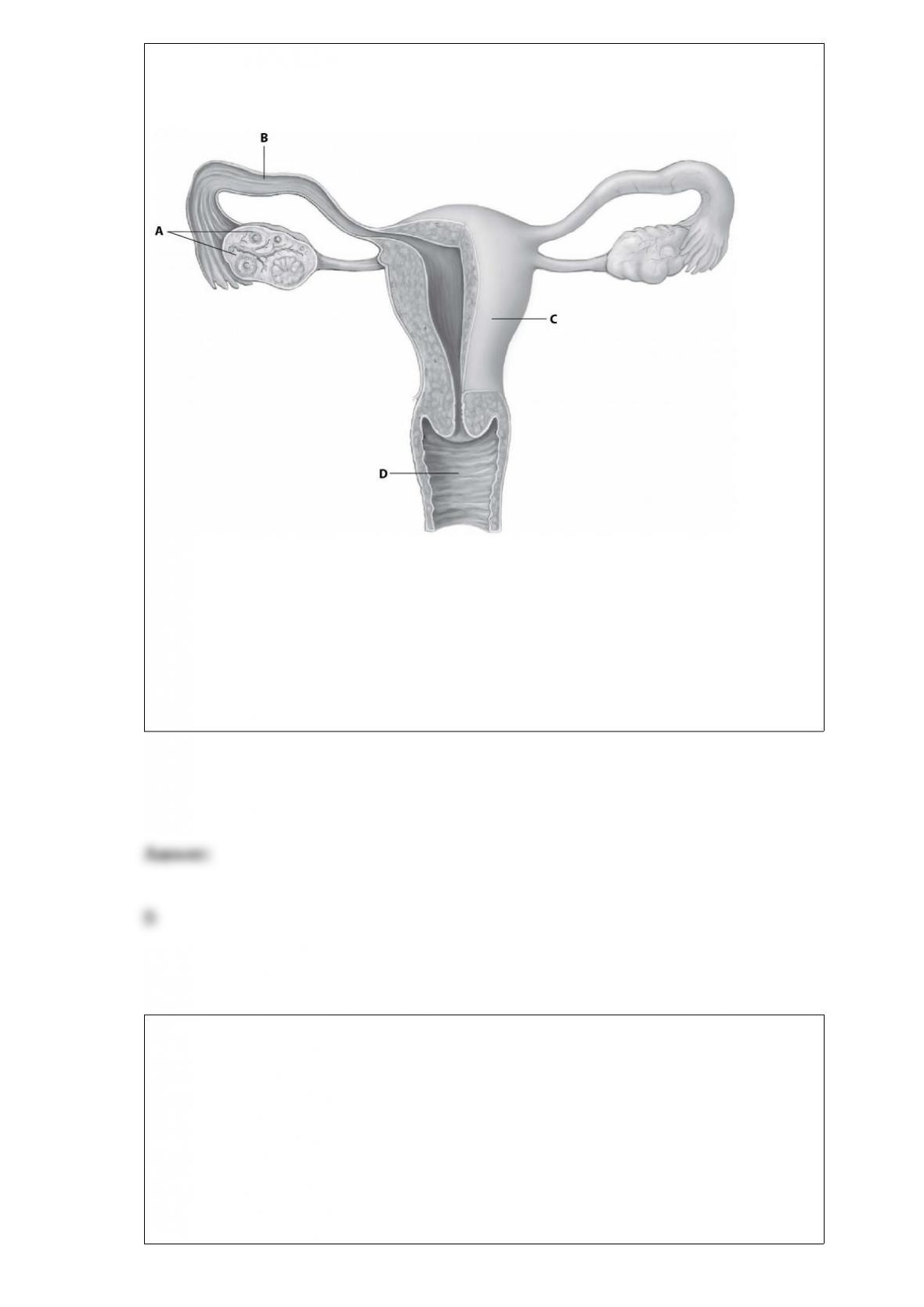
In which part of the human female reproductive system does fertilization normally take
place?
A) part A
B) part B
C) part C
D) part D
Which of the following organisms has a gastrovascular cavity?
A) hydra
B) earthworm
C) clam
D) bird

What is the primary reason that a hot spring will kill a fish placed in it but encourage
the growth of certain bacteria?
A) The high temperatures destroy most of the fish’s enzymes, but the specialized
bacteria have enzymes adapted to these temperatures.
B) Fish cannot feed directly on bacteria, but the bacteria can feed on dead fish.
C) At hot spring temperatures, the metabolic activity of the fish’s cells is so rapid that it
runs out of food reserves and dies; the bacteria feed on the dead fish.
D) Bacterial growth at high temperatures is so rapid that it deoxygenates the water and
kills the fish.
Which of the following choices correctly pairs a mineral with one of its major functions
in the body?
A) calcium, used in amino acid metabolism
B) phosphorus, maintaining water balance
C) iron, component of the nucleic acid backbone
D) sodium, maintaining water balance in cells
Which of the following processes occurs when a salamander regenerates a lost limb?
A) The homeotic genes of the regenerating limb are expressed.
B) Certain cells in the limb dedifferentiate, divide, and then redifferentiate to form a
new limb.
C) A new salamander develops from the lost limb.
D) The homeotic genes of the regenerating cells turn off.
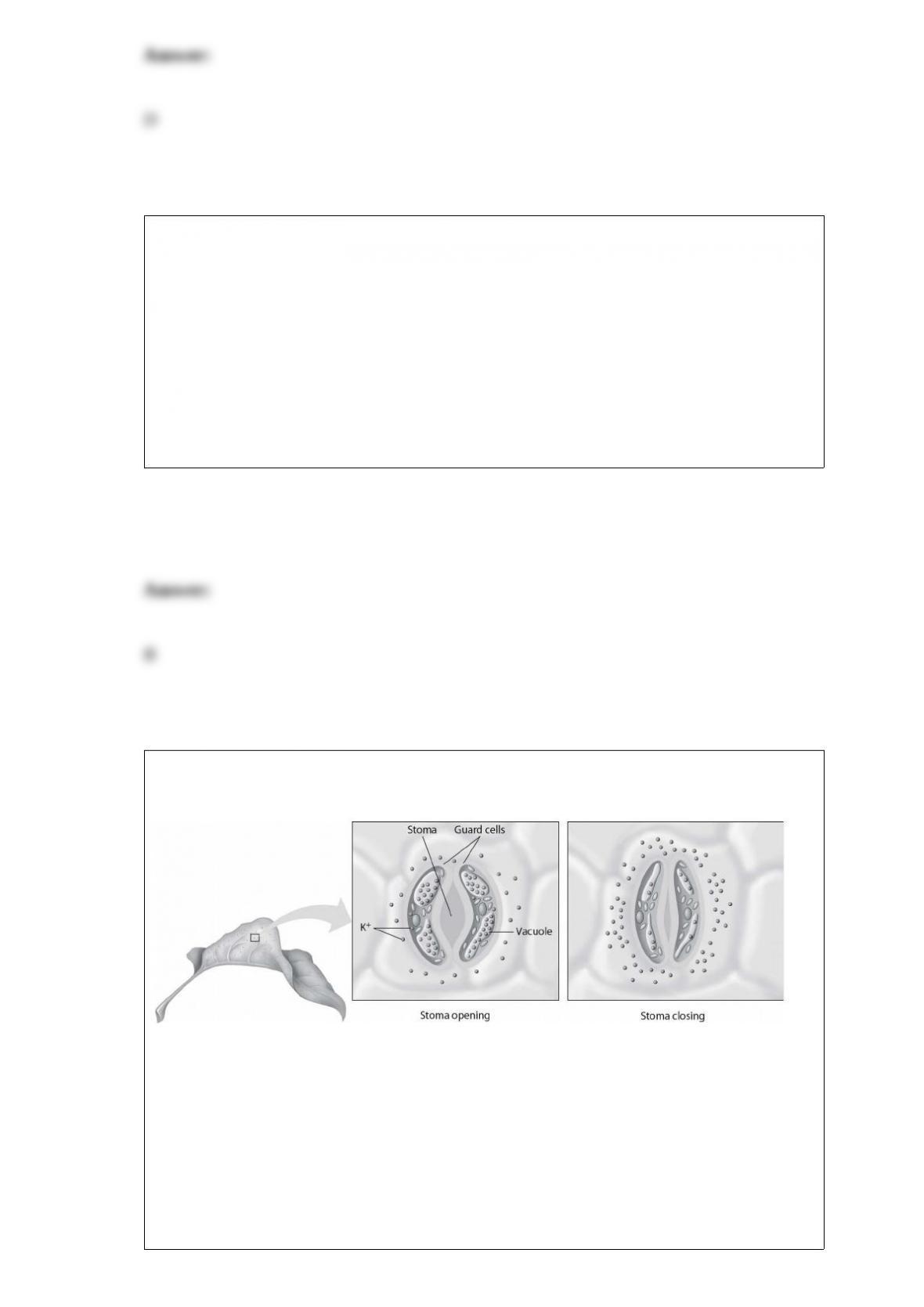
Under what circumstances would guard cells look like those in the right panel?
A) a cool rainy day
B) a hot humid day
C) at elevated levels of CO2

D) a hot dry day
Coral reefs are
A) shells of Mollusca that have been converted to rock by geological processes.
B) hard external skeletons secreted by coral animals (Cnidaria).
C) marine rocks that often are used as attachment places by Cnidaria.
D) hardened sugars that are secreted by algae.
Many amphibians (including many frogs, toads, and salamanders) spend the early part
of their lives in water but live on land as adults. The adults of many species return to
water to breed and lay their eggs. Frogs have small lungs and supplement their oxygen
intake by breathing through the skin. Although large frogs have more total surface area
than smaller frogs, the larger frogs have a lower surface area/volume ratio (less skin
surface relative to their total body volume). To keep their respiratory surfaces moist,
frogs are generally found in wet or very moist locations.
In an experiment designed to investigate oxygen consumption in relation to body size,
frogs from five different species were weighed and placed in a respirometer (a machine
that measures oxygen consumption) for 1 hour. The table shows the results of the
experiment.

You have obtained a frog from a species closely related to the frogs used in the
preceding study. If the frog weighs 30 grams, what do you expect its oxygen
consumption in 1 hour to be?
A) 0.30 cc
B) 1.00 cc
C) 1.50 cc
D) 2.00 cc
The sex chromosome complement of a normal human female is
A) XO.
B) XX.
C) XY.
D) YY.

Which of the following has not been a significant issue in the creation of genetically
modified (GM) organisms?
A) the fact that some plants carrying genes from other species might represent a threat
to the environment
B) the fact that GM organisms cannot be modified to prevent them from reproducing
once they pass beyond the experimental stage
C) the fact that rogue microbes might transfer dangerous genes into other organisms
D) the fact that the protein products of transplanted genes might lead to allergic
reactions
Which of the following physiological responses occurs in the human body when it
becomes overheated?
A) slowing of the heart rate
B) constriction of blood vessels in the skin
C) increased blood flow to the skin
D) retention of water

Which of the following statements about AIDS istrue?
A) The AIDS vaccine can prevent the spread of HIV.
B) There is now a treatment for AIDS that is simple and effective.
C) Using condoms during sex prevents the spread of the virus that causes AIDS.
D) AIDS patients live no longer than two to three years.
You exercised to the point that you were breathing heavily. Your heavy breathing was
the result of ________ relaying information about the amount of O2 in your blood to
the medulla, which ultimately resulted in your increased rate of breathing.
A) mechanoreceptors
B) electromagnetic receptors
C) chemoreceptors
D) thermoreceptors
A person whose eyeball is shorter than normal suffers from
A) hyperopia.
B) myopia.

C) astigmatism.
D) presbyopia.
Phagocytosis is to eating as pinocytosis is to
A) osmosis.
B) drinking.
C) chewing.
D) lysis.
Micronutrients function in plants mainly as
A) joining elements in organic molecule carbon skeletons.
B) regulators of membrane transport.
C) cofactors in chemical reactions.
D) food reserves for pollen grains.

Which of the following statements best describes how flight and feathers are related in
the evolution of birds?
A) The first flying birds did not have feathers, which evolved later.
B) Feathers and flight evolved at the same time.
C) The first feathered ancestors to birds did not fly but may have used their feathers for
insulation and display.
D) Feathers are soft and do not leave fossils or fossil traces, so it is unknown which
organisms first had feathers.
How are hormones distributed to tissues, and what determines which cells hormones
will affect?
A) They are carried throughout the body in the bloodstream, and each hormone affects
target cells that have receptors for it.
B) They are carried to specific organs by lymphatic vessels and affect the cells in those
organs.
C) They are delivered by neurosecretory cells to specific tissues and affect the cells in
those tissues.
D) They are distributed locally in the interstitial fluid and affect nearby responsive
target cells.

Which meal is high in fiber, low in saturated fats, and high in unsaturated fats?
A) a rib eye steak, mashed potatoes, and side salad with ranch dressing
B) a plate of scrambled eggs with a side of cottage cheese
C) a black bean, cheese, lettuce, and sour cream burrito in a flour tortilla
D) a bowl of spaghetti tossed with olive oil, artichokes, and broccoli
You drive through Iowa in the spring and notice that along a stretch of several
kilometers, every third fence post has a male redwing blackbird perched on it defending
its nesting territory. This is an example of
A) clumped dispersion.
B) random dispersion.
C) uniform dispersion.
D) artificial dispersion.

The overall process that refines the filtrate and ultimately returns water and valuable
solutes to the blood is known as
A) reabsorption.
B) excretion.
C) collection.
D) purification.
Uranium is a metallic element that is used in nuclear reactors and nuclear weapons. The
vast majority of uranium found on Earth is in the form of uranium-238, an isotope with
a mass number of 238, while the uranium that is used for nuclear reactors and weapons
is uranium-235, an isotope with a mass number of 235.
In a certain type of nuclear reactor, uranium-238 can be converted to plutonium-239,
another radioactive element (with an atomic number of 94) that can be used to power
nuclear reactions. Which of the following statements regarding uranium-238 and
plutonium-239 is false?
A) An atom of plutonium-239 contains one more proton than an atom of uranium-238.
B) An atom of plutonium-239 contains 145 neutrons.
C) An atom of uranium-238 has a smaller mass than an atom of plutonium-239.
D) An atom of plutonium-239 contains two more protons and one fewer neutron than an
atom of uranium-238.

One of the most important branch points in the evolution of animals and their nervous
systems was the appearance of
A) radial symmetry.
B) bilateral symmetry.
C) the spinal column.
D) specialized cells for transmitting signals.
Ever since Darwin, systematics has tried to
A) organize species into groups based on logical categories.
B) classify species in groups that reflect evolutionary relationships.
C) prove the existence of evolution using laboratory experiments.
D) keep classification and naming as a practical science, separate from controversies
involving evolution.

A hypothesis is
A) the same as a theory.
B) a proposed explanation for a set of observations.
C) an explanatory idea that is broad in scope and supported by a large body of evidence.
D) a widely accepted idea about a phenomenon.
What is the age structure of a population?
A) the curve that results when the likelihood of dying is plotted as a function of age
B) the curve that results when the likelihood of being alive is plotted as a function of
age
C) the proportion of individuals alive in different age-groups
D) the difference in the age distribution of a population at two different points in time
The Himalayas are an example of a mountain range that formed as a result of
A) the collision of two continental plates.
B) the separation of two continental plates.

C) the buildup of sediments and conversion to rock.
D) volcanic eruptions.
Which of the following is one of the three major categories of sex hormones?
A) glucocorticoids
B) estrogens
C) glucagons
D) prolactins
The nervous system determines the pitch of a tone by
A) the region of the basilar membrane that vibrates most vigorously at any one instant.
B) peak amplitude of basilar membrane displacement.
C) sites along the basilar membrane where vibrations are longest.
D) the frequency of oval window vibration.

In a flowering plant, the cells that give rise to sperm undergo meiosis in the
A) ovaries.
B) sepals.
C) anthers.
D) stigma.
The minimal amount of nutrients needed every day by healthy people to prevent
nutrient deficiencies is called the
A) RDA, Recommended Dietary Allowance.
B) minimum mineral requirements.
C) minimum vitamin requirements.
D) varied diet of minerals and vitamins.