1) when does oxyhemoglobin form during respiration?
a) during external respiration
b) immediately after carbon dioxide enters the blood
c) when the chloride shift occurs
d) during pulmonary ventilation
e) during internal respiration
2) all of the following are true of the primary response of humoral immunity, except
that
a) it depends on antigen triggering the appropriate b cell.
b) it requires b cell differentiation into plasma cells.
c) it is delayed by the memory cell stage.
d) circulating antibodies undergo a gradual, sustained rise.
e) it peaks 1 to 2 weeks after the initial exposure.
3) too little secretion of cortisol and aldosterone causes
a) goiter.
b) diabetes mellitus.
c) diabetes insipidus.
d) addison disease.
e) cushing disease.
4) when calcium ion binds to troponin,
a) tropomyosin moves into the groove between the helical actin strands.
b) active sites on the myosin are exposed.
c) actin heads will bind to myosin.
d) muscle relaxation occurs.
e) myosin shortens.
5) which of the following describes the action of the corrugator supercilii?
a) depresses the lips
b) purses the lips
c) wrinkles the brow

d) elevates the mandible
e) moves the external ear
6) the skull contains ________ bones.
a) 32
b) 22
c) 42
d) 12
e) 27
7) each of the following changes will result in increased blood flow to a tissue, except
a) increased hematocrit.
b) increased vessel diameter.
c) increased blood pressure.
d) decreased peripheral resistance.
e) relaxation of precapillary sphincters.
8) the binding of an antibody to an antigen can result in
a) neutralization of the antigen.
b) agglutination or precipitation.
c) complement activation and opsonization.
d) inflammation.
e) all of the answers are correct.
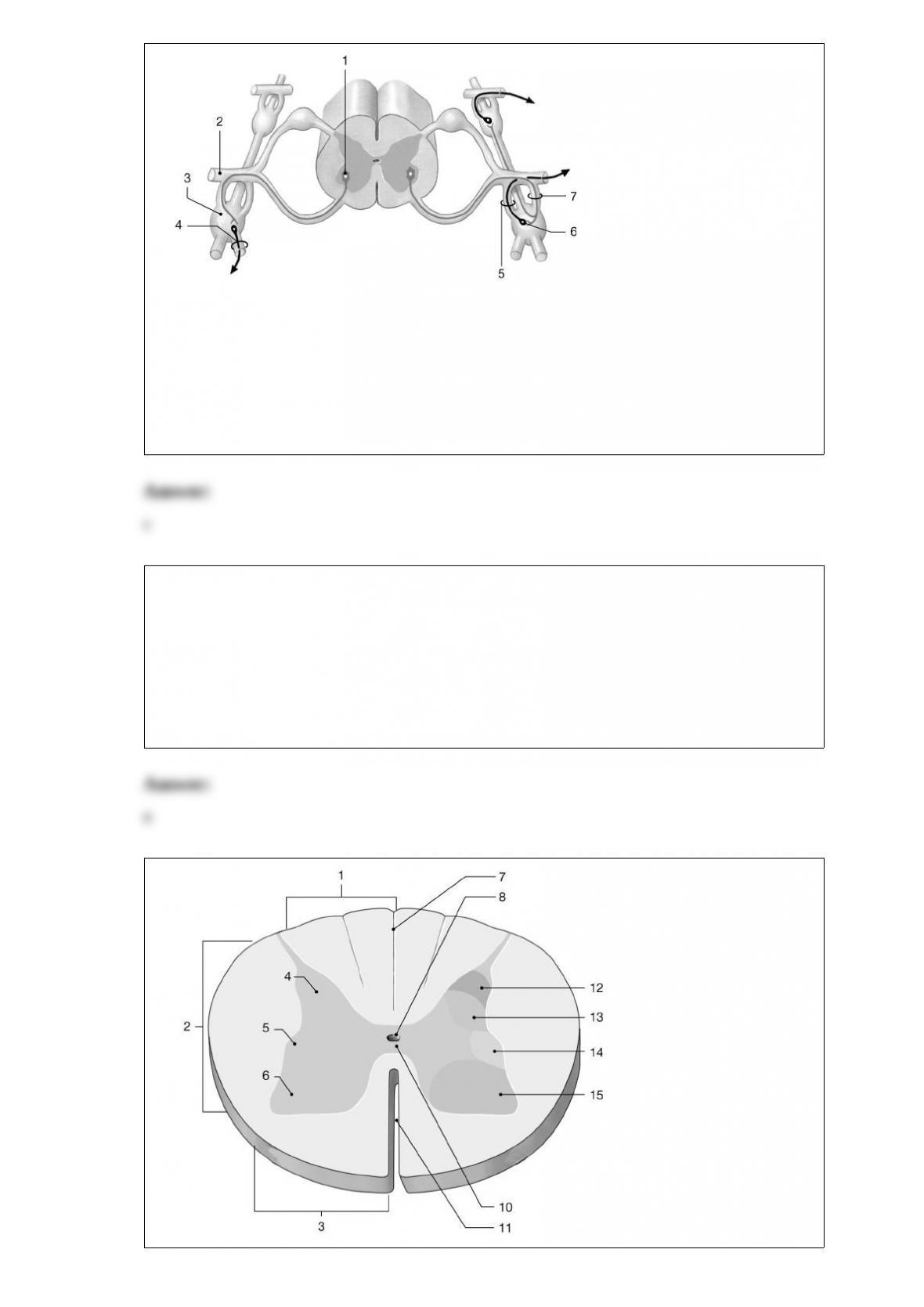
9)
figure 16-1 ans pathway
identify the structure labeled “2”
a) ventral root
b) dorsal ramus
c) spinal nerve
d) ventral ramus
e) white ramus
10) which one of the following statements is not correct about the reaction h2 + cl2 2
hcl?
a) h2 and cl2 are the reactants.
b) hcl is the product.
c) one molecule of hydrogen contains two atoms.
d) two molecules of hcl are formed in the reaction.
e) this reaction is easily reversible.
11)

figure 13-1 the spinal cord
identify the structure labeled “10”
a) anterior white commissure
b) anterior median fissure
c) anterior white column
d) anterior gray commissure
e) anterior white horn
12) the actual mass of an atom is known as its ________ ________.
13) fifty to seventy percent of circulating white blood cells are ________ .
14) the term ________ refers to all the factors that resist blood flow in the entire
circulatory system.
15) a(n) ________ is a homogeneous mixture containing a solvent and a solute.
16) in ________ growth, cartilage grows wider or thicker in diameter.
17) you are a researcher interested in studying the cytoskeleton. how can you use
antibodies to locate actin- and tubulin-containing structures?