
White blood cells play a particularly important role in ________.
A) fighting infections
B) supporting the activity of red blood cells
C) carrying carbon dioxide
D) blood clotting
Which of the following is an example that results from directional selection?
A) The birth weight at which newborn humans are most likely to survive and the
average weight of newborn humans are about the same.
B) There is an increase in antibiotic-resistant strains of bacteria.
C) There is an increase in the number of different breeds of dog.
D) Garter snakes with different coloration patterns behave differently when threatened.
A vaccine works by ________.
A) inhibiting bacterial reproduction
B) stimulating the immune system to develop lasting defenses

C) killing cells infected with a virus
D) preventing translation of mRNA molecules that code for disease-causing proteins
Which of the following is a function of roots?
A) absorbs water only
B) absorbs nutrients from the soil only
C) stores food only
D) stores food and absorbs water and nutrients from the soil
Which of these exhibits radial symmetry?
A) butterfly
B) spoon
C) snowflake
D) shoe box

If you lay your forearm along the table, you can rotate it so that your hand changes
from a palm-down to a palm-up position. This is possible because your radius and ulna
join at a ________ joint.
A) ball-and-socket
B) hinge
C) pivot
D) twist
Oxygen is transported through the body mostly ________.
A) dissolved in the blood
B) dissolved in red blood cells
C) bound to hemoglobin
D) bound to dissolved iron
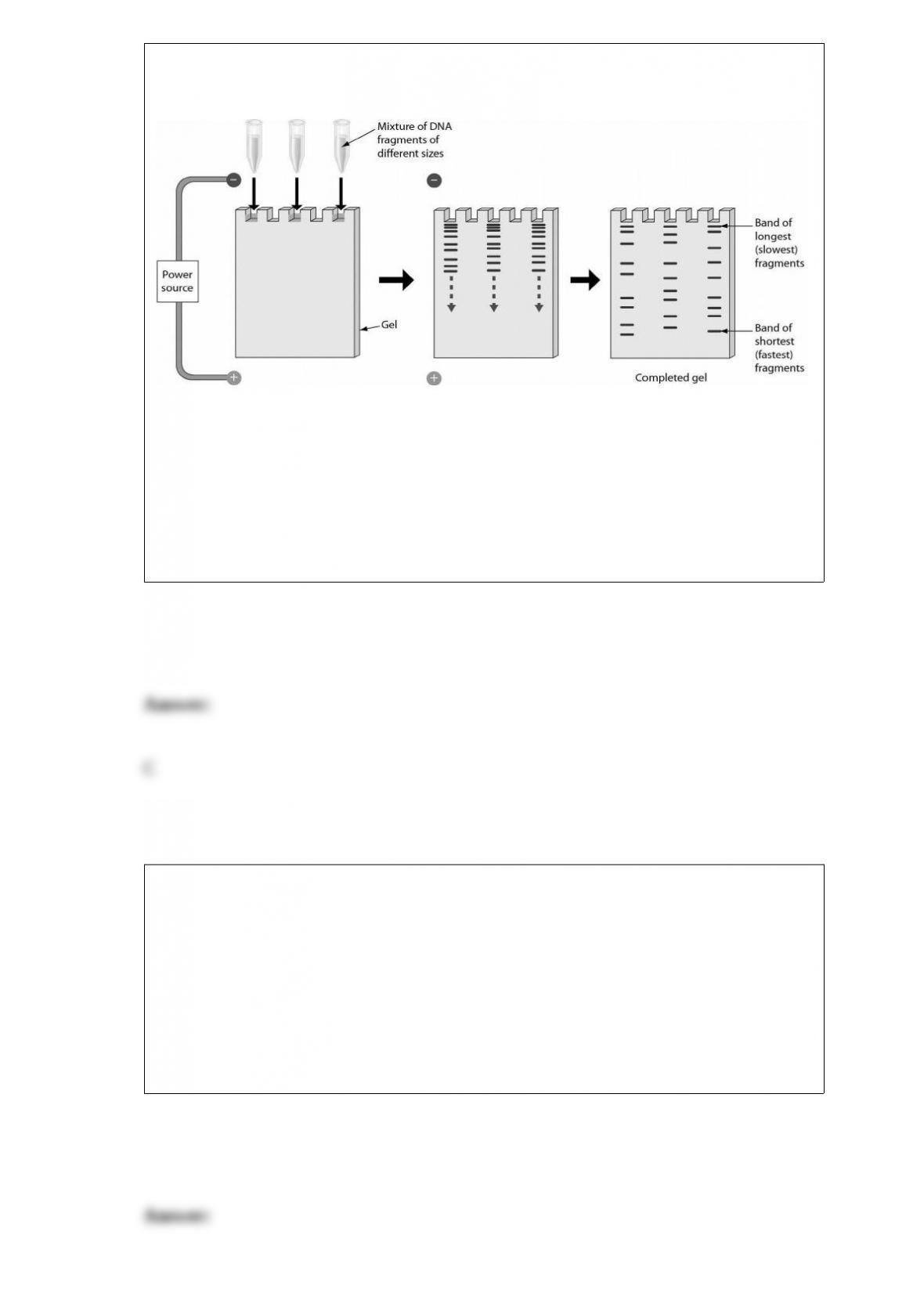
The following figure shows that gel electrophoresis can be used to separate repetitive
DNA sequences. Gel electrophoresis separates DNA fragments because ________.
A) double-stranded moves slower than single-stranded DNA
B) of ratios of guanine to cytosine
C) the DNA fragments have different lengths
D) of the salt concentration in the gel matrix
What name is given to the specific location of a gene on a chromosome?
A) locus
B) phenotype
C) genotype
D) allele
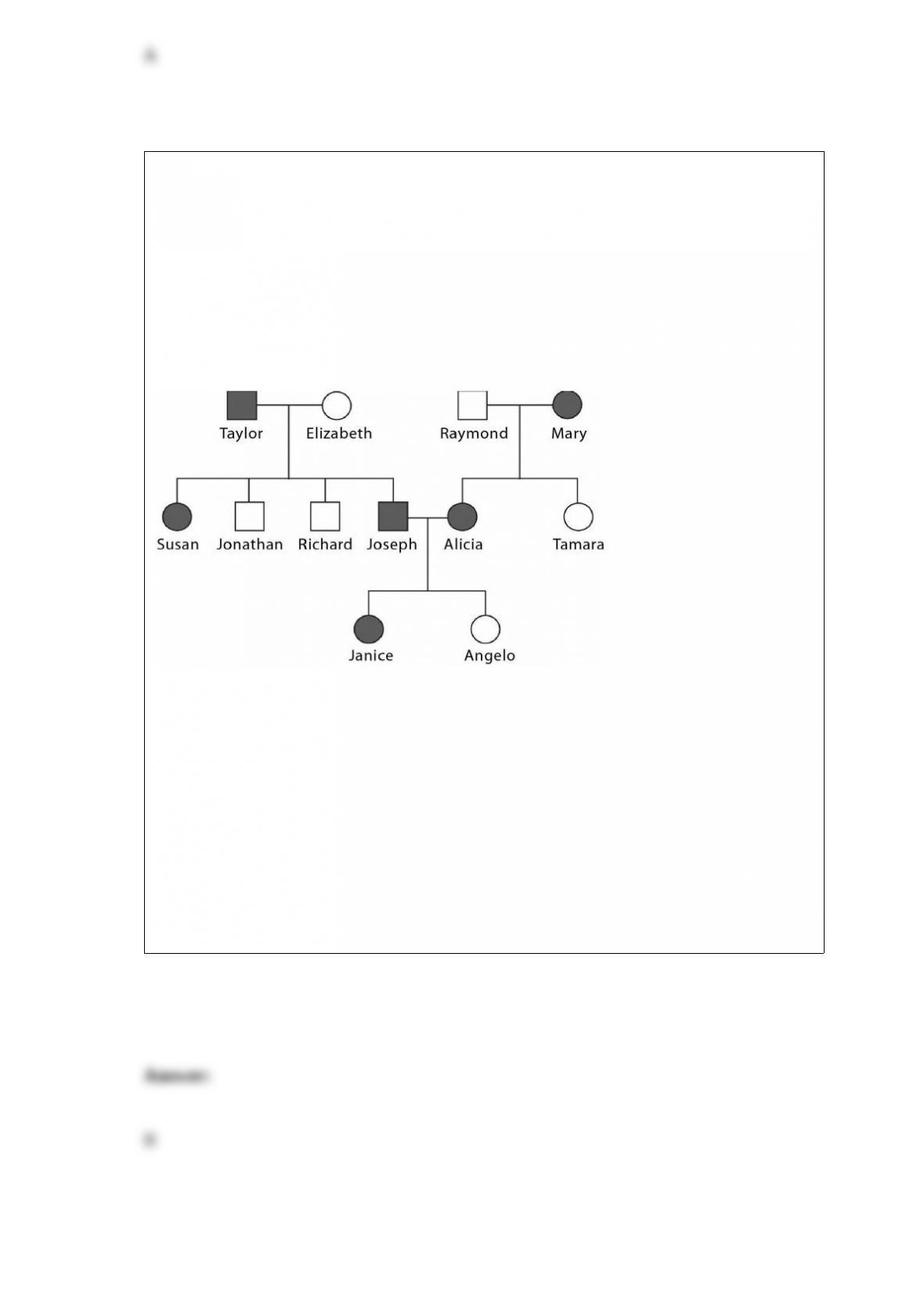
Please read the following scenario to answer the following questions.
Widow’s peak, a pointed hairline on the forehead, is a genetic trait caused by a
dominant allele. It can be traced back through a family’s history using pedigree analysis.
The pedigree shown here is of three generations of a family. Notice that some
individuals (shown in gray) have a widow’s peak (W = dominant allele and w =
recessive allele).
This pedigree supports the fact that widow’s peak is due to a dominant allele, because if
it were due to a recessive allele and both parents show the recessive phenotype, then
________.
A) half of the sons would have a widow’s peak
B) all of the offspring would have a widow’s peak
C) none of the daughters would have a widow’s peak
D) all of the daughters and none of the sons would have a widow’s peak

Assume that having three nostrils is inherited as a sex-linked trait on the Y
chromosome. A man with three nostrils has a daughter who has a son with a man who
has only two nostrils. What is the probability that the three-nostriled man’s grandson
has three nostrils?
A) 0%
B) 25%
C) 50%
D) 100%
Which of the following taxonomic levels is most inclusive?
A) order
B) genus
C) family
D) class
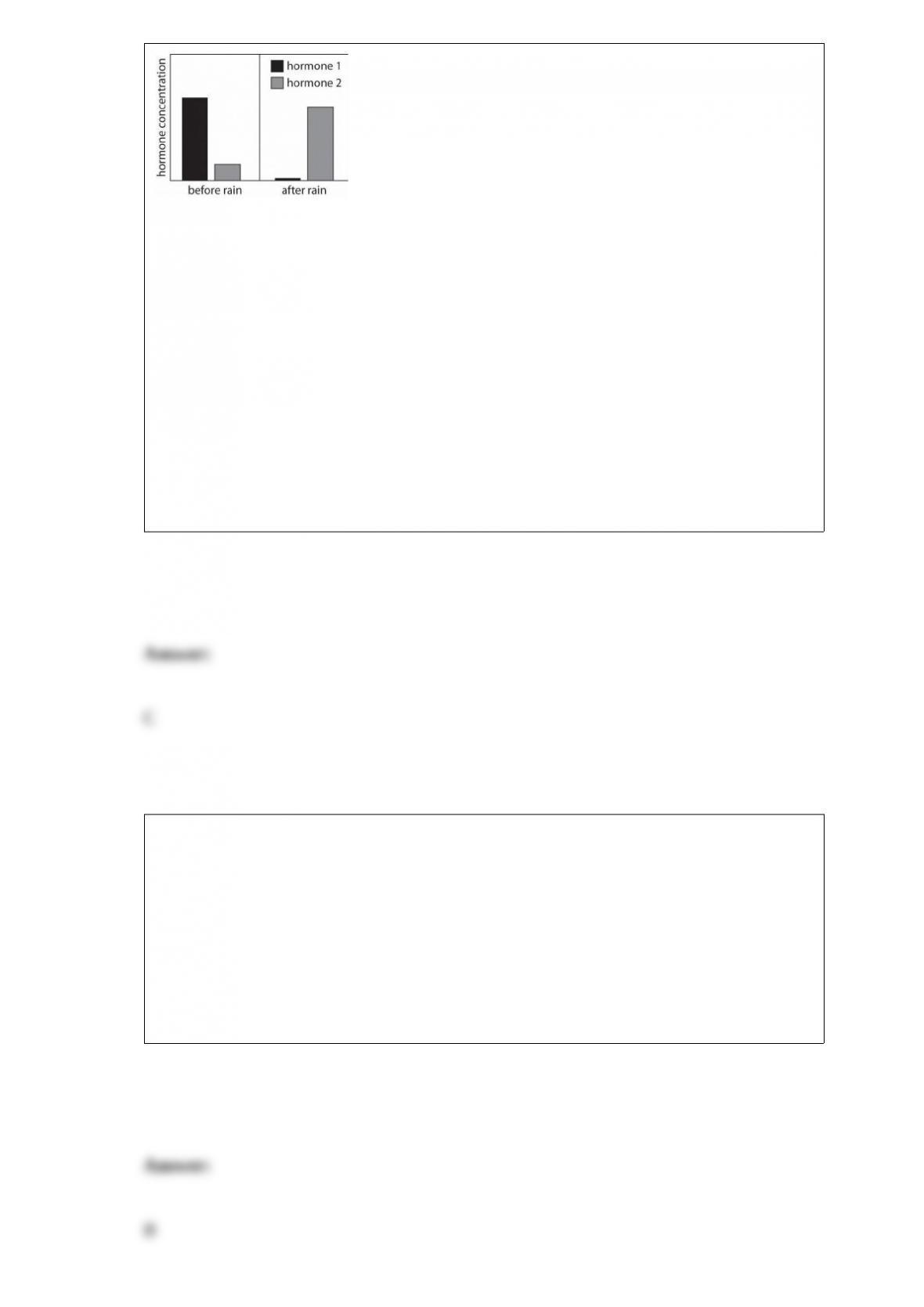
A scientist finds seeds of an unknown plant on top of the soil in a desert. She measures
the concentration of two hormones in these seeds. After it rains, she collects more of
these seeds, and finds that the concentration of the two hormones has changed. A graph
of her results is shown above. Identify the most likely hormones measured by the
scientist.
A) hormone 1: gibberellin; hormone 2: cytokinin
B) hormone 1: auxin; hormone 2: ethylene
C) hormone 1: abscisic acid; hormone 2: gibberellin
D) hormone 1: ethylene; hormone 2: auxin
In the Hardy-Weinberg formula, what does 2pq represent?
A) frequency of the dominant allele
B) frequency of heterozygotes
C) frequency of the recessive allele
D) frequency of the homozygous dominants

Many proto-oncogenes regulate ________.
A) cell growth
B) cell cloning
C) cell division
D) cell repair
Plants are susceptible to bacterial infections, which can damage their structure or even
kill them. Which of the following would be the best antibiotic to treat a plant that is
infected with bacteria?
A) a drug that interferes with mitochondria function
B) a drug that disrupts cell wall structure and function
C) a drug that destroys the central vacuole
D) a drug that blocks gene expression in circular chromosomes
Which of the following enzymes is responsible for RNA synthesis?
A) DNA polymerase

B) ribosome
C) reverse transcriptase
D) RNA polymerase
When you hold your breath, which of the following blood gas changes leads initially to
the urge to breathe again?
A) rising carbon monoxide level
B) rising carbon dioxide level
C) falling carbon monoxide level
D) rising carbon dioxide level and falling carbon monoxide level
Examine the figure below. Which part of Earth receives the greatest intensity of solar
radiation?

A) Tropic of Cancer and Tropic of Capricorn
B) equator
C) North and South Poles
D) All parts of Earth receive the same intensity of solar radiation.
Which of the following is a function of parenchyma cells?
I) food storage
II) photosynthesis
III) divide and develop to become other types of cells
A) I
B) II
C) III
D) I, II, and III

Please read the paragraph below to answer the following questions.
You conducted a series of experiments to test whether the expression of hexokinase, an
important enzyme involved in glycolysis, varies under different conditions. In the first
experiment, you measured the production of hexokinase mRNA in cells at three
different temperatures: 37ºC, 25ºC, and 10ºC. Your results showed that the mRNA
levels for hexokinase were 5 and 20 lower at 25ºC and 10ºC than at 37ºC, respectively.
Based on these results, you are going to conduct further experiments to attempt to
answer your research question.
What can you conclude from these results?
A) Unpacking of the hexokinase gene occurs only at 37ºC.
B) Transcription of the hexokinase gene occurs less frequently at lower temperatures.
C) The levels of hexokinase protein are not affected by temperature.
D) Translation of the hexokinase gene occurs more frequently at higher temperatures.
Read the following scenario to answer the following questions.
The earliest cells detectable in fossils were different from the cells in animals, plants,
fungi, and protists living today. These first prokaryotic cells gave rise to eukaryotic
cells approximately 1.7 billion years ago. The structure of eukaryotic cells today
suggests how they might have evolved from their prokaryotic ancestors. Scientists
examining mitochondria and chloroplasts now think that these organelles were probably
free-living prokaryotes before becoming a part of eukaryotic cells long ago.

What evidence suggests that mitochondria might have evolved before chloroplasts?
A) Mitochondria can sometimes divide to produce chloroplasts.
B) Only mitochondria have their own DNA.
C) Some mitochondria have chloroplasts inside of them.
D) Almost all eukaryotes have mitochondria but only some cells have chloroplasts.
________ is the source of the oxygen gas released by a photosystem.
A) H2O
B) Chlorophyll a
C) CO2
D) C6H12O6
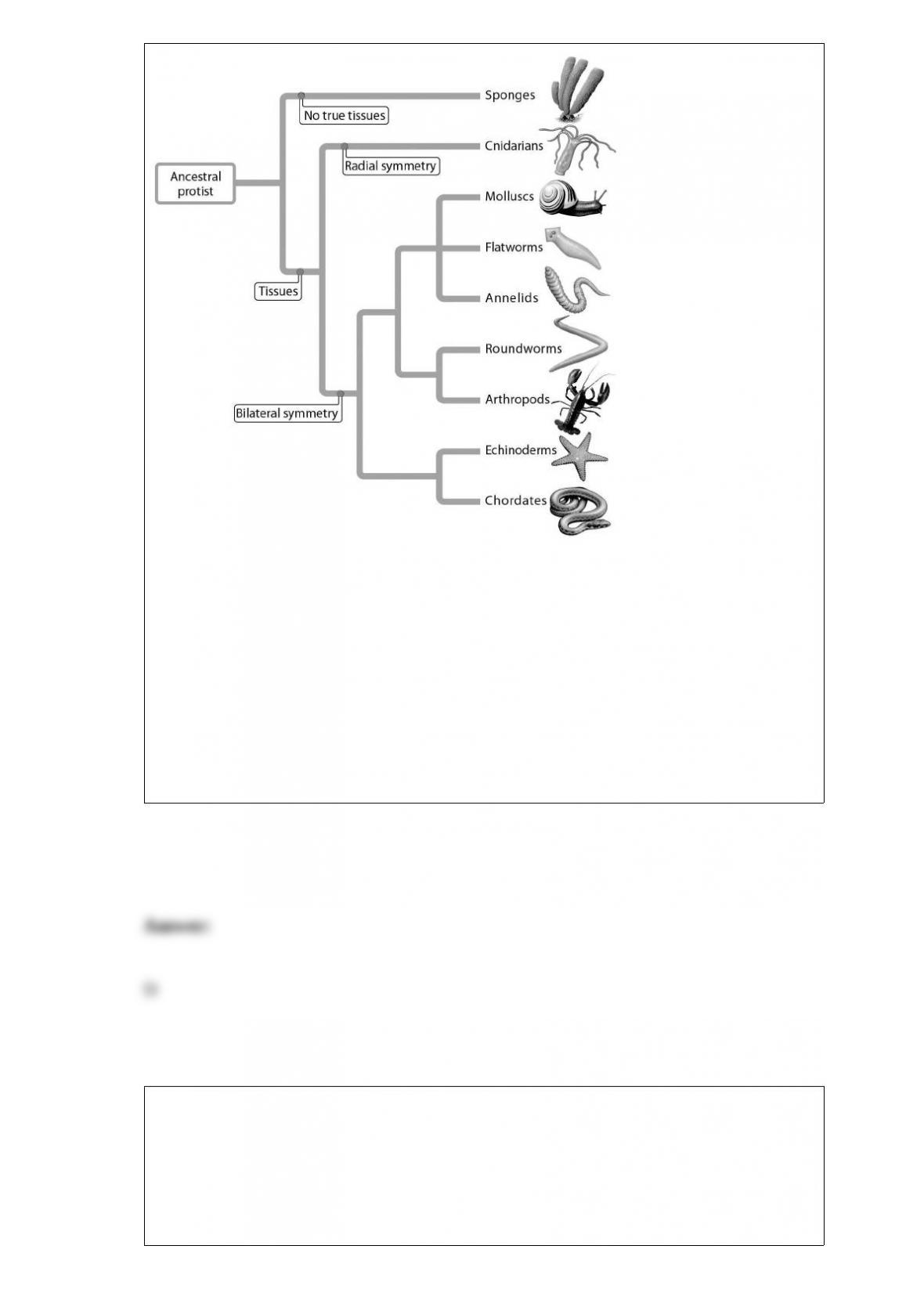
According to the figure, which organism group demonstrates the most advanced body
plan in reference to presence of tissue and symmetry?
A) sponges
B) cnidarians
C) ancestral protists
D) arthropods
Sympatric speciation specifically EXCLUDES ________.
A) behavioral isolation
B) postzygotic barriers

C) geographic isolation
D) temporal isolation
A friend of yours appears to have put on a lot of muscle very quickly. At the same time,
you notice that your friend seems to have a lot of mood swings and appears depressed.
It is reasonable for you to suspect that your friend has begun to take ________.
A) amino acid supplements
B) creatine
C) protein powder
D) an anabolic steroid
Cells communicate with one another via ________.
A) cascades of gene activation
B) the diffusion of RNA transcripts through adhesion junctions
C) signal transduction pathways
D) RNA splicing

Scientists are working to create a better biofuel factory through which of the following
processes?
A) increasing the rate at which certain algae reproduce
B) developing strains of algae that can clean up oil spills
C) increasing the genetic diversity of groups of algae
D) restricting hydrocarbon production
On a global scale, the most significant type of malnutrition is ________.
A) vitamin A deficiency
B) calcium deficiency
C) iron deficiency
D) protein deficiency

Experience with dog breeding has taught geneticists ________.
A) that, given enough time, any desired trait can be bred into dogs
B) that purebred dogs have offspring with qualities identical to the parents, because all
purebred dogs are alike genetically
C) that, while physical traits can be molded through artificial selection, behavioral traits
cannot
D) that geographically isolated groups of dogs may be selected for quite different traits,
resulting in a different dog breed
What path does a molecule of O2 take from the nose to the respiratory surface?
A) pharynx → larynx → trachea → bronchus → bronchiole → alveolus
B) larynx → pharynx → trachea → bronchus → bronchiole → alveolus
C) pharynx → larynx → bronchus → bronchiole → alveolus → trachea
D) pharynx → larynx → trachea → bronchiole → bronchus → alveolus
Which of the following hormones promotes cell division?
A) auxin

B) cytokinin
C) gibberellin
D) abscisic acid
Read the following scenario to answer the following questions.
People utilize plants to meet many everyday needs, including food, fiber, and building
materials. However, not many of the over 300,000 known species of plants are used by
people. One species with a lot of future promise is the jatropha tree. This species is
native to Central America and is now found throughout the tropics. Many people
believe the jatropha could help alleviate poverty in many areas of the world, as the
seeds produce an oil that can be used for cooking, lighting, or generating electricity.
This oil can also be mixed with diesel fuel or petrol to produce a biofuel. Mature trees
produce between 5 and 15 kg of seeds per year and can live more than 30 years.
However, critics argue that planting the jatropha tree will take land needed for food
production, which will in turn harm the poor.
Which of the following statements concerning the jatropha tree is TRUE?
A) Jatropha trees are found all over the world.
B) Everyone believes planting jatropha trees will be beneficial.
C) Humans use over half of the known species of plants for everyday uses.
D) Currently, the most valuable part of the jatropha tree is the seed.

Humans are chordates. Which animal group is most closely related to chordates?
A) molluscs
B) echinoderms
C) annelids
D) arthropods
What best describes the regulatory mechanism described in the scenario?
A) negative feedback
B) positive feedback
C) thermoregulation
D) natural selection