
1) which hormone from the adrenal cortex of the kidneys will cause the distal
convoluted tubules to reabsorb more sodium ions?
a. renin
b. angiotensinogen
c. angiotensin ii
d. adh
e. aldosterone
2) immediate allergic responses are caused by ______ antibodies.
a. iga
b. igg
c. ige
d. igm
e. igd
3) all of the following are true of methanogens except
a. they produce methane from co2 and h2.
b. they live in the intestinal tracts of cows, humans, and termites.
c. they live in swamps and marshes.
d. their biogas may contribute to global warming.
e. they are harmful human pathogens.
4) reproductive isolation is more likely to occur when
a. hybrids are more fit than members of the parent species.
b. hybrids are less fit than members of the parent species.
c. there are no differences between the fitness of the parent species and hybrids.
d. none of the above are true.
5) opercula are
a. gills on a lobster.

b. gill covers on a fish.
c. extensions of the body wall in polychaete worms.
d. internal spaces in a planarian used in digestion and respiration.
e. tentacles on a hydra.
6) which of the following human digestive enzymes is not correctly matched to its
substrate?
a. pepsin – protein
b. trypsin – nucleic acid
c. salivary amylase – starch
d. lipase – fat
e. maltase – maltose
incorrect
7) albumin is the large protein molecule found in egg white and blood plasma. table salt
dissociates into sodium and chloride ions. urea is assembled in the liver. in a healthy
person, what is the fate of the majority of these molecules as they pass through a
nephron?
a. all three remain in the bloodstream.
b. all three move into the glomerular capsule and are excreted in urine.
c. all three move into the glomerular capsule but the salt ions are mostly reabsorbed.
d. albumin remains in the blood and salt ions and urea moved into the glomerular
filtrate and excreted in the urine.
e. albumin remains in the blood, salt ions move into the filtrate but most are reabsorbed,
and the urea moves into the filtrate and is excreted in the urine.
8) which of these plant tissue types is composed of cells with primary walls thickened
at the corners that provide support for immature parts of the cell body?
a. xylem
b. phloem
c. collenchyma

d. sclerenchyma
e. parenchyma
9) during the elongation of a polypeptide chain, _________ occurs when the mrna
moves to the next site on the ribosome to read the next codon.
a. translocation
b. transcription
c. translation
d. transference
10) which feature of the mammalian skeleton provides an advantage for animals that
are land based predators?
a. walking on their toes.
b. elongated hindlimbs that propel them forward.
c. bipedal locomotion on the soles of the feet.
d. long legs and running on the tips of elongated phalanges.
e. all of these are advantages for land based predators.
11) a multicellular organism like a rabbit will be _______________.
a. composed of many cells that are all the same type.
b. composed of a single cell.
c. composed of a variety of different cell types.
d. composed of one giant cell.
12) a shared derived trait of all plants is
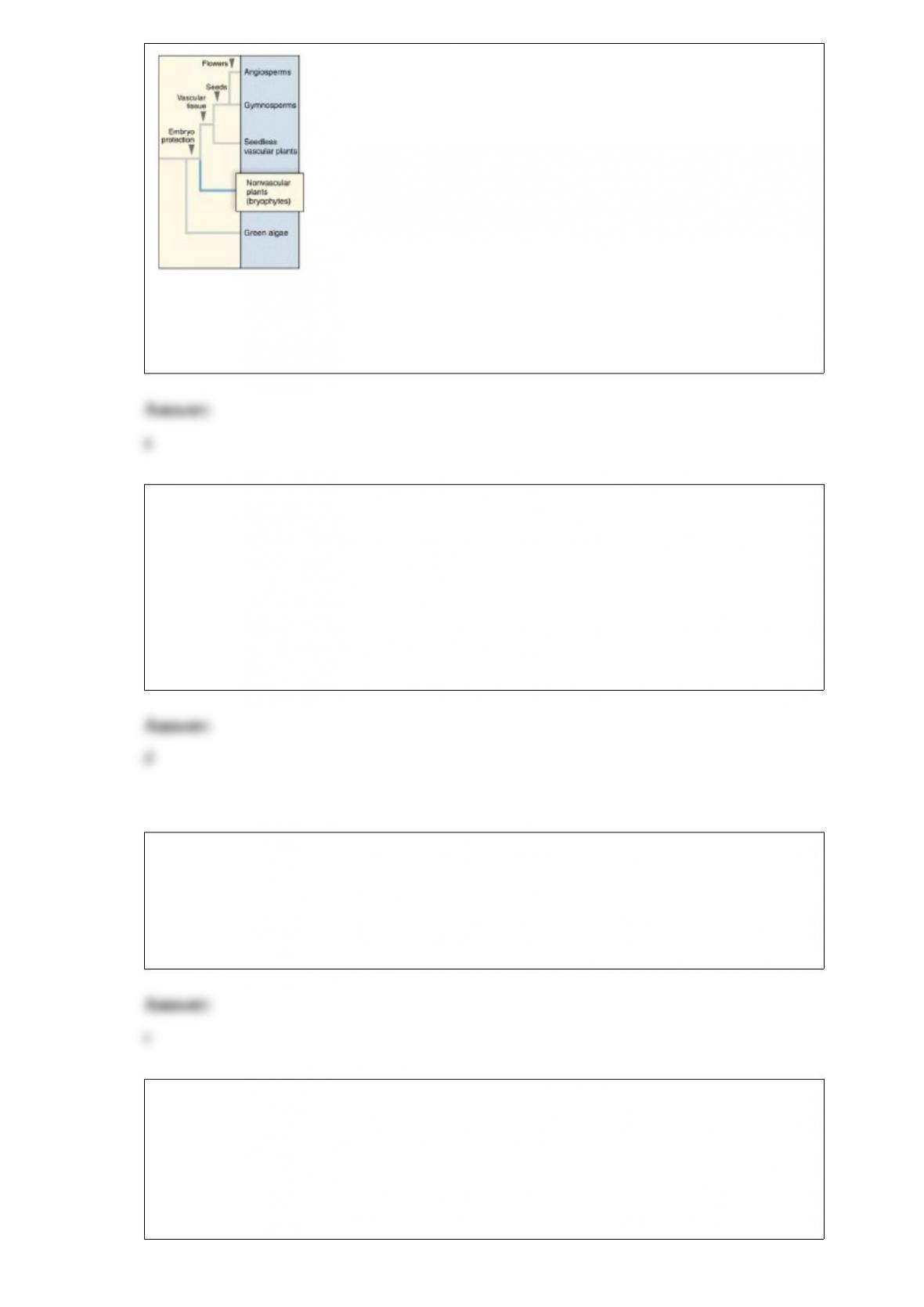
a. protection of the embryo.
b. seed production.
c. vascular tissue.
d. all of the above.
13) which of the following statements concerning homeostasis in body temperature is
not true? the body reacts to
a. heat by stimulating the sweat glands.
b. cold by contracting skeletal muscles in shivering.
c. cold by rerouting blood away from the skin.
d. heat by constricting the blood vessels in the skin.
e. all of the statements are not true.
14) a _____ is the first cell that results when an egg is fertilized by a sperm.
a. spermatogonium
b. gastrula
c. zygote
d. blastula
15) the innermost portion of a virus’ structure is made up of
a. a membranous envelope.
b. either dna or rna.
c. both dna and rna.
d. a protein capsid.
e. spikes.