
Cigarette smoking can sometimes lead to development of a ‘smoker’s cough,” which
results from paralysis of cilia in the airways. Why would the paralysis of cilia lead to
smoker’s cough?
A) Paralyzed cilia can no longer clear the airways of mucus so coughing helps remove
it.
B) Paralyzed cilia can no longer provide an immune response to protect the airways
from harmful compounds in the smoke, so coughing is used to try to prevent the
compounds from damaging the airways.
C) Paralyzed cilia lead to a nervous response that “tickles” the airways and induces
coughing.
D) Paralyzed cilia push mucus downward into the alveoli, which coughing attempts to
remove.
The organization of blood and water flow in a fish’s gills increases the fish’s ability to
A) extract oxygen from the water.
B) extract carbon dioxide from the water.
C) detect toxic materials in the water.
D) transport blood throughout the fish’s body.

Some complement proteins
A) induce antibody formation by phagocytic cells.
B) help trigger the inflammatory response.
C) are released by natural killer cells to attack cancer and virus-infected cells.
D) replace T cells in the cell-mediated response.
You recently sprayed your apartment with insecticide to remove an infestation of
cockroaches. In your kitchen, you noticed some roaches lying on their backs twitching
furiously before they died. This aroused your curiosity, so you decided to investigate
exactly how the insecticide works on the nervous system.
In your research, you discover that the insecticide you used contains a permanent
acetylcholinesterase inhibitor. Acetylcholine is a neurotransmitter that stimulates
skeletal muscle to contract. Acetylcholinesterase removes acetylcholine from the
synapse after the signal is received. Exposure to high pesticide concentrations has a
similar effect on humans, which can also be caused by exposure to the nerve gas Sarin
and other chemical agents.
Why did the insecticide cause uncontrollable twitching in the roaches?
A) Acetylcholine was released, but the insecticide prevented it from diffusing across the
synapse.
B) Acetylcholine was released, but the insecticide prevented it from binding to the
receptor sites of the postsynaptic neurons.
C) The insecticide caused continuous stimulation of the muscles.
D) The insecticide prevented acetylcholinesterase from being removed from the
synapse.

Which of the following structures develops from mesodermal tissue?
A) muscles
B) lining of the digestive tract
C) skin
D) nervous system
Carbon fixation
A) occurs when carbon atoms from CO2 are incorporated into an organic molecule.
B) supplies the cell with ATP.
C) occurs during the light reactions.
D) provides the cell with a supply of NADPH molecules.
Both prokaryotic and eukaryotic cells use ________ to turn certain genes on or off.
A) RNA transcriptase
B) intron segments
C) proteins
D) nucleosome packing
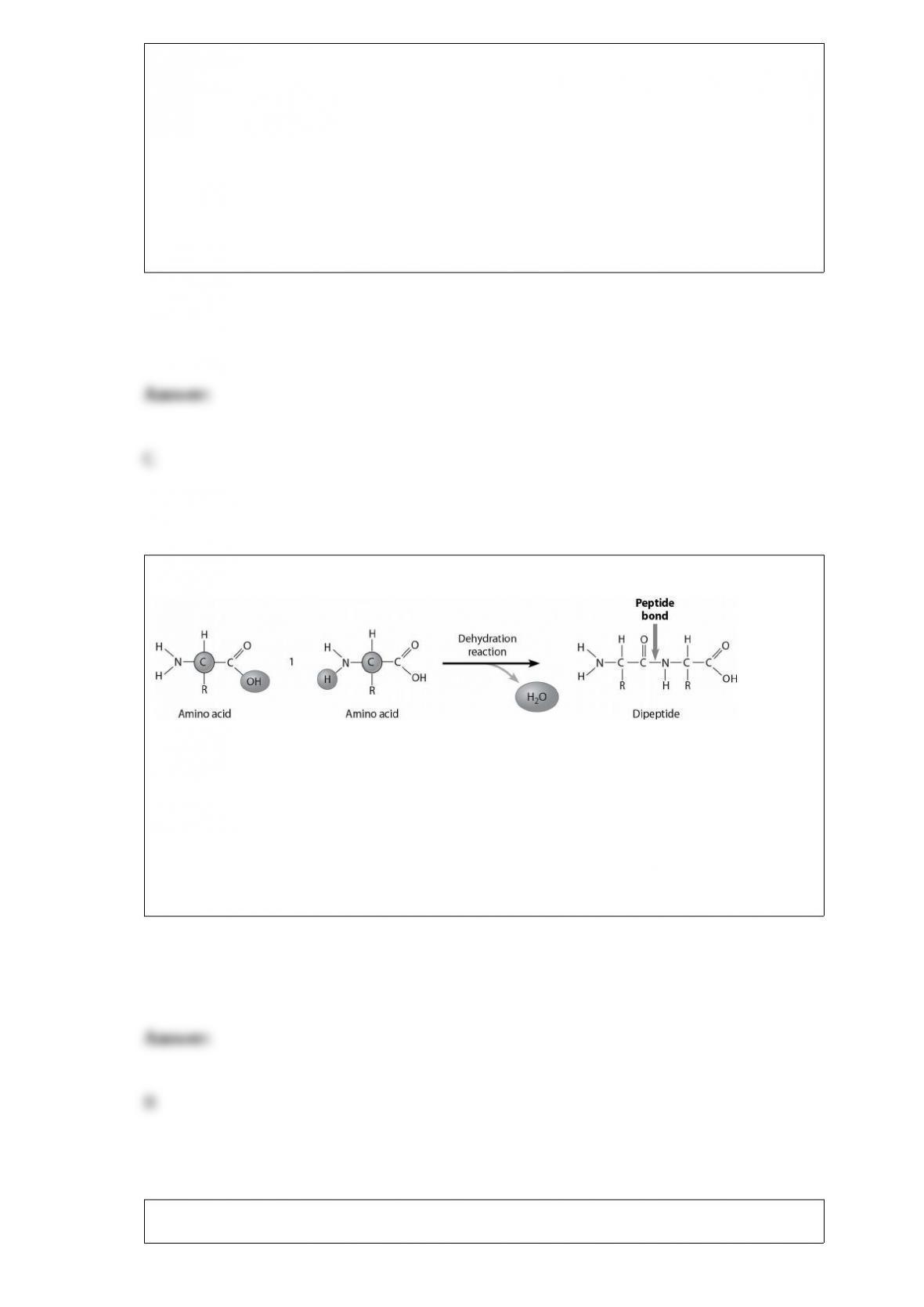
How are these two amino acids attached together?
A) amino group to amino group
B) amino group to carboxylic acid group
C) carboxylic acid group to carboxylic acid group
D) through a hydrolysis reaction
Oxygen crosses a plasma membrane by

A) osmosis.
B) active transport.
C) pinocytosis.
D) passive transport.
According to the “new” revised phylogeny based on genetic analyses, annelids are a
member of the Lophotrochozoa and are most closely related to which of the following
groups?
A) echinoderms
B) molluscs
C) cnidarians
D) arthropods
The ability to change phenotype in response to local environmental conditions is called
A) genetic drift.
B) mutation.

C) alteration of generations.
D) phenotypic plasticity.
Many names for sugars end in the suffix
A) -acid.
B) -ose.
C) -hyde.
D) -ase.
Most of the world’s deserts are located at latitudes where
A) hot, dry air moving toward the equator rises.
B) hot, dry air moving toward the poles rises.
C) cold, dry air moving toward the poles descends.
D) cold, dry air moving toward the equator descends.

In the reaction A → B + C + heat,
A) there is a net input of energy.
B) the potential energy of the products is greater than that of the reactant.
C) the potential energy of the products is less than that of the reactant.
D) entropy has decreased.
Some friends are trying to make wine in their basement. They’ve added yeast to a sweet
grape juice mixture and have allowed the yeast to grow. After several days they find
that sugar levels in the grape juice have dropped, but there’s no alcohol in the mixture.
The most likely explanation is that
A) the mixture needs more sugar because yeast need a lot of energy before they can
begin to produce alcohol.
B) the mixture needs less oxygen because yeast only produce alcohol in the absence of
oxygen.
C) the mixture needs more oxygen because yeast need oxygen to break down sugar and
get enough energy to produce alcohol.
D) the yeast used the alcohol as a carbon source.
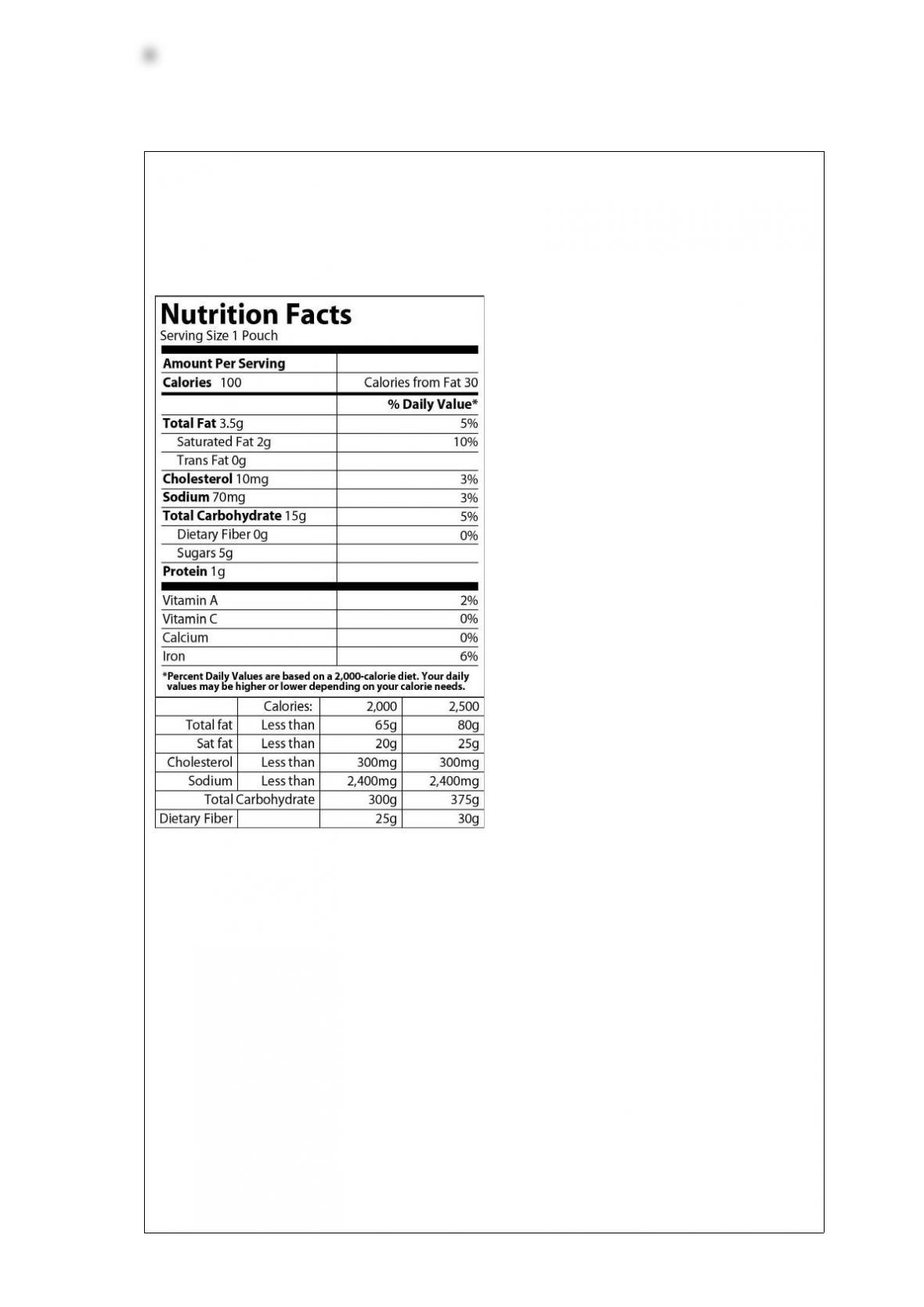
Consider the following food label and then answer the questions that follow.
Krispy Krackers 100-Calorie Pouches
You are trying to cut down on the number of dessert foods that you eat as one effort
toward losing weight. You don’t feel ready to cut all sweets from your diet, so you
decide to buy a dessert snack item that comes in small packages (hoping that the
smaller amount will satisfy your cravings for sweet foods). In the grocery store, you
study the label above for 100-calorie pouches of Krispy Krackers.
According to the Krispy Kracker label, which of the following contains the highest
percentage of nutrients needed for human diets?
A) calcium
B) iron
C) sodium
D) cholesterol

A gene that can cause cancer when present in a single copy in a cell is called a(n)
A) oncogene.
B) enhancer gene.
C) carcinogen.
D) proto-oncogene.
Which of the following organisms can make organic molecules from water and carbon
dioxide?
A) bear
B) mushroom
C) wheat
D) crayfish

Any change in the nucleotide sequence of DNA is called
A) a mutation.
B) a mutagen.
C) a base substitution.
D) an anticodon.
________ increase the surface area of roots.
A) Plasmodesmata
B) Cell walls and endoplasmic reticulum
C) Casparian strips
D) Root hairs
Regulation of the passage of food from the stomach is accomplished by
A) peristalsis.
B) nutrient absorption.

C) sphincters.
D) the stomach lining.
Which of the following is not an expected outcome of global climate change?
A) extreme weather patterns
B) lower sea levels
C) spread of tropical diseases
D) increased extinction rates
Brittany’s family includes several individuals with a genetic disorder that affects
primarily males. Her husband Tony has no history of the disease. They have decided
that their best chance to have a healthy family is to have only daughters. Through a new
type of assisted reproductive technology, it is possible to separate sperm that will
produce sons from those that will produce daughters. Brittany’s eggs will be fertilized
by in vitro fertilization (IVF) with sperm that can produce only daughters. The
developing female embryo can be implanted into her uterus to complete development
normally.
For IVF to be completed successfully, several ________ should be removed from
Brittany’s ovaries.

A) primary oocytes
B) secondary oocytes
C) follicles
D) endometrial fragments
Which of the following is a function of the human urinary system?
A) detoxification
B) elimination of undigested foods
C) maintenance of water balance
D) production of ammonia
Generally speaking, fluids in plants are
A) pushed through phloem and pulled through xylem.
B) pushed through xylem and pulled through phloem.
C) pulled through both xylem and phloem.
D) actively pumped throughout the plant.
Chlorophyll b
A) is best at absorbing the energy of green light.
B) is best at absorbing the energy of blue-violet and red light, just like chlorophyll a.
C) passes absorbed energy to chlorophyll a.
D) catalyzes the incorporation of carbon atoms into RuBP.
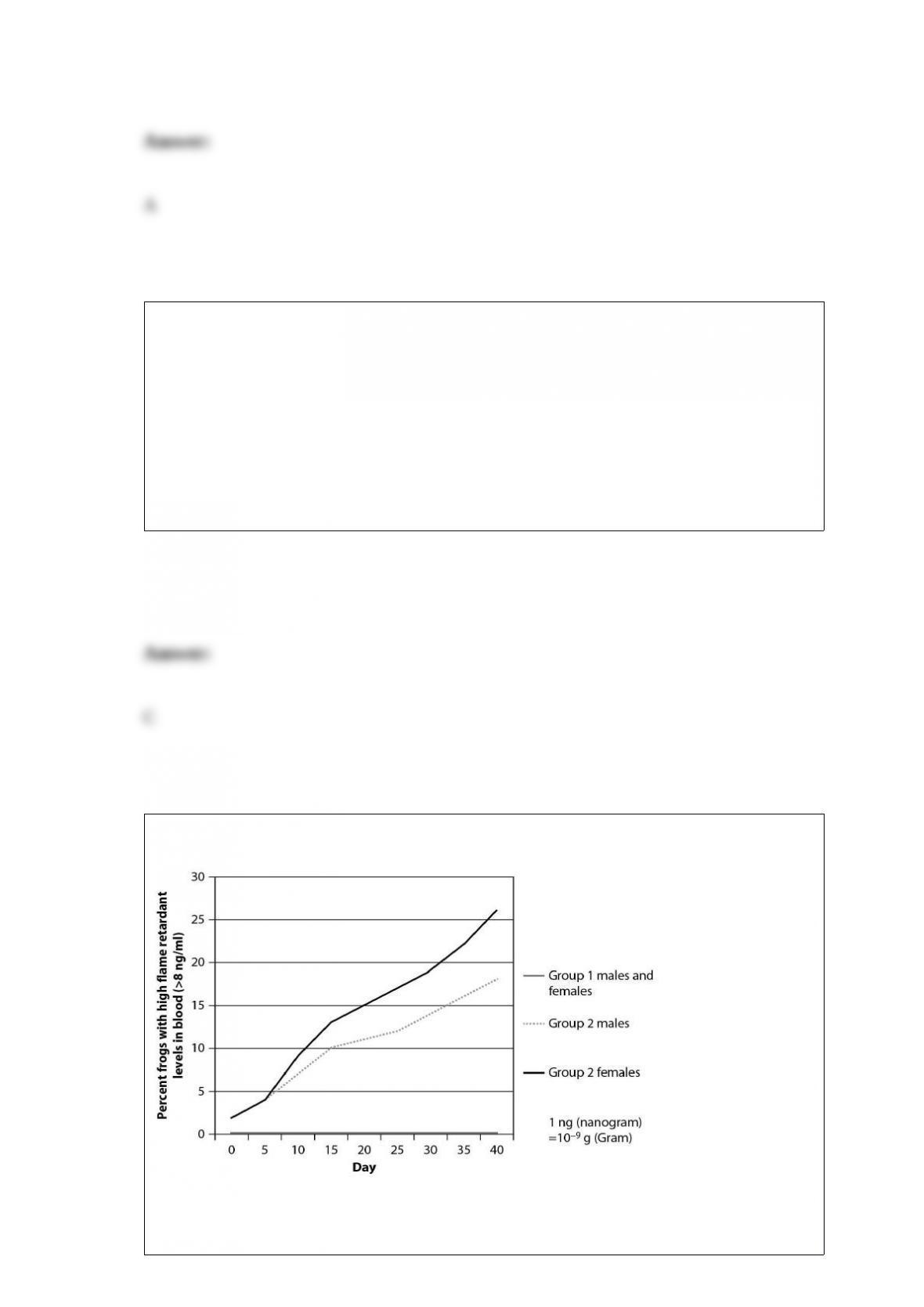
Results of the experiment yield the data shown in the following graph.
The figure shows percentage of male and female frogs with flame retardants in their
blood in two groups: Group 1 was not exposed to flame retardants, and group 2 was
exposed to low doses.

What is one overall conclusion that you can draw from these results?
A) There was no noticeable difference between the male and female frogs in group 2 in
percentage of frogs with high retardant levels.
B) As compared to the group 1 male frogs, group 1 female frogs had a lower percentage
of frogs with high retardant levels.
C) As compared to the group 2 female frogs, there were a lower percentage of group 2
male frogs with high levels of flame retardants in their blood.
D) As compared to the group 2 male frogs, there were a lower percentage of group 2
female frogs with high levels of flame retardants in their blood.
Osteoporosis has long been recognized as a problem for women after menopause, but it
is also emerging as a health concern for
A) women in their 20s and 30s.
B) teenage men.
C) men over the age of 65.
D) men and younger people in general.
Which of the following enzymes catalyzes the elongation of a new DNA strand?

A) helicase
B) ligase
C) single-stranded binding protein
D) DNA polymerase
Which of the following is a characteristic of eudicots?
A) parallel leaf venation
B) vascular bundles scattered throughout the stem
C) a flower with six petals
D) a taproot system
A manufacturing company dumps its wastes into a nearby pond. One of the wastes is
found to paralyze the contractile vacuoles of certain protists. A biologist looking at
individual samples of these organisms taken from the pond would find that they
A) have lost water and shrunk.
B) have gained water and burst.

C) have died of malnutrition.
D) have died because wastes have built up in the cytoplasm.
The basic function of activated T cells is to battle
A) pathogens in blood or lymph.
B) pathogens in interstitial fluid.
C) pathogens that have already entered body cells.
D) chemical mediators of immunity.
The kind of vegetation in a tropical rain forest is generally determined by the amount of
A) rainfall.
B) organic material in the soil.
C) minerals in the soil.
D) light.