
A buffer
A) is an acid that is used to offset overly basic conditions in the body.
B) is a base that is used to offset overly acidic conditions in the body.
C) donates H+ ions when conditions become too basic and accepts H+ ions when
conditions become too acidic.
D) donates OH– ions when conditions become too basic and accepts OH– ions when
conditions become too acidic.
A drug is tested in the laboratory and is found to create holes in both mitochondrial
membranes. Scientists suspect that the drug will be harmful to human cells because it
will inhibit
A) the citric acid cycle.
B) oxidative phosphorylation.
C) glycolysis.
D) the citric acid cycle and oxidative phosphorylation.
The skin is the body’s largest organ. It’s made up of many different types of cells. Oils,
produced by the sebaceous glands, prevent the skin from drying and splitting. The
protein melanin, produced by melanocytes in the epidermis, protects the skin from the

harmful effects of ultraviolet radiation. Sweat, released through ducts to the skin
surface, helps to cool the body. The types of cells that produce these compounds have
different numbers of specific organelles, depending on their function.
The oil from the sebaceous glands is produced by which of the following cell
organelles?
A) ribosomes
B) rough endoplasmic reticulum
C) cell membrane
D) smooth endoplasmic reticulum
The “Ironman” is a version of the triathlon, a race that includes three events: swimming,
bicycling, and running. In an Ironman, an athlete must swim 2.4 miles, bike 112 miles,
and run 26.2 miles, in that order, without a break. The annual Ironman World
Championship is held in Hawaii every year. The men’s course record was set in 2011 by
Australia’s Craig Alexander with a time of 8 hours, 18 minutes, and 37 seconds, and the
women’s course record was set in 2009 by England’s Chrissie Wellington with a time of
8 hours, 54 minutes, and 2 seconds.
What type of energy would the leg muscles of athletes that enter this race use during the
final 26.2-mile foot race?
A) stored ATP and PCr
B) aerobic respiration
C) stored ATP and PCr plus lactic acid fermentation
D) lactic acid fermentation
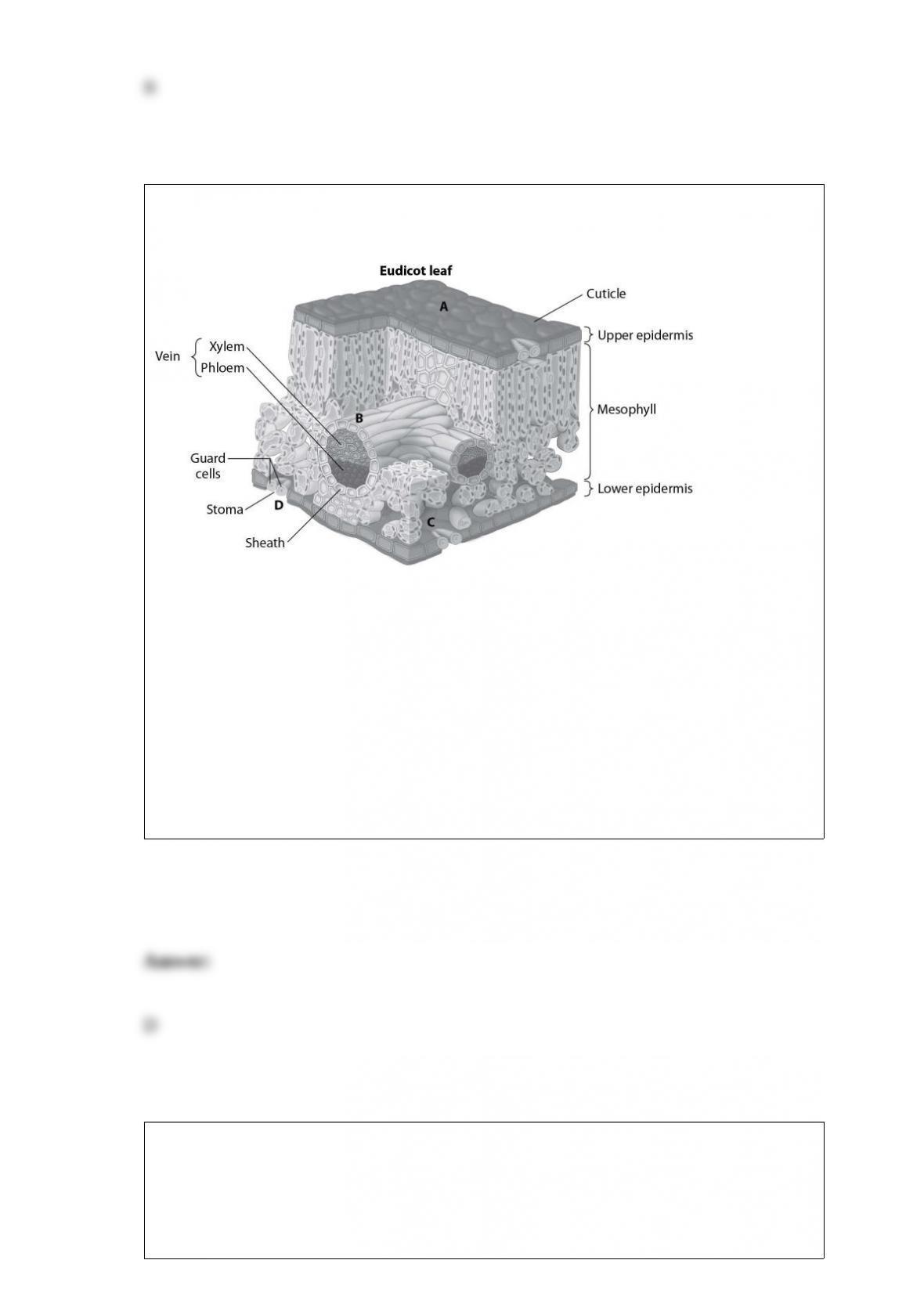
In the figure above, which structure can change to regulate the amount of CO2 entering
the leaf?
A) structure A
B) structure B
C) structure C
D) structure D
Which of the following statements about the domain Bacteria is true?
A) Archaea belong to this domain.
B) All bacteria have a membrane-bound nucleus.

C) All bacteria are multicellular organisms.
D) All bacteria lack a nucleus.
In the process of human gene cloning using plasmids, the bacterial plasmid
A) is used as the vector.
B) is the source of the gene to be cloned.
C) is cultured inside the human cell, which contains the gene to be cloned.
D) is used to insert the human gene into the bacterial chromosome.
In secondary endosymbiosis, a/an ________ became endosymbiotic in a/an ________.
A) autotrophic prokaryote; heterotrophic eukaryotic protist
B) heterotrophic prokaryote; autotrophic eukaryotic protist
C) heterotrophic eukaryotic protist; autotrophic heterotrophic protist
D) autotrophic eukaryotic protist; heterotrophic eukaryotic protist

To obtain energy from starch and glycogen, the body must begin by
A) hydrolyzing the starch to glucose and the glycogen to amino acids.
B) hydrolyzing both starch and glycogen to glucose.
C) converting both starch and glycogen to fatty acids.
D) removing one glucose at a time with a condensation reaction.
Home pregnancy test kits can detect whether a woman is pregnant within one to three
weeks of her egg being fertilized. The test kits include a short strip of paper that extends
from a plastic case. After a woman urinates on the strip of paper and waits three to five
minutes, a symbol is displayed on a small window in the plastic case. Some tests show
a single line to indicate the woman is not pregnant (negative result) and two lines to
indicate she is pregnant (positive result). Others show a minus or plus sign (or some
other variation) to indicate negative and positive results.
The test reports a positive symbol if it detects the presence of HCG in the woman’s
urine. In order for HCG to be detected, it must be present in the urine at a concentration
of at least 10 to 100 units per milliliter. Even though home pregnancy tests are well
designed and have been tested extensively, false negative and false positive results do
occur. A false positive occurs when a test tells a woman that she is pregnant when she
really is not, and a false negative occurs when a test tells a woman that she is not
pregnant when she really is. Most home pregnancy test kit manufacturers claim that
their tests are over 99% accurate.
If you were designing a home pregnancy test kit, which of the following statements
would you include in the instructions in an attempt to minimize false positive results?

A) If you are taking fertility drugs containing hormones, have your physician validate
the results.
B) Take the test, and 3 hours later check the results of the test.
C) Wait at least a week after missing the start of your menstrual cycle to take the test.
D) If you are taking fertility drugs containing androgens, have your physician validate
the results.
Which of the following lines of evidence suggests that lungfishes evolved while
Pangaea was intact?
A) Modern lungfishes on different continents show similar patterns of behavior.
B) Lungfishes are found today in Africa, Australia, and South America.
C) Fossil lungfishes have been found on every continent except Antarctica.
D) Lungfishes are restricted to Australia and neighboring islands.
Examine the age structure of Germany in the figure below. Which of the following
statements is not supported by the age structure?

A) There will be large positive population growth in the near future.
B) There are more women than men between the ages of 60 and 70.
C) There will be small negative population growth in the near future.
D) There are more people between the ages of 25 to 39 then between 0 and 14.
Which of the following hormones stimulates and maintains metabolic processes?
A) calcitonin
B) thyroxine
C) oxytocin
D) melatonin

Which of the following statements regarding sexual reproduction is true?
A) Sexual reproduction creates an individual that is a genetic copy of one parent.
B) Sexual reproduction generates greater genetic variation than asexual reproduction.
C) Sexual reproduction allows animals to expand their populations faster than asexual
reproduction.
D) Populations of organisms that reproduce through sexual reproduction generally have
more difficulty adapting to changing environments.
To protect U.S. soldiers serving overseas, each soldier receives vaccinations against
several diseases, including smallpox, before deployment. Following intelligence about
an imminent smallpox threat in Iraq, the U.S. Army wants to ensure that soldiers
stationed there are fully protected from exposure to the disease, so all the soldiers in the
threat zone are given a second vaccination against smallpox.
The second vaccination is beneficial because
A) it contains plasma cells that survive longer than 45 days.
B) it stimulates production of a higher concentration of antibodies in the bloodstream.
C) it requires two injections to stimulate antibody formation.
D) it keeps previously produced plasma cells circulating in the bloodstream.

Which of the following is not a potential advantage of asexual reproduction?
A) It allows animals that do not move around to produce offspring without finding
mates.
B) It saves the time and energy required to produce gametes.
C) It produces genetically diverse populations.
D) It allows animals that are genetically well suited to a particular environment to
quickly expand their populations.
Genomic libraries can be constructed using either bacterial plasmids or what other
vector?
A) ribosomes
B) tRNA
C) human chromosomes
D) bacteriophages
Which of the following statements about erythrocytes is true?
A) The main function of erythrocytes is to carry nutrients.
B) Erythrocytes are shaped like biconcave disks.
C) Each erythrocyte contains about 1 million molecules of hemoglobin.
D) Erythrocytes in adult humans have nuclei.
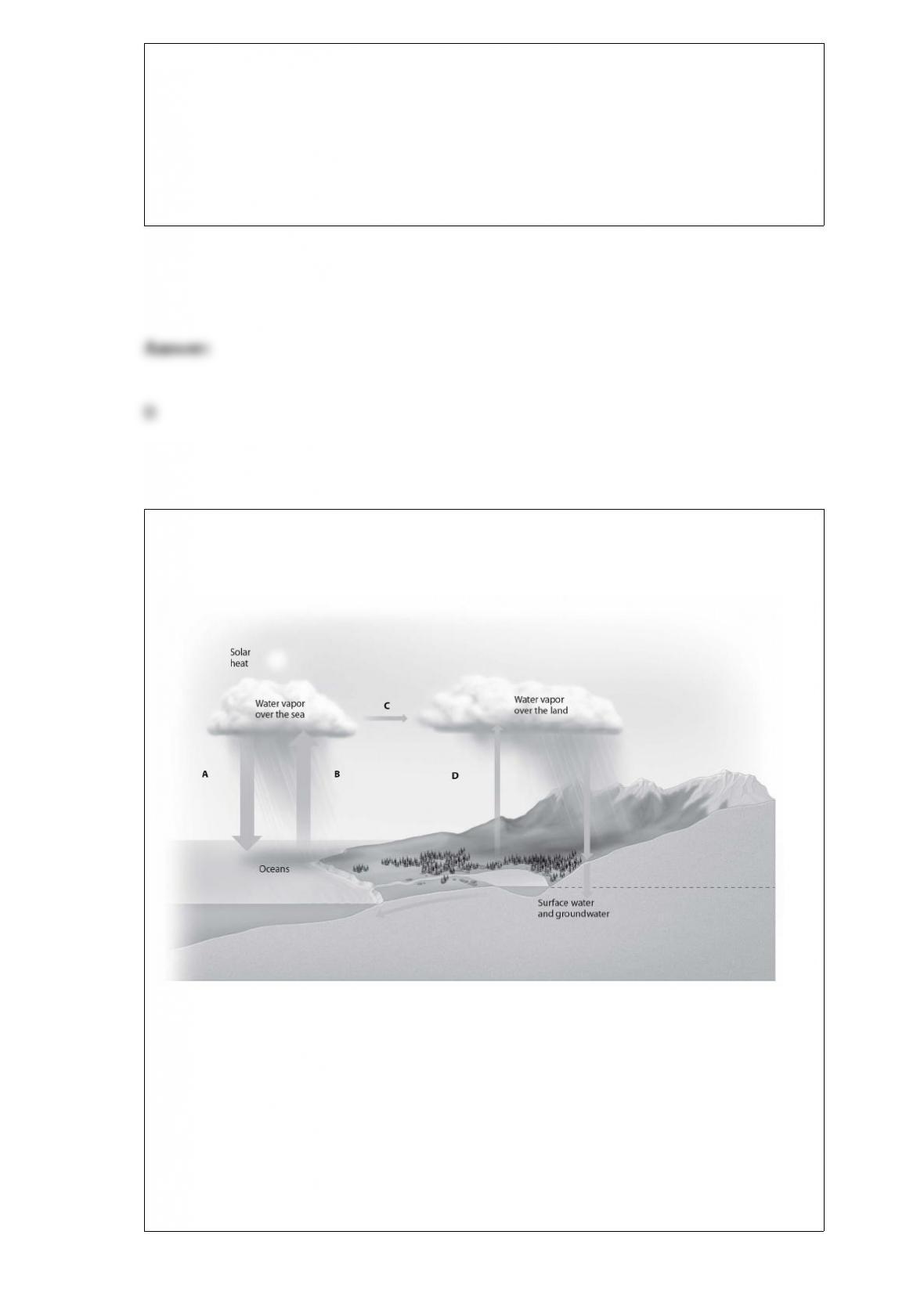
Which arrow in this image of the global water cycle includes transpiration?
A) arrow A
B) arrow B
C) arrow C
D) arrow D

The relationship between DNA and chromosomes is most like
A) an egg yolk inside of an egg.
B) a spoon cradling some peas.
C) thread wrapped around a spool.
D) the candy shell surrounding the chocolate in a piece of M&M candy.
Which of the following trace elements needed by humans is commonly added to table
salt?
A) iodine
B) iron
C) magnesium
D) fluoride

Which characteristic promoted the utilization of lipids as the first cell membrane?
A) spontaneous degradation of the intracellular environment
B) self-assembly into a simple membrane
C) ability to form an impermeable membrane
D) formation of a semi-solid membrane
The restriction enzyme BamHI recognizes the DNA sequence GGATCC and always
cuts between the two G nucleotides. How many bases long is the sticky end of a DNA
molecule that has been cut with BamHI?
A) two
B) three
C) four
D) five
Lampreys differ from fishes in that lampreys
A) lack a backbone.

B) lack an endoskeleton.
C) lack jaws.
D) possess a backbone and skull.
A common aspect of having a cold is nose congestion (‘stuffy nose”). Air is not able to
flow past your olfactory receptors, so you cannot detect smells. When eating, it is
olfactory receptors, and not taste receptors, that detect the smells of your food and
relate those to your brain as flavors.
Suppose you are trying to convince your sick child to drink some medicine that he
knows does not taste good. You tell him to hold his nose while he drinks it because that
will help take the bad taste away. Does your statement have any truth to it?
A) Yes. Holding your nose allows you to detect multiple tastes at one time.
B) Yes. Holding your nose increases production of glutamate.
C) Yes. Holding your nose dulls the sensitivity of taste receptors.
D) Yes. Holding your nose has the same effect as having a congested nose.
Plants and fungi first became established on land during the
A) Archaean.

B) Proterozoic.
C) Paleozoic.
D) Cenozoic.
Which of the following is an immediate effect of histamine release?
A) dilation of local blood vessels
B) blocking of a response to ragweed pollen
C) conversion of histamine to histidine
D) increase in blood pressure
How do mineral ions get into the xylem cells of a plant root by way of the intracellular
route?
A) They percolate between root cells to the xylem and then enter a xylem vessel.
B) They are actively taken in to the xylem of root hairs.
C) They are taken up by root hair cells and transferred from cell to cell via
plasmodesmata.

D) They move in solution through cell walls of the endodermis.
Which of the following helps maintain the structure of chromosomes and control the
activity of genes?
A) the nuclear membrane
B) proteins
C) centromeres
D) ribosomes
After reading the paragraphs below, answer the questions that follow.
Scientists believe that a shift from pollination by insects to pollination by birds occurred
several times over the course of angiosperm evolution. Two researchers designed an
experiment to investigate how these shifts might evolve using two species of monkey
flower (Mimulus spp.). M. lewisii has violet-pink flowers and is pollinated by
bumblebees. M. cardinalis has orange-red flowers and is pollinated by hummingbirds.
The researchers switched flower-color genes between the two species. As a result of the
gene transfer, they produced a variation of M. cardinalis with dark pink flowers (instead
of the original orange-red) and a variation of M. lewisiis with orange flowers (instead of
the original violet-pink). Plants of both genetically altered varieties were placed in their

original habitats and observed. The genetically altered variety of M. cardinalis was
visited by bumblebees 74 times more often than plants with the original color flowers.
The genetically altered variety of M. lewisii was visited by hummingbirds 68 times
more often than plants with the original color flowers.
The evolution of easily modified flower colors that can make plants attractive to
animals was an important factor in angiosperm evolution because
A) plants have no way to cross-pollinate without the intervention of animals.
B) animals are more effective at delivering pollen to other flowers than is the wind.
C) flower color attracts animals that can disperse the seeds of the plant.
D) successful evolution requires interactions between plants and animals.
Glucocorticoids help reduce inflammation, but they can also cause liver cells to produce
extra sugar. This could lead to high blood sugar levels and bring about steroid-produced
________.
A) gigantism
B) androgen insensitivity
C) hyperthyroidism
D) diabetes mellitus

One way that substances move between blood and interstitial fluid is by
A) alternatively breaking and regenerating membranes of cells lining capillaries.
B) osmosis.
C) pressure-driven flow through clefts between the epithelial cells of the capillary wall.
D) active transport utilizing ATP.
Earthworms crawl by
A) undulating from side to side.
B) peristalsis.
C) the leg-like action of their belly scales.
D) pushing themselves forward from the tail.
Inhibition of an enzyme is irreversible when
A) a competitive inhibitor is involved.
B) a noncompetitive inhibitor is involved.
C) the shape of the enzyme is changed.

D) covalent bonds form between inhibitor and enzyme.