
Which of the following statements is a correct explanation for the observation that all
offspring exhibit a phenotype for a particular trait that appears to be a blend of the two
parental varieties?
A) Neither of the parental genes is dominate over the other.
B) The genes for the trait are dominant in both of the parents.
C) The genes are linked and do not separate during meiosis.
D) The genes for the trait are recessive in both of the parents.
Which of the following is present in a prokaryotic cell?
A) mitochondrion
B) ribosome
C) chloroplast
D) ER
Changes in the shape of a cell usually involve a reorganization of the _____.
A) nucleus
B) cytoskeleton

C) extracellular matrix
D) transport proteins
What type of signal is long-lasting and works at night?
A) olfactory
B) visual
C) auditory
D) electrical
You observe scrub jays hiding food and notice that one particular individual only
pretends to hide food. What kind of experiment could you perform to test whether this
behavior was random or in response to another signal?
A) Observe more of these behaviors in the wild and try to determine if the behavior is
random.
B) Hypothesize a set of signals that could produce this behavior and try to match the
behaviors with the signals.
C) Attempt to reproduce the behavior in captivity by using bird models and a computer
simulation.

Scaffolding proteins are _____.
A) microtubular protein arrays that allow lipid-soluble hormones to get from the cell
membrane to the nuclear pores
B) large molecules to which several relay proteins attach to facilitate cascade effects
C) relay proteins that orient receptors and their ligands in appropriate directions to
facilitate their complexing
D) proteins that can reach into the nucleus of a cell to affect transcription
In a cool environment, an ectotherm is more likely to survive an extended period of
food deprivation than would an equally sized endotherm because the ectotherm _____.
A) maintains a higher basal metabolic rate
B) expends more energy per kilogram of body mass than does the endotherm
C) invests little energy in temperature regulation
D) has greater insulation on its body surface

How do cells at the completion of meiosis compare with cells that are in prophase of
meiosis I? They have _____.
A) half the number of chromosomes and half the amount of DNA.
B) the same number of chromosomes and half the amount of DNA.
C) half the number of chromosomes and one-fourth the amount of DNA.
D) half the amount of cytoplasm and twice the amount of DNA.
Most of the ATP supplies for a skeletal muscle undergoing one hour of sustained
exercise come from _____.
A) creatine phosphate
B) glycolysis
C) substrate phosphorylation
D) oxidative phosphorylation

Which of the following types of organisms is likely to have the widest geographic
distribution?
A) bacteria
B) songbirds
C) bears
D) lizards
Many terrestrial arthropods exchange gases with their environments by using tracheae,
tubes that lead from openings (called spiracles) in the animal’s exoskeleton or cuticle
directly to the animal’s tissues. Some arthropods can control whether their spiracles are
opened or closed; opening the spiracles allows the carbon dioxide produced in the
tissues to travel down the tracheae and be released outside the animal. Klok et al.
measured the carbon dioxide emitted over time (represented by ) by several
species of centipedes. The figure below presents graphs of their results for two species,
Cormocephalus morsitans and Scutigerina weberi. (C. J. Klok, R. D. Mercer, and S. L.
Chown. 2002. Discontinuous gas-exchange in centipedes and its convergent evolution
in tracheated arthropods. Journal of Experimental Biology 205:1019-29.) Copyright
2002 The Company of Biologists and the Journal of Experimental Biology.
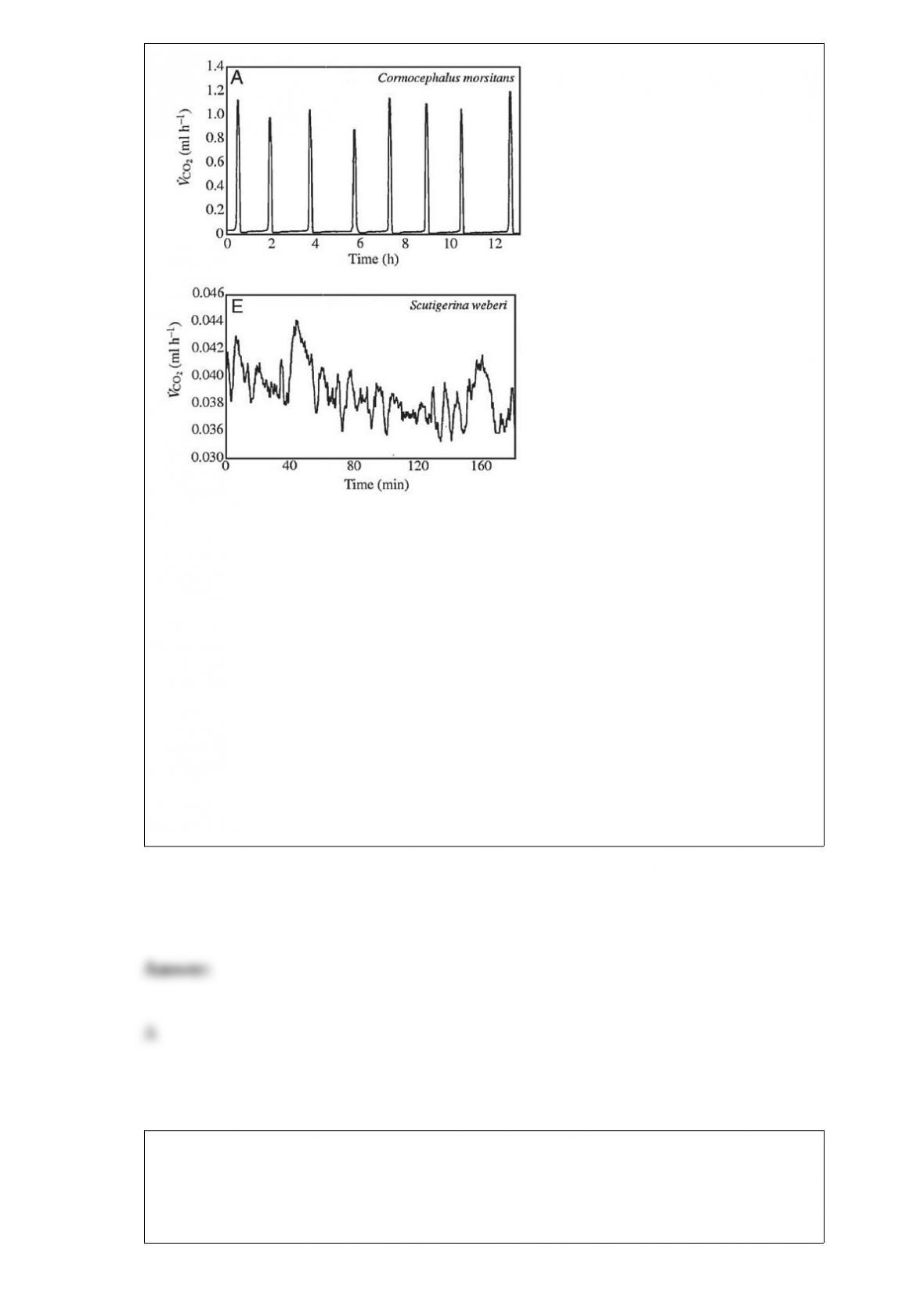
Look at the graph for Scutigerina weberi (note the scale of the y-axis) in the figure
above. What is the best interpretation of these results?
A) The centipede had its spiracles open the entire time.
B) The centipede had its spiracles closed the entire time.
C) The centipede had its spiracles open when carbon dioxide (CO2) emission peaked
and closed when CO2 emission was low.
D) The centipede had its spiracles closed when carbon dioxide (CO2) emission peaked
and open when CO2 emission was low.
Living organisms increase in complexity as they grow, resulting in a decrease in the
entropy of an organism. How does this relate to the second law of thermodynamics?
A) Living organisms do not obey the second law of thermodynamics, which states that
entropy must increase with time.
B) Life obeys the second law of thermodynamics because the decrease in entropy as the
organism grows is exactly balanced by an increase in the entropy of the universe.
C) As a consequence of growing, organisms cause a greater increase in entropy in their
environment than the decrease in entropy associated with their growth.
D) Living organisms are able to transform energy into entropy.
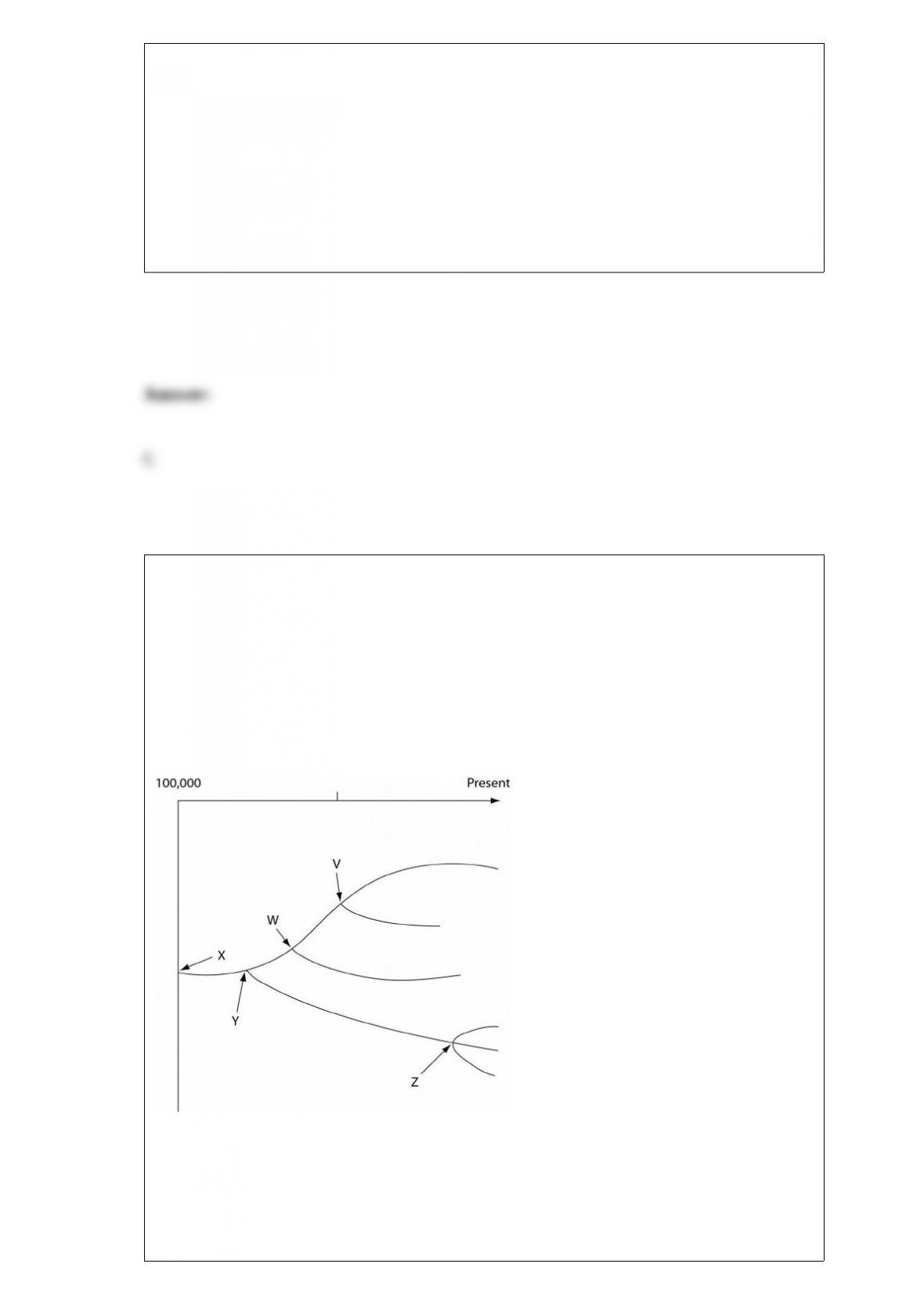
The following questions refer to the evolutionary tree in the figure below.
The horizontal axis of the cladogram depicted below is a timeline that extends from
100,000 years ago to the present; the vertical axis represents nothing in particular. The
labeled branch points on the tree (V-Z) represent various common ancestors. Let’s say
that only since 50,000 years ago has there been enough variation between the lineages
depicted here to separate them into distinct species, and only the tips of the lineages on
this tree represent distinct species.
Which of the five species, labeled V-Z, is the common ancestor of the fewest number of
species?
A) V
B) W
C) Y
D) Z
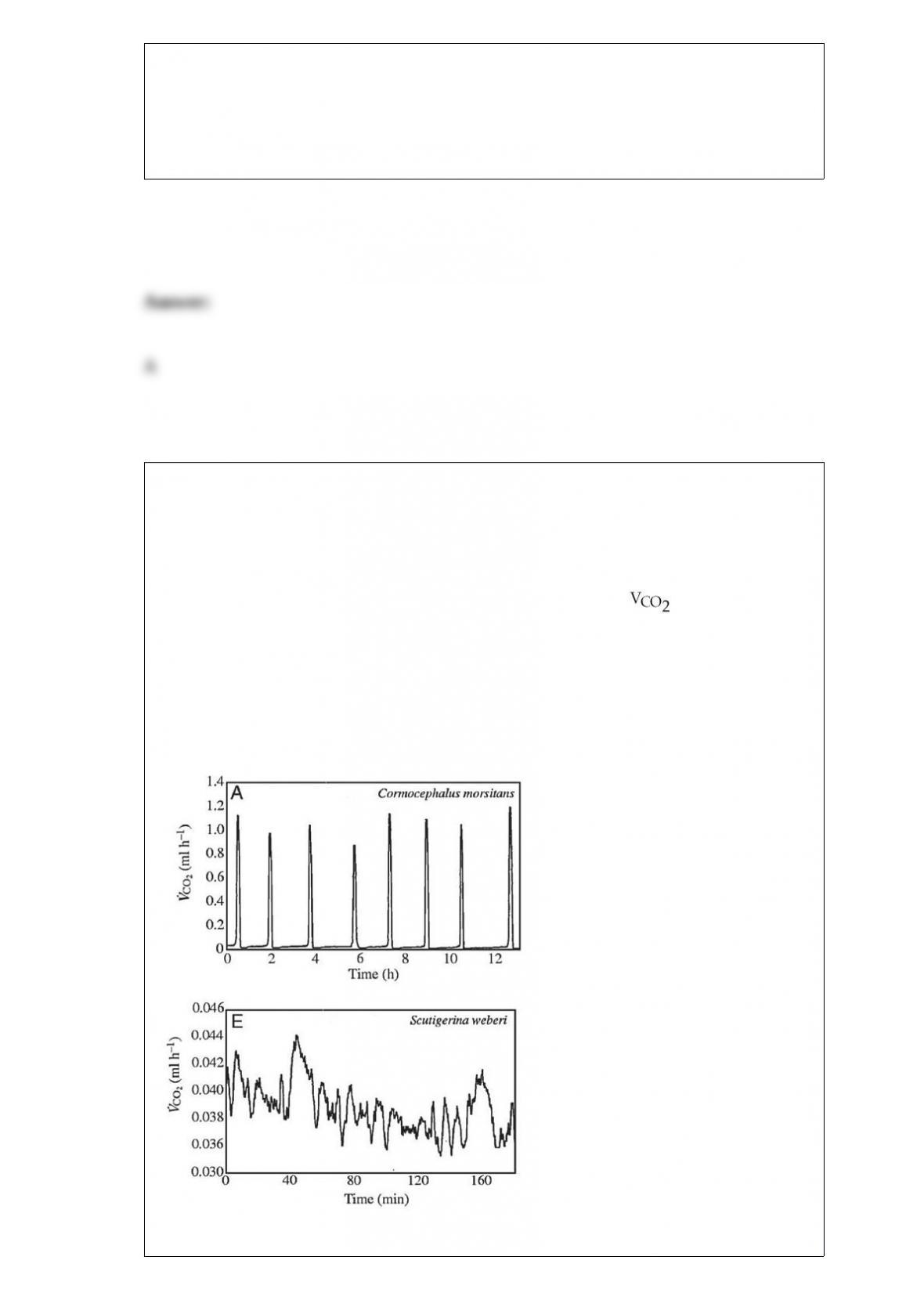
Many terrestrial arthropods exchange gases with their environments by using tracheae,
tubes that lead from openings (called spiracles) in the animal’s exoskeleton or cuticle
directly to the animal’s tissues. Some arthropods can control whether their spiracles are
opened or closed; opening the spiracles allows the carbon dioxide produced in the
tissues to travel down the tracheae and be released outside the animal. Klok et al.
measured the carbon dioxide emitted over time (represented by ) by several
species of centipedes. The figure below presents graphs of their results for two species,
Cormocephalus morsitans and Scutigerina weberi. (C. J. Klok, R. D. Mercer, and S. L.
Chown. 2002. Discontinuous gas-exchange in centipedes and its convergent evolution
in tracheated arthropods. Journal of Experimental Biology 205:1019-29.) Copyright
2002 The Company of Biologists and the Journal of Experimental Biology.

How would a terrestrial centipede most likely benefit from the ability to close its
spiracles? Closing spiracles would _____.
A) allow the centipede to move more quickly
B) allow the centipede to retain more moisture in its tissues
C) allow the centipede to stay warmer
D) allow more oxygen from the environment to reach the centipede’s tissues
With which of the following statements would a biologist be most inclined to agree?
A) Humans and other apes represent divergent lines of evolution from a common
ancestor.
B) Humans represent the pinnacle of evolution and have escaped from being affected
by natural selection.
C) Humans evolved from chimpanzees.
D) Humans and other apes are the result of disruptive selection in a species of
chimpanzee.
Extracellular glucose inhibits transcription of the lac operon by _____.
A) strengthening the binding of the repressor to the operator

B) weakening the binding of the repressor to the operator
C) inhibiting RNA polymerase from opening the strands of DNA to initiate
transcription
D) reducing the levels of intracellular cAMP
Two examples of lateral meristems in plants are _____.
A) vascular cambium, producing cork; cork cambium, producing secondary phloem
B) vascular cambium, producing secondary xylem; cork cambium, producing secondary
phloem
C) vascular cambium, producing secondary xylem; cork cambium, producing cork
D) vascular cambium, producing secondary phloem; cork cambium, producing
secondary xylem
Septic shock, a systemic response including high fever and low blood pressure, is a
response to _____.
A) certain bacterial infections
B) specific forms of viruses

C) the presence of natural killer cells
D) increased production of neutrophils
In birds, sex is determined by a ZW chromosome scheme. Males are ZZ and females are
ZW. A recessive lethal allele that causes death of the embryo is sometimes present on
the Z chromosome in pigeons. What would be the sex ratio in the offspring of a cross
between a male that is heterozygous for the lethal allele and a normal female?
A) 2:1 male to female
B) 1:2 male to female
C) 1:1 male to female
D) 3:1 male to female
In some cells, there are many ion electrochemical gradients across the plasma
membrane even though there are usually only one or two proton pumps present in the
membrane. The gradients of the other ions are most likely accounted for by _____.
A) cotransport proteins
B) ion channels
C) pores in the plasma membrane

D) passive diffusion across the plasma membrane
Increased antidiuretic hormone (ADH) secretion is likely after _____.
A) drinking lots of pure water
B) sweating-induced dehydration increases plasma osmolarity
C) eating a small sugary snack
D) blood pressure becomes abnormally high
What tissue makes up most of the wood of a tree?
A) primary xylem
B) secondary xylem
C) secondary phloem
D) vascular cambium

Metaphase is characterized by _____.
A) aligning of chromosomes on the equator
B) splitting of the centromeres
C) cytokinesis
D) separation of sister chromatids
Accuracy in the translation of mRNA into the primary structure of a polypeptide
depends on specificity in the _____.
A) binding of ribosomes to mRNA
B) binding of the anticodon to small subunit of the ribosome
C) attachment of amino acids to rRNAs
D) binding of the anticodon to the codon and the attachment of amino acids to tRNAs

Oviparous (egg-laying) animals have internal fertilization (sperm cells encounter eggs
within the female’s body). Yolk and/or albumen is (are) provided to the embryo, and a
shell is then deposited around the embryo and its food source. Eggs are subsequently
deposited in an environment that promotes their further development, or are incubated
by one or both parents.
The shell of a fertilized animal egg has what type of analog in angiosperms?
A) endosperm
B) carpels
C) fruit
D) seed coat
Which of the following mechanisms is (are) used to coordinate the expression of
multiple, related genes in eukaryotic cells?
A) Environmental signals enter the cell and bind directly to promoters.
B) The genes share a single common enhancer, which allows appropriate activators to
turn on their transcription at the same time.
C) The genes are organized into a large operon, allowing them to be coordinately
controlled as a single unit.
D) A single repressor is able to turn off several related genes.

Suppose you are studying the nitrogen cycling in a pond ecosystem over the course of a
month. While you are collecting data, a flock of one hundred Canada geese lands and
spends the night during a fall migration. What could you do to eliminate error in your
study as a result of this event?
A) Find out how much nitrogen is consumed in plant material by a Canada goose over
about a twelve-hour period, multiply this number by 100, and add that amount to the
total nitrogen in the ecosystem.
B) Find out how much nitrogen is eliminated by a Canada goose over about a
twelve-hour period, multiply this number by 100, and subtract that amount from the
total nitrogen in the ecosystem.
C) Find out how much nitrogen is consumed and eliminated by a Canada goose over
about a twelve-hour period and multiply this number by 100; enter this +/- value into
the nitrogen budget of the ecosystem.
D) Put a net over the pond so that no more migrating flocks can land on the pond and
alter the nitrogen balance of the pond.
Three-spined stickleback fish (Gasterosteus aculeatus) show substantial heritable
variation in gill-raker length related to differences in their diets. Longer gill rakers
appear to function better for capturing open-water prey, while shorter gill rakers
function better for capturing shallow-water prey. Which of the following types of
selection is most likely to be found in a large lake (open water in the middle and
shallow water around the sides) with a high density of these fish?
A) directional selection
B) stabilizing selection
C) disruptive selection
D) sexual selection

Neutral theory proposes that _____.
A) molecular clocks are more reliable when the surrounding pH is close to 7.0
B) most mutations of highly conserved DNA sequences should have no functional
effect
C) DNA is less susceptible to mutation when it codes for amino acid sequences whose
side groups (or R-groups) have a neutral pH
D) a significant proportion of mutations are not acted upon by natural selection
Which of the following events might you predict to occur if the tilt of Earth’s axis
relative to its plane of orbit was increased to degrees?
A) Summers and winters in the United States would likely become warmer and colder,
respectively.
B) Seasonal variation at the equator might decrease.
C) Both northern and southern hemispheres would experience summer and winter at the
same time.
D) Both poles would experience massive ice melts.

A number of systems for pumping ions across membranes are powered by ATP. Such
ATP-powered pumps are often called ATPases, although they do not often hydrolyze
ATP unless they are simultaneously transporting ions. Because small increases in
calcium ions in the cytosol can trigger a number of different intracellular reactions, cells
keep the cytosolic calcium concentration quite low under normal conditions, using
ATP-powered calcium pumps. For example, muscle cells transport calcium from the
cytosol into the membranous system called the sarcoplasmic reticulum (SR). If a resting
muscle cell’s cytosol has a free calcium ion concentration of 10-7 while the
concentration in the SR is 10-2, then how is the ATPase acting?
A) ATPase activity must be powering an inflow of calcium from the outside of the cell
into the SR.
B) ATPase activity must be transferring i to the SR to enable this to occur.
C) ATPase activity must be pumping calcium from the cytosol to the SR against the
concentration gradient.
D) ATPase activity must be opening a channel for the calcium ions to diffuse back into
the SR along the concentration gradient.
Fight-or-flight reactions include activation of the _____.
A) parathyroid glands, leading to increased metabolic rate
B) anterior pituitary gland, leading to cessation of gonadal function
C) adrenal medulla, leading to increased secretion of epinephrine
D) pancreas, leading to a reduction in the blood sugar concentration
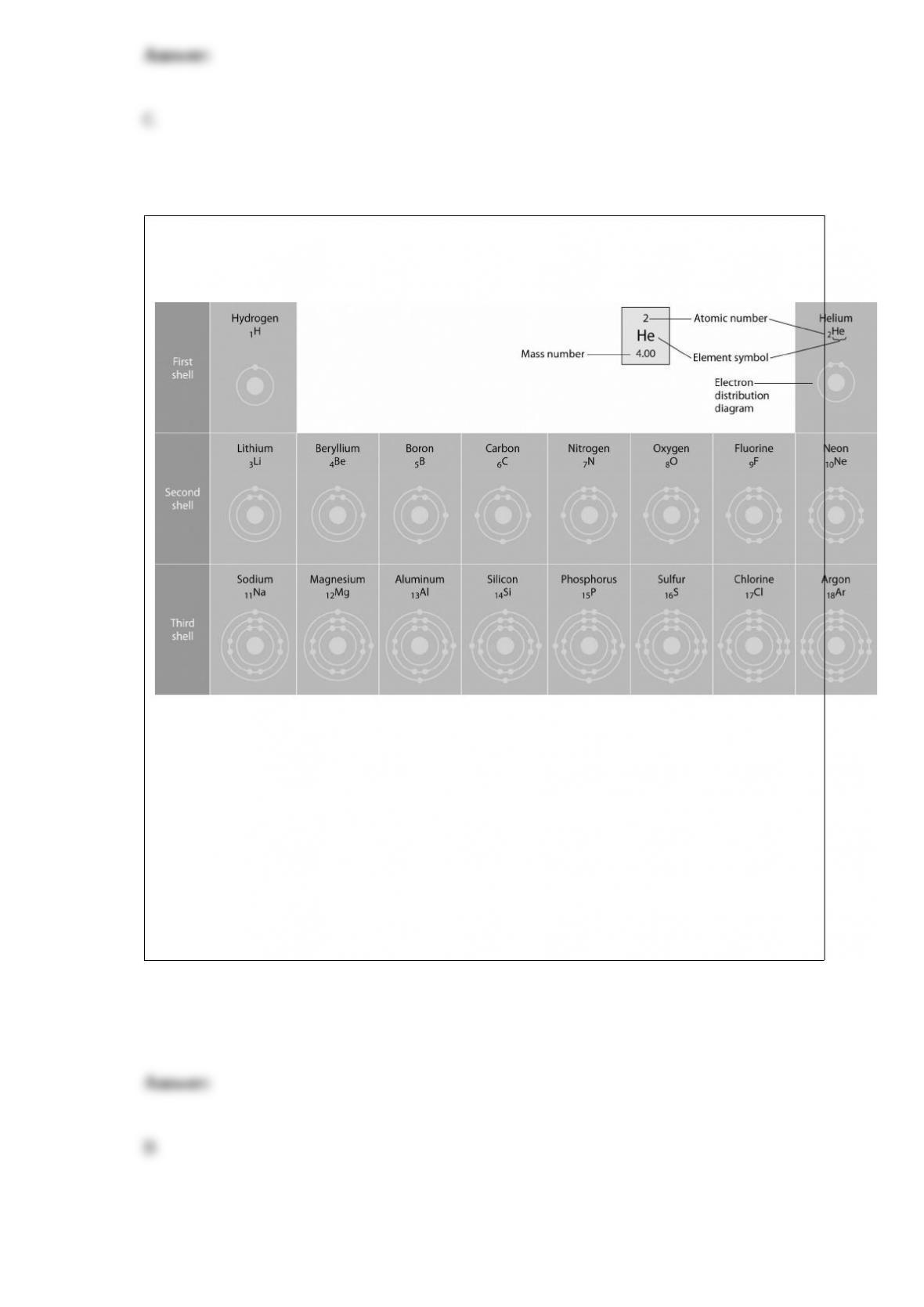
Refer to the following figure to answer the questions below.
Refer to the figure above (first three rows of the periodic table). What element has
properties most similar to carbon?
A) boron
B) silicon
C) nitrogen
D) phosphorus

When comparing root systems of corn plants growing on a square foot in a cornfield
with the root systems of natural prairie plants growing in a meadow, what result do you
expect to see?
A) The overall mass of roots will be identical in a cornfield and on a meadow.
B) The mass and length of roots in a cornfield will be higher because soil is fertilized.
C) The mass and length of roots on a meadow will be higher because soil is poorer and
there is higher diversity of plants.
D) The overall mass of roots on a meadow will be lower, but the length will be higher
since roots need to grow deeper to reach nutrients.
Which of the following statements concerning animal taxonomy is (are) true?
1. Animals are more closely related to plants than to fungi.
2. All animal clades based on body plan have been found to be incorrect.
3. Kingdom Animalia is monophyletic.
4. Animals only reproduce sexually.
5. Animals are thought to have evolved from flagellated protists similar to modern
choanoflagellates.
A) 1 and 2
B) 3 and 5
C) 3, 4, and 5
D) 2 and 4