1) The two cues that barn owls use to localize sounds are
a.echolocation and interaural time.
b.interaural time and interaural intensity.
c.interaural intensity and interaural frequency.
d.interaural frequency and echolocation.
2) Which of the following cells devour and remove damaged brain cells?
a.astrocytes
b. microglia
c.oligodendrocytes
d. Schwann cells
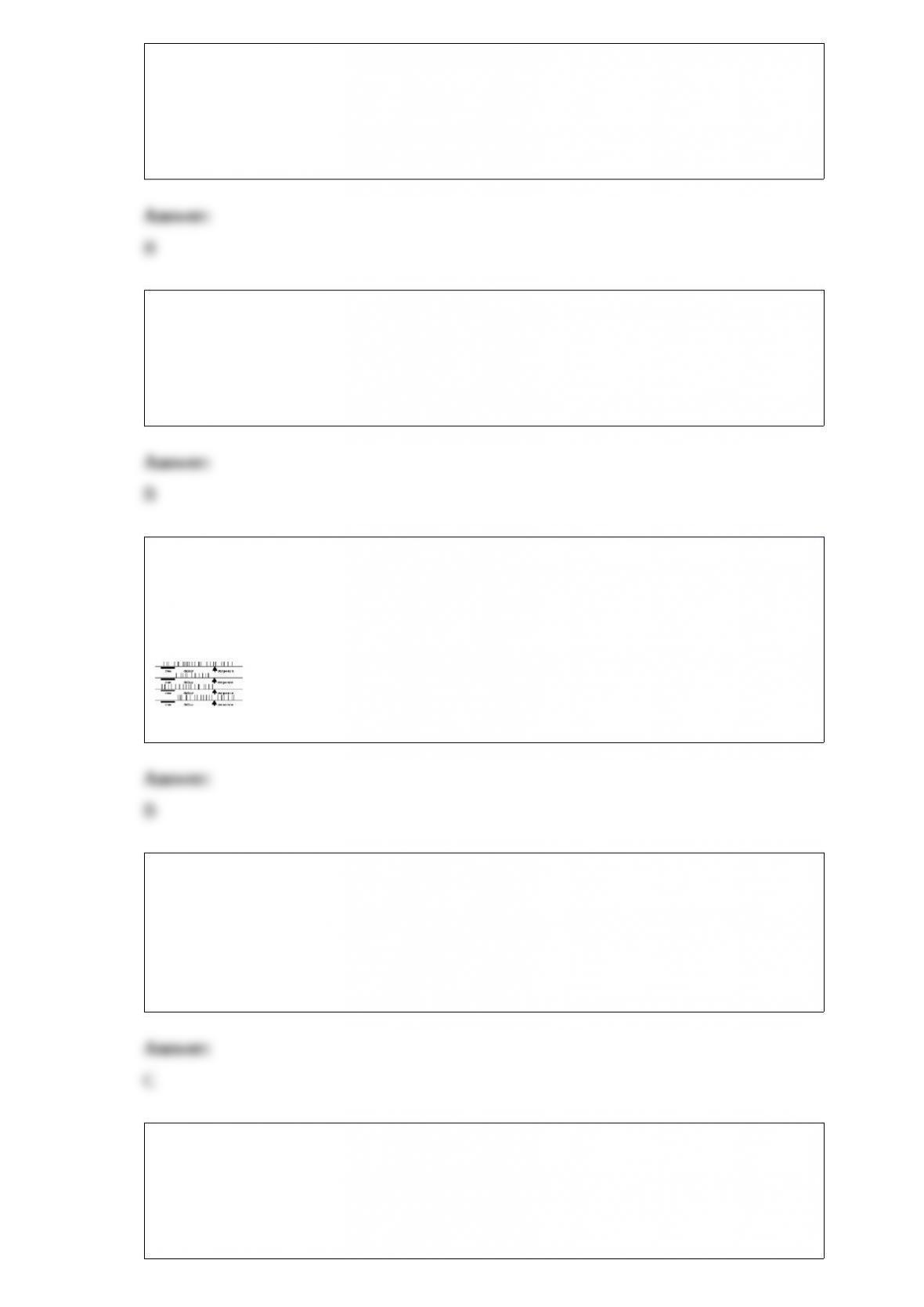
3) You conduct a single-cell recording study of a lateral prefrontal cortical cell while an
animal performs a delayed-response task. Which of the following response profiles best
matches the behavior of the cell if it is primarily involved in working memory function?
(Each vertical line represents an action potential.)
a.
b.
c.
d.
4) The neuroanatomist who described fifty-two distinct cortical areas based on cell
structure and arrangement, and whose classification scheme is often used today, was
a.Purkinje.
b. Helmholtz.
c. Brodmann.
d. Hyde.
5) Which of the following is a methodological issue that arises in studies investigating
cerebral laterality in split-brain patients?
a.Due to their epilepsy, these people may not have had normal brain organization before
surgery.
b. The size of the corpus callosum and the effects of severing it are too variable.

c.Sectioning the corpus callosum causes severe behavioral side effects that make
research participation difficult.
d. Each persons physiological response to the surgery is different and creates new
patterns of brain organization during recovery.
6) One concern with interpreting fMRI studies employing a resting state for comparison
with cognitive activities of interest is that
a.the brain uses considerably more blood and oxygen when it is at rest.
b. many processes are engaged at rest, including self-referential processes.
c.participants in experiments are particularly prone to movement artifacts when at rest.
d. there is too little blood flow in the brain at rest for accurate measurements.
7) Phrenologists believed that the contour of the skull could provide valuable
information about an individuals cognitive capacities and personality traits. This
approach was based on the assumption that
a.skull protrusions are caused by disproportionate development of the brain areas
beneath them, which are responsible for different specific functions.
b. certain traits such as aggressiveness lead to life experiences and injuries that alter the
shape of the skull in specific ways.
c.life experiences and injuries that alter the shape of the skull in specific ways lead to
certain traits, such as aggressiveness.
d. the development of the skull bones directly influences the configuration of the soft
brain areas beneath them, which are responsible for different specific functions.
8) The field of __________ is based on the idea that perception and thought employ
mental representations
that undergo transformations as they are used.
a. neuropsychology
b. computer modeling
c. cognitive psychology
d. neuroimaging
9) The ventromedial zone is also known as (the)

a.primary motor cortex.
b.Wernickes area.
c.anterior cingulate cortex.
d.orbitofrontal cortex.
10) Classical conditioning is an example of a specific type of __________ memory.
a. priming
b. semantic
c. episodic
d. nondeclarative
11) Which of the following sequences of steps best represents the order of events that
occur during synaptic transmission?
a.binding of neurotransmitter at the postsynaptic membrane -> diffusion of
neurotransmitter across the synapse -> release of neurotransmitter from the presynaptic
cell
b. diffusion of neurotransmitter across the synapse -> binding of neurotransmitter at the
postsynaptic membrane -> release of neurotransmitter from the presynaptic cell
c.release of neurotransmitter from the presynaptic cell -> binding of neurotransmitter at
the postsynaptic membrane -> diffusion of neurotransmitter across the synapse
d. release of neurotransmitter from the presynaptic cell -> diffusion of neurotransmitter
across the synapse -> binding of neurotransmitter at the postsynaptic membrane
12) Lesions of the right hemisphere disrupt perception of __________ in visual stimuli
and in speech
a. global structure ; prosody
b. global structure ; formants
c. local structure ; prosody
d. local structure ; formants
13) The Posner spatial cuing task (1980) showed that cuing participants to the location
of an upcoming target
a. increased reaction time to detect the target.

b. decreased reaction time to detect the target.
c. failed to affect reaction time but did increase detection accuracy.
d. failed to affect either reaction time or detection accuracy.
14) The concept of endpoint control refers to the observation that voluntary muscle
events
a. are programmed to result in the displacement of an effector based on the desired
distance from its starting point.
b. are programmed to result in the displacement of an effector based on its desired final
location.
c. require sensory feedback that arrives after an effector has been moved to its desired
location.
d. require sensory feedback from an effector that arrives during the entire course of its
movement.
15) Which of the following statements best describes the anatomical connectivity of the
prefrontal lobes to the rest of the brain?
a.Most synapses in the prefrontal cortex originate from subcortical regions rather than
from other cortical regions in the brain.
b. Almost all connections in this area carry inputs from other regions of the cortex
rather than from subcortical regions.
c.Connections in this region tend to carry inputs from other parts of the prefrontal
cortex rather than from other lobes of the brain.
d. There are extensive projections to and from the prefrontal cortex to all other lobes of
the brain.
16) John spots a snake in the forest. He immediately runs away from it and then notes
that he is scared as he is running. Which of the following theories would suggest that
his feeling of fear is entirely independent of him noticing his physiological response?
a. James-Lange theory
b. Cannon-Bard theory
c. Le-Douxs high road and low road theory
d. cognitive interpretation theory

17) Thompson-Schill and colleagues (1997, 1998) conducted an experiment in which
participants generated an appropriate verb in response to a presented noun. They found
that the processing of nounssuchasrope, which have many semantically associated
verbs, elicited_________activity in the inferior frontal cortex than did nouns such as
scissors, which do not. This result supports the________hypothesis of inferior frontal
lobe function.
a.greater ; working memory retrieval
b.greater ; selection
c.less ; working memory retrieval
d.less ; selection
18) How would theorists who follow Pinkers perspective label your subjective
experience of viewing the colors of this book?
a.qualia
b. sentience
c.self-knowledge
d. access to information
19) Why do people fail to notice when the mouth and eyes of an inverted face remain
upright?
a. Humans do not perceive eyes or mouths in faces.
b. The overall configuration remains the same.
c. They have apperceptive agnosia.
d. They have prosopagnosia.