
A recent study compared the Homo sapiens genome with that of Neanderthals. The
results of the study indicated that there was a mixing of the two genomes at some
period in evolutionary history. Additional data consistent with this hypothesis could be
the discovery of _____.
A) some Neanderthal sequences not found in living humans
B) a few modern H. sapiens with some Neanderthal sequences
C) duplications of several Neanderthal genes on a Neanderthal chromosome
D) some Neanderthal chromosomes that are shorter than their counterparts in living
humans
Which two functional groups are always found in amino acids?
A) carbonyl and amino groups
B) carboxyl and amino groups
C) amino and sulfhydryl groups
D) hydroxyl and carboxyl groups
Normally, only female cats have the tortoiseshell phenotype because _____.
A) a male inherits only one allele of the X-linked gene controlling hair color

B) the Y chromosome has a gene blocking orange coloration
C) only males can have Barr bodies
D) multiple crossovers on the Y chromosome prevent orange pigment production
When an ionic compound such as sodium chloride (NaCl) is placed in water, the
component atoms of the NaCl crystal dissociate into individual sodium ions (Na+) and
chloride ions (Cl-). In contrast, the atoms of covalently bonded molecules (e.g.,
glucose, sucrose, glycerol) do not generally dissociate when placed in aqueous solution.
Which of the following solutions would be expected to contain the greatest number of
solute particles (molecules or ions)?
A) 1 liter of 0.5M NaCl
B) 1 liter of 1.0M NaCl
C) 1 liter of 1.0M glucose
D) 1 liter of 1.0 M NaCl and 1 liter of 1.0 M glucose will contain equal numbers of
solute particles.
What is the goal of bioremediation?
A) to improve human health with the help of living organisms such as bacteria

B) to clean up areas polluted with toxic compounds by using bacteria
C) to improve soil quality for plant growth by using bacteria
D) to improve bacteria for production of useful chemicals
Mendel accounted for the observation that traits that had disappeared in the F1
generation reappeared in the F2 generation by proposing that _____.
A) new mutations were frequently generated in the F2 progeny, “reinventing” traits that
had been lost in the F1
B) the mechanism controlling the appearance of traits was different between the F1 and
the F2 plants
C) traits can be dominant or recessive, and the recessive traits were obscured by the
dominant ones in the F1
D) members of the F1 generation had only one allele for each trait, but members of the
F2 had two alleles for each trait
A proficient engineer can easily design skeletal structures that are more functional than
those currently found in the forelimbs of such diverse mammals as horses, whales, and
bats. The actual forelimbs of these mammals do not seem to be optimally arranged

because _____.
A) natural selection has not had sufficient time to create the optimal design in each
case, but will do so given enough time
B) in many cases, phenotype is determined by genotype and the environment
C) though we may not consider the fit between the current skeletal arrangements and
their functions excellent, we should not doubt that natural selection ultimately produces
the best design
D) natural selection is generally limited to modifying structures that were present in
previous generations and in previous species
GTPase activity is important in the regulation of signal transduction because it _____.
A) increases the available concentration of phosphate
B) decreases the amount of G protein in the membrane
C) hydrolyzes GTP to GDP, thus shutting down the pathway
D) converts cGMP to GTP
Use the following information to answer the question(s) below.
Big Bend National Park in Texas is mostly Chihuahuan desert, where rainfall averages

about 10 inches per year. Yet, it is not uncommon when hiking in this bone-dry desert to
encounter mosses and ferns. One such plant is called “flower of stone.” It is not a
flowering plant, nor does it produce seeds. Under arid conditions, its leaflike structures
curl up. However, when it rains, it unfurls its leaves, which form a bright green rosette
on the desert floor. Consequently, it is sometimes called the “resurrection plant.” At first
glance, it could be a fern, a true moss, or a spike moss.
What feature of both true mosses and ferns makes it most surprising that they can
survive for many generations in dry deserts?
A) flagellated sperm
B) lack of vascular tissues
C) lack of true roots
D) lack of cuticle
Yearly vaccination of humans for influenza viruses is necessary because _____.
A) of an increase in immunodeficiency diseases
B) the flu can generate anaphylactic shock
C) surviving the flu one year exhausts the immune system to nonresponsiveness the
second year
D) rapid mutation in flu viruses alters the surface proteins in infected host cells
One should expect to find cilia associated with the feeding apparatus of _____.
A) annelids
B) coral animals
C) tapeworms
D) sponges
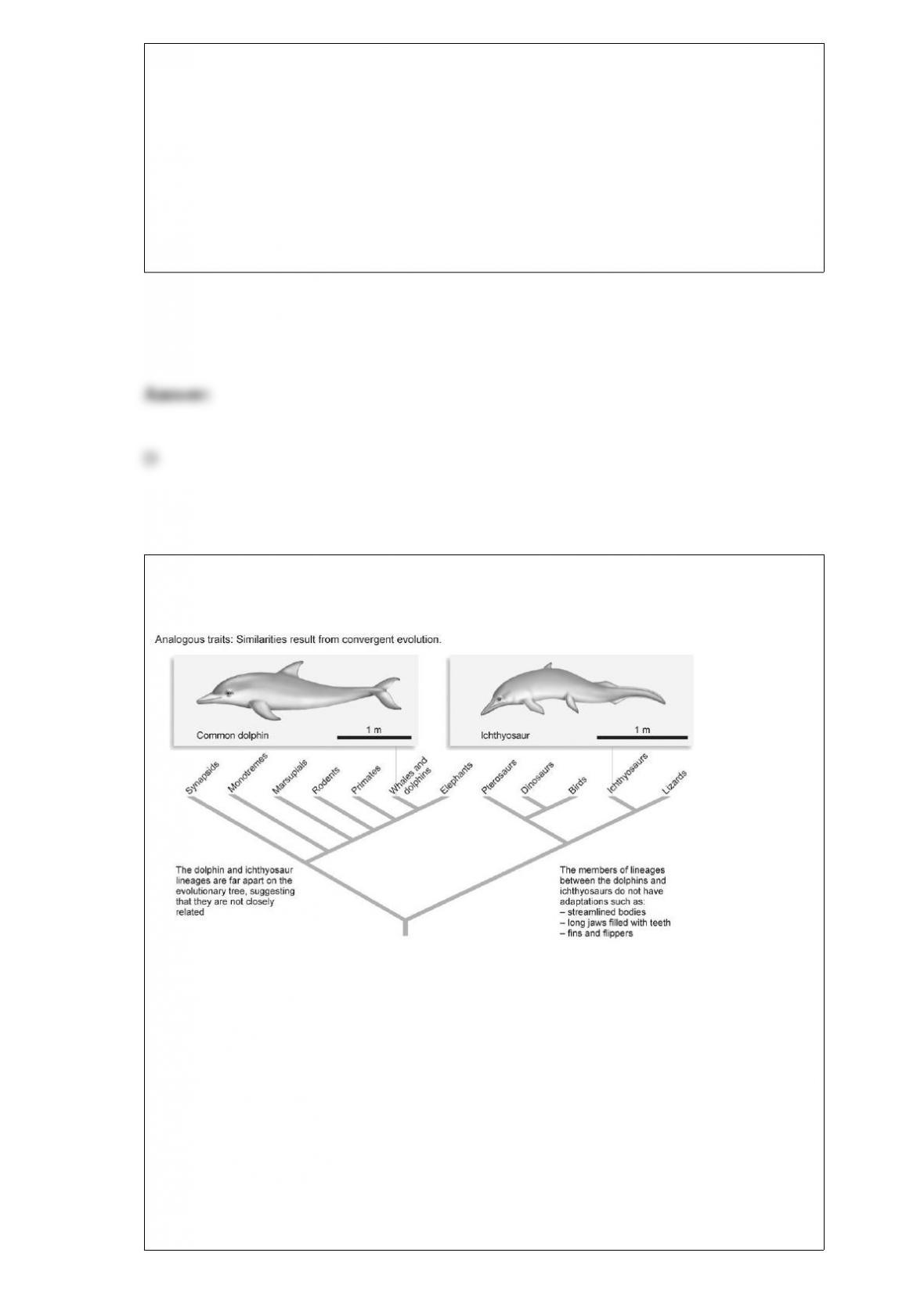
We know the streamlined bodies shown in the figure above are examples of homoplasy.
If the following groups also had streamlined bodies, which of the groupings would give
the most support to this body type being homologous?
A) lizards and elephants
B) pterosaurs, dinosaurs, and birds
C) synapsids, monotremes, marsupials, rodents, and primates
D) lizards, pterosaurs, dinosaurs, birds, synapsids, monotremes, marsupials, rodents,
and primates

The sharp, inch-long thorns of the crown-of-thorns sea star are its spines. These spines,
unlike those of most other sea stars, contain a potent toxin. If it were discovered that
crown-of-thorns sea stars do not make this toxin themselves, then the most likely
alternative would be that this toxin is _____.
A) derived from the nematocysts of its prey
B) absorbed from the surrounding seawater
C) an endotoxin of cellulose-digesting bacteria that inhabit the sea star’s digestive
glands
D) injected into individual thorns by mutualistic corals which live on the aboral
surfaces of these sea stars
Which organelle or structure is absent in plant cells?
A) mitochondria
B) microtubules
C) centrosomes
D) peroxisomes

Which of the following conclusions is supported by the research of both Went and
Charles and Francis Darwin on shoot responses to light?
A) When shoots are exposed to light, a chemical substance migrates toward the light.
B) A chemical substance involved in shoot bending is produced in shoot tips.
C) Once shoot tips have been cut, normal growth cannot be induced.
D) Light stimulates the synthesis of a plant hormone that responds to light.
If pigments from a particular species of plant are extracted and subjected to paper
chromatography, which of the following is most likely?
A) Paper chromatography for the plant would isolate a single band of pigment that is
characteristic of that particular plant.
B) Paper chromatography would separate the pigments from a particular plant into
several bands.
C) The isolated pigments would be some shade of green.
D) Paper chromatography would isolate only the pigments that reflect green light.

Which of these is a major trend in land plant evolution?
A) the trend toward smaller size
B) the trend toward a gametophyte-dominated life cycle
C) the trend toward a sporophyte-dominated life cycle
D) the trend toward larger gametophytes
Misfolding of polypeptides is a serious problem in cells. Which of the following
diseases are associated with an accumulation of misfolded polypeptides?
A) Alzheimer’s only
B) Parkinson’s only
C) diabetes mellitus only
D) Alzheimer’s and Parkinson’s only
Compared with a smaller cell, a larger cell of the same shape has _____.
A) less surface area

B) less surface area per unit of volume
C) a smaller average distance between its mitochondria and the external source of
oxygen
D) a smaller cytoplasm-to-nucleus ratio
Acid precipitation lowered the pH of soil in a terrestrial ecosystem that supported a
diverse community of plants and animals. The decrease in pH eliminated all
nitrogenfixing bacteria populations in the area. Which prediction most accurately
reflects the impact this will have on the community?
A) Since phosphorus can replace nitrogen as an essential nutrient, the impact will be
minimal.
B) Plants can obtain the nitrogen necessary for growth from the atmosphere, but
bacterial communities will be negatively impacted.
C) Primary producers will suffer from nitrogen deficiency and the entire community
will experience a decrease in carrying capacity.
D) The decrease in pH actually increases the availability of soil nutrients, so other
nutrients that were less available cause an increase in primary production and an
increase in biomass at other trophic levels.
If a prairie dog had the opportunity to perform an altruistic act (that is, give an alarm
call) to help its relatives, which combination of the following relatives would the prairie

dog be most likely to help (base your answer solely on the genetic relationships)?
A) two nieces, two cousins, and one half-brother
B) two half-sisters and two nieces
C) one son, one niece, and one half-sister
D) The prairie dog would be equally likely to act altruistically to each of the
combinations described.
While sampling marine plankton in a lab, a student encounters large numbers of
fertilized eggs. The student rears some of the eggs in the laboratory for further study
and finds that the blastopore becomes the mouth. The embryo develops into a
trochophore larva and eventually has a true coelom. These eggs probably belonged to
a(n) _____.
A) echinoderm
B) mollusc
C) nematode
D) arthropod
The questions below refer to the following evolutionary tree, in which the horizontal
axis represents time (present time is on the far right) and the vertical axis represents
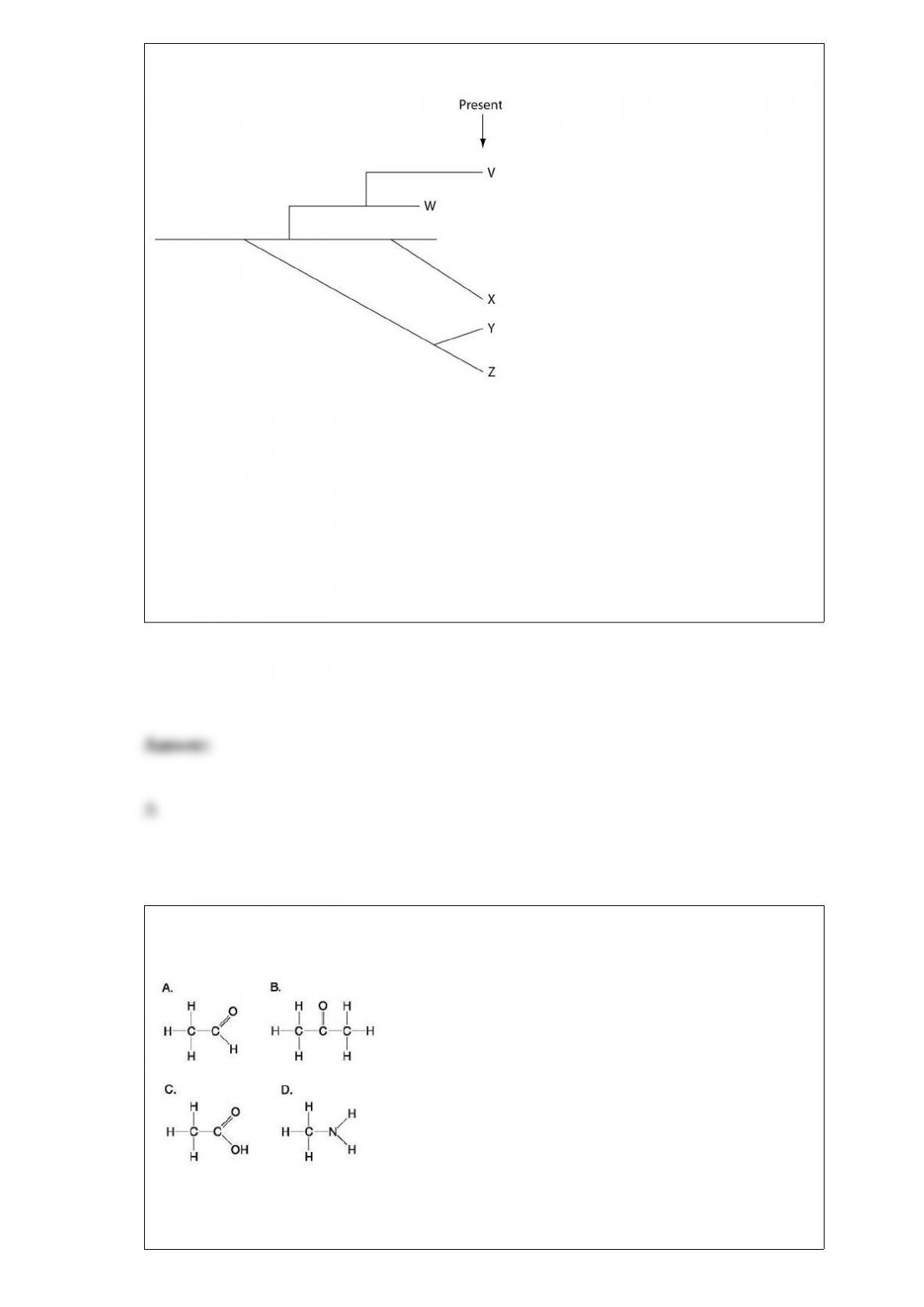
morphological change.
Which species is most closely related to species W?
A) V is most closely related to species W.
B) X is most closely related to species W.
C) Y and Z are equally closely related to W.
D) It is not possible to say from this tree.
Which molecule shown above can increase the concentration of hydrogen ions in a
solution and is, therefore, an organic acid?

A) A
B) B
C) C
D) D
At which stage of mitosis are chromosomes usually photographed in the preparation of
a karyotype?
A) prophase
B) metaphase
C) anaphase
D) interphase
Use the following information to asnwer the question(s) below.
Terry catches a ray-finned fish from the ocean and notices that attached to its flank is an
equally long, snakelike organism. The attached organism has no external segmentation,
no scales, a round mouth surrounded by a sucker, and two small eyes. Terry thinks it
might be a marine leech, a hagfish, or a lamprey.

Terry saved some of the tooth-like objects within the hagfish’s round mouth to analyze
their composition in his mentor’s biochemistry research lab. Terry will find that they are
composed of the same protein found in tetrapod _____.
A) skin
B) teeth
C) bones
D) cartilage
A genetic change that caused a certain Hox gene to be expressed along the tip of a
vertebrate limb bud instead of farther back helped make possible the evolution of the
tetrapod limb. This type of change is illustrative of _____.
A) the influence of environment on development
B) paedomorphosis
C) a change in a developmental gene or its regulation that altered the spatial
organization of body parts
D) heterochrony
What is the main advantage of controlled burnings of forested areas? Controlled
burnings _____.

A) eliminate the possibility of forest fires
B) clear forested areas for farmland
C) prevent the overgrowth of the underbrush
D) allow new species to form
Conifers and pines both have needlelike leaves, with the adaptive advantage of _____.
A) increased surface area, increasing photosynthesis
B) increased surface area, increasing gas exchange
C) decreased surface area, reducing gas exchange
D) decreased surface area, reducing water loss
Plant hormones produce their effects by_____.
I) altering the expression of genes
II) modifying the permeability of the plasma membrane
III) modifying the structure of the nuclear envelope membrane
A) only I
B) only II
C) only III
D) only I and II
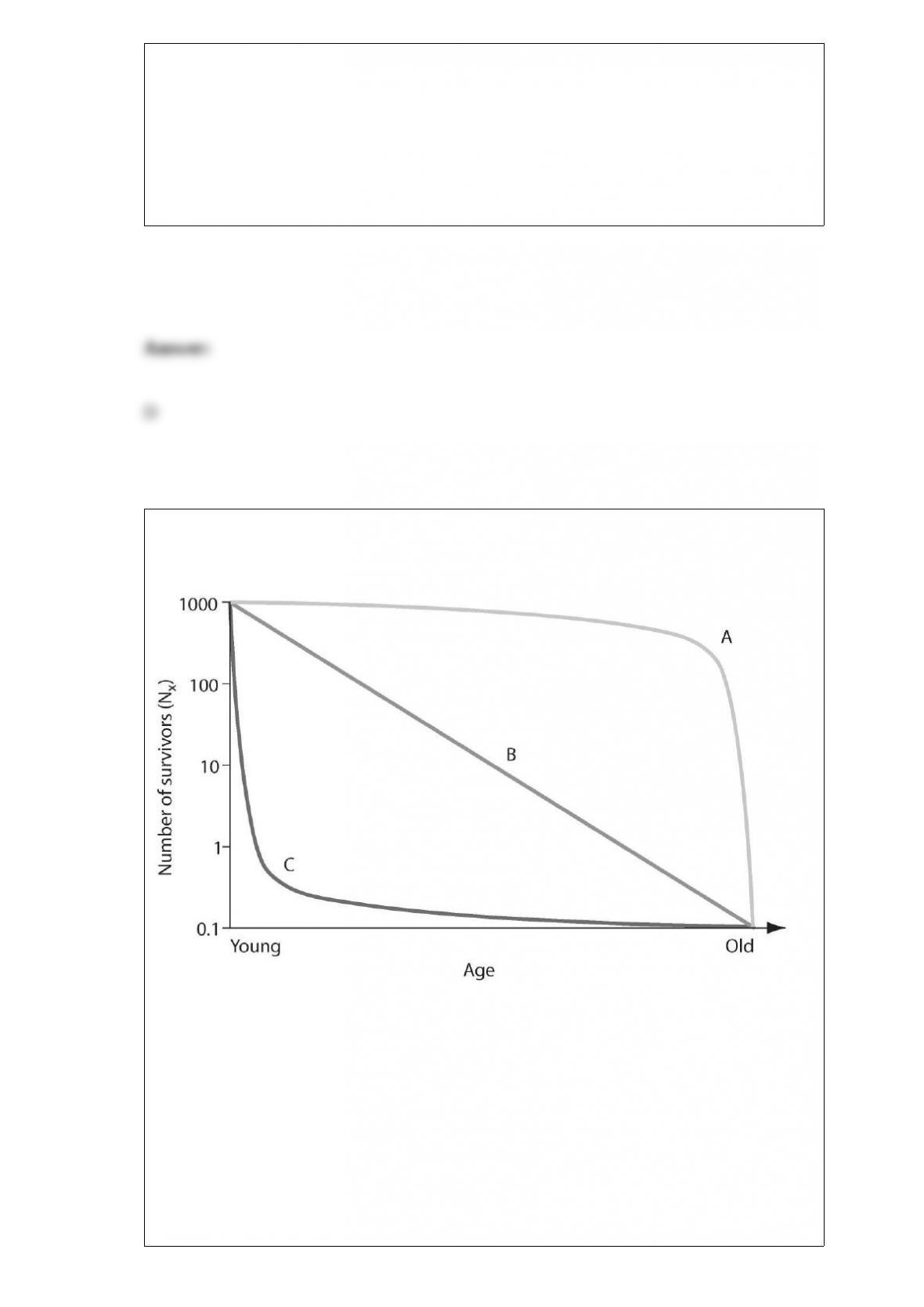
In the figure above, which of the following survivorship curves most applies to humans
living in developed countries?
A) curve A
B) curve B
C) curve C
D) curve A or curve B

Use the following information to answer the question(s) below.
The Brazil nut tree, Bertholletia excels (n = 17), is native to tropical rain forests of
South America. It is a hardwood tree that can grow to over 50 meters tall, is a source of
high-quality lumber, and is a favorite nesting site for harpy eagles. As the rainy season
ends, tough-walled fruits, each containing 8-25 seeds (Brazil nuts), fall to the forest
floor. Brazil nuts are composed primarily of endosperm. About $50 million worth of
nuts are harvested each year. Scientists have discovered that the pale yellow flowers of
Brazil nut trees cannot fertilize themselves and admit only female orchid bees as
pollinators. The agouti (Dasyprocta spp.), a cat-sized rodent, is the only animal with
teeth strong enough to crack the hard wall of Brazil nut fruits. It typically eats some of
the seeds, buries others, and leaves still others inside the fruit, which moisture can now
enter. The uneaten seeds may subsequently germinate.
If a female orchid bee has just left a Brazil nut tree with nectar in her stomach, and if
she visits another flower on a different Brazil nut tree, what is the sequence in which
the following events should occur?
1. double fertilization
2. pollen tube emerges from pollen grain
3. pollen tube enters micropyle
4. pollination
A) 4, 2, 3, 1
B) 4, 3, 2, 1
C) 2, 4, 3, 1
D) 2, 4, 1, 3

You observe two female fish of the same species breeding. One female lays 100 eggs
and the other female lays 1000 eggs. Which one of the following is LEAST likely given
the limits of fitness trade-offs?
A) The female laying 100 eggs breeds more often than the female laying 1000 eggs.
B) The female laying 100 eggs lives longer than the female laying 1000 eggs.
C) The eggs from the female laying 1000 eggs have larger yolks than the yolks of the
eggs from the female laying 100 eggs.
D) The female laying 1000 eggs is larger than the female laying 100 eggs.