
Which of the following descriptions best fits the class of molecules known as
nucleotides?
A) a nitrogenous base and a phosphate group
B) a nitrogenous base and a sugar
C) a nitrogenous base, a phosphate group, and a sugar
D) a sugar and a purine or pyrimidine
Which of the following are problems associated with intensive irrigation?
I) mineral runoff
II) over fertilization
III) aquifer depletion
IV) soil salinization
A) only I and II
B) only I, III, and IV
C) only III and IV
D) I, II, III, and IV

Experiments with genetically altered mice showed that the mice would consume
abnormally high amounts of bitter-tasting compounds in water after their _____.
A) hormone receptors for digestive hormones were reduced or eliminated, showing that
bitter tastes are reinforced by digestive responses
B) salt-taste cells were altered to express receptors for bitter tastants, suggesting that
animals have unregulated salt appetites
C) visual sense was reduced or eliminated, suggesting that mice learn visual cues about
bitter tastes
D) sweet-taste cells were altered to express receptors for bitter tastants, suggesting that
the sensation of taste depends only on which taste cell is stimulated
It is believed that the coelacanths and lungfish represent a crucial link between other
fishes and tetrapods. What is the major feature in these fish in support of this
hypothesis?
A) Like amphibians, they are tied to the water for reproduction.
B) Their fins have skeletal and muscular structures similar to amphibian limbs.
C) They have highly evolved nervous and circulatory systems.
D) They have lungs and are able to breathe air when water is scarce.

Introduced species can have deleterious effects on biological communities by _____.
I) preying on native species
II) competing with native species for food or light
III) displacing native species
IV) competing with native species for space or breeding/nesting habitat
A) only I and III
B) only II and IV
C) only II, III, and IV
D) I, II, III and IV
The contraction of skeletal muscles is based on _____.
A) myosin filaments coiling up to become shorter
B) actin and myosin filaments both coiling up to become shorter
C) actin cross-bridges binding to myosin and transitioning from a high-energy to a
low-energy state
D) myosin cross-bridges binding to actin and transitioning from a high-energy to a
low-energy state

Prostaglandins are local regulators whose chemical structure is derived from _____.
A) oligosaccharides
B) fatty acids
C) steroids
D) amino acids
In positive control of several sugar-metabolism-related operons, the catabolite activator
protein (CAP) binds to DNA to stimulate transcription. What causes an increase in CAP
activity in stimulating transcription?
A) an increase in glucose and an increase in cAMP
B) a decrease in glucose and an increase in cAMP
C) an increase in glucose and a decrease in cAMP
D) a decrease in glucose and a decrease in the repressor
Plant hormonal regulation differs from animal hormonal regulation in that_____.
A) there are no dedicated hormone-producing organs in plants as there are in animals

B) all production of hormones is local in plants with little long-distance transport
C) only animal hormone concentrations are developmentally regulated
D) only animal hormones may have either external or internal receptors
Which of the following are present in high densities in both smooth and skeletal muscle
cells?
I) cilia
II) mitochondria
III) nuclei
IV) endoplasmic reticulum
A) only I and II
B) only II and IV
C) only III and IV
D) only I, II, and III
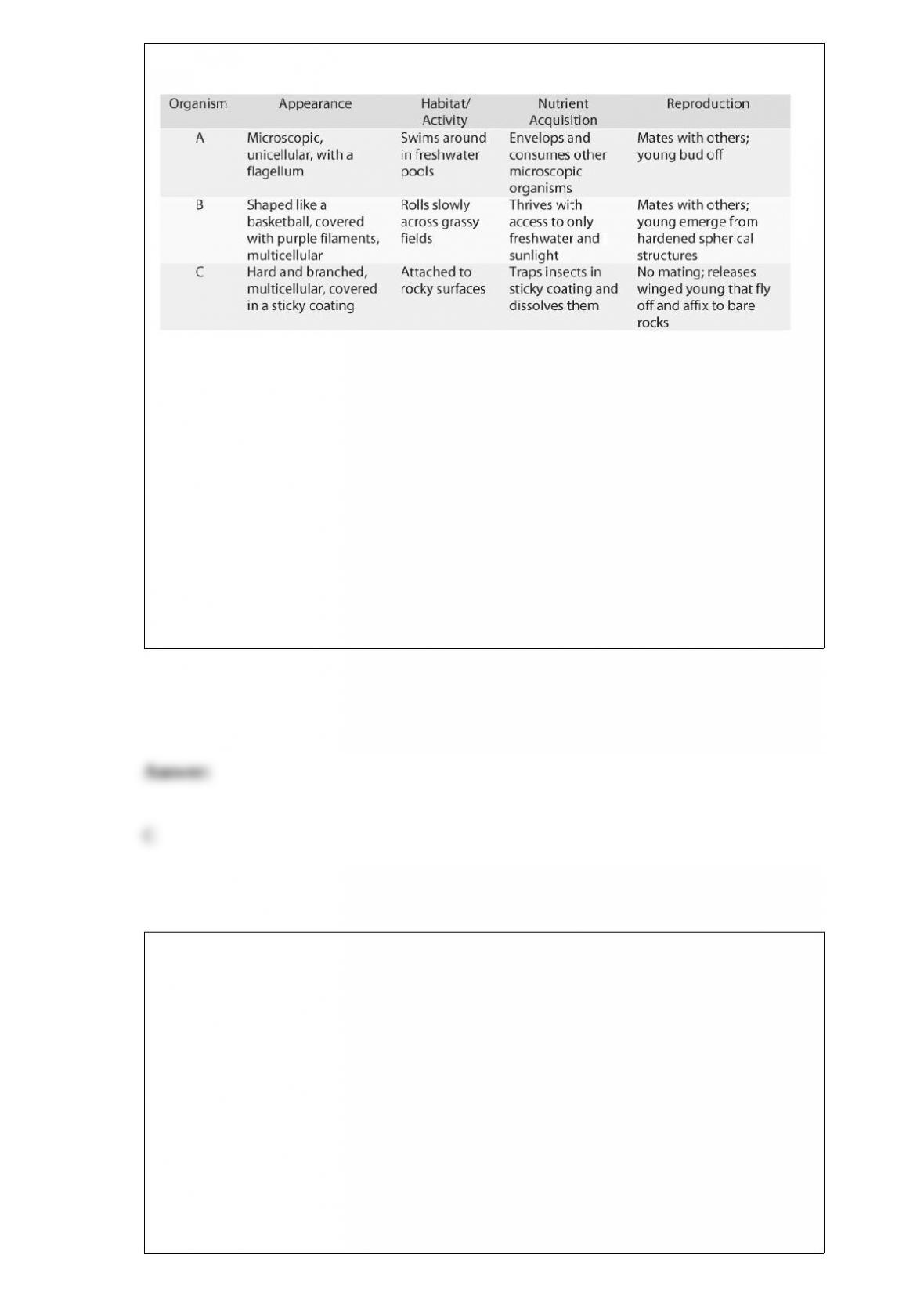
As you are on the way to Tahiti for a vacation, your plane crash-lands on a previously
undiscovered island. You soon find that the island is teeming with unfamiliar
organisms, and you, as a student of biology, decide to survey them (with the aid of the
Insta-Lab Portable Laboratory you brought along in your suitcase). You select three
organisms and observe them in detail, making the notations found in the figure
above.Which organism would you classify as an animal?
A) organism A
B) organism B
C) organism C
The following information applies to the questions below.
Several organisms, primarily protists, have what are called intermediate mitotic
organization.
What is the most probable hypothesis about these intermediate forms of cell division?
A) They represent a form of cell reproduction, which must have evolved completely
separately from those of other organisms.
B) They rely on totally different proteins for the processes they undergo.

C) They may be more closely related to plant forms that also have unusual mitosis.
D) They show some but not all of the evolutionary steps toward complete mitosis.
Which of the following is known as a Philadelphia chromosome?
A) a human chromosome 22 that has had a specific translocation
B) a human chromosome 9 that is found only in one type of cancer
C) an animal chromosome found primarily in the mid-Atlantic area of the United States
D) a chromosome found only in mitochondria
During exponential growth, a population always _____.
A) grows at its maximum per capita rate
B) quickly reaches its carrying capacity
C) cycles through time
D) loses some individuals to emigration
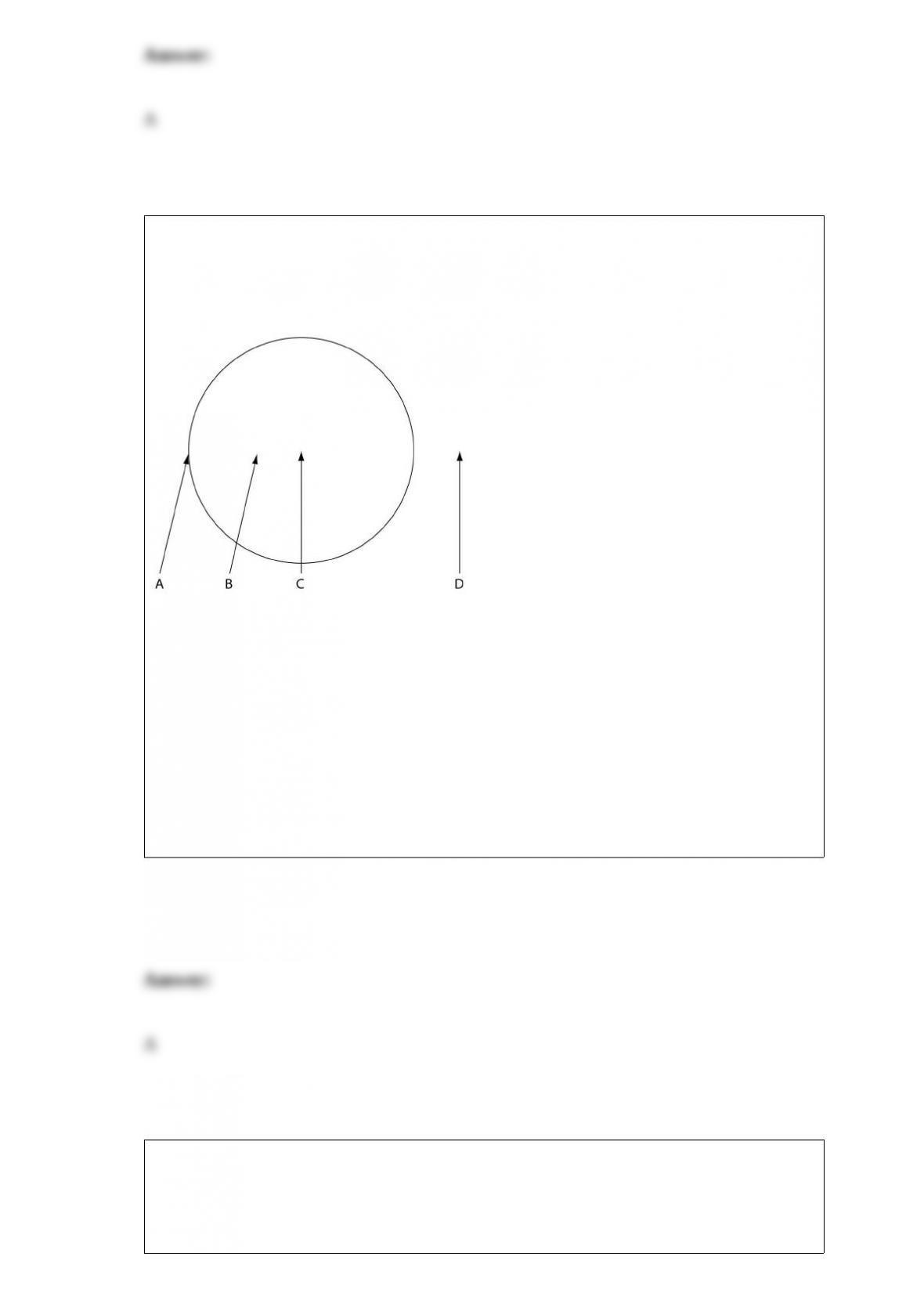
The following figure depicts the outline of a large fairy ring that has appeared overnight
in an open meadow, as viewed from above. The fairy ring represents the furthest
advance of this mycelium through the soil. Locations A-D are all 0.5 meters below the
soil surface.
At which location is the mycelium currently absorbing the most nutrients per unit
surface area, per unit time?
A) A
B) B
C) C
D) D
During which two times can the recipient accurately be described as “recombinant” due
to the sequence of events portrayed in the figure?
A) during Times C and D

B) during Times A and C
C) during Times A and B
D) during Times B and D
In an analysis of the nucleotide composition of DNA, which of the following will be
found?
A) A = C
B) A = G and C = T
C) A + C = G + T
D) G + C = T + A
One of the fundamental processes by which memories are stored and learning takes
place _____.
A) is related to changes in the degree of myelination of axons
B) results in an increase in the diameter of axons
C) results in a shift from aerobic to anaerobic respiration in neurons

D) involves two types of glutamate receptors
Which of the following is (are) true of natural selection?
A) It requires genetic variation.
B) It results in descent with modification.
C) It involves differential reproductive success.
D) It requires genetic variation, results in descent with modification, and involves
differential reproductive success.
If two species are close competitors, and one species is experimentally removed from
the community, the remaining species would be expected to _____.
A) change its fundamental niche
B) decline in abundance
C) become the target of specialized parasites
D) expand its realized niche
An atom has four electrons in its valence shell. What types of covalent bonds is it
capable of forming?
A) single, double, or triple
B) single and double only
C) single bonds only
D) double bonds only

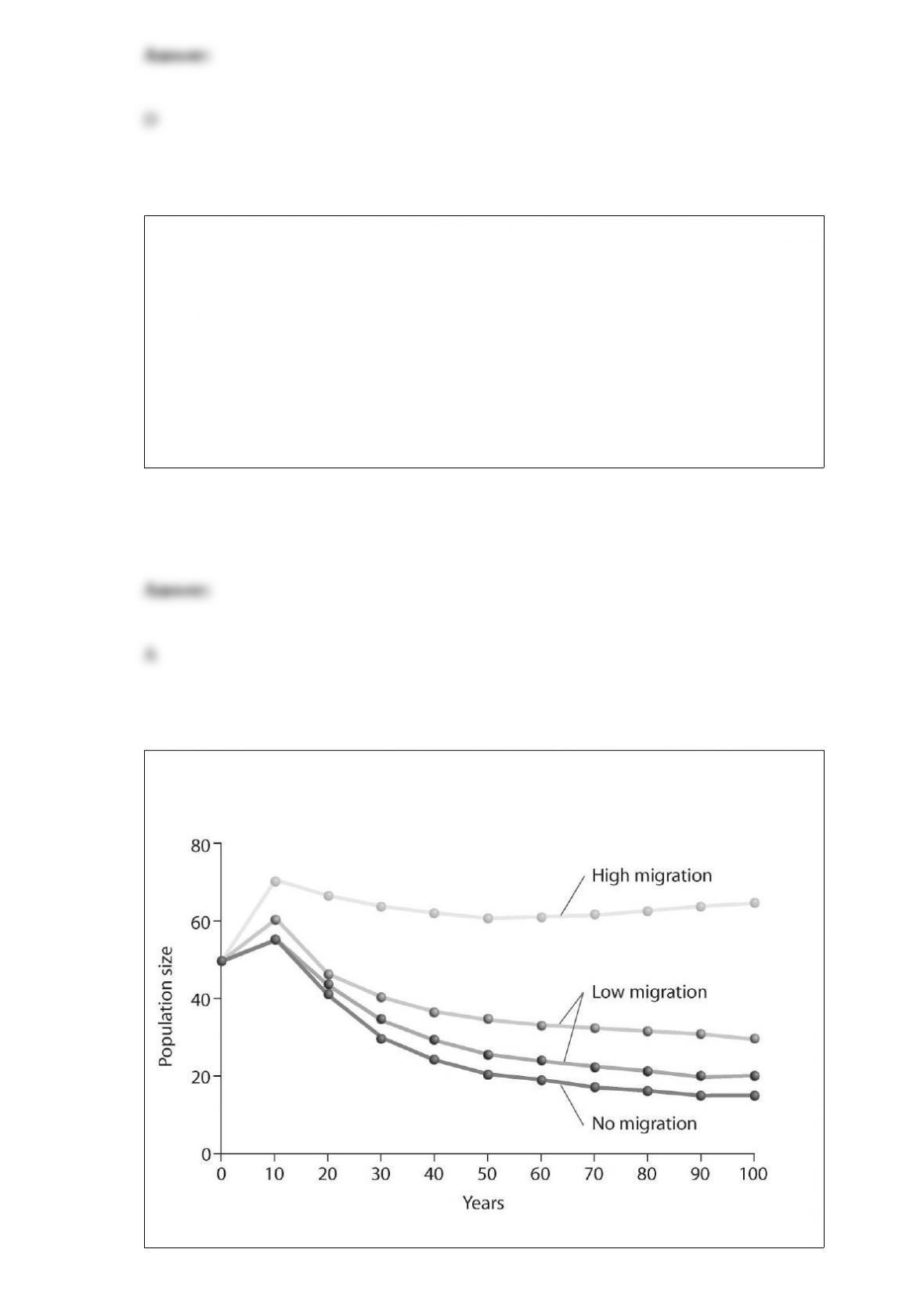
Looking at the figure above, what is contributing significantly to stabilizing population
size over time?
I) no migration
II) low migration
III) high migration
A) only I
B) only II
C) only III
D) only II and III
Accuracy in the translation of mRNA into the primary structure of a polypeptide
depends on specificity in the _____.
A) binding of ribosomes to mRNA
B) binding of the anticodon to small subunit of the ribosome
C) attachment of amino acids to rRNAs
D) binding of the anticodon to the codon and the attachment of amino acids to tRNAs

Two species of tree frogs that live sympatrically in the northeastern United States differ
in ploidy: Hyla chrysoscelis is diploid, and Hyla versicolor is tetraploid. The frogs are
identical in appearance, but their mating calls, which females use to find mates, differ.
Which difference most likely evolved first?
A) polyploidy
B) difference in mating calls
C) Polyploidy and different mating calls must have evolved at the same time.
Coprophagy is important for the nutritional balance of _____.
A) ruminants such as cows
B) insects and arthropods
C) rabbits and their relatives
D) squirrels and some rodents
The following experiment is used for the corresponding question(s).
A researcher discovered a species of moth that lays its eggs on oak trees. Eggs are laid
at two distinct times of the year: early in spring when the oak trees are flowering and in
midsummer when flowering is past. Caterpillars from eggs that hatch in spring feed on
oak flowers and look like oak flowers. But caterpillars that hatch in summer feed on
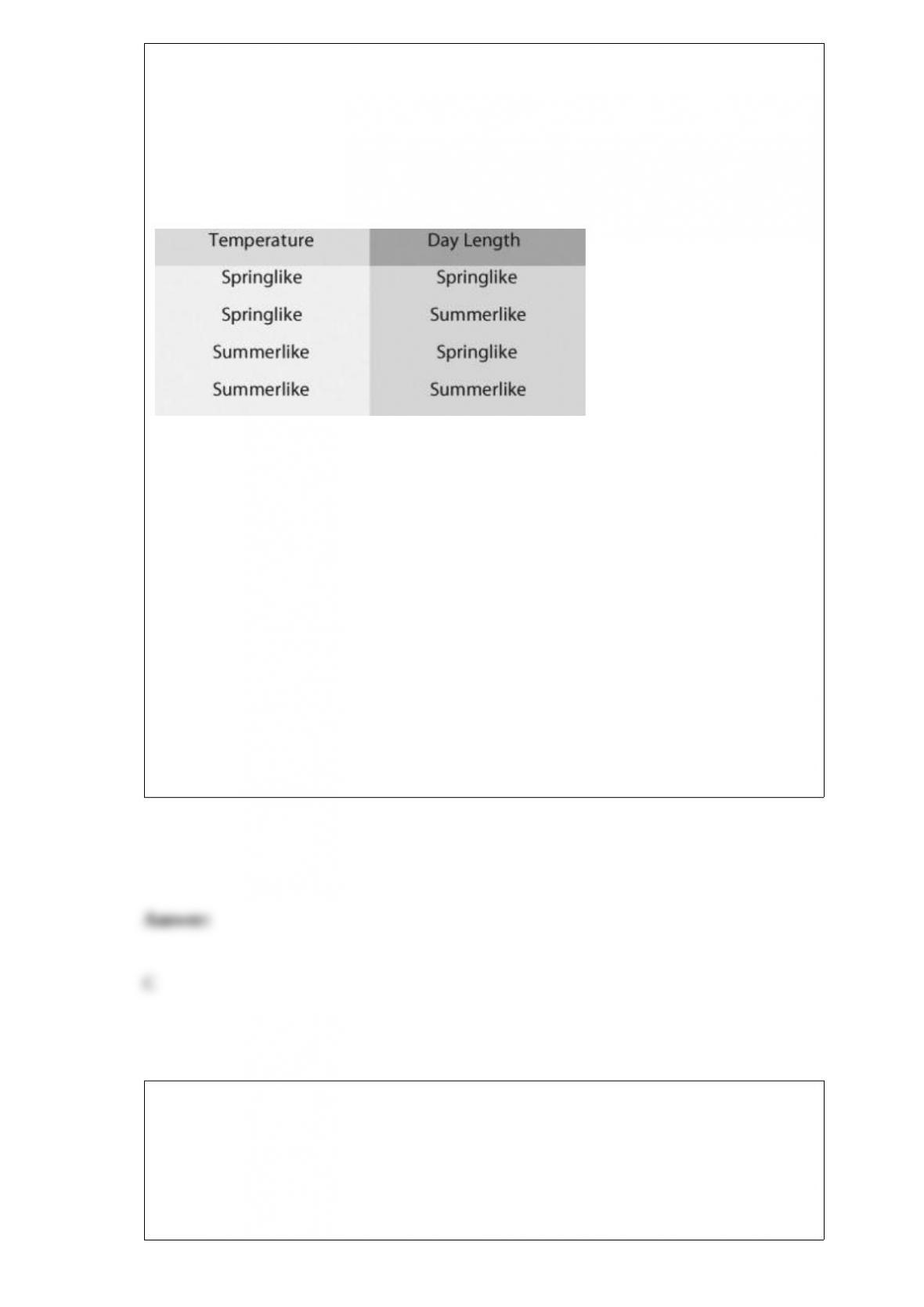
oak leaves and look like oak twigs.
How does the same population of moths produce such different-looking caterpillars on
the same trees? To answer this question, the biologist caught many female moths from
the same population and collected their eggs. He put at least one egg from each female
into eight identical cups. The eggs hatched, and at least two larvae from each female
were maintained in one of the four temperature and light conditions listed below.
In each of the four environments, one of the caterpillars was fed oak flowers, the other
oak leaves. Thus, there were a total of eight treatment groups (4 environments 2 diets).
Refer to the accompanying figure. Which one of the following is NOT a plausible
hypothesis to explain the differences in caterpillar appearance observed in this
population?
A) The longer day lengths of summer trigger the development of twig-like caterpillars.
B) The cooler temperatures of spring trigger the development of flowerlike caterpillars.
C) Differences in air pressure, due to differences in elevation, trigger the development
of different types of caterpillars.
D) Differences in diet trigger the development of different types of caterpillars.
Gene expression is often assayed by measuring the level of mRNA produced from a
gene. If one is interested in knowing the amount of a final active gene product, a
potential problem of this method is that it ignores the possibility of _____.
A) chromatin condensation control

B) transcriptional control
C) alternative splicing
D) translational control
Rank the following one-base point mutations (from most likely to least likely) with
respect to their likelihood of affecting the structure of the corresponding polypeptide.
1. insertion mutation deep within an intron
2. substitution mutation at the third position of an exonic codon
3. substitution mutation at the second position of an exonic codon
4. deletion mutation within the first exon of the gene
A) 1, 2, 3, 4
B) 4, 3, 2, 1
C) 2, 1, 4, 3
D) 3, 1, 4, 2
Which of the following cells or tissues arise from lateral meristem activity?

A) secondary xylem
B) leaves
C) trichomes
D) tubers
Darwin and Wallace’s theory of evolution by natural selection was revolutionary
because it _____.
A) was the first theory to refute the ideas of special creation
B) proved that individuals acclimated to their environment over time
C) dismissed the idea that species are constant and emphasized the importance of
variation and change in populations
D) was the first time a biologist had proposed that species changed through time
Which of the following is a representation of gene density?
A) Humans have 2900 Mb per genome.
B) C. elegans has ~20,000 genes.
C) Humans have ~20,000 protein-encoding genes in 2900 Mb.

D) Fritillaria has a genome 40 times the size of a human.
Use the following information to answer the question(s) below.
Giardia intestinalis is an intestinal parasite of humans and other mammals that causes
intestinal ailments in most people who ingest the cysts. Upon ingestion, each cyst
releases two motile cells, called trophozoites. These attach to the small intestine’s lining
via a ventral adhesive disk. The trophozoites anaerobically metabolize glucose from the
host’s intestinal contents to produce ATP. Reproduction is completely asexual, occurring
by longitudinal binary fission of trophozoites, with each daughter cell receiving two
haploid nuclei (n = 5). A trophozoite will often encyst as it passes into the large
intestine by secreting around itself a case that is resistant to cold, heat, and dehydration.
Infection usually occurs by drinking untreated water that contains cysts.
Giardia’s mitosome can be said to be “doubly degenerate,” because it is a degenerate
type of ________, an organelle that is itself a degenerate form of ________.
A) nucleus; archaean
B) nucleus; bacterium
C) mitochondria; proteobacterium
D) mitochondria; spirochete