
Sometime after a human baby is born, the expression of fetal hemoglobin ceases and
the expression of adult hemoglobin begins. Imagine that a baby is born and this switch
from fetal to adult hemoglobin does not occur. In which part of the world would this
baby be well-adapted to living?
A) high-altitude cities
B) open grasslands
C) sea level at the beach
D) a tropical rain forest
What is the evolutionary advantage of the very long life span of some plants?
A) the ability to adapt to changing environments
B) the ability to develop resistance to many diseases
C) the ability to produce many offspring over many years
D) the ability to grow back after being damaged
In an ecosystem, you would expect to find interspecific competition between
A) males and females of a species in which both sexes occupy the same niche.

B) populations of two species that occupy the same niche.
C) a prey species and its predator.
D) two wasp species that mimic each other’s appearance.
If you commit a crime, you need to make sure that you do not leave even the smallest
speck of blood, hair, or other organic matter from your body. If you do, the DNA in this
material can be amplified by ________, subjected to genetic analysis, and used to
identify you as the perpetrator of the crime.
A) PCR
B) STR analysis
C) RFLP
D) restriction digests
The copying mechanism of DNA is most like
A) taking a picture of yourself and of your reflection in a mirror.
B) mixing flour, sugar, and water to make bread dough.
C) dripping water out of a faucet.

D) carving a figure out of wood.
Large antlers in male elk, which are used for battles between males, are a good example
of a trait favored by
A) intersexual selection.
B) intrasexual selection.
C) disruptive selection.
D) stabilizing selection.
ATP can be used as the cell’s energy exchange mechanism because
A) endergonic reactions can be fueled by coupling them with the formation of ATP
from ADP.
B) ATP is the most energy-rich small molecule in the cell.
C) endergonic reactions can be fueled by coupling them with the hydrolysis of
high-energy phosphate bonds in ATP.
D) ATP is a disposable form of chemical energy, used once and then discarded by the
cell.

Fungi are found associated with the earliest plant fossils. Fungi may have helped plants
become terrestrial by
A) forming mycorrhizal associations with plants and by decomposing organic matter.
B) stocking the soil with organic matter.
C) providing simple organic compounds in return for sugars.
D) killing the bacterial enemies of plants.
If you eat a hamburger, you are mainly eating ground-up beef muscle. What levels of
organization are represented in this ground-up muscle?
A) organism, population, and community
B) organ, organ system, and organism
C) organelle, cell, and tissue
D) tissue, organ, and organ system

The monomers of DNA and RNA are
A) monosaccharides.
B) nucleotides.
C) fatty acids.
D) nucleic acids.
Which of the following statements regarding vitamins is true?
A) They are simple inorganic compounds.
B) They must be ingested in large quantities.
C) They can serve as coenzymes or parts of coenzymes.
D) They are major sources of dietary calories.
Lysozyme is an enzyme that breaks down bacterial cell walls and is found in your tears,
mucus, and saliva. A mutation occurs in the gene for lysozyme that results in a lysine (a
positively charged amino acid) being substituted for an arginine (also a positively
charged amino acid). Do you think that the mutant lysozyme will function similarly to
the normal lysozyme?

A) no, because all changes in protein primary sequence result in functional differences
B) no, because changing lysine to arginine will cause the protein to denature
C) yes, because both lysine and arginine are positively charged so the tertiary structure
and therefore function should be similar
D) yes, because protein function stays the same no matter what mutations occur
A cDNA library differs from a genomic library in that
A) the cDNA was constructed from introns only.
B) genomic libraries are only stored in bacterial cells.
C) cDNA libraries are more stable.
D) cDNA libraries only contain information from genes that have been transcribed.
Like many insects, some amphibians undergo ________ in their life cycle as they have
distinct larval and adult stages.
A) aquatic development followed by terrestrial existence
B) development in a nest followed by flight
C) metamorphosis
D) alternation of generations
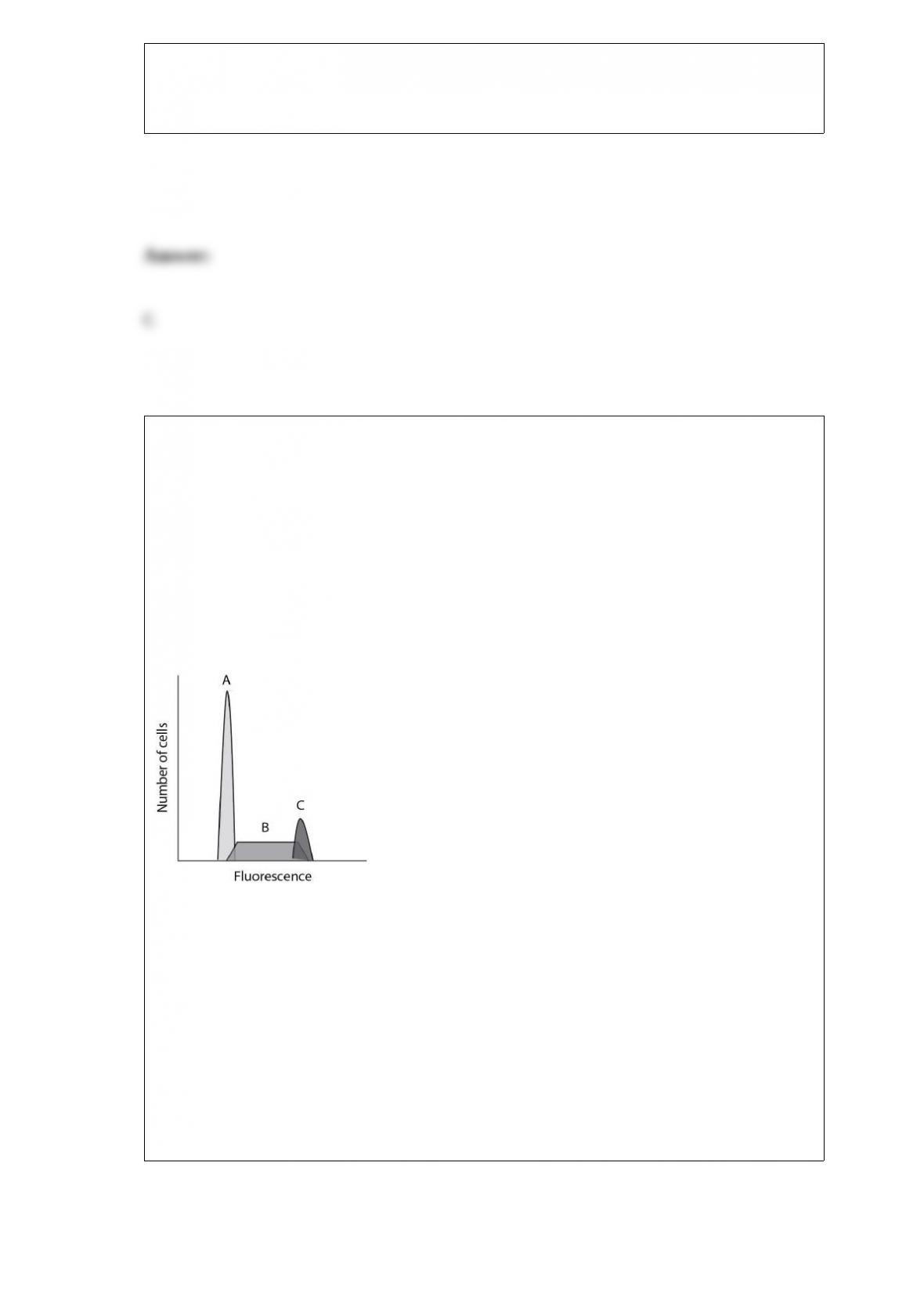
A technique called flow cytometry is used by scientists and researchers to count or sort
cells based on specific properties. By labeling cellular DNA with a fluorescent dye,
flow cytometry can sort cells based on the amount of DNA present, thereby making it
possible to distinguish between cells that are in different stages of the cell cycle. Flow
cytometry is especially useful to the medical community because it can help with the
diagnosis of certain types of cancers.
Below is a typical set of data that you might obtain when running a flow cytometry
experiment using a sample of healthy skin cells. Use this figure to help you answer the
following questions.
Which peak corresponds to cells in G1? In S phase? In G2?
A) A: G1; B: G2; C: S
B) A: G2; B: S; C: G1
C) A: S; B: G1; C: G2
D) A: G1; B: S; C: G2

Complete the analogy: ________ are to vertebrate evolution as ________ are to plant
evolution
A) Lungs; stomata
B) Amniotic eggs; seeds
C) Limbs; flowers
D) Opposable thumbs; hyphae
The pores that facilitate gas exchange in plant leaves are called
A) stomata.
B) guard cells.
C) lenticels.
D) plasmodesmata.

Which of the following statements regarding a DNA double helix is true?
A) The amount of adenine is equal to the amount of uracil, and the amount of guanine is
equal to the amount of cytosine.
B) The amount of adenine is equal to the amount of guanine, and the amount of
thymine is equal to the amount of cytosine.
C) The amount of adenine is equal to the amount of cytosine, and the amount of
guanine is equal to the amount of thymine.
D) The amount of adenine is equal to the amount of thymine, and the amount of
guanine is equal to the amount of cytosine.
Bacterial infections can cause a serious, potentially fatal systemic inflammatory
response called
A) anaphylaxis.
B) pelvic inflammatory disease.
C) septic shock.
D) pneumonia.
Which of the following statements about the functions of a plant cell central vacuole is
false?

A) The central vacuole of a plant cell may help increase the size of cells by absorbing
water.
B) The central vacuole of a plant cell may store waste products.
C) The central vacuole of a plant cell may digest chemicals for recycling.
D) The central vacuole of a plant cell may store poisons.
After reading the paragraphs below, answer the questions that follow.
In the 1930s, the Navajo Nation treated sheep and cattle for ticks and other parasites by
using concrete “dip tanks,” a common practice in the United States during that time
period. Animals were herded into one end of the tank and out the other. Each day, the
tanks were filled with 200,000 gallons of insecticide, and any remaining chemicals
were emptied onto the ground. The pesticide solution seeped into the ground, ditches,
and pits around the tanks.
In the 1990s, the EPA Emergency Response Team (ERT) was called to the Navajo
Nation to investigate the problem. They concluded that bioremediation procedures were
the best option for cleaning up the site. Certain types of bacteria are able to feed on and
digest toxic organic substances, such as pesticides, and use them as fuel for cell
respiration. The ERT distributed these pesticide-eating microorganisms throughout the
contaminated soil to remove the chemical residues. Once the contaminants are
degraded, these microorganism populations will die off because they will have used up
all of their food supply.
The pesticide-eating bacteria probably evolved from species that
A) fed on pesticides present on the early planet Earth.
B) fed on the tissues and blood of cattle and sheep.
C) were previously adapted to colonize anaerobic environments.
D) fed on molecules with a chemical structure similar to pesticides.

If most of the individuals of a human population are in their pre-reproductive years, you
would expect the population size to ________ after 20 years.
A) stay the same
B) increase
C) decrease
D) decrease and then stabilize
Which of these is an example of natural selection acting on genetic variation resulting
in evolutionary adaptation?
A) As global warming has continued, many species that were found near the tropics
have migrated either northward or southward toward the poles.
B) During years of drought, tree rings are narrower.
C) As the African environment became drier and the grasslands more prevalent, arched
feet and non-opposable toes, both more effective for walking upright, became more
common in hominins.
D) Insect diversity in temperate broadleaf forests varies from year to year based on the
amount of precipitation.

Which of the following is characteristic of the circulatory system of arthropods?
A) lack of a heart
B) lack of blood
C) lack of blood vessels
D) lack of distinction between blood and interstitial fluid
Which of the following statements regarding food is false?
A) Food provides the raw materials for biosynthetic pathways that make molecules for
cellular repair and growth.
B) Food provides the raw materials for biosynthetic pathways that can produce
molecules that are not actually present in the original food.
C) Food provides the raw materials for biosynthetic pathways that can produce sugar by
a process that is the exact opposite of glycolysis.
D) Food provides the raw materials for biosynthetic pathways that consume ATP.

Which of the following endocrine glands synthesizes melatonin?
A) pineal
B) adrenal cortex
C) thyroid
D) parathyroid
The production of multiple identical copies of gene-sized pieces of DNA defines
A) gene cloning.
B) transformation.
C) DNA technology.
D) genetic engineering.
Receptors that transduce when the plasma membrane becomes more permeable to
positive ions as it changes shape are called
A) pain receptors.

B) thermoreceptors.
C) mechanoreceptors.
D) chemoreceptors.
You collect a protist from a rotting log and grow it in a petri dish containing E. coli,
which it engulfs. For a while the protists multiply as single cells. Then the E. coli run
short, and the protists aggregate to form a clump, which rises up to become a stalked
structure with a globular head. What kind of protist do you have?
A) a plasmodial slime mold
B) a cellular slime mold
C) a free-living amoeba
D) a water mold
A systematist includes a lizard in a phylogenetic analysis of relationships among bird
families. In this analysis, the lizard would be treated as
A) the ingroup.
B) the outgroup.
C) a derived group.

D) an analogous group.
Which of the following adaptations allowed reptiles to complete their life cycles on
land?
A) lungs
B) ectothermic metabolism
C) an amniotic egg
D) four legs