
Many plants flower in response to day-length cues. Which of the following statements
best summarizes this phenomenon?
A) As a rule, short-day plants flower in the summer.
B) As a rule, long-day plants flower in the spring or fall.
C) Long-day plants flower in response to long days, not short nights.
D) Flowering in short-day and long-day plants is controlled by phytochrome.
The proximate causes of behavior are interactions with the environment, but behavior is
ultimately shaped by _____.
A) hormones
B) evolution
C) pheromones
D) the nervous system
The transfer of fluid from the glomerulus to Bowman’s capsule _____.
A) results from active transport
B) transfers large molecules as easily as small ones

C) is very selective as to which subprotein-sized molecules are transferred
D) is mainly a consequence of blood pressure in the capillaries of the glomerulus
The questions below refer to the following phylogenetic trees.
Which tree depicts the microsporidians as a sister group of the ascomycetes?
A) I
B) II
C) III
D) IV
The following questions refer to the figure below.
In this eight-year experiment, twelve populations of E. coli, each begun from a single
cell, were grown in low-glucose conditions for 20,000 generations. Each culture was
introduced to fresh growth medium every twenty-four hours. Occasionally, samples
were removed from the populations, and their fitness in low-glucose conditions was
tested against that of members sampled from the ancestral (common ancestor) E. coli
population.

If new genetic variation in the experimental populations arose solely by spontaneous
mutations, then the most effective process for subsequently increasing the prevalence of
the beneficial mutations in the population over the course of generations is _____.
A) transduction
B) binary fission
C) conjugation
D) transformation
If the direction of Earth’s rotation reversed, the most predictable effect would be _____.
A) a big change in the length of the year
B) winds blowing from west to east along the equator
C) a loss of seasonal variation at high latitudes
D) the elimination of ocean currents

Apical meristems of dicots are at the tips of stems. Apical meristems of grasses are at
ground level or slightly below, concealed by the leaves. The leaves also have an
intercalary meristem at their bases. What does this mean when considering care of a
lawn or soccer field?
A) If you mow right at ground level, the leaves can keep growing with no problem.
B) Grass mowed two inches above ground level grows at a slower rate compared to
grass mowed three inches above the ground level.
C) If you mow two inches above ground level, most apical meristems will be cut down.
D) If you mow two inches above ground level, both the apical and intercalary
meristems can keep producing new cells.
What was the most significant conclusion that Gregor Mendel drew from his
experiments with pea plants?
A) There is considerable genetic variation in garden peas.
B) Traits are inherited in discrete units and are not the results of “blending.”
C) Recessive genes occur more frequently in the F1 generation than do dominant ones.
D) Genes are composed of DNA.

Recombination between linked genes comes about for what reason?
A) Nonrecombinant chromosomes break and then rejoin with one another.
B) Independent assortment sometimes fails.
C) Linked genes travel together at anaphase.
D) Crossovers between these genes result in chromosomal exchange.
How do we describe transformation in bacteria?
A) the creation of a strand of DNA from an RNA molecule
B) the creation of a strand of RNA from a DNA molecule
C) the infection of cells by a phage DNA molecule
D) assimilation of external DNA into a cell
Which of the following is present in a prokaryotic cell?
A) mitochondrion
B) ribosome

C) chloroplast
D) ER
Sweating allows a person to lose heat through the process of _____.
A) conduction
B) convection
C) radiation
D) evaporation
Which eukaryotic kingdom includes members that are the result of endosymbioses that
included an ancient aerobic bacterium and an ancient cyanobacterium?
A) Plantae
B) Fungi
C) Animalia
D) Protista
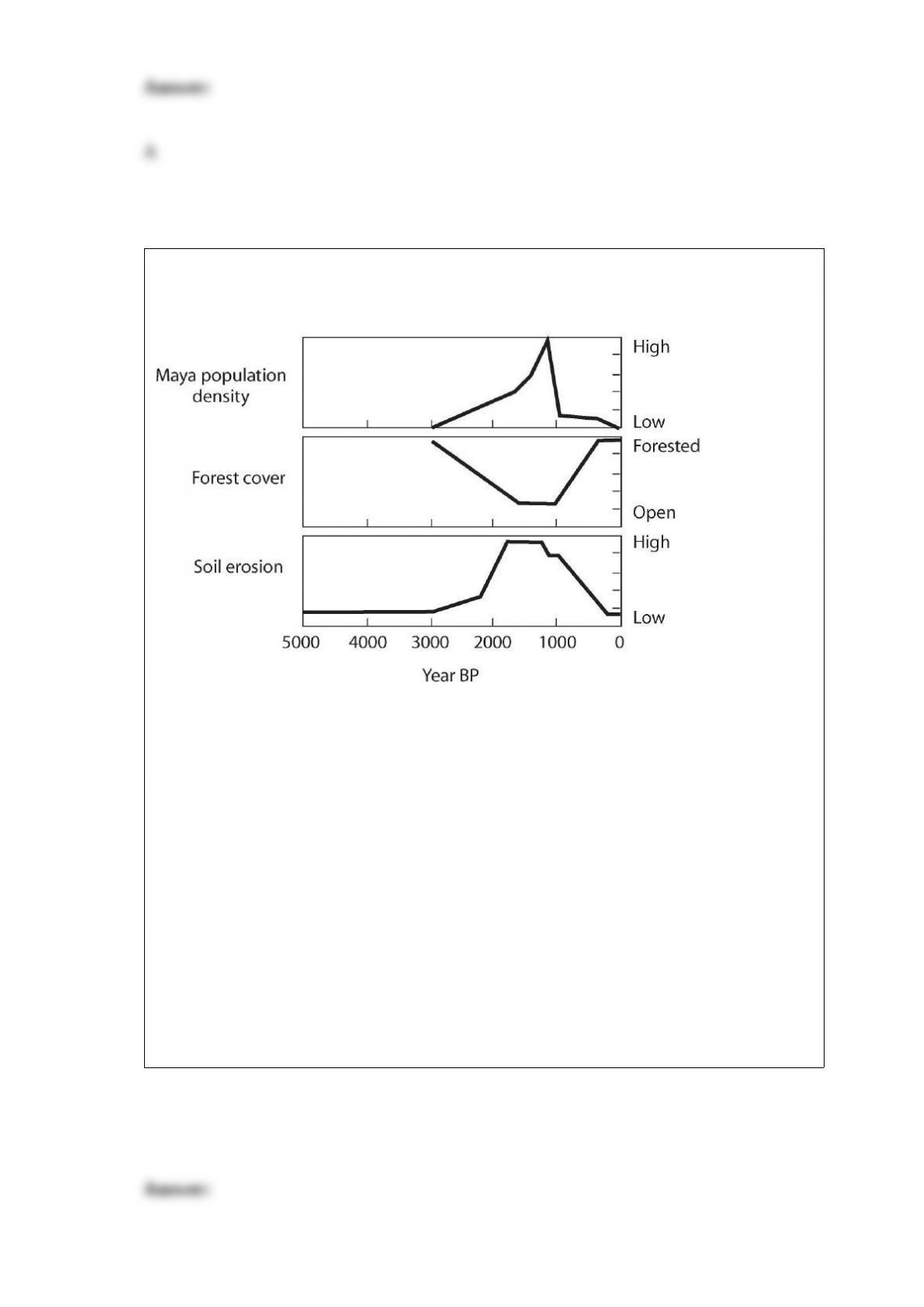
Copyright 2003 American Institute of Biological Sciences. (Foster, D.R., F. Swanson, J.
Aber, D. Tilman, N. Brokaw, I. Burke and A. Knapp. 2003. The importance of land-use
and its legacies to ecology and environmental management. BioScience 53:77-88.)
Based on the figure above, what can you conclude about the history of land use in the
southern Yucatn?
A) Massive soil erosion caused the Mayan population to crash.
B) Reduction in forest cover caused the Mayan population to crash.
C) As Mayan population increased, deforestation increased, probably leading to
increased soil erosion.
D) This Mayan population practiced sustainable development.
Which of the following statements comparing respiration in fish and in mammals is
correct?
A) The respiratory medium for fish carries more oxygen than the respiratory medium of
mammals.
B) A countercurrent exchange mechanism between the respiratory medium and blood
flow is seen in mammals but not in fish.
C) The movement of the respiratory medium in mammals is bidirectional, but in fish it
is unidirectional.
D) In blood, oxygen is primarily transported by plasma in fish, but by red blood cells in
mammals.
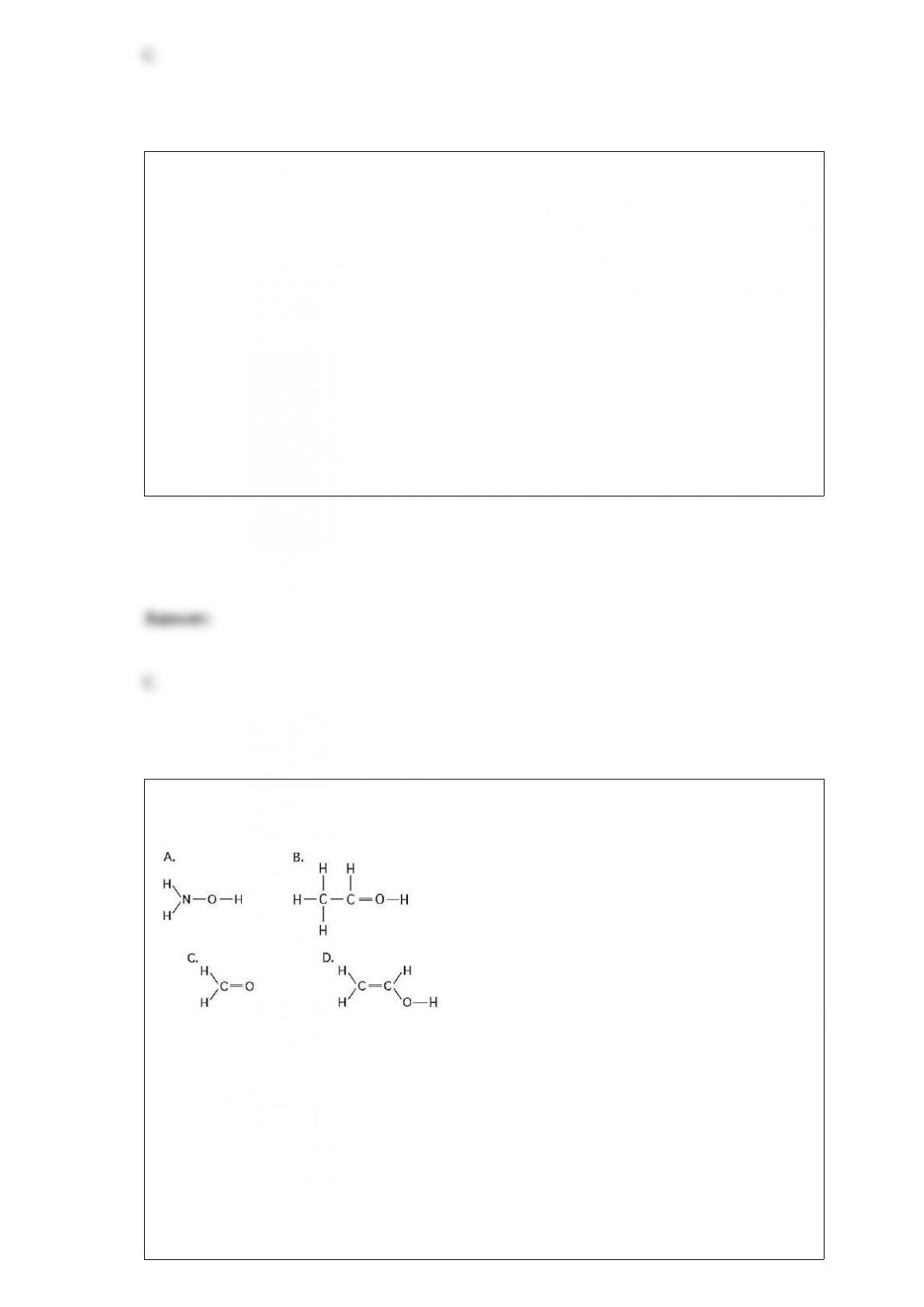
Which of the structures illustrated above is an impossible covalently bonded molecule?
A) A
B) B
C) C
D) D

Studies in knockout mice have demonstrated an important role of the FOXP2
transcription factor in the development of vocalizations. Recent sequence comparisons
of the FOXP2 gene in Neanderthals and modern humans show that while the DNA
sequence may be different, the protein sequence it codes for is identical. What might
logically be inferred from this information?
A) There was a problem with the experiment because different DNA sequences cannot
result in the same protein sequence.
B) The differences in DNA sequence support the hypothesis that Neanderthals were
primitive beings that could only grunt.
C) Human and Neanderthal vocalizations may have been more similar than previously
thought.
D) The experiments in mice demonstrating the function of the FOXP2 gene are not
relevant to humans and Neanderthals because they are not primates.
A cage containing male mosquitoes has a small earphone placed on top, through which
the sound of a female mosquito is played. All the males immediately fly to the earphone
and go through all of the steps of copulation. What is the best explanation for this
behavior?
A) Copulation is a fixed action pattern, and the female flight sound is a sign stimulus
that initiates it.
B) The sound from the earphone irritates the male mosquitoes, causing them to attempt
to sting it.

C) The reproductive drive is so strong that when males are deprived of females, they
will attempt to mate with anything that has even the slightest female characteristic.
D) Through classical conditioning, the male mosquitoes have associated the
inappropriate stimulus from the earphone with the normal response of copulation.
Consider two old-growth forests: one is undisturbed while the other is being logged. In
which region are species likely to experience exponential growth, and why?
A) Old growth, because of stable conditions that would favor exponential growth of all
species in the forest.
B) Old growth, because each of the species is well established and can produce many
offspring.
C) Logged, because the disturbed forest affords more resources for increased specific
populations to grow.
D) Logged, because the various populations are stimulated to a higher reproductive
potential.
An advantage of a complete digestive system over a gastrovascular cavity is that the
complete system _____.
A) excludes the need for extracellular digestion

B) allows for specialized regions with specialized functions
C) allows extensive branching
D) facilitates intracellular digestion
Upon closer inspection of the leaves of “flower of stone,” one can observe tiny,
cone-like structures. Each cone-like structure emits spores of two different sizes.
Further investigation also reveals that the roots of “flower of stone” branch only at the
growing tip of the root, forming a Y-shaped structure. Based on these additional
observations, which of the following can be properly inferred about “flower of stone”?
1. It is heterosporous.
2. It is a fern.
3. The cone-like structures are sori.
4. It is a lycophyte.
5. It has separate male and female gametophytes.
A) 1 and 5
B) 2 and 3
C) 1, 2, and 3
D) 1, 4, and 5

The plasma membrane of the sea urchin egg _____.
A) is outside of the fertilization membrane
B) releases calcium, which initiates the cortical reaction
C) has receptor molecules that are specific for binding acrosomal proteins
D) is a mesh of proteins crossing through the cytosol of the egg
Historically inaccurate diagnosis of acid reflux disorders and gastric ulcers has been
improved by _____.
A) pH monitoring
B) X-ray technology
C) screening for H. pylori infections
D) sonography
According to the fossil record, plants colonized terrestrial habitats _____.
A) in conjunction with insects that pollinated them

B) in conjunction with fungi that helped provide them with nutrients from the soil
C) to escape abundant herbivores in the oceans
D) only about 150 million years ago
You are dissecting a fish in your biology laboratory section. Your teaching assistant
points out a long oval structure and tells you it is an endocrine gland. Which of the
following would you then know is a true statement about this structure?
A) It secretes a product that is released through a series of ducts.
B) The gland’s product will only interact with receptors on the cell membrane.
C) The gland’s product is lipid soluble.
D) The gland produces and secretes its product into the blood.
Food moves along the digestive tract as the result of contractions by _____.
A) cardiac muscle
B) smooth muscle
C) striated muscle
D) skeletal muscle

Which of the following would be the most effective strategy to remove toxic heavy
metals from a soil?
A) heavy irrigation to leach out the heavy metals
B) application of sulfur to lower the soil pH and precipitate the heavy metals
C) adding plant species that have the ability to take up and accumulate heavy metals
D) inoculating soil with mycorrhizae to avoid heavy-metal uptake
In large scale, genome-wide association studies in humans we look for _____.
A) lengthy sequences that might be shared by most members of a population
B) SNPs where one allele is found more often in persons with a particular disorder than
in healthy controls
C) SNPs where one allele is found in families with particular introns sequence
D) SNPs where one allele is found in two or more adjacent genes

Growth and development of plant parts involves _____.
I) cell division to produce new cells
II) enlargement and elongation of cells
III) specialization of cells into tissues
A) only I
B) only II
C) only III
D) I, II, and III
Water molecules are attracted to one another by _____.
A) nonpolar covalent bonds
B) ionic bonds
C) hydrogen bonds
D) hydrophobic interactions
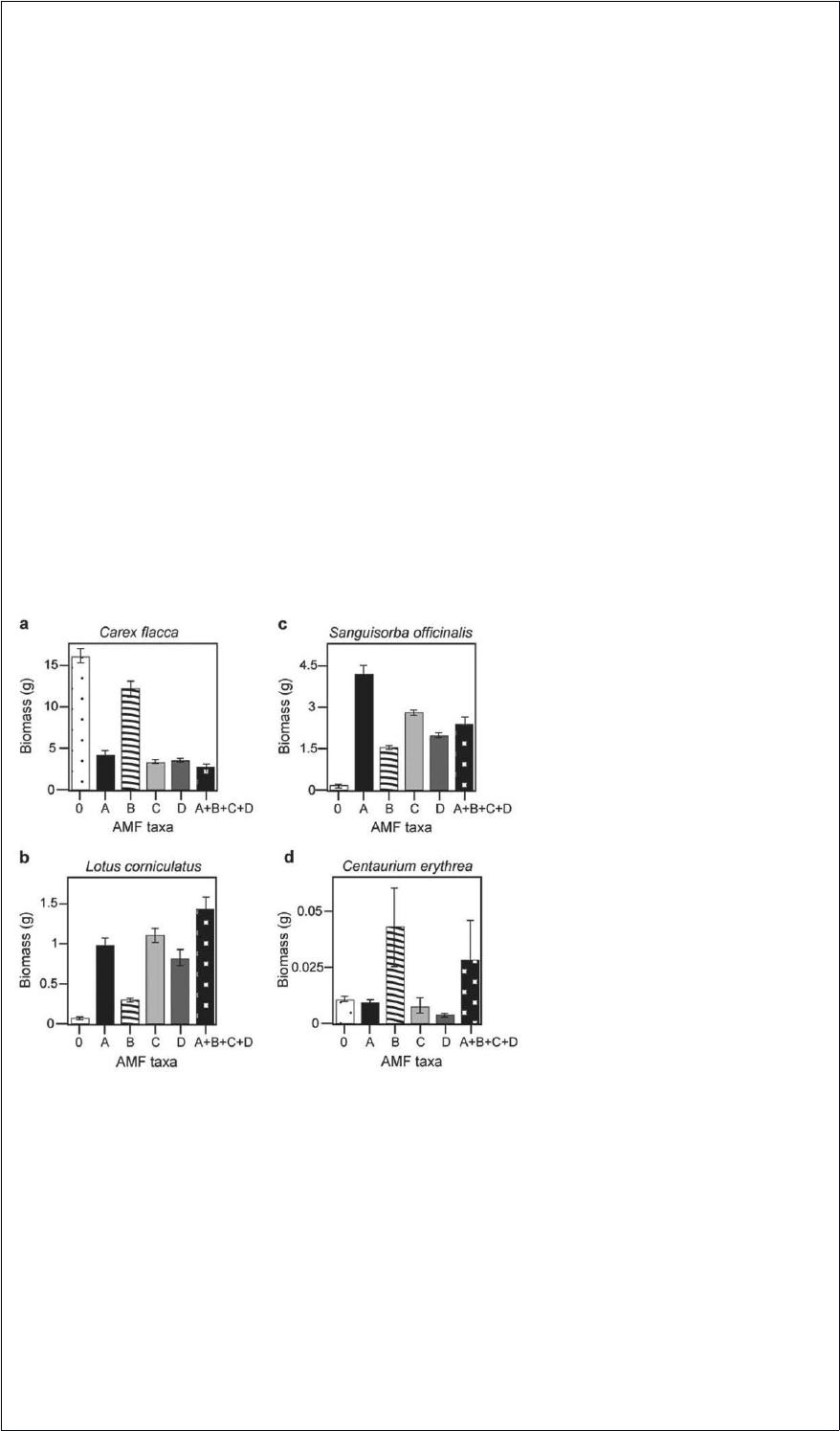
Use the following information to answer the question(s) below.
There is much discussion in the media about protecting biodiversity. But does
biodiversity really matter? Canadian and Swiss researchers wanted to know if the
diversity of arbuscular mycorrhizal fungi (AMF) was important to the productivity of
grasslands (M.G.A. van der Heijden, J. N. Klironomos, M. Ursic, P. Moutoglis, R.
Streitwolf-Engel, T. Boler, A. Wiemken, and I. R. Sanders. 1998. Mycorrhizal fungal
diversity determines plant biodiversity, ecosystem variability and productivity. Nature
396:69-72). Specifically, they wanted to know if it mattered which specific AMF
species were present, or just that some type of AMF was present. They grew various
plants in combination with one of four AMF species (A, B, C, and D), no AMF species
(O), or all four AMF species together (A+B+C+D); and they measured plant growth
under each set of conditions. All plant species were grown in each plot, so they always
competed with each other with the only difference being which AMF species were
present.
On the graphs below, the x-axis labels indicate the number and identity of AMF species
(bar 0 = no fungi; bars A-D = individual AMF species; bar A+B+C+D = all AMF
species together). The y-axis indicates the amount (grams) of plant biomass for the
species shown in italics above each graph.
In graph (b) in the figure above, which of the following best explains the data given
about Lotus corniculatus?
A) This plant grows best when AMF taxa A or C are present.
B) Lotus corniculatus does not form mycorrhizal associations.
C) Mycorrhizal fungi parasitize the plant’s roots when they are present, reducing its
growth.
D) This plant forms multiple AMF associations, growing best with increased fungal

diversity.
Which of the following is directly related to a single amino acid?
A) the base sequence of the tRNA
B) the amino acetyl tRNA synthase
C) the three-base sequence of mRNA
D) the complementarity of DNA and RNA
In chemiosmosis, what is the most direct source of energy that is used to convert ADP +
i to ATP?
A) energy released as electrons flow through the electron transport system
B) energy released from substrate-level phosphorylation
C) energy released from movement of protons through ATP synthase, down their
electrochemical gradient
D) No external source of energy is required because the reaction is exergonic.