
1) which of the following endocrine glands does not produce its own hormones, but
stores hormones produced by the hypothalamus?
a. thyroid
b. adrenal cortex
c. adrenal medulla
d. posterior pituitary
e. anterior pituitary
2) what type of fiber accounts for the strength of various connective tissues?
a. elastic
b. collagen
c. actin
d. reticular
3) which of the following is not an anthropoid?
a. chimpanzee
b. human
c. new world monkey
d. lemur
4) if a researcher was interested in slowing down the movement of amoebas by
disrupting their cell membranes, which protein filaments should she be studying?
a. actin
b. intermediates
c. microtubules
d. myosin
5) which of the following would be transcribed into mrna?
a. a noncoding gene
b. a protein-coding gene
c. a promoter
d. a ribozyme

6) which of the following statements applies to an ecosystem with a high level of
biodiversity?
a. the ecosystem will have a higher rate of photosynthesis than a comparable ecosystem
with a low level of biodiversity.
b. resource partitioning will occur easier in an ecosystem that has a high level of
biodiversity.
c. the food web will be more complex and will have a greater number of connections
within it.
d. areas of high biodiversity are economically more valuable than areas with limited
biodiversity.
e. all of these apply to an ecosystem with a high level of biodiversity.
7) which of the following best describes sensory transduction?
a. the conversion of a stimulus into a nerve impulse by using a receptor.
b. the conversion of a nerve impulse into a stimulus by using a receptor.
c. the detection of an environmental stimulus by a nerve receptor.
d. the analysis of a nerve impulse by the brain.
8) what is the body’s response to a rise in temperature above 37.0 degrees c?
a. blood vessels in the skin begin to dilate which increases blood flow to the surface of
the skin. environmental variables will help decrease the temperature of the blood. the
nervous system also activates the sweat glands which help decrease temperature.
b. blood vessels in the skin begin to constrict which increases blood flow to the surface
of the skin. environmental variables will help decrease the temperature of the blood. the
nervous system also activates the sweat glands which help decrease temperature.
c. blood vessels in the skin begin to dilate which increases blood flow to the surface of
the skin. environmental variables will help decrease the temperature of the blood. the
heart rate decreases in an attempt to slow down blood flow.
d. blood vessels in the skin begin to dilate which decreases blood flow to the surface of
the skin. environmental variables will help decrease the temperature of the blood. the
heart rate increases in an attempt to slow down blood flow.
e. blood vessels in the skin begin to dilate which increases blood flow to the surface of
the skin. environmental variables will help decrease the temperature of the blood. the
nervous system will deactivatethe sweat glands to help decrease body temperature.

9) during cellular movement which of the following filaments will be the ones that are
responsible for attaching and pulling the other filaments along?
a. actin
b. myosin
c. trypsin
d. intermediate filaments
10) _______ is a product of the calvin cycle that is used to form glucose phosphate,
amino acids or fatty acids.
a. atp.
b. ribulose bisphosphate (rubp).
c. glyceraldehyde-3-phospate (g3p).
d. pep carboxylase (pepcase).
e. carbon dioxide.
11) which statement is true about the life cycle of plants but not of animals?
a. the gametophyte can be larger than the diploid generation
b. they use sexual reproduction to produce new offspring
c. they use meiosis in order to produce the gametes
d. they will have a haploid and diploid phase of the life cycle
12) the ability to roll the edges of the tongue upward in a u-shape has been considered
to be an inherited ability. the standard assumption is that tongue-rolling is a dominant
allele at a single gene locus. which of the following would cast doubt on this
assumption?
a. a teacher reports that after testing her class on the ability to roll their tongue, with
very little effort the non-tongue-rollers can learn to also roll their tongues.
b. a student who can roll his tongue has a mother and father, both of whom cannot.
c. a student who cannot roll his tongue has a mother and father, both of whom can.
d. two of the aboveare situations that would cast doubt on this assumption.

13) among aquatic animals, only the blood of ____ is nearly isotonic to seawater.
a. whales
b. freshwater bony fish
c. marine bony fish
d. cartilaginous fish
e. salamanders
14) the mammal-like reptiles that gave rise to mammals were the
a. coelacanths.
b. therapsids.
c. lampreys.
d. archaeopteryx.
15) if a dna sample contains 13% adenine, what percentage of the sample contains
cytosine?
a. 13%
b. 37%
c. 26%
d. 74%
16) which of the following features is not associated with alzheimer’s disease?
a. a loss of reasoning and memory.
b. plaques accumulate along the axons of the neurons in the brain.
c. neurofibrillary tangles surround the nucleus of the neural cells.
d. the most common cause of dementia in older adults.
e. all of these are features of alzheimer’s disease.
17) aerobic cellular respiration yields about ____ of the energy of glucose in atp
molecules.
a. 2%
b. 15%
c. 28%
d. 39%
18) in human females, when is meiosis ii completed?
a. at ovulation
b. immediately after the sperm penetration of the secondary oocyte
c. immediately after the sperm penetrates the primary oocyte
d. none of the choices are correct.
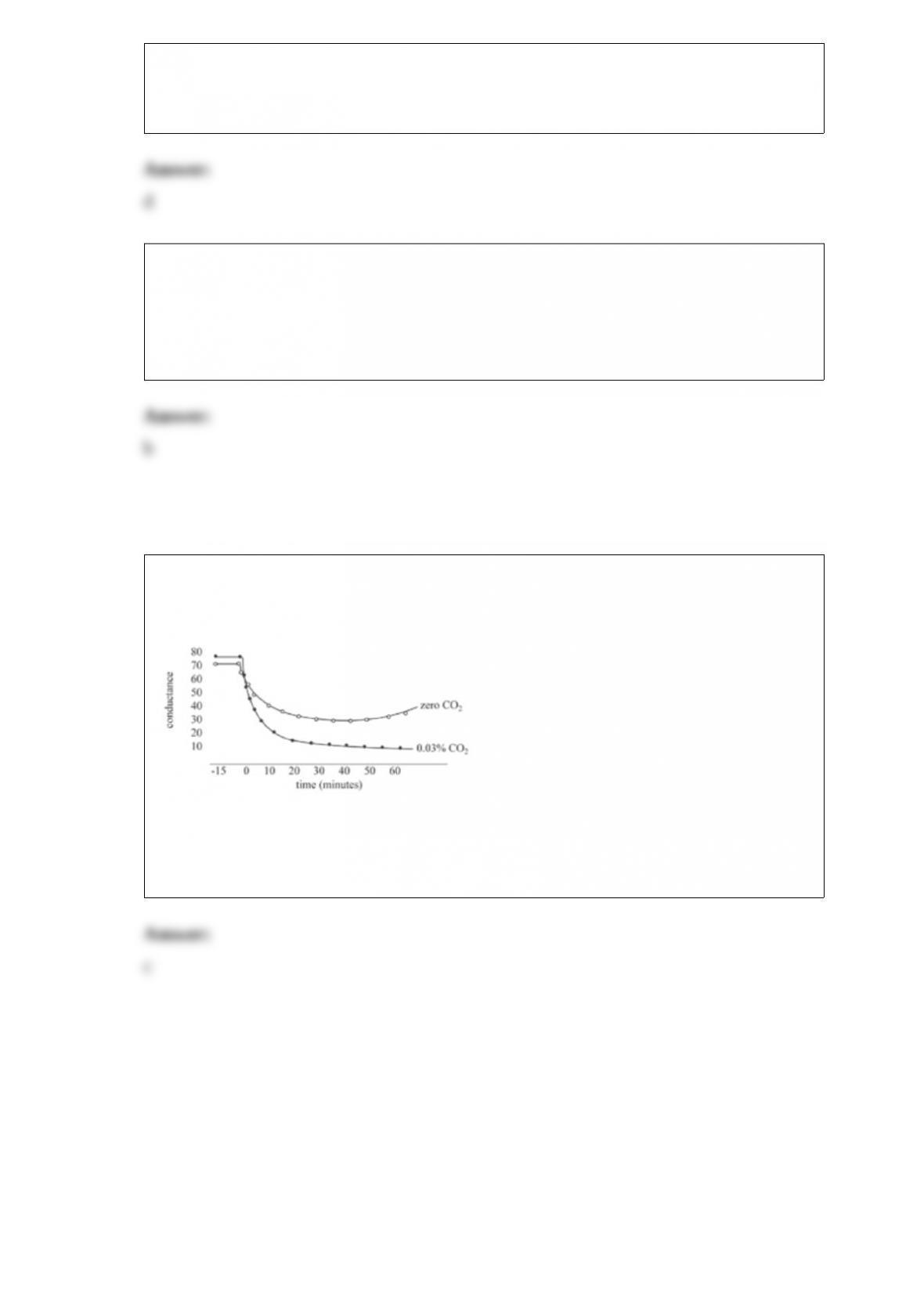
19) stomate closure in darkened environment, at time zero, with air (0.03% co2) or
co2-free airflow through leaf. (note: a decrease in conductance indicates inactivation of
the proton pump.)
a. supports both hypothesis i and ii.
b. supports only hypothesis i.
c. supports only hypothesis ii.
d. supports neither hypothesis.