
The molar mass of glucose is 180 grams per mole (g/mol). Which of the following
procedures should you carry out to make a 1 M solution of glucose? Into 0.8 liter (L) of
water, dissolve _____.
A) 1 g of glucose and then add more water until the total volume of the solution is 1 L
B) 18 g of glucose and then add more water until the total volume of the solution is 1 L
C) 180 g of glucose and then add 0.2 L more of water
D) 180 g of glucose and then add more water until the total volume of the solution is 1
L
Use the following information to answer the question(s) below.
A farm pond, usually dry during winter, has plenty of water and aquatic pond life
during the summer. One summer, Sarah returns to the family farm from college.
Observing the pond, she is fascinated by some six-legged organisms that can crawl
about on submerged surfaces or, when disturbed, seemingly “jet” through the water.
Watching further, she is able to conclude that the “mystery organisms” are ambush
predators, and their prey includes everything from insects to small fish and tadpoles.
If the pond organisms are larvae, rather than adults, Sarah should expect them to have
all of the following structures, EXCEPT_____.
A) antennae
B) an open circulatory system
C) an exoskeleton of chitin
D) sex organs

Whiteflies are common pest insects found on cotton, tomato, poinsettia, and many other
plants. Nymphs are translucent and mostly sessile, feeding on their host plants’ phloem
(sap) from the undersides of leaves. They undergo incomplete metamorphosis into
winged adults. Because whitefly nymphs cannot escape predation by moving, you
hypothesize that their translucent bodies make them hard to spot by predators. How
could you directly test this hypothesis?
A) Compare rates of predation on whitefly nymphs on plant leaves of different colors
(for example, red vs. green poinsettia leaves).
B) Compare rates of predation on whitefly nymphs coated with a nontoxic dye vs.
undyed whitefly nymphs.
C) Compare rates of predation on whitefly nymphs vs. whitefly adults.
D) Compare rates of predation on whitefly nymphs by predators that are translucent vs.
predators that are not translucent.
Use the following information to answer the question(s) below.
In the United States and Canada, bats use one of two strategies to survive winter: They
either migrate south, or they hibernate. Recently, those that hibernate seem to have
come under attack by a fungus, Geomyces destructans (Gd), an attack that is occurring
from Missouri to southern Canada. Many infected bats have a delicate, white
filamentous mat on their muzzles, which is referred to as white-nose syndrome (WNS).
The fungus invades the bat tissues, causes discomfort, and awakens the bat from its
hibernation. The bat fidgets and wastes calories, using up its stored fat. The bat then
behaves abnormally, leaving its cave during daytime in winter to search for food. Their
food, primarily insects, is scarce during the winter, and the bats ultimately starve to
death. Since 2007, it is estimated that up to one million bats have perished from WNS.
What do fungi and arthropods have in common?
A) The haploid state is dominant in both groups.

B) Both groups are predominantly autotrophs that produce their own food.
C) Both groups use chitin for support.
D) Both groups have cell walls.
If an adult person has a faulty version of the human analog to ced-4 of the nematode,
which of the following is most likely to result?
A) activation of a developmental pathway found in the worm but not in humans
B) a form of cancer in which there is insufficient apoptosis
C) formation of molecular pores in the mitochondrial outer membrane
D) excess skin loss
Based on the data in the Amino Acid Identity Table, which two members of the human
globin gene family are the most divergent?
A) a1 and ß
B) ? and ß
C) a1 and a2

D) a1 and G?
A drug designed to inhibit the response of cells to testosterone would most likely result
in _____.
A) lower cytoplasmic levels of cAMP
B) a decrease in transcriptional activity of certain genes
C) an increase in cytosolic calcium concentration
D) a decrease in G protein activity
To make a vaccine against mumps, measles, or rabies, which type of viruses would be
useful?
A) dsDNA viruses
B) negative-sense ssRNA viruses
C) positive-sense ssRNA viruses
D) dsRNA viruses

Natural selection should favor the highest proportion of juxtamedullary nephrons in
which of the following species?
A) a river otter
B) a mouse species living in a tropical rain forest
C) a mouse species living in a temperate broadleaf forest
D) a mouse species living in a desert
Which of the following is an example of negative feedback?
A) During birthing contractions, oxytocin (a hormone) is released and acts to stimulate
further contractions.
B) When a baby is nursing, suckling leads to the production of more milk and a
subsequent increase in the secretion of prolactin (a hormone that stimulates lactation).
C) After a blood vessel is damaged, signals are released by the damaged tissues that
activate platelets in the blood. These activated platelets release chemicals that activate
more platelets.
D) When the level of glucose in the blood increases, the pancreas produces and releases
the hormone insulin. Insulin acts to decrease blood glucose. As blood glucose
decreases, the rate of production and release of insulin decreases as blood glucose
decreases.

Which value(s) would be required to calculate how long ago the most recent ancestor of
ungulates lived?
I) the number of base pairs that differ among species in a certain genetic sequence
II) the total number of base pairs in the genetic sequence examined
III) the age of a fossil ancestor for calibration
A) I
B) II
C) III
D) I, II, and III
When wefirst see chiasmata under a microscope, we know that _____.
A) meiosis II has occurred
B) anaphase II has occurred
C) prophase I is occurring
D) separation of homologs has occurred

Which of the following statements describes a eukaryotic chromosome?
A) a single strand of DNA
B) a series of nucleosomes wrapped around two DNA molecules
C) a chromosome with different numbers of genes in different cell types of an organism
D) a single linear molecule of double-stranded DNA plus proteins
Cell membranes are asymmetrical. Which of the following statements is the most likely
explanation for the membrane’s asymmetrical nature?
A) Since the cell membrane forms a border between one cell and another in tightly
packed tissues such as epithelium, the membrane must be asymmetrical
B) Since cell membranes communicate signals from one organism to another, the cell
membranes must be asymmetrical.
C) The two sides of a cell membrane face different environments and carry out different
functions.
D) Proteins only function on the cytoplasmic side of the cell membrane, which results
in the membrane’s asymmetrical nature.
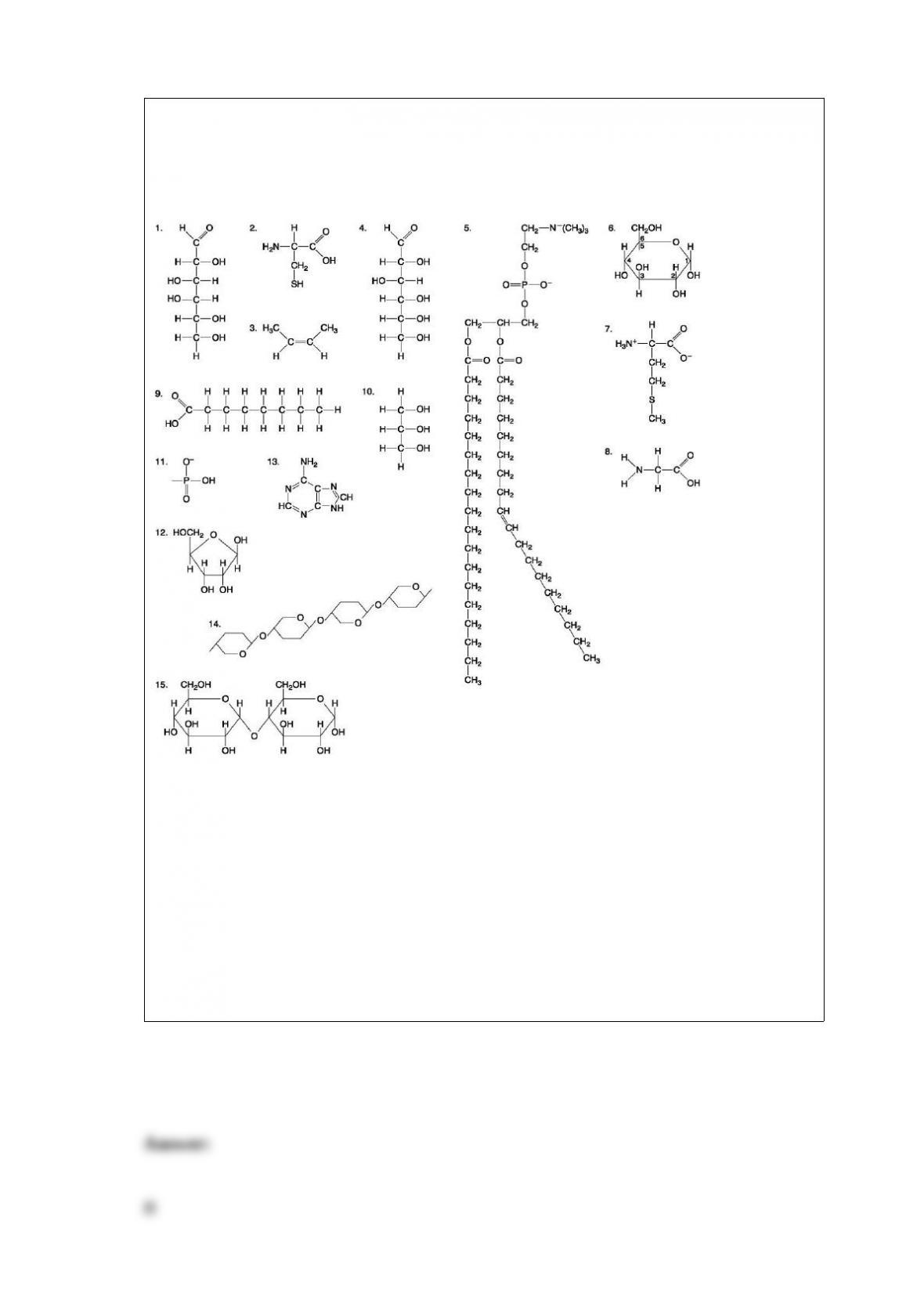
The following questions are based on the 15 molecules illustrated in the accompanying
figure. Each molecule may be used once, more than once, or not at all.
Which of the following pairs of molecules could be joined together by a peptide bond in
a dehydration reaction?
A) 2 and 3
B) 7 and 8
C) 8 and 9
D) 12 and 13

In terms of community ecology, why are pathogens often more virulent now than in the
past?
A) More new pathogens have recently evolved.
B) Host organisms have become more susceptible because of weakened immune
systems.
C) Human activities are transporting pathogens into new habitats (or communities) at
an unprecedented rate.
D) Medicines for treating pathogenic disease are in short supply.
The steroid hormone that coordinates molting in arthropods is _____.
A) ecdysteroid
B) glucagon
C) thyroxine
D) growth hormone
Most cells cannot harness heat to perform work because _____.

A) heat is not a form of energy
B) temperature is usually uniform throughout a cell
C) heat can never be used to do work
D) heat must remain constant during work
The point of connection between two communicating neurons is called the _____.
A) axon hillock
B) dendrite
C) synapse
D) cell body
A genetic test to detect predisposition to cancer would likely examine the APC gene for
involvement in which type(s) of cancer?
A) colorectal only
B) lung and breast
C) lung only

D) lung and prostate
Your brother has just purchased a new plastic model airplane. He places all the parts on
the table in approximately the positions in which they will be located when the model is
complete. His actions are analogous to which process in development?
A) morphogenesis
B) determination
C) differentiation
D) pattern formation
A lack of which molecule would result in a cell’s inability to “turn off” genes?
A) operon
B) inducer
C) promoter
D) corepressor

All of the following are part of a prokaryotic cell EXCEPT_____.
A) a cell wall
B) a plasma membrane
C) ribosomes
D) an endoplasmic reticulum
Exposure of zebrafish nuclei to meiotic cytosol resulted in phosphorylation of NEP55
and L68 proteins by cyclin-dependent kinase 2. NEP55 is a protein of the inner nuclear
membrane, and L68 is a protein of the nuclear lamina. What is the most likely role of
phosphorylation of these proteins in the process of mitosis?
A) They enable the attachment of the spindle microtubules to kinetochore regions of the
centromere.
B) They are involved in the disassembly and dispersal of the nucleolus.
C) They are involved in the disassembly of the nuclear envelope.
D) They assist in the movement of the centrosomes to opposite sides of the nucleus.

Which of the following is the correct sequence of blood flow in birds and mammals?
A) left ventricle → aorta → lungs → systemic circulation
B) vena cava → right atrium → right ventricle → pulmonary vein
C) pulmonary vein → left atrium → left ventricle → pulmonary circuit
D) vena cava → right atrium → right ventricle → pulmonary artery
If a doctor attempts to trigger the patellar tendon reflex and a lack of response occurs,
what are potential regions where pathology might exist?
I) the brain
II) the knee
III) the spinal cord
A) only I
B) only II
C) only III
D) only II and III

What is believed to be the most significant result of the evolution of the amniotic egg?
A) Tetrapods were no longer tied to the water for reproduction.
B) Tetrapods can now function with just lungs.
C) Newborns are much less dependent on their parents.
D) Embryos are protected from predators.
Use the following information to answer the question(s) below.
Scarlet gilia (Ipomopsis aggregata) usually has red flowers in an inflorescence of up to
250 flowers. In certain populations in the Arizona mountains, however, the flowers
range from red to pink to white. In early summer, most of the flowers were red. Six to
eight weeks later, the same individual plants were still present; the flowers ranged from
pink to white, and few red flowers were present. The major pollinators early in the
season were two species of hummingbirds active during the day; they emigrated to
lower elevations, and the major pollinator later in the season was a hawk moth (a type
of moth). The hawk moth was most active at sunset and later, and it preferred light pink
to white flowers after dark. When hummingbirds were present, more red flowers than
white flowers produced fruit. When only hawk moths were present, more white flowers
produced fruit (K. N. Paige and T. G. Whitham. 1985. Individual and population shifts
in flower color by scarlet gilia: A mechanism for pollinator tracking. Science
227:315-17).
Refer to the paragraph on scarlet gilia. Some plants changed their flowers to lighter
colors, and some retained the same darker color all season. Which plants do you expect
produced more fruit?
A) those that changed their color to a lighter shade
B) those that stayed darker
C) the same numbers of fruit on both

Most moss gametophytes do not have a cuticle and are 1-2 cells thick. What does this
imply about moss gametophytes and their structure?
A) They use stomata for gas exchange regulation.
B) They can easily lose water to, and absorb water from, the atmosphere.
C) Photosynthesis occurs throughout the entire gametophyte surface.
D) They have branching veins in their leaves.
The drug cytochalasin B blocks the function of actin. Which of the following aspects of
the cell cycle would be most disrupted by cytochalasin B?
A) spindle formation
B) spindle attachment to kinetochores
C) cell elongation during anaphase
D) cleavage furrow formation and cytokinesis

How many molecules of water are used to completely hydrolyze a polymer that is 11
monomers long?
A) 12
B) 11
C) 10
D) 9
When a neuron responds to a particular neurotransmitter by opening gated ion channels,
the neurotransmitter is serving as which part of the signal pathway?
A) relay molecule
B) transducer
C) signal molecule
D) response molecule
A mutant bacterial cell has a defective aminoacyl-tRNA synthetase that attaches a
lysine to tRNAs with the anticodon AAA instead of the normal phenylalanine. The
consequence of this for the cell will be that _____.
A) none of the proteins in the cell will contain phenylalanine
B) proteins in the cell will include lysine instead of phenylalanine at amino acid
positions specified by the codon UUU
C) the cell will compensate for the defect by attaching phenylalanine to tRNAs with
lysine-specifying anticodons
D) the ribosome will skip a codon every time a UUU is encountered
A new DNA strand elongates only in the to direction because _____.
A) DNA polymerase begins adding nucleotides at the end of the template
B) the polarity of the DNA molecule prevents addition of nucleotides at the end
C) replication must progress toward the replication fork
D) DNA polymerase can add nucleotides only to the free end
The value for Ψ in root tissue was found to be -0.15 MPa. If you take the root tissue and
place it in a 0.1 M solution of sucrose (Ψ = -0.23 MPa), the net water flow would
_____.
A) be from the tissue into the sucrose solution
B) be from the sucrose solution into the tissue

C) be in both directions and the concentration of water would remain equal
D) be impossible to determine from the values given here