
Recent studies have shown that the onset of puberty in American girls has decreased
from an average of 12-13 years of age to as young as 8-10. Many scientists who study
premature puberty suggest that steroids in our food and in the environment may be
contributing factors, since steroids are known to cross cell membranes and bind to
receptors inside cells.
Why are hormones present in our foods? Synthetic testosterone compounds (similar to
those used by some athletes) make young animals gain weight faster so they are ready
for market sooner. Female animals receive synthetic estrogen to inhibit the reproductive
cycle and divert all energy into weight gain. In the United States, up to two-thirds of
meat animals are raised using hormones. In addition, hormones are used to increase
milk production in dairy cattle.
Scientific investigation of the exact effects of environmental steroids on humans is
extremely difficult since there are multiple sources of hormones in the environment. A
valid study would require a control group who hasn’t been exposed to the chemicals
being studied. Since everyone has had some exposure to environmental hormones, no
control group is available to use as a reference.
When environmental estrogens trigger premature puberty in girls, the main organs
affected are the
A) ovaries and uterus.
B) thyroid gland and pituitary gland.
C) adrenal cortex.
D) pituitary gland and parathyroid glands.
A signal outside a cell triggers changes in the transcription and translation inside the
cell through
A) post-translational editing.
B) signal transduction pathways.
C) protein activation.

D) protein breakdown.
A motor unit is
A) the bundle of axons that goes from the spinal cord to a muscle.
B) one of the connective tissue-wrapped bundles of muscle fibers in a muscle.
C) a motor neuron and all of the muscle fibers it controls.
D) the muscle or group of muscles that accomplishes a specific movement.
An advantage of using reverse transcriptase to prepare a gene for cloning is that
A) reverse transcriptase is more efficient than RNA polymerase.
B) the resulting DNA strand will lack exons.
C) reverse transcriptase is more efficient than DNA polymerase.
D) the resulting DNA strand will lack introns.

Which of the following options lists the events of protist evolution in the correct order,
according to current science?
A) Mitochondria evolved through primary endosymbiosis; chloroplasts then evolved
through secondary endosymbiosis.
B) Mitochondria and then chloroplasts evolved through primary endosymbiosis; later,
protozoans were incorporated into several other groups of protists through secondary
endosymbiosis.
C) Chloroplasts and then mitochondria evolved through primary endosymbiosis; later,
algae were incorporated into several other groups of protists through secondary
endosymbiosis.
D) Mitochondria and then chloroplasts evolved through primary endosymbiosis; later,
algae were incorporated into several other groups of protists through secondary
endosymbiosis.
Rickets is a softening of the bones that can lead to frequent fractures and skeletal
deformities. The legs of a person with rickets tend to bow outward under the force
exerted by body weight and movement. British scientists recently found a serious
increase in the incidence of rickets and other bone deficiencies among women in
Middle Eastern countries who cover their bodies completely to express a form of
religious belief, as well as among their breast-fed children.
Most of the body’s vitamin D, which is necessary for calcium absorption by bone tissue,
is obtained through sunlight acting on the skin. Doctors warn that women who
completely cover their skin do not get enough sunlight to produce the vitamin D
necessary for bone health. This lack of sun exposure also lowers the level of vitamin D
in their breast milk, which means that their children may develop the same vitamin D
deficiencies. Lack of calcium and phosphorous, which are needed for bone repair and
replacement, can also lead to rickets. Rickets caused by a dietary lack of these minerals
is more common in developing countries because dairy products and green vegetables,

the best sources of calcium, are not commonly eaten.
In rickets, lack of calcium decreases the strength of the mineral matrix of compact bone
so that it is unable to
A) resist compression.
B) complete extension.
C) complement muscle contraction.
D) bend at the joints.
In what way does the green alga Ulva resemble land plants?
A) It produces diploid gametes.
B) It has a complex life cycle with diploid body cells and haploid gametes.
C) It has a complex life cycle with alternation between multicellular diploid and haploid
generations.
D) It has a multicellular haploid stage that alternates with a unicellular diploid stage.
In thinking about their role in cell division, oncogenes are like the ________ of a car,
while tumor suppressor genes are like the ________ of a car.

A) gas pedal; brakes
B) steering wheel; brakes
C) gas pedal; headlights
D) brakes; gas pedal
Which enzyme breaks large polypeptides into smaller polypeptides?
A) amylase
B) lipase
C) lactase
D) chymotrypsin
Which of the following biomes is dominated by coniferous trees adapted to surviving
long, harsh winters and short, wet summers?
A) coniferous forests
B) tundra
C) temperate broadleaf forest

D) savanna
Which of these sequences is not a correct pathway of energy through an ecosystem?
A) insects → birds → bacteria
B) plants → insects → birds
C) plants → birds → bacteria
D) bacteria → plants → birds
About 95% of all modern plant species
A) have a dominant sporophyte in their life cycle.
B) have no gametophyte.
C) have a gametophyte adapted to house a sporophyte stage.
D) have flagellated sperm.
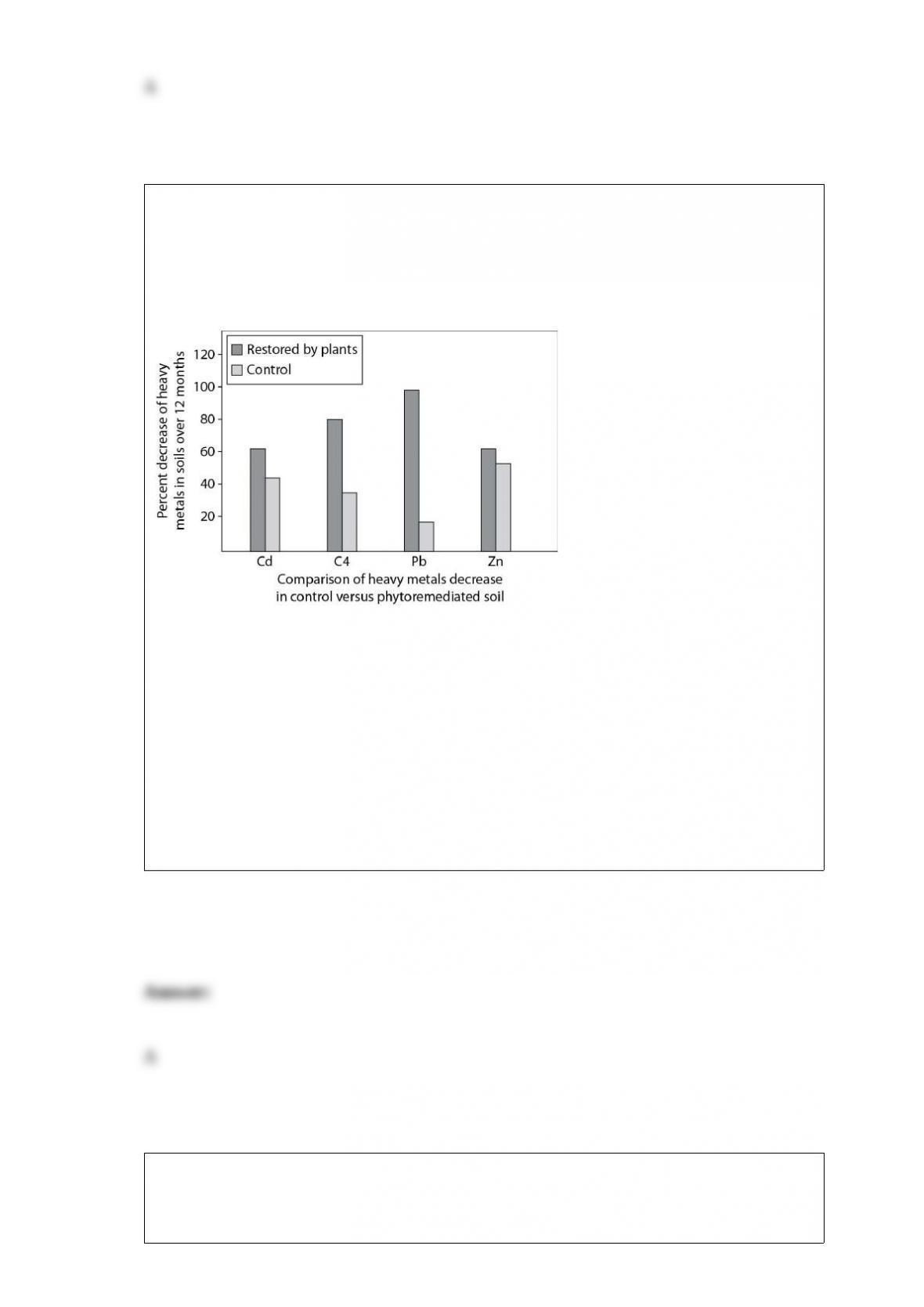
Plants are sometimes used for phytoremediation in areas where the soil has been
contaminated with heavy metals. Suppose the Acme Remediation Company is
proposing to remediate a contaminated area that you wish to restore. Acme presents you
with the following data as evidence of their company’s ability to remediate soil.
Which would provide the best evidence that Acme’s phytoremediation really works?
A) data on heavy metal content of plants grown in normal soil versus soil contaminated
with heavy metals
B) testimonials from former Acme customers
C) a list of plant species that tolerate heavy metals
D) a list of publications of the scientists that work at Acme
You have been running a high fever, have stomach cramps, and have felt weak and
disoriented for five days, so you set up an appointment with your physician. After
asking you a few questions, she starts a physical examination by probing for swollen

areas in your abdomen. You immediately sense that she is looking for
A) lymph nodes.
B) histamines.
C) antibodies.
D) antigens.
Agonistic behavior
A) usually causes serious injury to one or both of the combatants.
B) increases the number of individuals who mate.
C) is typically used to determine access to food, mates, or territories.
D) is rare among vertebrates.
Uranium is a metallic element that is used in nuclear reactors and nuclear weapons. The
vast majority of uranium found on Earth is in the form of uranium-238, an isotope with
a mass number of 238, while the uranium that is used for nuclear reactors and weapons
is uranium-235, an isotope with a mass number of 235.
If the atomic mass of uranium is 92, how many neutrons does an atom of uranium-235
have in its nucleus?

A) 92
B) 143
C) 146
D) 235
The body’s innate defenses against infection include
A) several specific antibodies.
B) barriers such as dead skin cells and mucus.
C) increased production of certain hormones and changes in microcirculation.
D) memory cells.
Which of the following is a function of epinephrine?
A) release of glucose from the liver
B) decreased heart rate
C) decreased metabolic rate

D) increased digestive activities
Which of the following is the cause of more than half of all deaths in the United States?
A) cardiovascular disease
B) flu
C) cancer
D) diabetes
Two chromosomes in a nucleus that carry genes controlling the same inherited
characteristics are
A) homologous chromosomes.
B) heterologous chromosomes.
C) complementary chromosomes.
D) parallel chromosomes.

The development of colon cancer occurs slowly, and colon cancer is more frequently
seen in the elderly than the young. This is most likely because
A) cancer cells don’t have mitochondria, so they grow slowly.
B) usually six or more somatic mutations must occur to give rise to the cancer, which
takes time.
C) cancer cells have to wait until new blood vessels grow into the area, which takes
much time.
D) most cancer mutations interfere with mitosis, so cell division occurs more slowly.
Neanderthals are best described as
A) direct ancestors to modern humans.
B) direct ancestors to modern Europeans but not to other human populations.
C) a localized form or subspecies of Homo sapiens that was well-adapted to living in
caves and carrying clubs.
D) a hominin that colonized Europe independently of Homo sapiens and that may or
may not have interbred with modern humans.

The cochlea is
A) a coiled structure found in the inner ear.
B) part of the organ of Corti.
C) involved in the maintenance of body temperature.
D) part of the middle ear.
Which of the following forms of homeostasis would not be affected by a severe burn
involving both the epidermis and dermis?
A) control of water loss by the integumentary system
B) protection from microbes by the integumentary system
C) defense against microbes by the immune system
D) sensation of external temperature
Karyotyping

A) shows chromosomes as they appear in metaphase of meiosis II.
B) can reveal alterations in chromosome number.
C) examines points of crossing over.
D) reveals the presence of cancerous genes.
Which of the following processes does not occur in ecosystems?
A) Energy flows through the system.
B) Carbon is cycled between biotic and abiotic forms.
C) Producers convert light energy to chemical energy.
D) The energy source that powers the system is used by consumers to make organic
compounds.
The type of life cycle seen in plants is called
A) haploid generations.
B) gametophyte production.
C) alternation of generations.

D) diploid generations.
Vegetarians who rely upon a single type of plant food
A) may become severely dehydrated.
B) run the risk of depleting their liver of glycogen.
C) are soon unable to produce sufficient quantities of bile.
D) may become protein-deficient.
To initiate a signal transduction pathway, a signal binds to a receptor protein usually
located in the
A) nucleus.
B) plasma membrane.
C) ER.
D) cytoplasm.

Under the conditions known as El Nio, the inorganic nutrient content of the seawater off
the coast of Peru declines to very low levels. What effect will this likely have on marine
life in the area?
A) The lower the levels of minerals, the less polluted the water; hence, most
populations will increase.
B) It will result in toxic red tides, which will reduce the populations of many species.
C) It will reduce the abundance of phytoplankton and, consequently, the abundance of
other organisms.
D) It will increase the productivity of phytoplankton and, therefore, the productivity of
other organisms by allowing sunlight to penetrate deeper into the ocean.
Which of the following colors contributes the least energy to photosynthesis?
A) blue
B) red
C) orange
D) green