
Which clade does NOT include humans?
A) lobe-fins
B) diapsids
C) craniates
D) osteichthyans
What is the importance of consuming an adequate amount of proteins in the diet?
A) They are most commonly used to meet energy demands of cells.
B) Proteins serve a variety of functions, and the body does not store excess quantities of
protein.
C) They are used as cofactors for metabolic reactions and are required in minute
quantities.
D) Proteins are necessary to produce urea and other important metabolites.
Among the following choices, the most concentrated urine is excreted by _____.
A) frogs
B) kangaroo rats

C) humans
D) freshwater bass
If alternative splicing did NOT occur then _____.
A) the human genome would likely contain many more genes
B) the E. coli genome would contain many fewer genes
C) there would be little correlation between the complexity of organisms and genome
size
D) there would be many fewer genes devoted to metabolism in Arabidopsis and yeast
Under identical atmospheric conditions, freshwater _____.
A) has more oxygen than seawater
B) has less oxygen than seawater
C) can hold 10-40 times more carbon dioxide than air
D) can hold 10-40 times more oxygen than air

A strong acid like HCl _____.
A) dissociates completely in an aqueous solution
B) increases the pH when added to an aqueous solution
C) reacts with strong bases to create a buffered solution
D) is a strong buffer at low pH
A sexually reproducing animal has two unlinked genes, one for head shape (H) and one
for tail length (T). Its genotype is HhTt. Which of the following genotypes is possible in
a gamete from this organism?
A) Hh
B) HhTt
C) T
D) HT

Fluorine has an atomic number of 9. Which of the following would you do to a neutral
fluorine atom to complete its valence shell?
A) add 1 electron
B) add 2 electrons
C) remove 1 electron
D) Nothing. If fluorine is neutral, it has a complete valance shell.
On a submarine expedition to the ocean bottom, you discover a population of fish that
are only female. What type of reproduction does this fish most likely use?
A) sexual
B) budding
C) cloning
D) parthenogenesis
During which phase of mitosis do the chromatids become chromosomes?
A) telophase

B) anaphase
C) prophase
D) metaphase
Which of the following animals most likely uses the largest percentage of its energy
budget for homeostatic regulation?
A) a marine jelly (an invertebrate) living deep in the ocean
B) a snake in a tropical forest
C) a shark swimming in the open ocean
D) a bird living year round in a desert
Which of the following is a scientific concern related to creating genetically modified
crops?
A) Herbicide resistance may spread to weedy species.
B) Genetically modified crops cannot survive without the addition of great amounts of
fertilizer to the soil.
C) The monetary costs of growing genetically modified plants are significantly greater

than traditional breeding techniques.
D) Genetically modified plants are less stable and may revert back to parental
genotypes.
When we compare animal development to plant development, we find that _____.
A) plant cells, but not animal cells, migrate during morphogenesis
B) animal cells, but not plant cells, migrate during morphogenesis
C) plant cells and animal cells migrate extensively during morphogenesis
D) neither plant cells nor animal cells migrate during morphogenesis
Suppose a researcher for a pest-control company developed a chemical that inhibited
the development of an embryonic mosquito’s endodermal cells. Which of the following
would be a likely mechanism by which this pesticide works?
A) The mosquito would develop a weakened exoskeleton that would make it vulnerable
to trauma.
B) The mosquito would have trouble digesting food, due to impaired gut function.
C) The mosquito would have trouble with respiration and circulation, due to impaired
muscle function.

D) The mosquito wouldn’t be affected at all.
An organism is discovered that thrives in both the presence and absence of oxygen in
the air. Curiously, the consumption of sugar increases as oxygen is removed from the
organism’s environment, even though the organism does not gain much weight. This
organism _____.
A) is a normal eukaryotic organism
B) is photosynthetic
C) is an anaerobic organism
D) is a facultative anaerobe
Which of the following is an important feature of most terrestrial biomes?
A) annual average rainfall in excess of 250 centimeters
B) a distribution predicted almost entirely by rock and soil patterns
C) clear boundaries between adjacent biomes
D) vegetation demonstrating vertical layering

Chum salmon (Oncorhynchus keta) are born in freshwater environments and then
migrate to the sea. Near the end of their lives, they return to the freshwater stream
where they were born to spawn. In freshwater, water constantly diffuses into the body
and ions are lost from the body. In salt water, body water diffuses out of the body and
excess ions are gained from the water. A salmon’s gills have special cells to pump salt in
or out of the body to maintain homeostasis. In response to the salmon’s moves between
freshwater and salt water, some cells in the gills are produced and others are destroyed.
These changes made in the cells of the gills during the lifetime of an individual salmon
are an example of which of the following?
A) evolution
B) trade-off
C) acclimatization
D) adaptation
Which of the following statements is FALSE?
A) Carbon, hydrogen, oxygen, and nitrogen are the most abundant elements of living
matter.
B) Some naturally occurring elements are toxic to organisms.
C) All life requires the same essential elements.
D) Iron is needed by all humans.

Use the following information to answer the question(s) below.
Healthy individuals of Paramecium bursaria contain photosynthetic algal
endosymbionts of the genus Chlorella. When within their hosts, the algae are referred to
as zoochlorellae. In aquaria with light coming from only one side, P. bursaria gather at
the well-lit side, whereas other species of Paramecium gather at the opposite side. The
zoochlorellae provide their hosts with glucose and oxygen, and P. bursaria provides its
zoochlorellae with protection and motility. P. bursaria can lose its zoochlorellae in two
ways: (1) if kept in darkness, the algae will die; and (2) if prey items (mostly bacteria)
are absent from its habitat, P. bursaria will digest its zoochlorellae.
Which term most accurately describes the nutritional mode of healthy P. bursaria?
A) photoautotroph
B) photoheterotroph
C) chemoautotroph
D) mixotroph
Use the following information to answer the question(s) below.
Paulinella chromatophora is one of the few cercozoans that is autotrophic, carrying out
aerobic photosynthesis with its two elongated “chromatophores.” The chromatophores
are contained within vesicles of the host cell, and each is derived from a
cyanobacterium, though not the same type of cyanobacterium that gave rise to the
chloroplasts of algae and plants.
The genome of modern chloroplasts is roughly 50% the size of the genome of the
cyanobacterium from which it is thought to have been derived. In comparison, the
genome of P. chromatophora‘s chromatophore is only slightly reduced relative to the
size of the genome of the cyanobacterium from which it is thought to have been
derived. What is a valid hypothesis that can be drawn from this comparison?
A) Lytic phage infections have targeted the chloroplast genome more often than the P.
chromatophora genome.
B) P. chromatophora‘s chromatophore is the result of an evolutionarily recent
endosymbiosis.
C) The genome of the chloroplast ancestor contained many more introns that could be
lost without harm, compared to the chromatophore’s genome.
D) The genome of the cyanobacteria was smaller than the genome of P.
chromatophora.
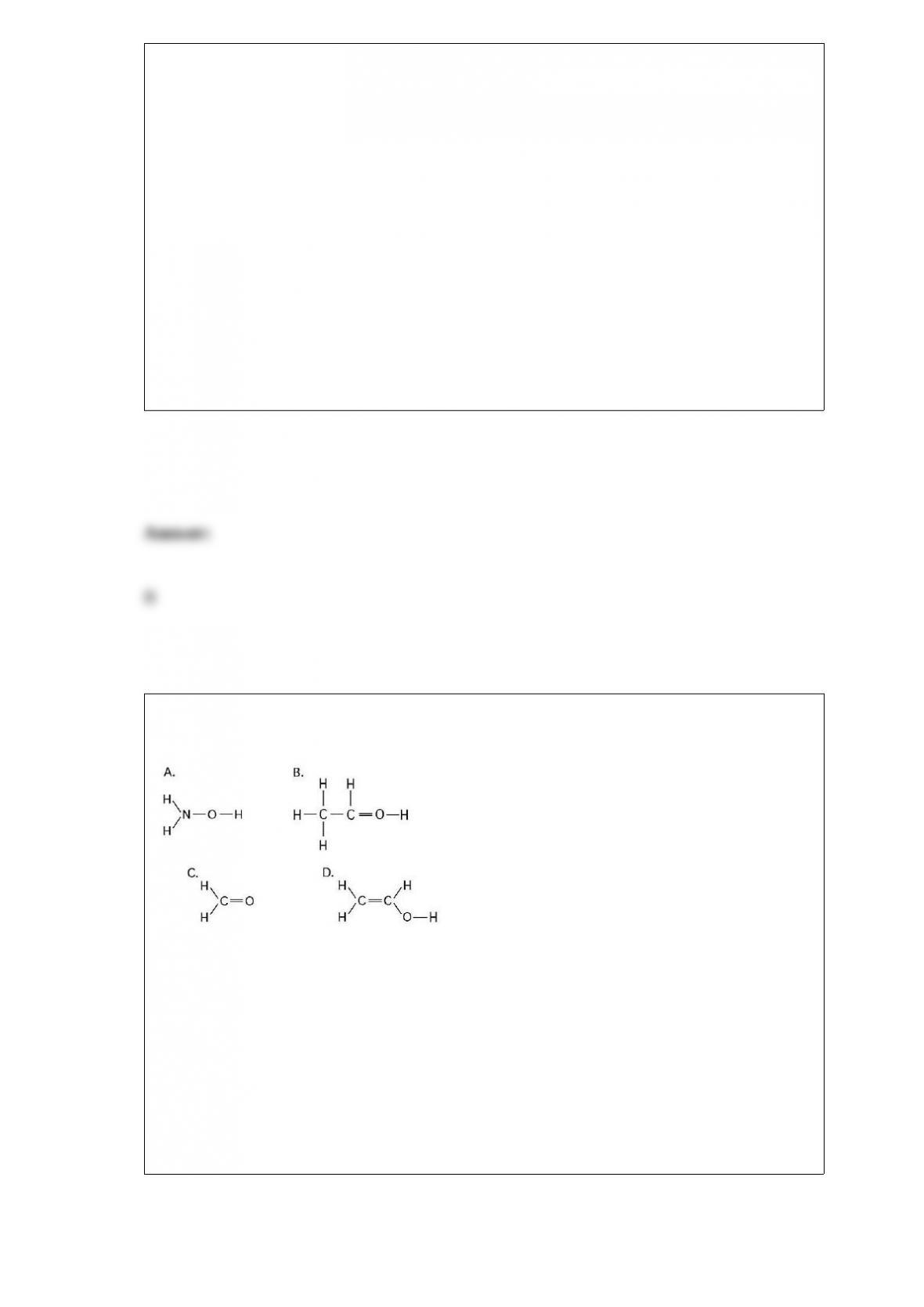
In which of the structures illustrated above are the atoms bonded by ionic bonds?
A) A
B) B
C) C
D) none of the structures

Which of the following is the most direct threat to biodiversity?
A) increased levels of atmospheric carbon dioxide
B) the depletion of the ozone layer
C) overexploitation of selected species
D) habitat destruction
The legless condition that is observed in several groups of extant reptiles is the result of
_____.
A) their common ancestor having been legless
B) a shared adaptation to an arboreal (living in trees) lifestyle
C) several instances of the legless condition arising independently of each other
D) individual lizards adapting to a fossorial (living in burrows) lifestyle during their
lifetimes

Why did scientists originally hypothesize that proteolytic enzymes such as pepsin and
trypsin are secreted in inactive form?
A) These proteolytic enzymes, in active form, would digest the very tissues that
synthesize them.
B) They identified the hormone that activates pepsin and trypsin.
C) The stomach is too acidic to maintain these enzymes in their active form.
D) Pepsin and trypsin have never been isolated in their fully activated form.
At some time during their life cycles, bryophytes make _____.
A) microphylls
B) true roots
C) true leaves
D) sporangia
Use the following information to answer the question(s) below.
The most recently discovered phylum in the animal kingdom (1995) is the phylum

Cycliophora. It includes three species of tiny organisms that live in large numbers on
the outsides of the mouthparts and appendages of lobsters. The feeding stage
permanently attaches to the lobster via an adhesive disk and collects scraps of food
from its host’s feeding by capturing the scraps in a current created by a ring of cilia. The
body is sac-like and has a U-shaped intestine that brings the anus close to the mouth.
Cycliophorans are coelomates, do not molt (though their host does), and their embryos
undergo spiral cleavage.
Using similarities in embryonic development, body symmetry, and other anatomical
features to assign an organism to a clade involves _____.
1. cladistics based on body plan
2. molecular-based phylogeny
3. morphology-based phylogeny
A) 1 only
B) 2 only
C) 3 only
D) 1 and 3
Upon witnessing a robber hold up a convenience store at gunpoint, which of the
following reactions would your nervous system initiate?
A) increased heartbeat
B) constriction of airways
C) constriction of pupils
D) decreased heartbeat

Plants often use changes in day length (photoperiod) to trigger events such as dormancy
and flowering. It is logical that plants have evolved this mechanism because
photoperiod changes_____.
A) are more predictable than air temperature changes
B) predict moisture availability
C) are modified by soil temperature changes
D) can reset the biological clock
If a cell were unable to produce histone proteins, which of the following would be a
likely effect?
A) There would be an increase in the amount of ‘satellite” DNA produced during
centrifugation.
B) The cell’s DNA couldn’t be packed into its nucleus.
C) Spindle fibers would not form during prophase.
D) Amplification of other genes would compensate for the lack of histones.
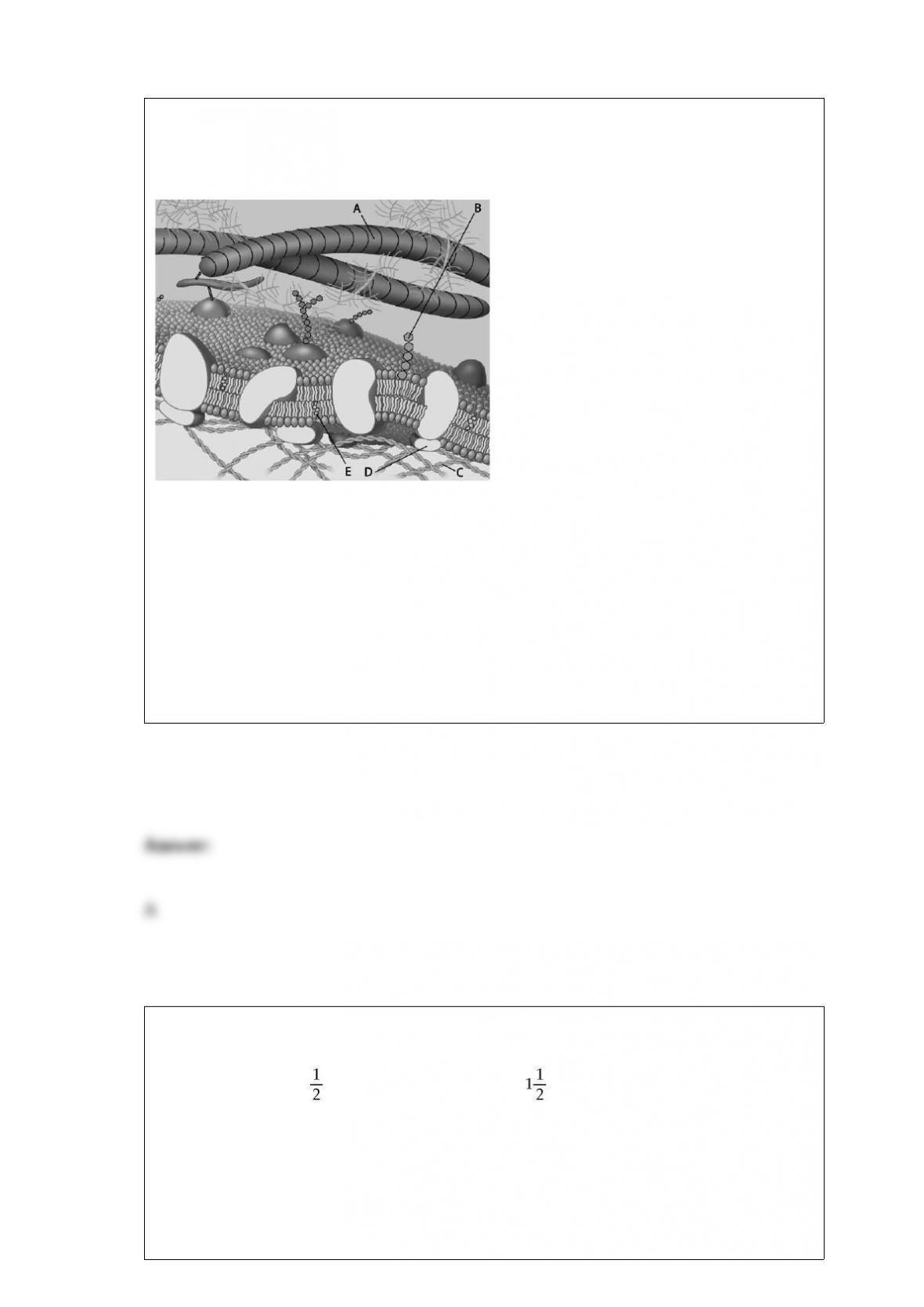
For the following questions, match the labeled component of the cell membrane in
the figure with its description.
Which component is a protein fiber of the extracellular matrix?
A) A
B) B
C) C
D) E
Girdling is a procedure to kill unwanted tress by cutting a groove into the bark of the
tree. The groove must completely encircle the trunk and should penetrate into the wood
to a depth of at least -inch on small trees, and 1- inches on larger trees. Why does
this procedure cause tree death?
A) No water can be transported from the roots to the leaves.
B) No water can be transported from the leaves to the roots.

C) No sugars can be transported from the leaves to the roots.
D) Both water and sugars are prevented from being transported.
Overharvesting encourages extinction and is most likely to affect _____.
A) animals that occupy a broad ecological niche
B) large animals with low intrinsic reproductive rates
C) most organisms that live in the oceans
D) edge-adapted species
Proton pumps are used in various ways by members of every domain of organisms:
Bacteria, Archaea, and Eukarya. What does this most probably mean?
A) Proton gradients across a membrane were used by cells that were the common
ancestor of all three domains of life.
B) The high concentration of protons in the ancient atmosphere must have necessitated
a pump mechanism.
C) Cells of each domain evolved proton pumps independently when oceans became
more acidic.
D) Proton pumps are necessary to all cell membranes.

Increased activity in the sympathetic nervous system leads to _____.
A) decreased heart rate
B) increased secretion by the pancreas
C) increased contractions of the stomach
D) relaxation of the airways in the lungs