
Biology Basics 1—Cells and Cell Structure
MULTIPLE CHOICE
1. What is the largest organelle within a cell?
a.
mitochondria
b.
nucleus
c.
lysosomes
d.
Golgi apparatus
e.
endoplasmic reticulum
2. What is the term for all of the internal structures in a cell?
a.
organelles
b.
mitochondria
c.
nucleic acids
d.
plasma membrane
e.
macromolecules
3. Which part of the cell contains chromatin?
a.
Golgi apparatus
b.
cytoplasm
c.
plasma membrane
d.
lysosomes
e.
nucleus
4. A fertilized egg is called a(n)
a.
nucleus.
b.
germ cell.
c.
organelle.
d.
zygote.
e.
sperm.
5. Mitosis refers to
a.
division that produces genetically identical daughter cells.
b.
the fusion of sperm and egg.
c.
cell division by germ cells.
d.
cell division that produces sperm and eggs.
e.
errors in genetic information.

6. The plasma membrane
a.
has attached ribosomes.
b.
is studded with pores.
c.
keeps cytoplasm from entering the cell.
d.
is a site for energy production in a human cell.
e.
regulates the movement of materials such as water, oxygen and nutrients.
7. What is the function of mitochondria?
a.
sites of protein production
b.
synthesizes plasma membrane lipids
c.
organelle recycling
d.
energy production for the cell
e.
sorts and distributes proteins
8. Human chromosomes
a.
bind to the ribosomes in the production of proteins.
b.
are found in the nucleoli.
c.
are present in 46 pairs in all cells.
d.
are assembled on ribosomes.
e.
carry genetic information.
9. The lysosomes
a.
contain digestive enzymes.
b.
are involved in energy production.
c.
contain chromatin.
d.
are the sites of protein synthesis.
e.
are not known to be involved in any genetic disorders.
10. Which cell will contain only 23 chromosomes?
a.
sperm cell
b.
stem cell
c.
somatic cell
d.
germ cell
e.
zygote
11. All of the following are typically present in or on the surface of the plasma membrane EXCEPT
a.
cholesterol.
b.
lipids.
c.
chromosomes.
d.
channel proteins.
e.
HLA markers.
12. All of the following are classes of macromolecules found in the cell EXCEPT
a.
lipids.
b.
nucleic acids.
c.
carbohydrates.
d.
proteins.
e.
nucleotides.
TRUE/FALSE
13. The human body consists of only a few different types of cells.
14. The instructions for making all the different types of cells in a human are encoded in the DNA of every
cell.
15. The Golgi apparatus is responsible for energy production within the cell.
16. Homologous chromosomes are members of a pair of chromosomes.
17. A zygote results from the fusion of a sperm and an egg.
18. The mitochondria are the only organelles that are not associated with any genetic disorders.
19. The HLA markers are present in the cytoplasm of the cell.
Biology Basics 1—Cells and Cell Structure
MATCHING
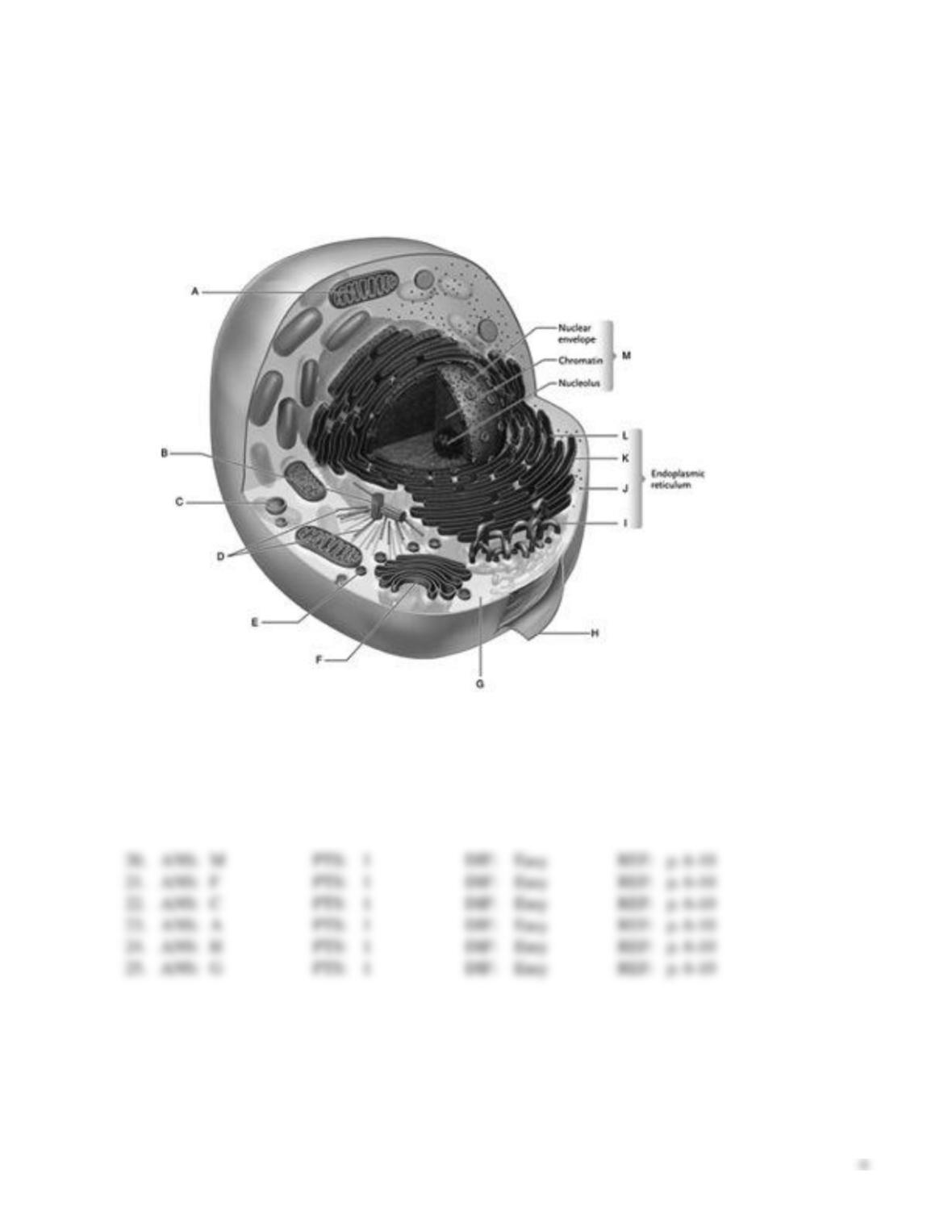
Match the letter from the figure with the cell structure.
20. nucleus
21. Golgi apparatus
22. lysosome
23. mitochondrion
24. plasma membrane
25. cytoplasm