51. Which of the following is the purpose of the Bank Holding Company Act of 1956?
a. To prevent bank holding companies from branching across state lines
b. To allow bank holding companies to open branches across state lines
c. To allow interstate bank mergers
d. To prevent banks from owning commercial firms
52. The Depository Institutions Deregulation and Monetary Control Act that allows payments on interest on transactions
accounts of individuals was passed in the year
a. 1990.
b. 1980.
c. 1965.
d. 1975.
53. A charter is a bank’s application for
a. investing in non–bank activities.
b. going into business.
c. making a loan to a corporation.
d. opening up a new branch.
54. The United States has a dual banking system, which means that a bank
a. has two regulators.
b. may hold its reserves either in the form of vault cash or as deposits at a Federal Reserve Bank.
c. may take out a primary credit discount loan or a secondary credit discount loan.
d. may choose whether to be chartered by federal government authorities or by a state government.
55. A commercial bank that gets a charter from the federal government is called a bank.
a. charter
b. state
c. national
d. federal reserve
56. A commercial bank that gets its charter from a state government (the state in which its headquarters are located) is
called a bank.
a. local
b. community
c. charter
d. state
57. From which of the following agencies does a national bank obtain its charter?
a. The Federal Deposit Insurance corporation
b. The Federal Reserve
c. The Office of the Comptroller of the Currency
d. National Credit Union Administration
58. A national bank is supervised by all of the following agencies EXCEPT
a. the Federal Deposit Insurance Corporation.
b. the Federal Reserve.
c. the Office of the Comptroller of the Currency.
d. the National Credit Union Administration.
59. A national bank that is not in a financial holding company or a bank holding company is mainly supervised by the
a. Federal Deposit Insurance Corporation.
b. Federal Reserve.
c. Office of the Comptroller of the Currency.
d. National Credit Union Administration.
60. A national bank that is part of a financial holding company or a bank holding company is mainly supervised by the
a. Federal Deposit Insurance Corporation.
b. Federal Reserve.
c. Office of the Comptroller of the Currency.
d. National Credit Union Administration.
61. A state bank that is a member of the Federal Reserve System and is not in a financial holding company or a bank
holding company is mainly supervised by the
a. Federal Deposit Insurance Corporation.
b. Federal Reserve.
c. Office of the Comptroller of the Currency.
d. National Credit Union Administration.
62. The Office of the Comptroller of the Currency is the main supervisor for
a. national banks that are part of a financial holding company or a bank holding company.
b. national banks that are not in a financial holding company or a bank holding company.
c. state banks that are not members of the Federal Reserve and are not in a financial holding company or a bank
holding company.
d. state banks that are members of the Federal Reserve System.
63. The Federal Deposit Insurance Corporation is the main supervisor for
a. national banks that are part of a financial holding company or a bank holding company.
b. national banks that are not in a financial holding company or a bank holding company.
c. state banks that are not members of the Federal Reserve System.
d. state banks that do not have Federal Deposit Insurance Corporation insurance.
64. Which of the following illustrates a difference between the Federal Reserve and the Federal Deposit Insurance
Corporation?
a. The Fed supervises most of the largest banks; whereas the Federal Deposit Insurance Corporation has mostly
very small banks under its supervision.
b. The Fed supervises state banks that do are not the members of the Federal Reserve System; whereas the
Federal Deposit Insurance Corporation supervises all financial holding companies.
c. The Fed supervises national banks that are not in Financial Holding Companies or bank holding companies;
whereas the Federal Deposit Insurance Corporation supervises bank holding companies.
d. The Fed supervises credit unions; whereas the Federal Deposit Insurance Corporation supervises thrift
institutions.
65. A thrift institution that obtains a federal charter obtains its charter from which government agency?
a. The Federal Savings and Loan Insurance Corporation
b. Federal Reserve
c. The Office of Thrift Supervision
d. The Office of Comptroller of Currency
66. A thrift institution have Federal Deposit Insurance Corporation insurance and, in general, own
or be owned by a commercial firm.
a. must; cannot
b. is not required to; cannot
c. must; can
d. is not required to; can
67. Thrifts can have a maximum of 20 percent of their assets in the form of and must have percent of
their assets in the form of mortgage or consumer loans in order to qualify for special funding from a Federal Home
Loan bank.
a. bank holding companies; 60
b. commercial loans; 65
c. securities; 75
d. government bonds; 70
68. A credit union that obtains a federal charter obtains its charter from which government agency?
a. The Federal Savings and Loan Insurance Corporation
b. The National Credit Union Administration
c. The Federal Deposit Insurance Corporation
d. The Office of the Comptroller of the Currency
69. Most credit unions obtain deposit insurance from which government agency?
a. The Federal Savings and Loan Insurance Corporation
b. The National Credit Union Administration
c. The Federal Deposit Insurance Corporation
d. The National Credit Union Share Insurance Fund
70. Which of the following serves as the lender of last resort for credit unions?
a. The Federal Deposit Insurance Corporation
b. The Federal Reserve
c. National Credit Union Administration’s Credit Liquidity Facility
d. The National Credit Union Share Insurance Fund
71. Credit Unions get slight competitive advantage over commercial banks and thrifts because they
a. get their charter from the Comptroller of the Currency.
b. get tax exemptions as they are often run as non-profit organizations.
c. are insured by the Federal Deposit Insurance Corporation.
d. can rely on the funds from the Federal Reserve at times of emergency.
72. The Dodd-Frank Act requires that the FDIC restore its Deposit Insurance Fund to a healthy level by the year
a. 2040.
b. 2020.
c. 2018.
d. 2012.
73. In the CAMELS rating system, which is used to assess the health of the banks, the letter C stands for
a. controls.
b. currency reserves.
c. capital adequacy.
d. compliance with regulations.
74. In the CAMELS rating system, which is used to assess the health of the banks, the letter A stands for
a. accounting practices.
b. auditing procedures.
c. analysis of risk.
d. asset quality.
75. The letter M, in the CAMELS rating system, which is used to assess the health of the banks, stands for _____.
a. management
b. money market account
c. mortgage
d. maturity
76. The letter E, in the CAMELS rating system, which is used to assess the health of the banks, represents the _____
for a bank.
a. elasticity of demand.
b. equal opportunity compliance.
c. earnings.
d. elements of risk.
77. In the CAMELS rating system, the letter L stands for
a. liquidity.
b. losses.
c. legal environment.
d. loan documentation.
78. Which of the following is NOT a component evaluated under the CAMELS rating system?
a. Management
b. Sensitivity to risk
c. Strategic planning
d. Asset quality
79. Bank supervisors around the world use a common measurement standard for capital adequacy, based on agreement
known as the .
a. Bank Holding Record
b. balance sheet
c. Redlining
d. Basel Accord
80. The agreement concluded in 2010 imposed higher capital requirements on banks all over the world.
a. Basel III.
b. Basel II.
c. Basel I.
d. Basel IV.
81. The Community Reinvestment Act attempts to prevent a banking practice known as
a. redlining.
b. credit scoring.
c. credit diving.
d. term intermediation.
82. The Herfindahl-Hirschman Index (HHI) is used to
a. calculate whether or not a bank has met its reserve requirements.
b. determine if a merger reduces competition in a banking market.
c. measure the capital adequacy of a bank.
d. find which bank has the lowest spread.
83. Which of the following is a factor considered by authorities in evaluating the mergers of banks?
a. The level to which the new bank increases competition in the market
b. The number of employees in the new bank
c. The adequacy of the financial and managerial resources of the new bank
d. The value of the total assets owned by the new bank
84. Suppose the banking market in Cedar Rapids consists of banks that have the following shares of the market: 24
percent, 18 percent, 17 percent, 14 percent, 9 percent, 8 percent, 4 percent, 3 percent, 2 percent, 1 percent.
Calculate the HHI.
a. 100
b. 576
c. 780
d. 1,560
85. A banking market with six banks of equal size would have an HHI approximately equal to
a. 278.
b. 556.
c. 1,111.
d. 1,667.
86. Suppose three banks in a banking market have market shares of 42 percent, 33 percent, and 25 percent. Calculate
the HHI of the banking industry.
a. 100
b. 1,356
c. 3,478
d. 4,320
87. Suppose the Federal Reserve is considering the applications of four different banks to merge with other banks. Given
the level of the new HHI and the change in the HHI shown below, in which case could the Fed challenge the
merger?
a. New HHI = 1,900; change in HHI = 150
b. New HHI = 1,500; change in HHI = 400
c. New HHI = 1,200; change in HHI = 700
d. New HHI = 1,850; change in HHI = 250
88. According to the Dodd-Frank Act, a bank merger can be stopped if the new bank would hold more than
percent of the nation’s deposits.
a. 20
b. 15
c. 10
d. 5
89. In order to analyze the competitiveness of the banks affected by mergers, the Fed found out that in out of the
49 banking markets, in which both Wells Fargo and Wachovia had operations, the merger will not violate any
guidelines based on HHI or other guidelines.
a. 32
b. 40
c. 48
d. 37
90. Most often after a merger, bank profits
a. rise.
b. remain constant.
c. drop slightly.
d. fall to zero.
91. Prior to the passage of the McFadden Act in 1927, what characterized a national bank?
92. The Dodd-Frank Act of 2010 set a limit to prevent a bank merger if the new bank would increase its liabilities to
more than 10 percent of national bank liabilities. Why?
93. Describe the moral hazard problem of deposit insurance.
94. What is the Basel III Accord?
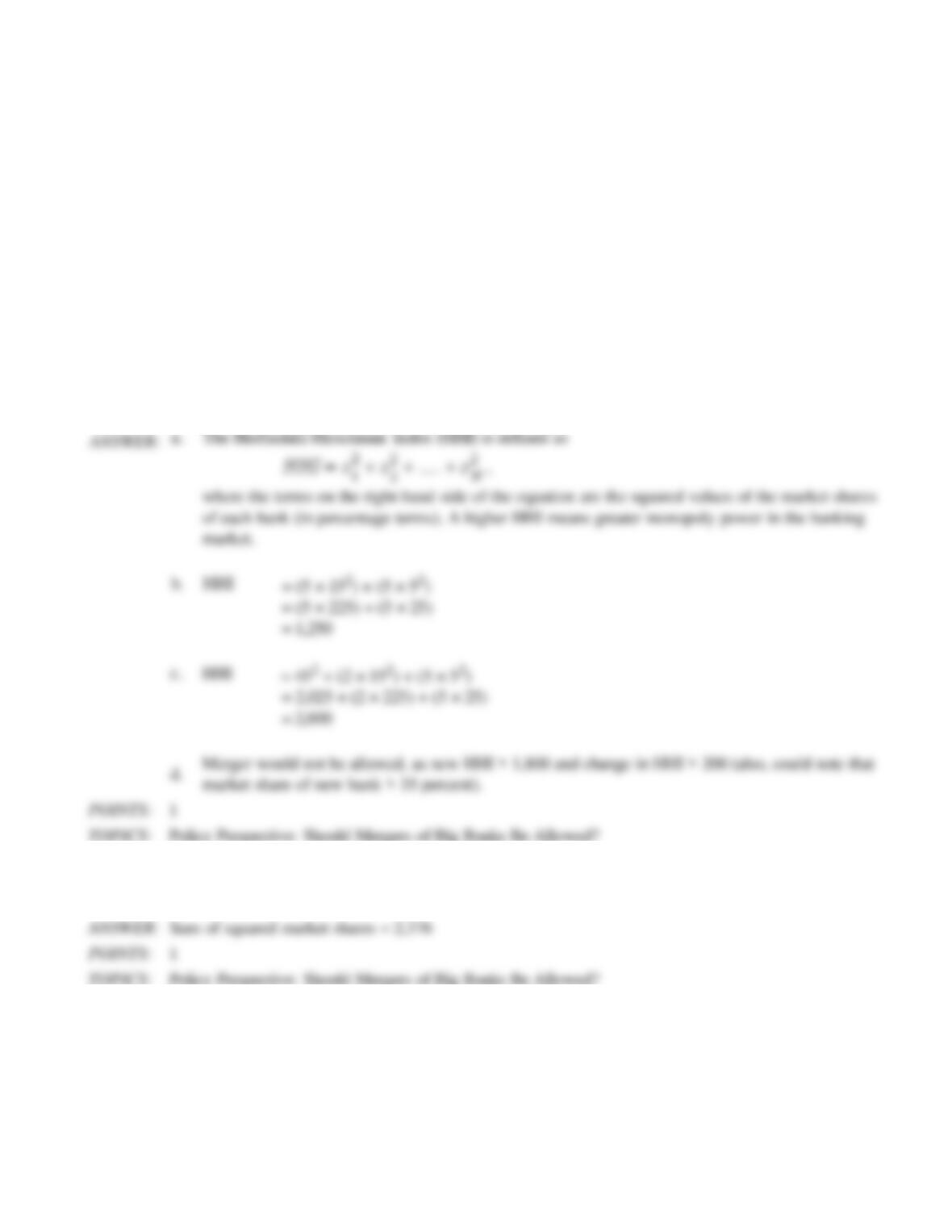
95. Answer the questions below.
What measure is used by banking authorities who wish to calculate the degree of monopoly
a. power in a banking market (give the name or the acronym)? Write the equation that is used
and describe what each term means.
Suppose the banking market in Charlottesville consists of five banks that each having a
b. market share of 15 percent and five more banks each having a market share of 5 percent.
Calculate the measure of monopoly power.
Three of the banks that currently have 15 percent of the market would like to merge and
c. form First Super Bank of Charlottesville. If the merger were allowed, calculate the new
measure of monopoly power.
Under the standard set of guidelines of the U.S. Department of Justice, would the merger be
d. allowed? Explain why or why not, describing the guidelines and your results from parts (b)
and (c).
96. Suppose a banking market consists of banks that have the following shares of the market: 34 percent, 28 percent, 16
percent, 10 percent, 8 percent, and 4 percent. Calculate the HHI.

97. In a market with six banks of equal size, two of the banks propose merging. Does the merger violate the U.S.
Department of Justice’s guidelines?