36. The is a place where banks can request loans from the Federal Reserve.
a. money market
b. domestic trading desk
c. Treasury
d. discount window
37. The interest rate in the market for loans of reserves between banks is the
a. three–month Treasury bill rate.
b. reserve ratio.
c. discount rate.
d. federal funds rate.
38. The discount rate is the interest rate on
a. loans of reserves between banks.
b. discount loans from the Federal Reserve.
c. discount bonds.
d. federal agency securities.
39. In which of the following ways can a bank increase its reserves?
a. Give out more loans
b. Sell securities
c. Reduce interest rate on time deposits
d. Increase service charges for safety vault facility
40. A bank is said to have when its average costs decline as its volume of sales increases.
a. economies of scope.
b. economies of scale.
c. cost diminution.
d. decreasing returns to scale.
41. A bank is said to have when its average costs decline when it offers a wider variety of products.
a. economies of scope.
b. economies of scale.
c. cost diminution.
d. decreasing returns to scale.
42. A bank’s spread equals
a. the bank’s average profit per dollar of assets.
b. the bank’s return on equity.
c. the average interest rate on all the bank’s investments minus the inflation rate.
d. the average interest rate on the bank’s assets minus the average interest rate on its liabilities.
43. Which of the following is true of bank spread?
a. The more vigorous the competition among banks, the smaller will be spread between the interest rates on
loans and deposits.
b. The larger the banks that are competing with each other, the larger will be spread between the interest rates
on loans and deposits.
c. The spread between the interest rates on loans and deposits will be much narrower in banks in rural areas
than the banks in big cities.
d. The lower the number of banks in a city, the smaller will be the spread between the banks’ interest rates on
loans and deposits.
44. Which size category of banks generally has the largest spread?
a. Small banks
b. Medium-sized banks
c. The 100 largest banks
d. The 10 largest banks
45. Which size category of banks generally has the smallest spread?
a. The 10 smallest banks
b. The 100 smallest banks
c. Medium-sized banks
d. Large banks
46. Which of the following statements is true of banks?
a. Small banks do not face the same competitive pressure as large banks do.
b. Location of banks does not determine the level of competition among them.
c. Bank spreads are large for large banks.
d. Returns on equity are large for small banks.
47. A bank borrows funds from its depositors by paying them 2% interest on the funds. It lends those funds to borrowers
by charging an interest of 5% on the loans. The bank’s spread is
a. 2 percent.
b. 3 percent.
c. 4 percent.
d. 5 percent.
48. Suppose a bank earned $12 million in interest on its assets of $157 million, it paid out $8 million in interest on its
liabilities (excluding capital) of $172 million, and it paid its workers $3 million in total compensation. The bank‘s profit
equals
a. $12 million.
b. $8 million.
c. $3 million.
d. $1 million.
49. Suppose a bank earned $173 million in interest on its assets of $2,153 million, it paid out $81 million in interest on its
liabilities (excluding capital) of $2,007 million, and it paid its workers $71 million in total compensation. The bank‘s
spread is approximately
a. 2 percent.
b. 3 percent.
c. 4 percent.
d. 5 percent.
50. Suppose a bank earned $173 million in interest on its assets of $2,153 million, it paid out $81 million in interest on its
liabilities (excluding capital) of $2,007 million, and it paid its workers $71 million in total compensation. The bank‘s
return on equity is approximately
a. 12 percent.
b. 14 percent.
c. 16 percent.
d. 18 percent.
51. The possibility that a bank’s loan customers might not repay their loans is known as
a. withdrawal risk.
b. default risk.
c. interest-rate risk.
d. foreign-exchange risk.
52. A bank can reduce the impact of a default risk by
a. having assets with the same time to maturity.
b. making risky loans at low interest rates.
c. making safe loans at high interest rates.
d. diversifying its portfolio.
53. The risk that market interest rates may change, affecting the value of a bank‘s assets and liabilities, is known as
a. withdrawal risk.
b. default risk.
c. interest-rate risk.
d. foreign-exchange risk.
54. Credit risk means the same thing as
a. withdrawal risk.
b. default risk.
c. interest-rate risk.
d. foreign-exchange risk.
55. If a bank has assets with the same time to maturity as its liabilities, then
a. the interest rate on assets changes faster than the interest rate on liabilities.
b. the interest rate on liabilities changes faster than the interest rate on assets.
c. changes in interest rates will not affect the bank’s overall portfolio.
d. changes in interest rates puts the bank at a high risk of default.
56. Securitization is the process by which a bank sells a loan (which it made previously) to
a. investors.
b. the government.
c. other banks.
d. depositors.
57. Which of the following is a way in which banks can equalize the time to maturity of their assets and liabilities?
a. Securitization
b. Quantitative easing
c. Privatization
d. Credit easing
58. Before October 2008, banks earned interest on reserve balances that they held at the Federal Reserve at a rate of
a. 0.00%.
b. 0.05%.
c. 0.60%.
d. 1.00%.
59. When the Fed began paying interest on reserves, reserve balances
a. increased dramatically.
b. decreased dramatically.
c. decreased only slightly.
d. increased only slightly.
60. In addition to paying interest on reserves starting in October 2008, the Fed also provided
a. lending against a variety of collateral, such as commercial paper and mortgage-backed securities.
b. advice on how to conduct contemporaneous reserve accounting.
c. the power for banks to print and distribute their own currency.
d. staff people to help banks make real-estate decisions regarding the locations of their branch offices.
61. In order to manipulate the money supply, the Fed can change the interest rate that it pays on reserves in comparison
to the ____ rate.
a. federal funds
b. prime
c. 30–year fixed mortgage
d. credit card interest
62. Which of the following measures by the Federal Reserve led to an increase in bank reserves between 2009 and
2013?
a. Moral Suasion
b. Open market operations
c. Haircut
d. Quantitative easing
63. A bank offers credit cards with a 24 percent interest rate, when its competitors’ cards have just a 18 percent interest
rate. What do you predict will happen? Will the bank profit from its offer?
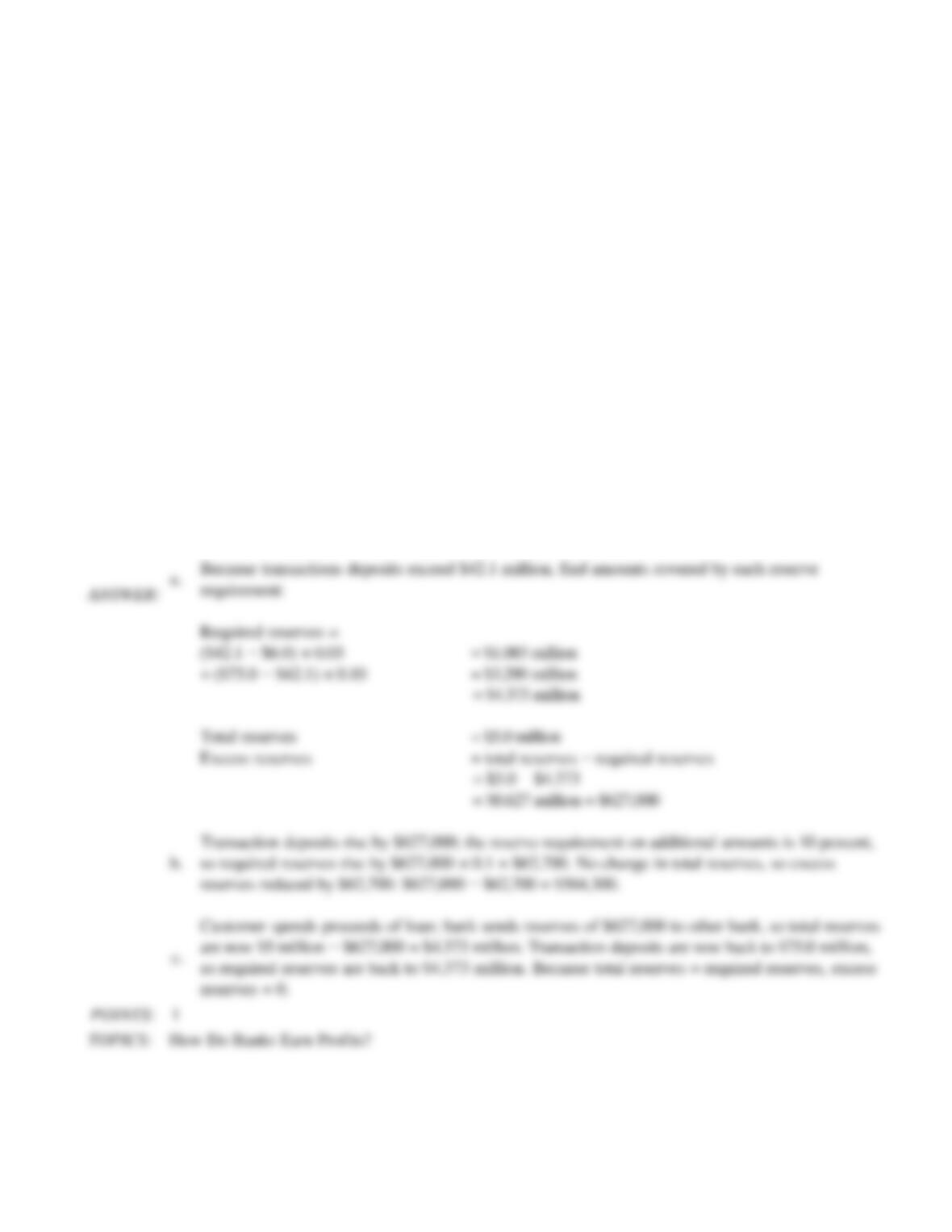
64. The reserve requirement is 0 percent on the first $6.0 million in transaction deposits, 3 percent on amounts between
$6.0 million and $42.1 million, and 10 percent on amounts above $42.1 million.
The First Bank of Boston has the following assets and liabilities (all amounts in millions of dollars):
Assets
Reserves $5.0
Loans $345.0
Securities $70.0
Liabilities + Capital
Transaction deposits $75.0
Nontransaction deposits $315.0
Equity capital $30.0
a. Calculate the bank’s excess reserves. Show your work.
Suppose First Bank makes a loan to a customer equal to the amount of the excess reserves
b. you found in part a. Calculate the bank’s excess reserves before the customer spends the
proceeds of the loan. Show your work.
c. Now suppose the customer spends the proceeds of the loan. Calculate the bank’s excess
reserves. Show your work.
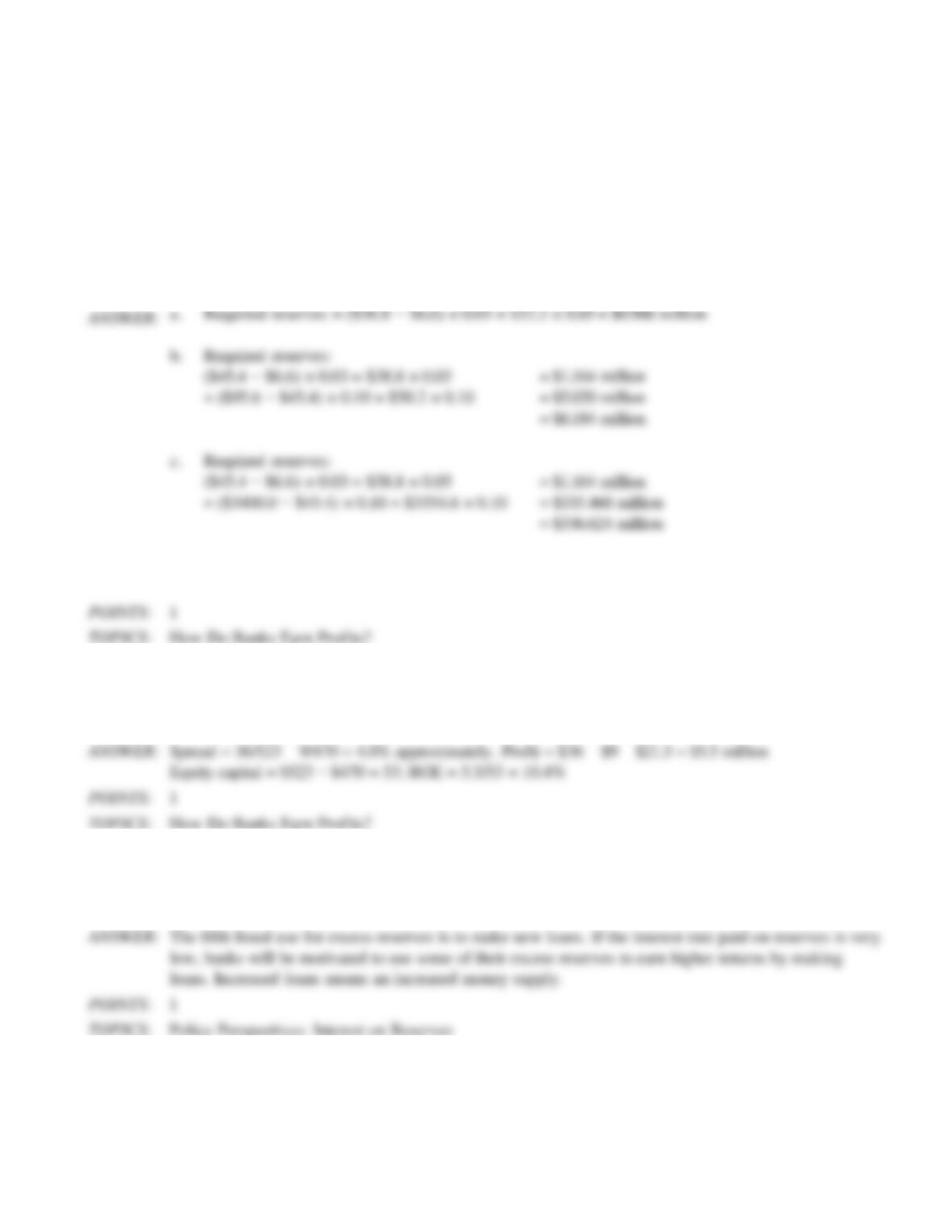
65. Reserve requirements for banks are currently:
Amount of Bank’s Reserve
Transaction Deposits Requirement
The first $6.6 million 0 percent
Amounts from $6.6 to $45.4 million 3 percent
Amounts over $45.4 million 10 percent
Calculate the reserve requirements for three banks with the following amounts of transaction deposits.
a. $38.8 million
b. $95.6 million
c. $3,400 million
66. In a recent year, a bank earned $36 million in interest on its assets of $523 million, it paid out $9 million in interest on
its liabilities (excluding capital) of $470 million, and it paid its workers $21.5 million in total compensation. Calculate
the bank‘s spread and its return on equity.
67. The fact that the Fed is willing to pay interest on reserves gives the Fed another mechanism for affecting the money
supply and the amount of reserves that banks hold. How might a very low interest rate paid on reserves increase the
money supply? (Hint: Consider the possible uses of excess reserves.)