Chapter 08 – Stocks, Stock Markets, and Market Efficiency
Multiple Choice Questions
1. A share of common stock represents:
A. A claim from a lender against a borrower
2. Two characteristics that make owning stock attractive are:
D. Dividends are paid before any other distributions are made and stocks are transferable
3. Voting rights in a corporation are held by:
A. The board of directors
Chapter 08 – Stocks, Stock Markets, and Market Efficiency
4. The fact that common stockholders are residual claimants means
D. The stockholders are paid before the bondholders but after any taxes are paid
5. If a public corporation goes bankrupt and does not have enough assets to pay off all
creditors:
A. The stockholders are personally liable for the balance
6. The concept of limited liability says a stockholder of a corporation:
A. Is liable for the corporation’s liabilities, but nothing more
Chapter 08 – Stocks, Stock Markets, and Market Efficiency
7. Which of the following statements is most correct?
A. Stockholders have limited liability and have no control over corporate leadership
8. Which of the following is not a feature of common stock?
D. Stockholders have voting rights
9. What do bondholders and stockholders have in common?
D. Both receive fixed payments on their securities each year
Chapter 08 – Stocks, Stock Markets, and Market Efficiency
10. Which of the following statements is most correct?
D. Directors and stockholders have the same interests, but this usually conflicts with the
interests of managers
11. Which of the following stock price indexes is a price-weighted index?
D. Wilshire 5000
12. An index number is valuable because:
A. It provides useful information to the viewer
Chapter 08 – Stocks, Stock Markets, and Market Efficiency
13. The Dow Jones Industrial Average is:
A. An index made up of the stock prices of the 100 largest corporations in the U.S
14. The Dow Jones Industrial Average is:
D. A total-value index
15. The Dow Jones Industrial Average:
A. Gives equal weight to a change in the price of the stock of any company in the index
Chapter 08 – Stocks, Stock Markets, and Market Efficiency
16. If the Dow Jones Industrial Average is currently at 10,000 and the price of one stock
included in the index increases by $10, the Dow Jones Industrial Average will:
A. Not change; it is a value-weighted index
17. If the Dow Jones Industrial Average is at 10,205 and it is up 4% from the previous day,
what was the index at the close of the market the previous day?
A. 10,201.0
18. The stocks that make up the Dow Jones Industrial Average:
A. Are dominated by the automobile industry
Chapter 08 – Stocks, Stock Markets, and Market Efficiency
19. If each company that made up the Dow Jones Industrial Average increased the number of
their shares outstanding by 10%, but the share prices did not change, the value of the index
D. Decrease since there are more shares outstanding
20. The Standard & Poor’s 500 Index differs from the Dow Jones Industrial Index because:
A. It takes into account the stock prices of 500 of the largest firms, which is less than the
DJIA
21. The Standard & Poor’s 500 Index:
D. Assigns equal weight to all the prices of all the stocks in the index
Chapter 08 – Stocks, Stock Markets, and Market Efficiency
D. The weights in the index would change to reflect the percentage changes in the prices of
the various stocks
23. Which of the following statements is not true?
A. A value-weighted index is a better index to use to reflect changes in the economy’s overall
wealth
D. Is made of mainly older firms and is heavily weighted by manufacturing
Chapter 08 – Stocks, Stock Markets, and Market Efficiency
25. The Nasdaq Composite Index:
A. Is made up of over 50,000 firms traded on the Over-the-Counter market
26. The most broadly based stock index in use is:
D. The Standard and Poor’s 500 Index
27. When studying world stock indexes, we observe that:
A. The S&P 500 is largest in terms of index value
Chapter 08 – Stocks, Stock Markets, and Market Efficiency
28. When comparing stock indexes around the world we:
A. Find that a given percentage change across all indexes has the same value
29. People differ on the method by which stock should be valued. Some people are chartists,
others behavioralists. The basic difference between these groups is:
A. Chartists rely on astrological charts to predict stock values, behavioralists rely on
psychology
30. The dividends that stockholders receive:
D. Are always equal to the average amount of interest paid to a bond holder, adjusting for the
value of the holdings
Chapter 08 – Stocks, Stock Markets, and Market Efficiency
31. You start with a $1000 portfolio; it loses 50% over the next year, the following year it
gains 50% in value. At the end of two years your portfolio is worth:
A. $1000
32. You start with a portfolio valued at $500. Over the next twelve months it loses 40%; the
following year it has a gain of 30%. At the end of two years your portfolio is worth:
D. $410
33. You have a portfolio valued at $1000. Over the next twelve months it loses 75% of its
value. What return does the portfolio need to earn over the following twelve months to restore
the portfolio to its original value?
A. 75%
Chapter 08 – Stocks, Stock Markets, and Market Efficiency
34. You have a portfolio valued at $10,000. Over the next twelve months it loses 50% of its
value. What return does the portfolio need to earn over the following twelve months to be
D. 25%
35. The dividend-discount model of stock valuation:
D. Takes the annual dividend, adds it to the expected future selling price and divides by the
number of years to get the current price
36. A stock has an annual dividend of $10.00 and it is expected not to grow. It is believed the
stock will sell for $100 one year from now, and an investor has a discount (interest) rate of
6% (0.06). The dividend discount model predicts the stock’s current price should be:
A. $94.67
Chapter 08 – Stocks, Stock Markets, and Market Efficiency
37. A stock has a current annual dividend of $6.00 per year and it is expected to grow by 3%
(0.03) a year. It is expected that two years from now the stock will sell for $90.00 a share. If
the interest rate is 5% (0.05), the dividend discount model predicts the stock’s current price
should be:
D. $94.30
38. A stock currently does not pay an annual dividend. An investor expects this policy to
remain in force. She believes, however, the stock of this company will sell for $110.00 per
share four years from now. If she has an interest (discount) rate of 7% (0.07), the dividend
discount model predicts the current price of this stock should be:
D. $86.35
39. Next year, the price of a stock is expected to be $2200 and the stock will pay a $55
dividend. The interest rate is 10%. Based on the dividend-discount model, what is the current
price of this stock?
A. $1980
Chapter 08 – Stocks, Stock Markets, and Market Efficiency
40. The price of a stock is currently $750 and the stock will pay a $43 dividend. The interest
rate is 7.5%. Based on the dividend-discount model, what is the expected price of this stock
for next year?
A. $651.17
41. A company currently pays a dividend of $4.00 per share. It expects the growth rate of the
dividend to be 3% (0.03) annually. If the interest rate is 6% (0.06) what does the dividend-
discount model predict the current price of the stock should be?
A. $103.33
42. A company currently pays an annual dividend of $6.50 per share. It expects the growth
rate of the dividend will be 2.5% (0.025) annually. If the interest (discount) rate is 5% (0.05)
what does the dividend-discount model predict the current price of the stock should be?
A. It doesn’t, you need an expected future price to use the model
Chapter 08 – Stocks, Stock Markets, and Market Efficiency
D. Should be high when dividends are low
44. Suppose that the current dividend for a stock is Dtoday, the expected dividend growth rate
is r, and the interest rate is i. If we ignore risk, which of the following represents the dividend-
discount model formula for the fundamental price of a stock?
A. Dtoday / (i+g)
45. A share of stock resembles a consol in all of the following ways except that:
Chapter 08 – Stocks, Stock Markets, and Market Efficiency
46. As the corporation uses more debt financing, which of the following holds true for the
stockholders?
A. The expected return to the stockholders decreases and the standard deviation of that return
47. The fact that many corporations use debt financing as well as equity financing creates all
of the following except:
A. The opportunity for a greater expected return for the stockholders
48. Without the stockholders’ limited liability, the risk from the use of leverage:
D. Would be irrelevant; limited liability eliminates the risk from leverage
Chapter 08 – Stocks, Stock Markets, and Market Efficiency
49. Consider the effect of business cycles on bondholders versus stockholders. We expect that
business cycles will affect:
A. Bondholders and stockholders about the same
50. In the event of bankruptcy, stockholders:
A. Are paid before bondholders.
51. As a company issues more debt:
A. Its leverage decreases.
Chapter 08 – Stocks, Stock Markets, and Market Efficiency
52. All other things equal, a decrease in the equity risk premium leads to a(n):
A. Increase in the required return on stock.
53. The basic dividend-discount model is a bit of an oversimplification for valuing stocks
because:
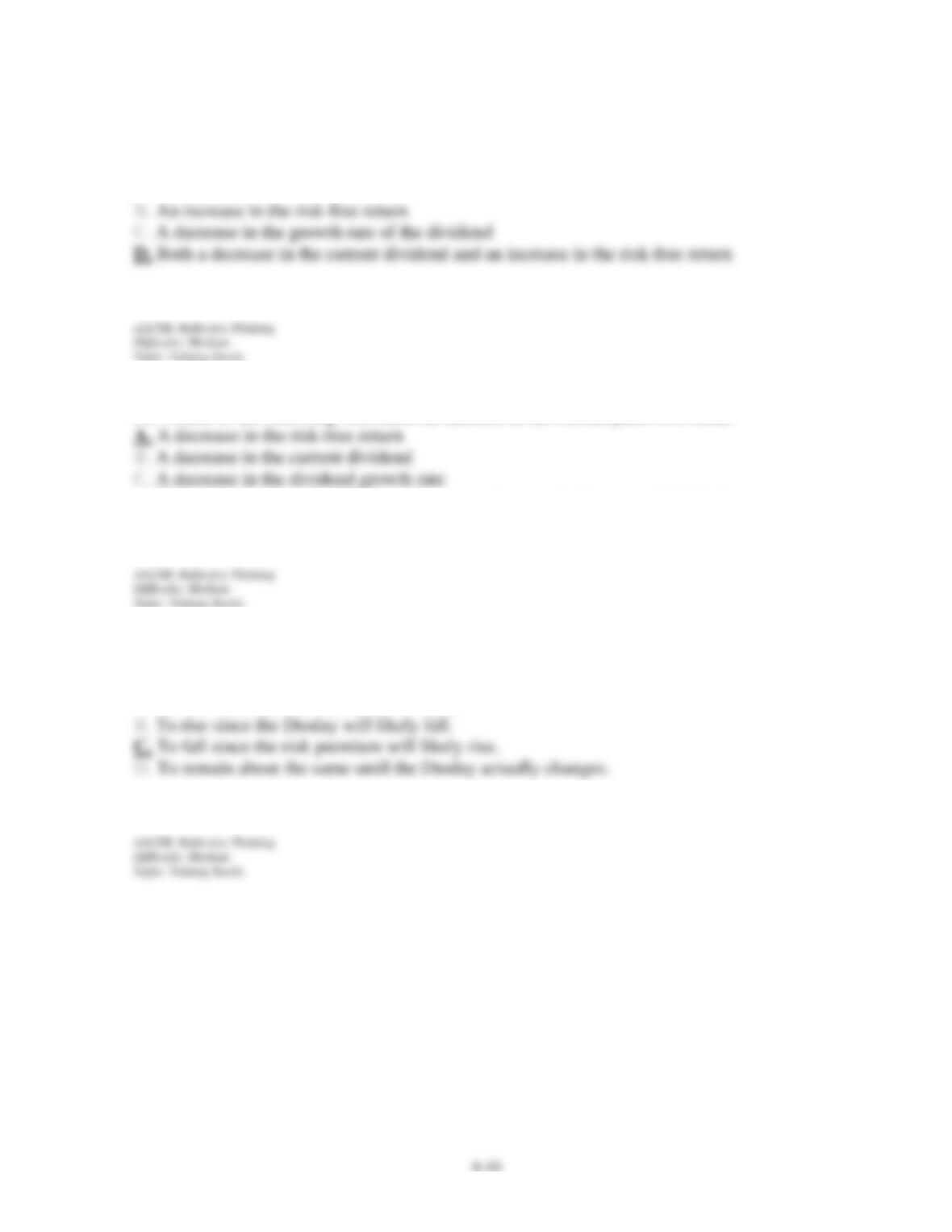
54. The required stock return an investor seeks can best be represented by which of the
following?
A. Risk Premium – Risk-free Return
Chapter 08 – Stocks, Stock Markets, and Market Efficiency
55. Which of the following will cause a reduction in the current price of a stock?
A. A decrease in the current dividend
D. Both an increase in the risk-free return or an increase in the current dividend
57. If a company reports that it is going to have a difficult time meeting its debt obligations,
you would expect the Ptoday:
A. To fall since the risk-free return will rise.
Chapter 08 – Stocks, Stock Markets, and Market Efficiency
58. Suppose there is a reduction of the return provided on U.S. Treasury bonds. We should
expect the current price of stocks to:
D. Stay the same; there is no effect on stock prices from this reduction.
59. The impact from rapid dividend growth on a stock’s current price will be:
D. Positive, but only if the corporation does not have any debt.
60. The theory of efficient markets assumes that:
D. The best approach to determining stock prices is to follow the chartists.