50. In the CAPM, systematic risk
a. is also known as idiosyncratic risk.
b. can be diversified away.
c. is also known as market risk.
d. is the risk to a stock’s return that is not attributable to the fluctuations in the overall stock market.
51. In the CAPM, unsystematic risk
a. is also known as market risk.
b. can be diversified away.
c. is the risk to a stock‘s return that is attributable to the fluctuations in the overall stock market.
d. is assumed to be zero.
52. In the CAPM, if a stock has a large beta coefficient, then
a. the stock’s return is less volatile than the market’s average return.
b. the stock’s return is about as volatile as the market’s average return.
c. the stock’s return is more volatile than the market’s average return.
d. the stock’s risk is greater than its expected return.
53. In the CAPM,
a. larger the value of β for a stock, larger is the unsystematic risk involved in investing in the stock.
b. larger the value of β for a stock, smaller is the unsystematic risk involved in investing in the stock.
c. larger the value of β for a stock, larger is the systematic risk involved in investing in the stock.
d. larger the value of β for a stock, smaller is the systematic risk involved in investing in the stock.
54. In the CAPM, if a stock has a beta coefficient near one, then
a. the stock’s return is less volatile than the market’s average return.
b. the stock’s return is about as volatile as the market’s average return.
c. the stock’s return is more volatile than the market’s average return.
d. the stock’s risk is greater than its expected return.
55. In the CAPM, if a stock has a beta coefficient near zero, then
a. the stock’s return is less volatile than the market’s average return.
b. the stock’s return is about as volatile as the market’s average return.
c. the stock’s return is more volatile than the market’s average return.
d. the stock’s risk is greater than its expected return.
56. In the CAPM, a stock has a beta coefficient of 0.5. The average returns to all stocks in the market is 8%. If the
interest rate on three-month T-bills is at around 3 percent, what is the expected return to this stock? Assume that
unsystematic risk is zero.
a. 2.5 percent
b. 3.5 percent
c. 5.5 percent
d. 7.0 percent
57. In the CAPM, a stock has a beta coefficient of 0.1. The average returns to all stocks in the market is 10%. If the
interest rate on three-month T-bills is at around 2 percent, what is the expected return to this stock? Assume that
unsystematic risk is zero.
a. 2.5 percent
b. 5.0 percent
c. 7.5 percent
d. 10.0 percent
58. A model of stock prices that allows for more sources of risk than just the stock market’s excess return is the
________ theory.
a. excess-return
b. random-walk
c. arbitrage-pricing
d. idiosyncratic-risk
59. The arbitrage-pricing theory was developed as an alternative to the
a. the efficient market hypothesis.
b. the random walk theory.
c. capital asset pricing model.
d. rational expectations theory.
60. You are planning to buy a stock, the risk on which is dependent on two factors: (1) the change over the last year in
the inflation rate and (2) the spread between ten-year Treasury bonds and three-month Treasury bills. Suppose the
average risk-free interest rate is 1 percent. The beta coefficients of the stock associated with the change in inflation
rate and spread between ten-year Treasury bonds and three-month Treasury bills are -2 and 5 respectively. If you
expect the inflation rate to rise 1 percentage point and you think the spread will be 3 percentage points. What is the
expected return to this stock? Use the arbitrage-pricing theory.
a. 11 percent
b. 12 percent
c. 14 percent
d. 18 percent
61. You are planning to buy a stock, the risk on which is dependent on two factors: (1) the change in the inflation
rate over the last year and (2) the spread between ten-year Treasury bonds and three-month Treasury bills.
Suppose the average risk-free interest rate is 3 percent. The beta coefficients of the stock associated with the
change in inflation rate and the spread between ten-year Treasury bonds and three-month Treasury bills are -2 and 4
respectively. If you expect the inflation rate to rise 6 percentage point and you think the spread will be 8 percentage
points. What is the expected return to this stock? Use the arbitrage-pricing theory.
a. 11 percent
b. 12 percent
c. 18 percent
d. 23 percent
62. Fundamental value is the
market as a whole.
a. past
b. future
c. expected
d. present
value of expected earnings of a company or of all companies in the stock
63. If stock prices exceed their fundamental values,
a. the stock market is overvalued.
b. the stock market is undervalued.
c. the stock market is rightly valued.
d. investors have rational expectations.
64. If stock prices are below their fundamental values,
a. the stock market is overvalued.
b. the stock market is undervalued.
c. investors have rational expectations.
d. mutual funds will be worth more than their price.
65. Consider two stocks: A and B. The price of stock A is $400, while the price of stock B is $600. If the fundamental
value of both stocks is $500,
a. stock A is overvalued and stock B is undervalued.
b. stock A is undervalued and stock B is overvalued.
c. both stocks are undervalued.
d. both stocks are overvalued.
66. The fundamental value of a stock varies
a. directly with the rate of discount.
b. inversely with the growth rate of earnings on the stock.
c. directly with previous year’s actual earnings on the stock.
d. inversely with the time frame for which a stock is held.
67. An investor expects earnings from a stock to grow at a constant rate of 3% over time and the investors’ rate of
discount is constant at 4%. If earnings last year were $152, then the fundamental value of the stock would be
a. $152.
b. $190.
c. $1,520.
d. $15,656.
68. An investor expects earnings from a stock to grow at a constant rate of 2% over time and the investors’ rate of
discount is constant at 5%. If earnings last year were $37, then the fundamental value of the stock would be
a. $74.
b. $111.
c. $1,258.
d. $11,100.
69. A theory that investors use all the information available to them about companies future prospects in determining
their buying and selling decisions is called expectations.
a. rational
b. irrational
c. adaptive
d. realized
70. If people have rational expectations,
a. the stock market may be overvalued.
b. the stock market may be undervalued.
c. stock prices are nonvolatile.
d. stock prices always equal their fundamental value.
71. The theory states that the stock market goes through periods in which stock prices rise higher than their
fundamental value and other periods where stock prices fall below their fundamental value.
a. rational expectations
b. adaptive expectations
c. irrational expectations
d. realized expectations
72. The average amount by which the returns on stocks exceeds the return on debt securities is referred to as
a. beta coefficient.
b. gamma coefficient.
c. return spread.
d. equity premium.
73. The equity-premium puzzle refers to the surprising result that
a. stock prices are inversely related to interest rates.
b. the transactions costs for buying stocks may be as high as 5 percent of the total value of those stocks, greatly
reducing the net returns to stocks.
c. equity prices are much too high when compared with the fundamental value of the stock market, as
determined by using the present-value formula.
d. people will not pay to avoid risk in everyday situations, but when it comes to the stock market, people are
willing to give up large potential returns to stocks in order to buy safer Treasury securities.
74. In the United States, the average annual real return on stocks from 1960 to 2012 has been approximately
a. 1 percent.
b. 2 percent.
c. 7 percent.
d. 10 percent.
75. In the United States, the average annual real return on short-term Treasury securities since 1960 to 2012 has been
approximately
a. 1.5 percent.
b. 4 percent.
c. 7.25 percent.
d. 10 percent.
76. One of the advantages of holding real estate over stocks is that
a. real estate assets are more liquid than stocks.
b. monetary return on real estate is always greater than the monetary return on stocks.
c. part of the returns on real estate are not subject to tax payments, while all returns on stocks are subject to tax
payments.
d. principal amount required for investing in real estate is often smaller than the principal amount required to
invest in stocks.
77. Which of the following is the best example of a nonfinancial security?
a. Coupon bonds
b. Stocks
c. Human capital
d. Foreign exchange
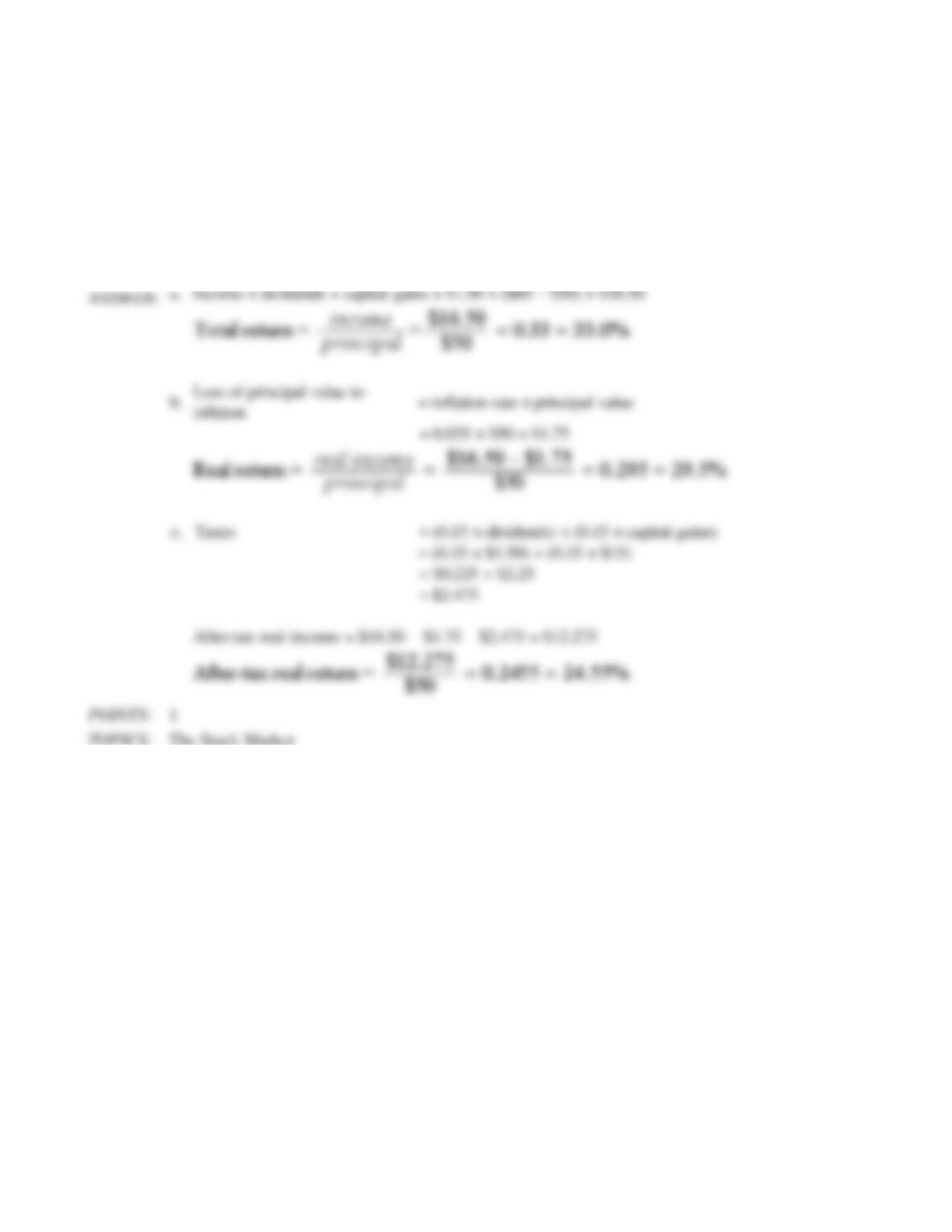
78. Suppose an investor purchased 100 shares of JDSU stock at a price of $50 per share on December 31, 2011. On
December 31, 2012, JDSU paid dividends of $1.50 per share, and the investor received the dividends, then sold the
stock at a price of $65 per share.
a. If there were no taxes or inflation, what was the total return?
b. If there were no taxes, but inflation was 3.5 percent, what was the real return?
c. If the tax rate was 15 percent on dividends and capital gains, what was the after-tax real
return?
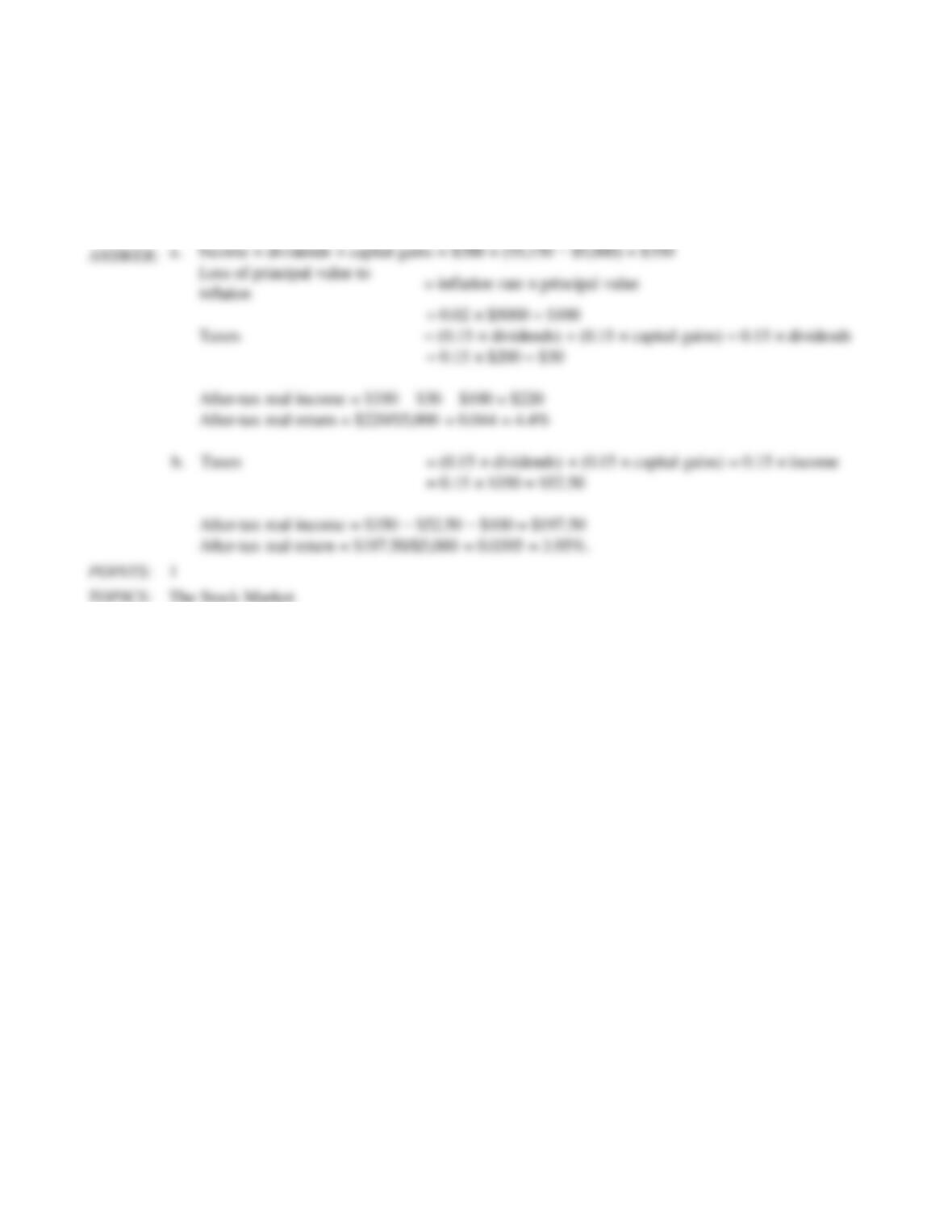
79. An investor buys stock for $5,000 at the beginning of the year. She earns dividends of $200 during the course of the
year. At the end of the year, the stock is worth $5,150. The tax rate on dividends and capital gains is 15 percent. The
inflation rate is 2 percent.
a. Calculate the investor’s after-tax real return if she does not sell the stock at the end of the
year.
b. Calculate the investor’s after-tax real return if she sells the stock at the end of the year.
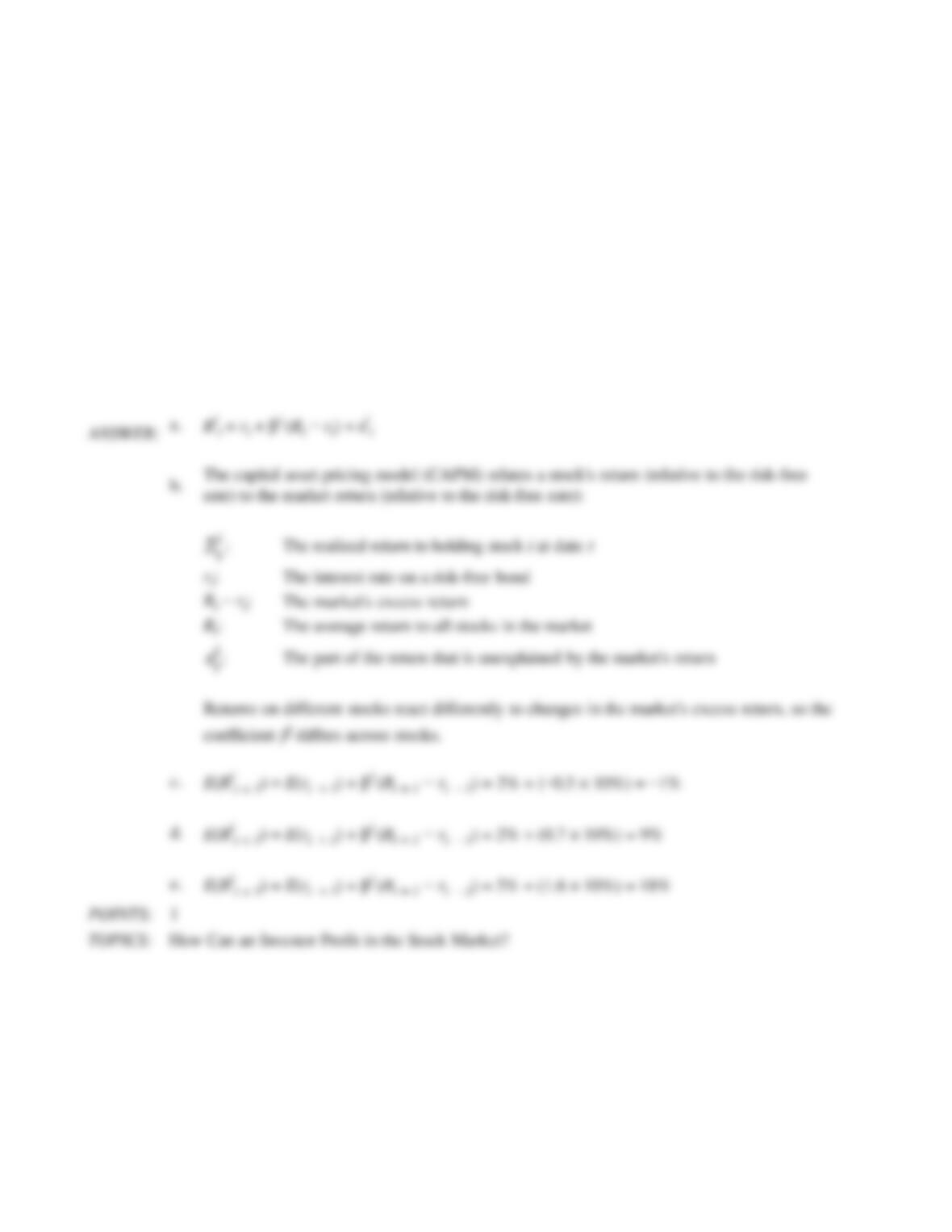
80. Answer the questions below.
a. Write the equation for the capital-asset pricing model.
b. Describe, in words, what the CAPM is trying to explain, and describe each element of the
equation in part a.
Use the capital–asset pricing model to predict the returns next year of the following stocks, if
you expect the return to holding stocks to be 12 percent on average, and the interest rate on
three-month T-bills will be 2 percent. Show your calculations.
c. A stock with a beta of −0.3
d. A stock with a beta of 0.7
e. A stock with a beta of 1.6
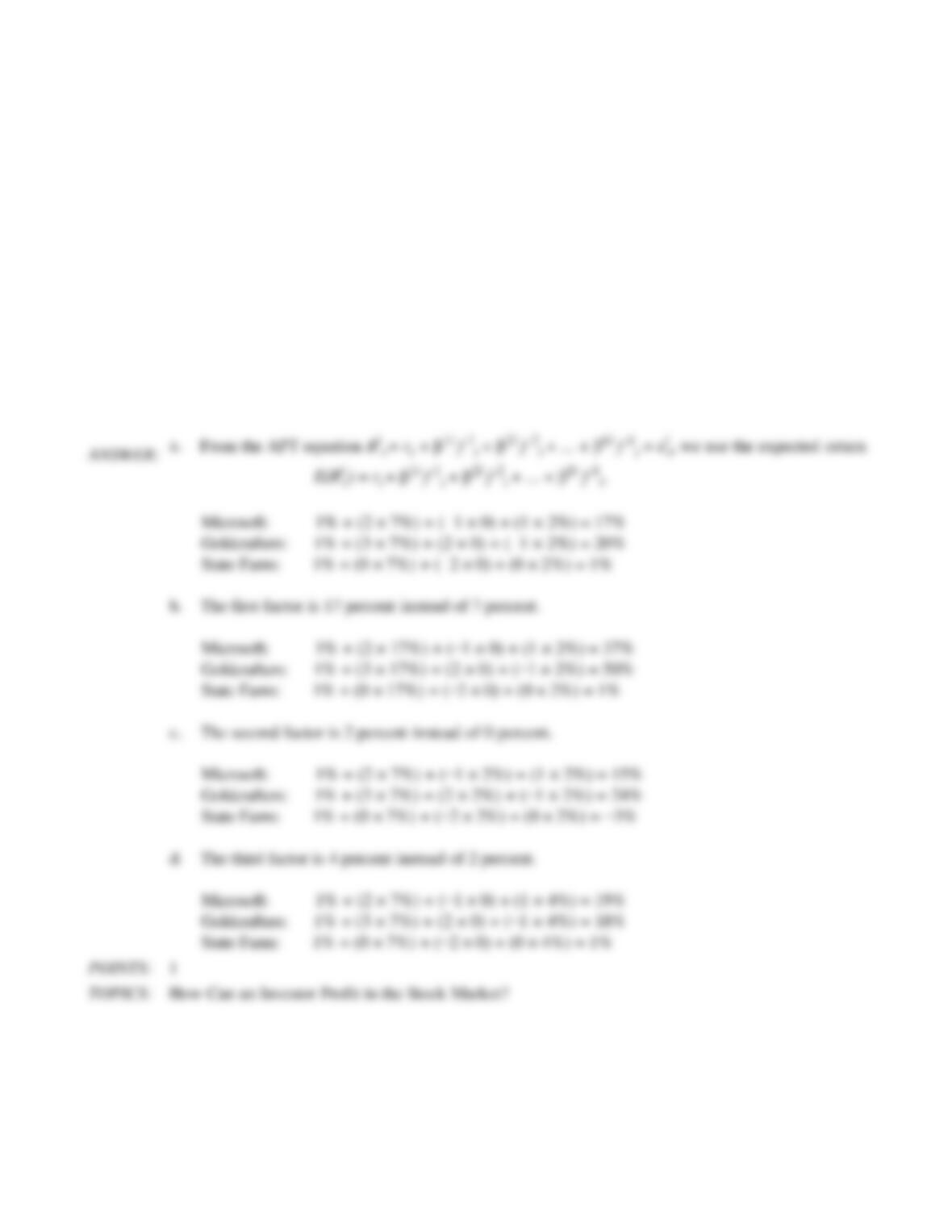
81. Suppose the following version of the APT is a good model of risk in the stock market. There are three factors: (1)
the stock market’s excess return, in percentage points; (2) the change over the last year in the inflation rate, in
percentage points; and (3) the spread between ten-year Treasury bonds and three-month Treasury bills, in
percentage points. Suppose the stock market’s average excess return is 7 percentage points and the average risk-
free interest rate is 1 percent, the average change in the inflation rate is 0 percentage points, and the average spread
between ten-year Treasury bonds and three-month Treasury bills is 2 percentage points. Each of the following
stocks has the beta coefficients shown in the table below:
β1i
β2i
β3i
Microsoft
2
−1
1
Goldcrafters 3 2 −1
State Farm 0 −2 0
a. What is the expected return to each of the three stocks? Show your calculations.
If the market’s excess return were to rise 10 percentage points in a particular year (that is,
b. instead of the average of 7 percent, the market’s excess return will be 17 percent), what
would you expect the effect to be on the return to each of the three stocks? Show your
calculations.
If the inflation rate was expected to rise 2 percentage points in a particular year (that is,
c. instead of the average of 0 percent, the inflation rate will rise by 2 percentage points), what
would you expect the effect to be on the return to each of the three stocks?
If the interest-rate spread rose 2 percentage points in a particular year (that is, instead of the
d. average of 2 percentage points, the interest-rate spread will be 4 percentage points), what
would you expect the effect to be on the return to each of the three stocks?
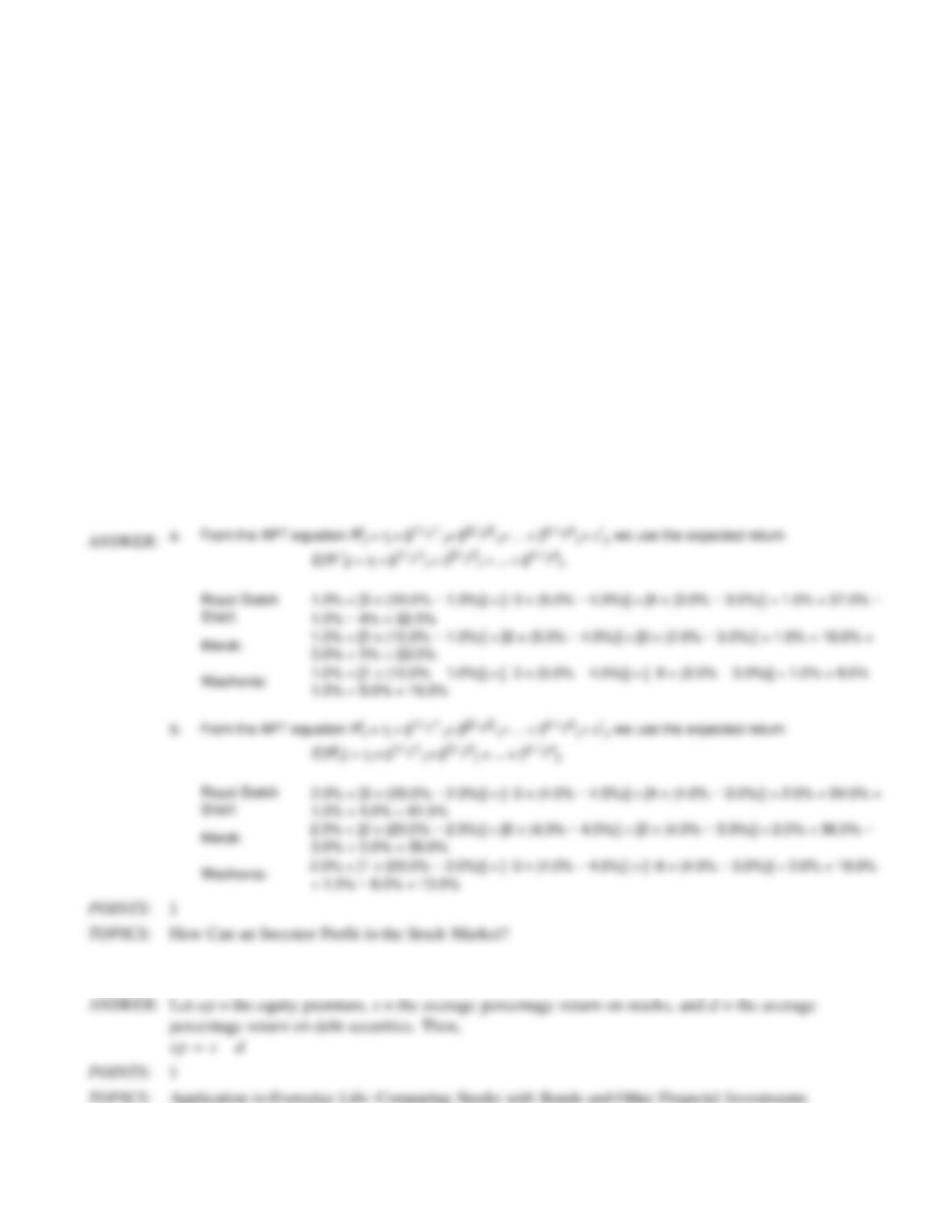
82. Suppose the following version of the APT is a good model of risk in the stock market. There are three factors: (1)
the stock market’s excess return, in percentage points; (2) the unemployment rate minus its natural rate (the level the
unemployment rate would be if the economy were at full employment), in percentage points; and (3) the real federal
funds rate minus its long-run equilibrium value. Suppose the natural rate of unemployment is 4.5 percent and the
long-run equilibrium value of the real federal funds rate is 3.0 percent. Each of the following stocks has the beta
coefficients shown in the table below:
β1i
β2i
β3i
Royal Dutch Shell
3
−3
4
Merck
2
6
0
Wachovia
1
−3
−8
If your forecast for next year is that the risk-free interest rate next year will be 1.0 percent,
a. the overall stock market will return 10.0 percent, the unemployment rate will be 5.0 percent,
and the real federal funds rate will be 2.0 percent, what is the expected return (in percent,
with two decimals) to each of the three stocks? Show your calculations.
If your forecast for next year is that the risk-free interest rate next year will be 2.0 percent,
b. the overall stock market will return 20.0 percent, the unemployment rate will be 4.0 percent,
and the real federal funds rate will be 4.0 percent, what is the expected return (in percent,
with two decimals) to each of the three stocks? Show your calculations.
83. Write a formula for the equity premium.