
Chapter 07 – The Risk and Term Structure of Interest Rates
108. Why do economists pay particular attention to inverted yield curves?
109. If the yield curve is flat, using liquidity premium theory, what do you know about the
expected future short-term interest rate?
110. What does the risk structure of interest rates predict about the yield on bonds of the same
maturities?

Chapter 07 – The Risk and Term Structure of Interest Rates
111. Explain why many mayors of cities facing the need to borrow for infrastructure
improvements, may not look favorably on a large federal income tax rate reduction?
112. What is the effective after-tax yield to an investor from a bond paying $70 per $1,000
annually, if the investor is in a 25% marginal tax bracket? Explain.

Chapter 07 – The Risk and Term Structure of Interest Rates
113. Consider the following four investors. Rank each according to who has the most to gain
from investing in 30-year tax-exempt municipal bonds. Each investor has $1000 in a savings
account that he/she plans to use to buy bonds. Explain briefly why you ranked the investors
this way.
(a) A 20-year old college student who earns low income through working over summers and
breaks. The student plans to graduate next year.
(b) The CEO of a large company who is currently in the highest tax bracket.
(c) A middle-income household saving up to move into a larger home.
(d) A 60-year old nurse who plans to retire at age 62. He uses a tax-exempt pension fund for
all of his savings.
Chapter 07 – The Risk and Term Structure of Interest Rates
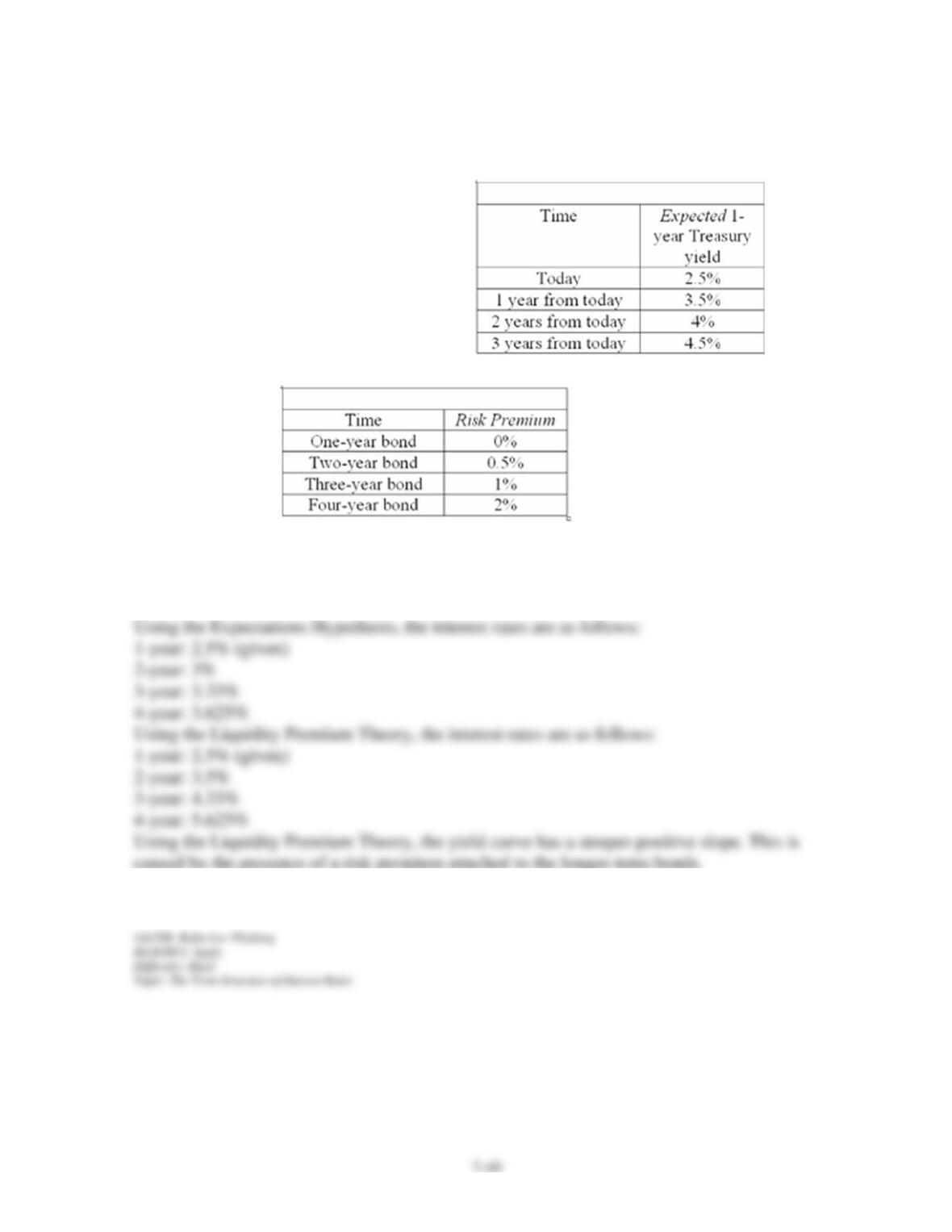
114. Using the information provided and the Expectations Hypothesis, compute the yields for
a two-year, three-year, and four-year bonds.
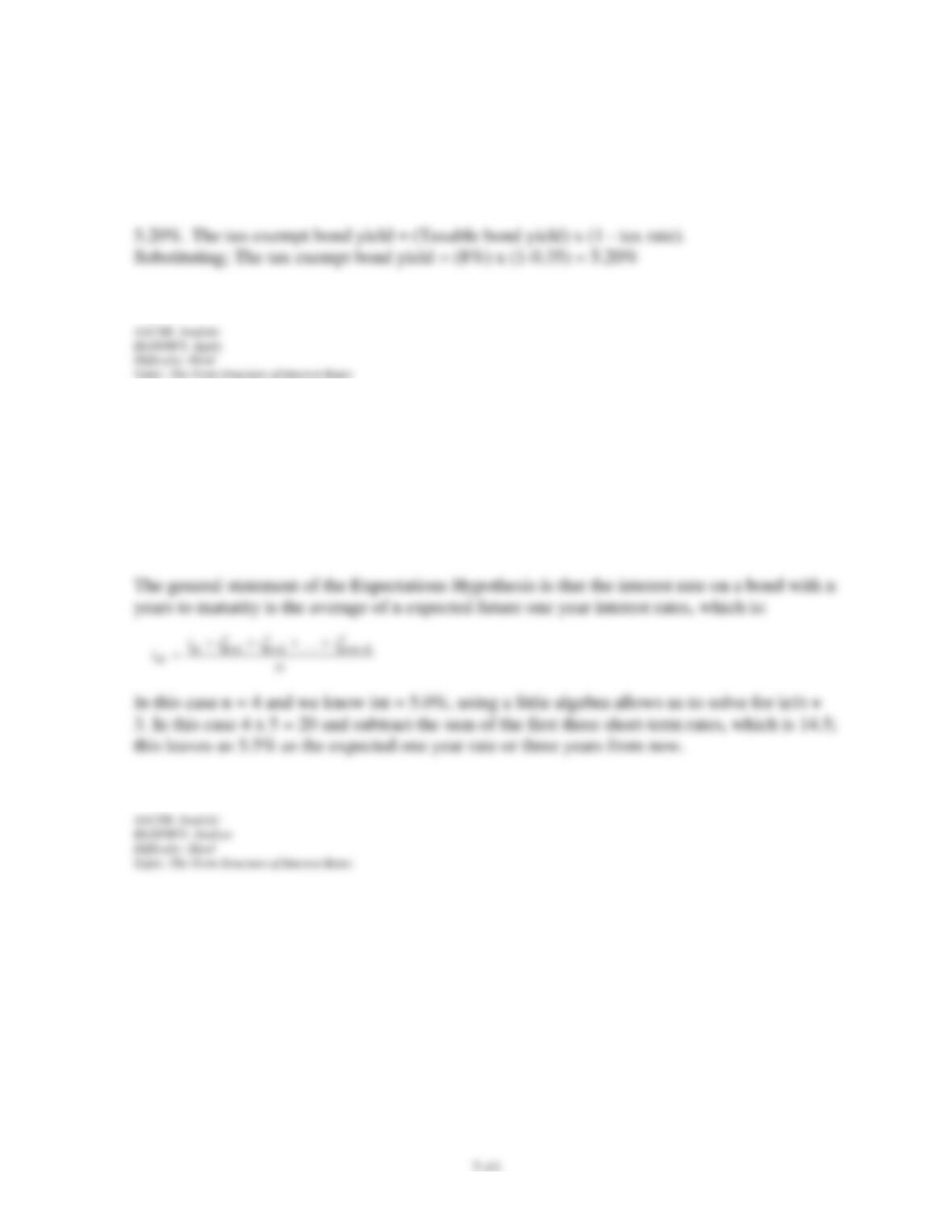
Now, suppose there is a risk premium attached to each bond. These risk premiums are given
in the table below:
Using the information above and the Liquidity Premium Theory, compute the yields for a
two-year, three-year, and four-year bonds. How does this yield curve compare to the one you
computed using the Expectations Hypothesis?
Chapter 07 – The Risk and Term Structure of Interest Rates
115. What is the equivalent tax-exempt bond yield for a taxable bond with an 8% yield and a
bondholder in a 35% marginal tax rate? Explain.
116. Assuming the Expectations Hypothesis is correct, and given the following information:
The current four-year interest rate is 5.0%
The current one-year interest rate is 4.0%
The expected one-year rate for one year from now is 5.0%
The expected one-year rate for two years from now is 5.5%
What is the expected one-year rate for three years from now? Explain.
Chapter 07 – The Risk and Term Structure of Interest Rates
117. Any theory of the yield curve must be able to explain what three general conditions?
118. The usually upward sloping yield curve indicates that long-term bonds have higher
yields than short-term bonds. Why is this?
119. Why can’t the Expectations Hypothesis stand alone as an adequate theory to explain
yield curves?
Chapter 07 – The Risk and Term Structure of Interest Rates
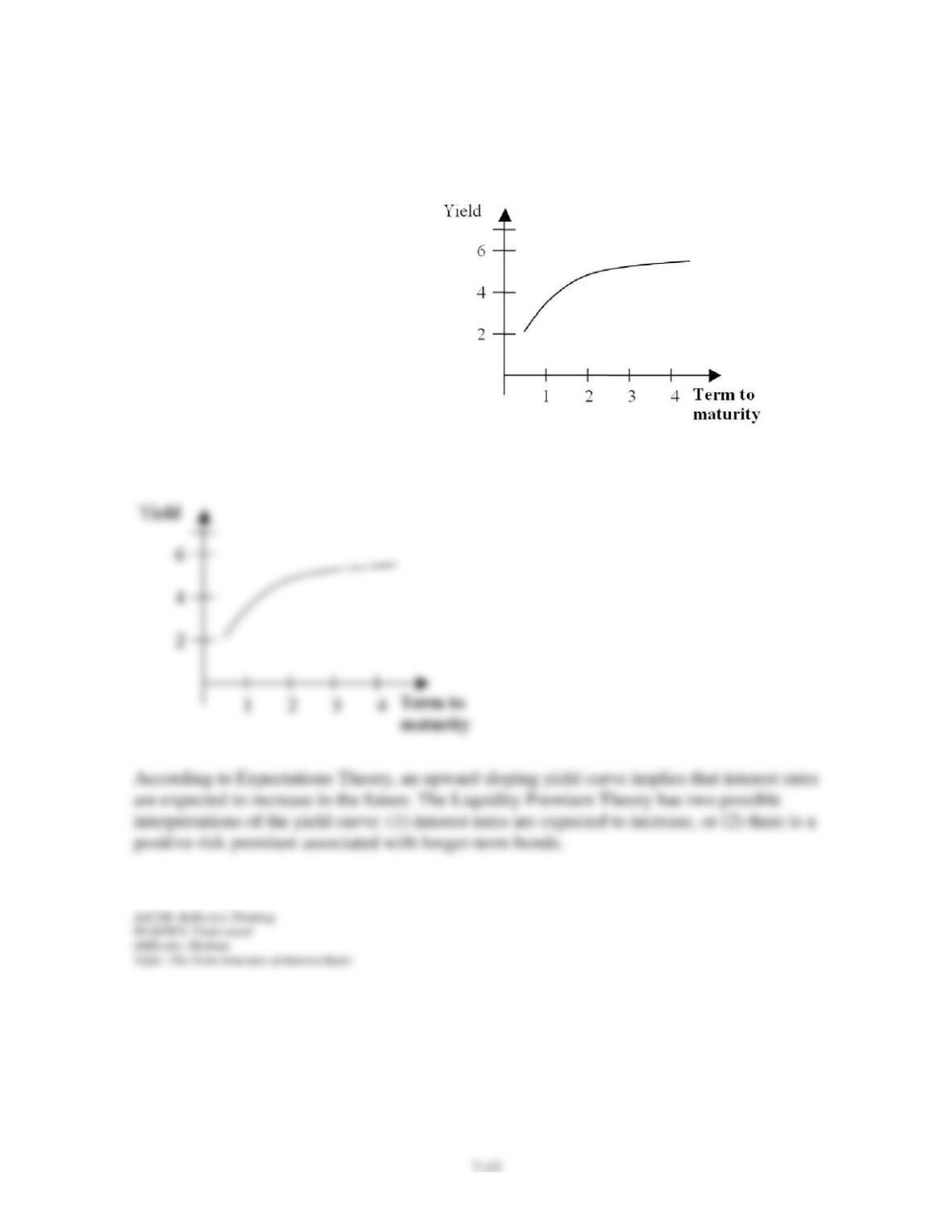
120. Consider the yield curve below. Using the Expectations Hypothesis, what conclusion can
we draw from the data? Now, using the Liquidity Premium Theory, cite two possible
conclusions we can draw from the data.
Chapter 07 – The Risk and Term Structure of Interest Rates
121. What impact should an economic slowdown have on the risk structure of interest rates?
122. During economic slowdowns why would you expect the risk premium to increase the
most between U.S. Treasury bonds and junk bonds?
123. When we compare the graphs of GDP growth over time to the corresponding risk spread
on Baa bonds compared to 10-year U.S. Treasury bonds, what relationship can be inferred?

Chapter 07 – The Risk and Term Structure of Interest Rates
124. Describe the concept of flight to quality in terms of the Russian government default of
August 1998.
125. Why do yield curves usually slope upward?
126. Explain why an inverted yield curve is a valuable forecasting tool?

Chapter 07 – The Risk and Term Structure of Interest Rates
127. If an economy is experiencing rapid economic growth, explain what you would expect to
happen to the yield curve and why?
128. Why might we expect to see a high correlation between increases in the risk structure of
interest rates and the yield curve becoming inverted?
129. Does the Expectations Hypothesis allow for people to have a preference for longer-term
investments? Explain

Chapter 07 – The Risk and Term Structure of Interest Rates
7-47
130. Explain why most retired individuals are not likely to be heavily invested in municipal
bonds.
131. At the beginning of 2006 the yield curve was usually flat, and sometimes downward
sloping (inverted). This raised concerns that a recession might be on the way. But the slope of
the yield curve is only part of the story. What else is important?
Essay Questions
Chapter 07 – The Risk and Term Structure of Interest Rates
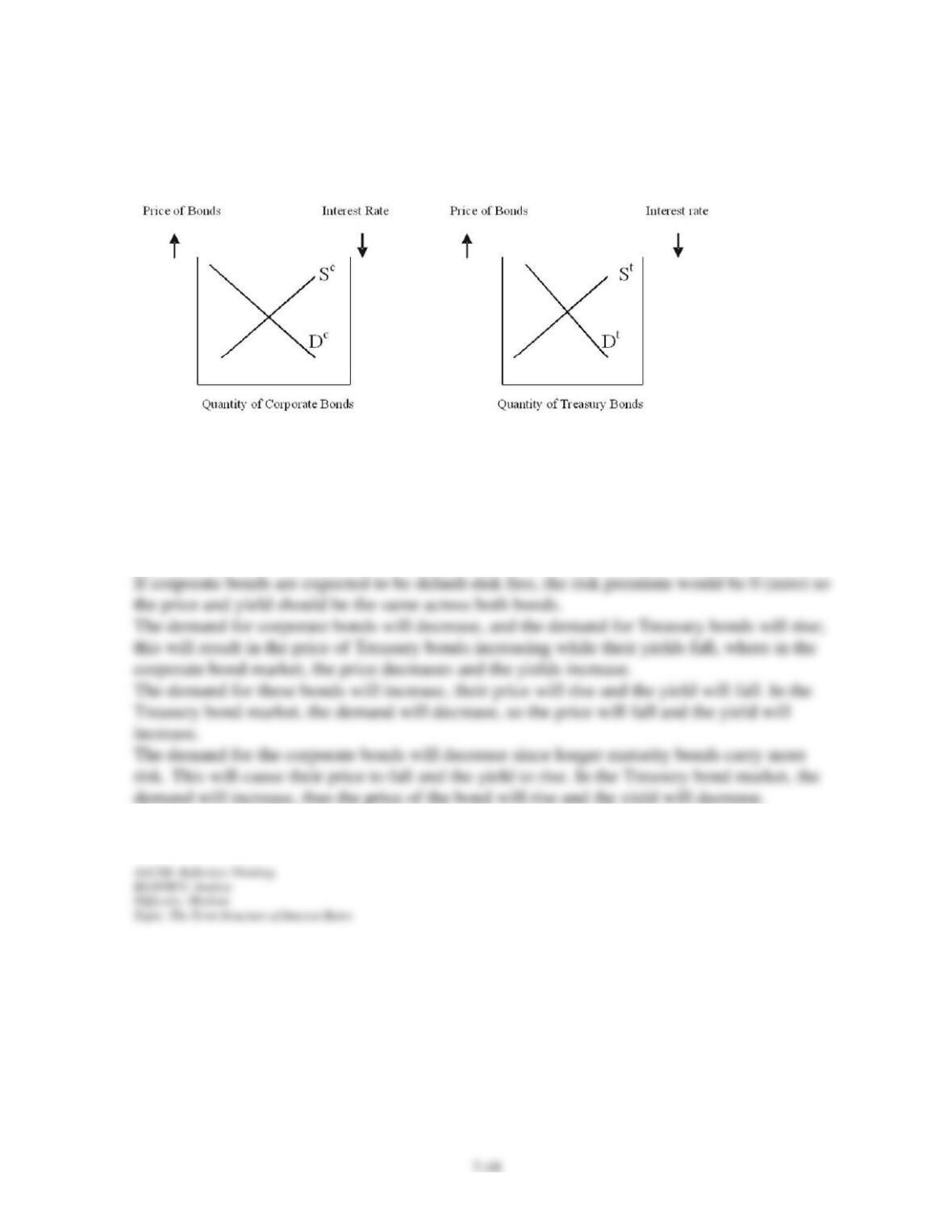
132. Please use the graphs to show what happens to the risk (yield) differential in each
situation and why.
Assume the corporate and Treasury bonds have the same maturity; if the corporate bonds are
default-risk free what could you tell about the price and yields of each? Explain.
If the corporate bonds are now viewed as having the possibility of default, what happens in
each market?
If the corporate bonds are granted tax-exempt status, what happens in each market?
If the corporate bonds have a longer maturity than the Treasury bonds what would happen?
Chapter 07 – The Risk and Term Structure of Interest Rates
133. In 2002 and 2003, the financial markets were hit by many corporate accounting scandals.
Discuss these scandals and the impact they would have not only in terms of a flight to quality,
but also in terms of the faith that people place in bond rating agencies.
134. Under the Expectations Hypothesis of the term structure of interest rates, explain the
impact of a U.S. Treasury decision to phase out the 30-year bond and to only focus on 3-
month, 1-year, 5-year and 10-year bonds?
Chapter 07 – The Risk and Term Structure of Interest Rates
135. We have heard the predictions regarding the large number of people that will be retiring
over the next 25-50 years and the strain this is going to place on the federal budget. Assuming
that federal borrowing will have to increase, what is the likely impact going to be on the risk
and term structure (if any) of interest rates and why?
136. The paper-bill spread refers to the interest rate spread between commercial paper and
Treasury bills with the same maturity. Is this a risk spread or a term spread? How do you
expect the paper-bill spread is related to GDP growth? What is the intuition for this result?
What does this imply about the yield curve?

Chapter 07 – The Risk and Term Structure of Interest Rates
137. Suppose that the Federal Reserve is concerned about rising inflation, so they increase
short-term interest rates. How will this affect long-term rates and the yield curve? What does
the slope of the yield curve reveal about the effectiveness of the Fed’s policy? Explain in the
context of the Liquidity Premium Theory.