35. One way that homeowners and banks can share the risk of inflation is through
a. fixed-rate mortgages.
b. refinancing.
c. default.
d. adjustable-rate mortgages.
36. Investors can lock in a real interest rate and thus avoid most of the risk of unexpected inflation by buying
a. corporate bonds.
b. inflation–indexed securities.
c. stock.
d. mortgage-backed securities.
37. If you expect inflation to be 3 percent next year and you buy a one-year bond paying 4 percent interest, what is your
after-tax expected real interest rate if you face a tax rate of 30 percent?
a. −0.2 percent
b. 0.0 percent
c. 0.3 percent
d. 1.0 percent
38. If you expect inflation to be 2 percent next year and you buy a one-year bond paying 5 percent interest, what is your
after-tax expected real interest income if the price of the bond is $200 and your tax rate is 40 percent?
a. $0.20
b. $20
c. $10
d. $2
39. If actual inflation was 4 percent over the past year and you owned a one-year bond that paid 6 percent interest, what
was your after-tax realized real interest rate if your tax rate was 15 percent?
a. −0.6 percent
b. 0.0 percent
c. 1.1 percent
d. 2.0 percent
40. If the actual inflation was 4 percent over the past year and you owned a one-year bond that paid 4 percent interest,
what was your after-tax realized real interest rate if your tax rate was 15 percent?
a. −0.6 percent
b. 0.0 percent
c. 1.1 percent
d. 2.0 percent
41. If your after-tax realized real interest rate was 1 percent over the past year and you owned a one-year bond that
paid 6 percent interest, what was the inflation rate if your tax rate was 15 percent?
a. 3.95 percent
b. 4.1 percent
c. 4.25 percent
d. 5.0 percent
42. If your after-tax realized real interest rate was 2 percent over the past year and you owned a one-year bond that
paid 8 percent interest, what was the inflation rate if you faced a tax rate of 15 percent?
a. 4.8 percent
b. 5.1 percent
c. 5.4 percent
d. 6.0 percent
43. Mary bought a bond a debt security for $2,500 with a nominal interest rate of 5 percent. If the inflation rate is 4
percent and Mary must pay 30 percent of her income in taxes, her after-tax nominal interest income is .
a. $87.50
b. $22.50
c. $37.50
d. $48.50
44. If your after-tax expected real interest rate is 3 percent on a one-year bond that pays 4 percent interest, what is the
expected inflation rate if you face a tax rate of 20 percent?
a. 0.0 percent
b. 0.2 percent
c. 2.0 percent
d. 20.0 percent
45. If your after-tax realized real interest rate was 1 percent over the past year and the inflation rate was 3 percent,
what was the nominal interest rate on your one-year bond if your tax rate was 15 percent?
a. 4.45 percent
b. 4.7 percent
c. 5.0 percent
d. 5.25 percent
46. If your after-tax expected real interest rate is 3 percent and your expected inflation rate is 2 percent, what was
the nominal interest rate on your one-year bond if you faced a tax rate of 20 percent?
a. 5.0 percent
b. 5.75 percent
c. 6.0 percent
d. 6.25 percent
47. Suppose that a change in the expected inflation rate leads supply and demand to adjust so that the expected real
interest rate is unchanged at 3.0 percent. The tax rate is 30 percent. Initially, the expected inflation rate is 3.0
percent. If the expected inflation rate rises from 3 percent to 6 percent, the after-tax expected real interest rate
a. rises by 1.8 percent.
b. rises by 0.9 percent.
c. falls by 0.9 percent.
d. falls by 1.8 percent.
48. Suppose that a change in the expected inflation rate leads supply and demand to adjust so that the expected real
interest rate is unchanged at 3.0 percent. The tax rate is 30 percent. Initially, the expected inflation rate is 3.0
percent. If the expected inflation rate falls from 6 percent to 0 percent, the after-tax expected real interest rate
a. rises by 1.8 percent.
b. rises by 0.9 percent.
c. falls by 0.9 percent.
d. falls by 1.8 percent.
49. Suppose that a change in the expected inflation rate leads supply and demand to adjust so that the after-tax expected
real interest rate is unchanged at 2.0 percent. The tax rate is 30 percent. Initially, the expected inflation rate is 3.0
percent. If the expected inflation rate rises from 3 percent to 6 percent, the nominal interest rate
a. rises by 3 percent.
b. rises by 4.25 percent.
c. falls by 4.25 percent.
d. falls by 3 percent.
50. Suppose that a change in the expected inflation rate leads supply and demand to adjust so that the after-tax expected
real interest rate is unchanged at 2.0 percent. The tax rate is 30 percent. Initially, the expected inflation rate is 3.0
percent. If the expected inflation rate rises from 3 percent to 6 percent, the expected real interest rate
a. rises by 0.75 percent.
b. rises by 1.25 percent.
c. falls by 1.25 percent.
d. falls by 0.75 percent.
51. Suppose that a change in the expected inflation rate leads supply and demand to adjust so that the after-tax expected
real interest rate is unchanged at 2.0 percent. The tax rate is 30 percent. Initially, the expected inflation rate is 3.0
percent. If the expected inflation rate falls from 6 percent to 0 percent, the nominal interest rate
a. rises by 8.5 percent.
b. rises by 4.25 percent.
c. falls by 4.25 percent.
d. falls by 8.5 percent.
52. Suppose that a change in the expected inflation rate leads supply and demand to adjust so that the after-tax expected
real interest rate is unchanged at 2.0 percent. The tax rate is 30 percent. Initially, the expected inflation rate is 3.0
percent. If the expected inflation rate falls from 6 percent to 0 percent, the expected real interest rate
a. rises by 1.25 percent.
b. rises by 2.5 percent.
c. falls by 2.5 percent.
d. falls by 1.25 percent.
53. Explain why inflation risk is a problem for investors.
54. The president of the United States is considering two different candidates to chair the Federal Reserve. If he
chooses Alan, the probability that inflation will be 2 percent is 0.4 and the probability that inflation will be 4 percent is
0.6. If the president chooses Ben, the probability that inflation will be 2 percent is 0.6 and the probability that inflation
will be 3 percent is 0.4. If you are an investor with your funds invested in bonds paying 7 percent, calculate the
standard deviation of your real return if Alan is chosen to chair the Fed and if Ben is chosen to chair the Fed. Which
candidate would you prefer? Explain why.
55. Suppose you buy an inflation-indexed bond that will adjust with inflation and thus pay you $2,500 in real (inflation-
adjusted) terms each year for the next five years, plus your real principal of $100,000 at the end of the fifth year.
The nominal interest rate is 4 percent and the expected inflation rate is 1 percent. What is the present value of the
bond? Show your work.
56. One year ago, you bought a bond for $10,000. You received interest of $400 at the end of the year, as well as your
$10,000 principal. If the inflation rate over the last year was 5 percent, calculate your real return. Show your work.
57. How can the expected inflation rate be measured?
58. Describe how inflation interacts with the tax system to distort savings and thus affect investment. Is this problem
more severe now or less severe than it has been in the prior 20 years? Why?
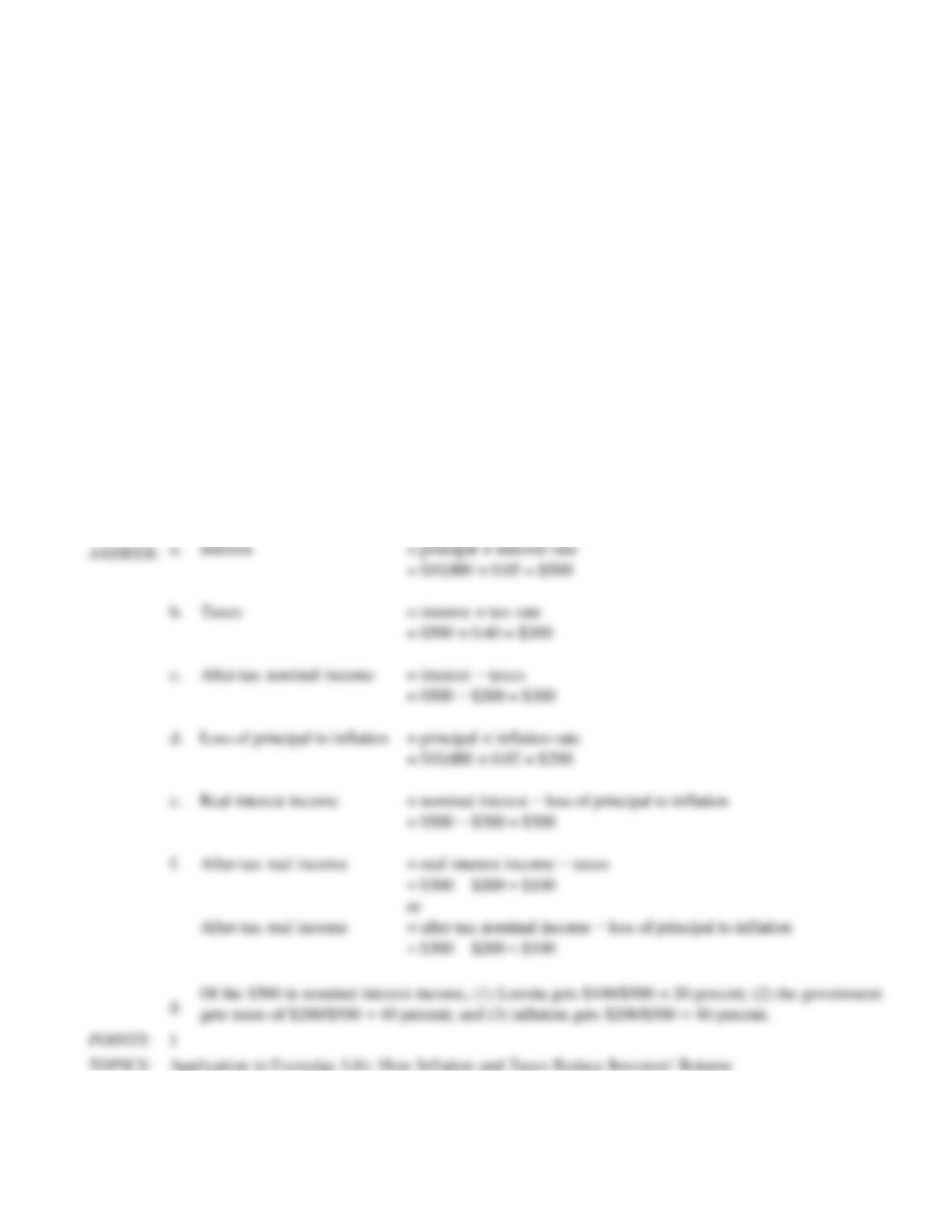
59. Loretta buys a one-year debt security on December 31, 2013, for $10,000, which will pay her a nominal interest rate
of 5% percent. From December 31, 2013, to December 31, 2014, the inflation rate is 2 percent. Loretta has a tax
rate of 40 percent.
a. How much nominal interest (in dollars) does Loretta earn during the year? Show your
calculations.
b. How much (in dollars) does Loretta pay in taxes on her interest income? Show your
calculations.
c. How much (in dollars) is Loretta’s after-tax nominal income? Show your calculations.
d. How much principal (in dollars) does Loretta lose because of inflation? Show your
calculations.
e. How much real interest income (in dollars) does Loretta earn? Show your calculations.
f. How much (in dollars) is Loretta’s after-tax real interest income? Show your calculations.
What percent of Loretta’s nominal interest income goes to: (1) her, in the form of after tax
g. real interest income; (2) the government, in the form of taxes; and (3) inflation, in the form of
lost principal value? Show your calculations.
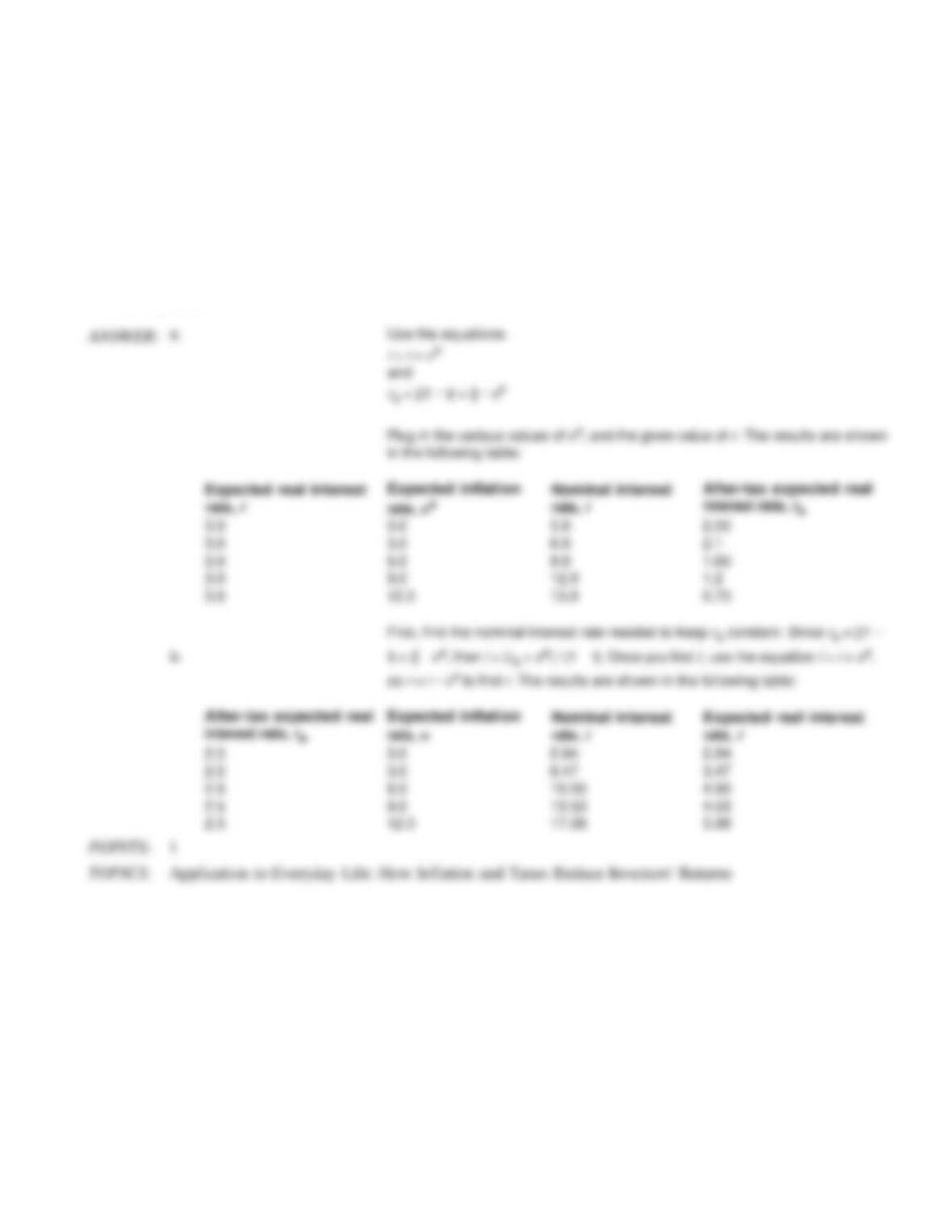
60. Answer the questions below.
Suppose the Fisher hypothesis holds for an economy that has an expected real interest rate of
a. 3 percent. For each of the expected inflation rates of 0, 3, 6, 9, and 12 percent, calculate the
after-tax expected real interest rate (expressed in percentage points with two decimals), if
the tax rate is 15 percent.
Suppose the Fisher hypothesis does not hold, but instead that the after-tax expected real
interest rate will be unchanged at 2.5 percent if the expected inflation rate changes. For each
b. of the expected inflation rates of 0, 3, 6, 9, and 12 percent, calculate the (before-tax)
expected real interest rate (expressed in percentage points with two decimals), if the tax rate
is 15 percent.