Chapter 06 – Bonds, Bond Prices, and the Determination of Interest Rates
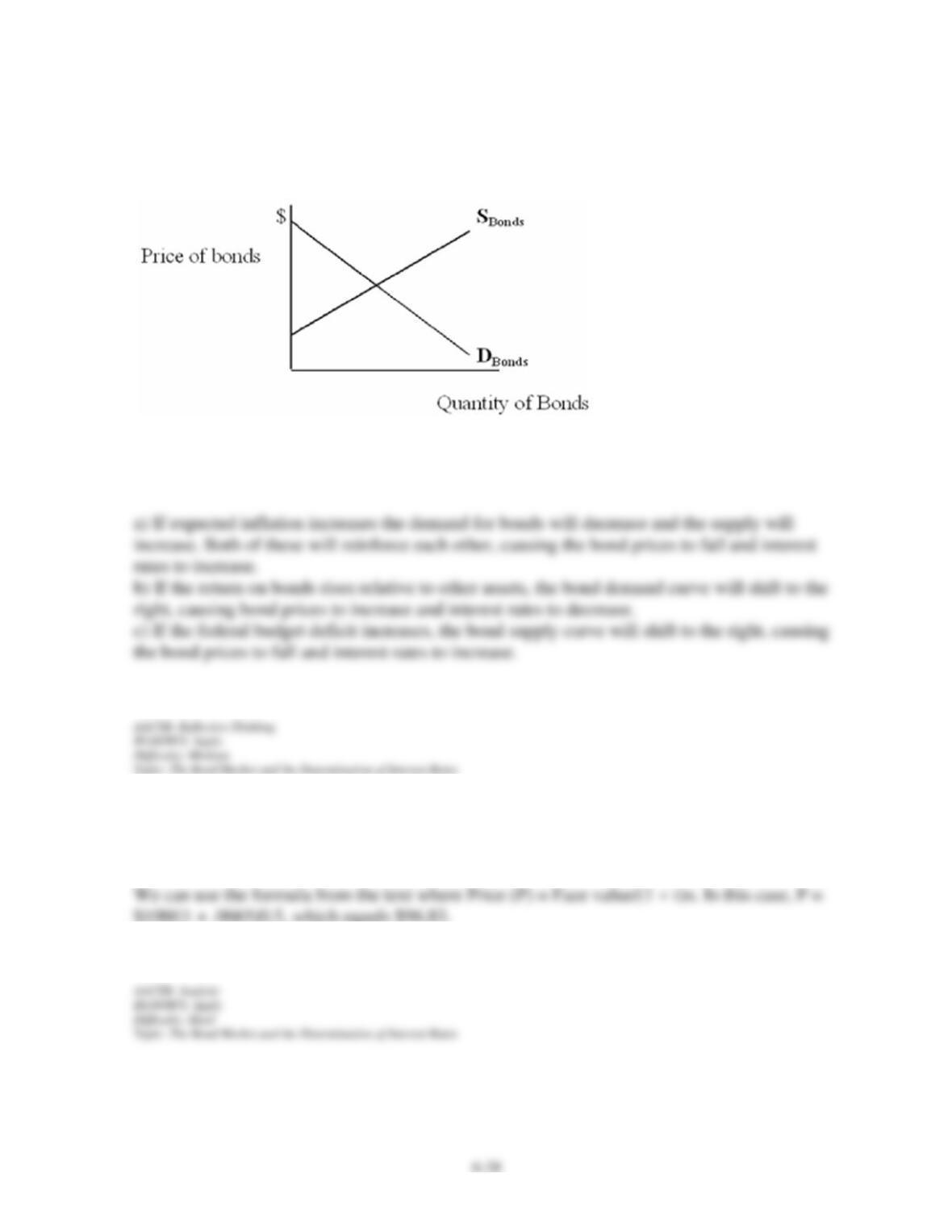
107. Notice the following model of a bond market. In each situation given, explain what
happens to the bond price and yield and why.
a) Expected inflation increases
b) The return on bonds rises relative to other assets
c) The federal government deficit increases
108. Calculate the price of a zero coupon bond that has an interest rate of 6.65% (.0665), a
face value of $100.00 and six-months to maturity.
Chapter 06 – Bonds, Bond Prices, and the Determination of Interest Rates
109. Calculate the monthly payment for a 30-year mortgage, where the amount borrowed is
$100,000 and the annual interest rate is 6.0%.
110. Calculate the price of a $1,000 face value bond that offers a $45 annual coupon, and has
six years to maturity, when the interest rate is 6.0% (0.060).
111. Which bond will have a higher yield to maturity, a $1,000 face value bond, with a 5.0%
coupon rate that sells for $900; or a $1000 face value bond, with a $50 annual coupon that
sells for $1,050? Explain your choice.
Chapter 06 – Bonds, Bond Prices, and the Determination of Interest Rates
112. Compute the change in the price of a five-year (until maturity) $1,000 face value zero-
coupon bond that currently yields 7% when expected inflation increases from 3% to 4%.
113. Suppose that the interest rate on a conventional 30-year mortgage is currently 8%. You
receive a call from a mortgage broker who offers you a 30-year adjustable rate mortgage at
2% that is adjusted once each year. Evaluate each mortgage in terms of the following: risk
that the monthly payment will change over the next 30 years and interest-rate risk.
Chapter 06 – Bonds, Bond Prices, and the Determination of Interest Rates
114. Explain the relationship between coupon rate (or coupon yield) and current yield.
115. Explain why the spreads on most municipal bonds would be greater than the spread on
U.S. Treasury bonds.
Chapter 06 – Bonds, Bond Prices, and the Determination of Interest Rates
116. The U.S. Treasury offers several ways to purchase U.S. government bonds. There are the
traditional coupon bonds, plus Treasury Inflation-Indexed Securities and STRIPS. How do
these bonds differ from their traditional counterparts?
117. In the late 1990s, the U.S. government ran a surplus for the first time in decades. It
instituted a buyback program, whereby the Treasury bought outstanding government bonds.
How would this program affect the bond market price, yield, and quantity of bonds? How
might it affect the liquidity of government bonds?
Chapter 06 – Bonds, Bond Prices, and the Determination of Interest Rates
118. Explain why holding period return, as an economic measure, does not have the same
significance as current yield or yield to maturity.
119. Suppose that a bond is purchased at a discount (meaning that it is sold for less than face
value). Could the yield to maturity ever be less than the coupon rate? Could the holding
period return be less than the coupon rate? Explain.
Chapter 06 – Bonds, Bond Prices, and the Determination of Interest Rates
120. In early 2001 the stock market in the U.S. suffered significant losses. What impact
should this have had on the bond market and why?
121. In mid-2004 there was speculation that the Federal Reserve would be raising interest
rates before the end of the year. How would this news affect the bond market and why?
Chapter 06 – Bonds, Bond Prices, and the Determination of Interest Rates
122. Use our model of the bond market (supply and demand) to explain what happens if the
U.S. economy continues to grow at robust rates.
123. How can a bond mutual fund promise a return of over 13% when the coupon rate of the
bonds they are holding are just 7% and interest rates are falling?
Chapter 06 – Bonds, Bond Prices, and the Determination of Interest Rates
124. The Fisher effect refers to a situation where a change in expected inflation is offset one-
for-one with a change in nominal interest rates (yield to maturity). Specifically, the real
interest rate remains unchanged and the amount of borrowing remains unchanged. Assuming
an increase in expected inflation, explain how this change would be reflected in the bond
market. What would happen to bond prices and the quantity of bonds outstanding?
125. At the time the government of Bulgrovia issued new bonds, they issued them at a price
that reflected the risk-free rate because investors had no concerns regarding default risk, so
did not require a risk premium. That risk-free rate was 4%. These bonds currently have one
year to maturity and you notice the yield is 20%. Can you calculate the probability that the
Bulgrovian government will default?
Chapter 06 – Bonds, Bond Prices, and the Determination of Interest Rates
126. Consider two investors: one is risk-neutral and the other is risk-averse. How do they each
assess a risk premium?
127. Explain why two countries with the same average rate of inflation may not present the
same inflation risk for holders of those countries’ bonds?
128. Which bond should sell for the higher price and why? (i) A basic U.S. Treasury bond,
with a $10,000 face value and 20 years to maturity (ii) a U.S. Treasury TIPS bond with the
same maturity and face value.
Chapter 06 – Bonds, Bond Prices, and the Determination of Interest Rates
129. The text identified the various sources of risk for bonds. Are U.S. Treasury TIPS bonds
free from risk? Explain.
130. In the chapter you read about David Bowie, a rock and roll artist from Great Britain, who
has issued bonds. Would this be a likely avenue of financing for a new rock and roll group
needing to raise funds to get their career going? Explain.
Chapter 06 – Bonds, Bond Prices, and the Determination of Interest Rates
6-49
131. If you were going to issue bonds, would you prefer to be in a country where the average
inflation rate is 3% inflation but fluctuates wildly, or in a country with a higher, 4% expected
inflation rate that is stable (meaning it’s always 4%). Explain.
Essay Questions
Chapter 06 – Bonds, Bond Prices, and the Determination of Interest Rates
132. You win your state lottery. The lottery officials offer you the option of taking your
winnings in one lump-sum payment, or fixed annual payments for the next 20 years. The sum
of the 20 annual payments is larger than the lump-sum payment. Before deciding, what are the
key factors you will want to consider that could influence your decision?
Chapter 06 – Bonds, Bond Prices, and the Determination of Interest Rates
133. During economic recessions, interest rates may decrease or increase. This question asks
you to analyze two recent U.S. recessions:
(i) 1990-91 recession (interest rates increased)
(ii) 2001 recession (interest rates decreased)
What happened to bond prices during each of these recession? What do the interest rate data
from these two recessions reveal about the shifts in bond demand and bond supply?
Chapter 06 – Bonds, Bond Prices, and the Determination of Interest Rates
134. Consider the factors that affect bond demand and bond supply. Describe how the
following are likely to change during a period of robust economic growth: wealth, default
risk, and general business conditions. For each, state how the factor is likely to change, and
discuss the implications for bond demand/supply, bond price, and yield. Bond prices tend to
decrease during periods of high economic growth. What does this reveal about which of these
factors is important?
Chapter 06 – Bonds, Bond Prices, and the Determination of Interest Rates
135. Many people are worried that, with the growing number of people that will be retiring in
the U.S. over the next 40 years, the Social Security System will need to borrow large amounts
of money. If we assume that Social Security taxes and the current eligibility age remain
constant, explain the likely impact this will have on bond markets.