35. Which of the following bonds has the greatest interest-rate risk?
a. A one–year bond
b. A five-year bond
c. A ten-year bond
d. A thirty-year bond
36. Which of the following bonds is likely to have the highest term premium?
a. A one–year bond
b. A five-year bond
c. A ten-year bond
d. A thirty-year bond
37. Assume that the bond market is in equilibrium. The current interest rate on one-year bonds is 5 percent, the interest
rate on one–year bonds, one year from now is 6 percent, and in two years the interest rate on one-year bonds will be
6.5 percent. Assume that there is no term premium on a one-year bond. If the term premium equals 0.5 percent ×
the number of years to maturity, for two-year bonds and three-year bonds. The interest rate today on the two-year
bond is and the interest rate today on a three-year bond is .
a. 5.5 percent; 5.8 percent
b. 6.0 percent; 6.3 percent
c. 6.2 percent; 6.8 percent
d. 6.5 percent; 7.3 percent
38. Which of the following statements is true?
a. The prices of debt securities fall during recessions.
b. Interest rates on neither the short-term securities nor the long-term securities fall in recession.
c. Interest rates on long-term securities fall more than the interest rates on short-term securities in recession.
d. Interest rates on short-term securities fall more than the interest rates on long-term securities in recession.
39. An inverted yield curve indicates that
a. an economic expansion has just begun.
b. an economic expansion has been going on for several years.
c. a recession is about to begin.
d. a recession is nearly over.
40. Which of the following is likely to happen to short-term and long-term interest rates during recessions?
a. The short-term interest rates rise during recessions but the long-term interest rates fall during recessions.
b. The short-term interest rates fall during recessions but the long-term interest rates rise during recessions.
c. Both the short-term and the long-term interest rates fall during recessions.
d. Both the short-term and the long-term interest rates rise during recessions.
41. If you observe that the current yield curve is upward sloping, it is likely that
a. an economic expansion has just begun.
b. an economic expansion has been going on for several years.
c. a recession is about to begin.
d. a recession is nearly over.
42. A sharp upward sloping yield curve indicates that
a. an economic expansion has just begun.
b. an economic expansion has been going on for several years.
c. a recession is about to begin.
d. an economic expansion is nearly over.
43. Which of the following is likely to happen to short-term and long-term interest rates during expansions?
a. Both the short-term and the long-term interest rates rise during expansions.
b. The short-term interest rates fall during expansions but the long-term interest rates rise during expansions.
c. Both the short-term and the long–term interest rates fall during expansions.
d. The short-term interest rates rise during expansions but the long-term interest rates fall during expansions.
44. Which of the following statements is true?
a. During recessions, there is an increase in the demand for debt securities.
b. During recessions, there is an increase in the supply of debt securities.
c. During recessions, the supply-curve of debt securities shift comparatively more, to the left, than the demand-
curve for securities.
d. During recessions, the demand-curve for debt securities shift comparatively more, to the left, than the supply-
curve of securities.
45. Which of the following is true of the yield curve?
a. The yield curve is steep and is upward sloping when the recession ends and the economy starts to recover.
b. The yield curve is flat and is downward sloping when the recession ends and the economy starts to recover.
c. The yield curve is flat or inverted when the term premium is small.
d. The yield curve is downward sloping when the term premium is large.
46. When an economic expansion has been going on for several years, you are likely to observe that
a. the yield curve is sharply upward sloping.
b. the yield curve is somewhat upward sloping.
c. the yield curve is flat or inverted.
d. the yield curve is a vertical straight line.
47. Term spread is the interest rate on a long-term debt security
security.
a. minus
b. plus
c. times
d. divided by
the interest rate on a short-term debt
48. If the interest rate on three-month Treasury securities is 6 percent and the interest rate on ten-year Treasury
securities is 4 percent, then
a. the economy has probably just emerged from a recession.
b. the yield curve slopes upward steeply.
c. a recession is likely to occur.
d. the economy is probably in the middle of an economic expansion.
49. If the interest rate on three-month Treasury securities is 5 percent and the interest rate on ten-year Treasury
securities is 6 percent, then the odds of a recession are
a. less than 15 percent.
b. about 25 percent.
c. about 40 percent.
d. about 80 percent.
50. Which of the following statements is true?
a. The yield curve slopes downward when the term spread is positive.
b. Researchers suggest that the smaller the term spread, the higher the chance is of a recession in the coming
year.
c. The yield curve slopes upward when the term spread is negative
d. Researchers suggest that the larger the spread, the higher the chance is of a recession in the coming year.
51. Which of the following is a possible outcome of a negative or low term spread?
a. A low of negative spread may indicate higher short-term interest rates in the future.
b. A low or negative spread may cause the yield curve to slope upward.
c. A low or negative spread may reduce lending by banks.
d. A low or negative spread may indicate the early stages of economic expansions.
52. What is the reason for a low rated security to generate a high yield to maturity?
53. Put the following securities in order according to their after-tax interest rates, from lowest to highest. The federal tax
rate on interest income is 30 percent. Show your work.
A: A corporate bond that pays an interest rate of 6 percent.
B: A corporate bond that pays an interest rate of 7 percent.
C: A local government bond identical that pays an interest rate of 4.5 percent.
54. Compare a two-year bond with two successive one-year bonds, in which an investor buys a one-year bond today,
then another one-year bond when the first matures. Suppose the two-year bond has an annual interest rate of 4
percent.
Consider the pattern of interest rates on the one-year bonds listed below and explain whether an investor should buy
the two-year bond or the one–year bond today, assuming that the only thing that matters to the investor is the amount
of money she has at the end of the two years; that is, she is risk neutral. In each case, how much would an investor
have at the end of two years if she invested $1,000 today? Show your work. Round to the nearest penny ($0.01). In
each case be sure to say which bond the investor would buy today.
a. The interest rate on a one-year bond today is 1 percent, and the interest rate on a one-year
bond purchased in one year from now is 8 percent.
b. The interest rate on a one-year bond today is 2 percent; and the interest rate on a one-year
bond purchased one–year from now is 6 percent.
c. The interest rate on a one-year bond today is 3 percent; and the interest rate on a one-year
bond purchased one–year from now is 5 percent.
d. The interest rate on a one-year bond today is 5 percent; nd the interest rate on a one-year
bond purchased one–year from now is 3 percent.
55. Suppose that a risk-neutral investor has a choice between buying a one–year bond paying 5 percent today, a two-
year bond paying 5.4 percent today, a three-year bond paying 5.8 percent today, or a four-year bond paying 6.2
percent today, if a one-year bond purchased one year from now is expected to have an interest rate of 6 percent, a
one-year bond purchased two years from now is expected to have an interest rate of 7 percent, and a one-year bond
purchased three years from now is expected to have an interest rate of 8 percent. Explain with the help of suitable
calculations, which of the following would the investor decide to do?
a. The investor will purchase a one–year bond today, followed by three successive one–year bonds.
b. The investor will purchase a two-year bond today, followed by two successive one-year bonds.
c. The investor will purchase a three-year bond today, followed by a one-year bond.
d. The investor will purchase a four-year bond today.
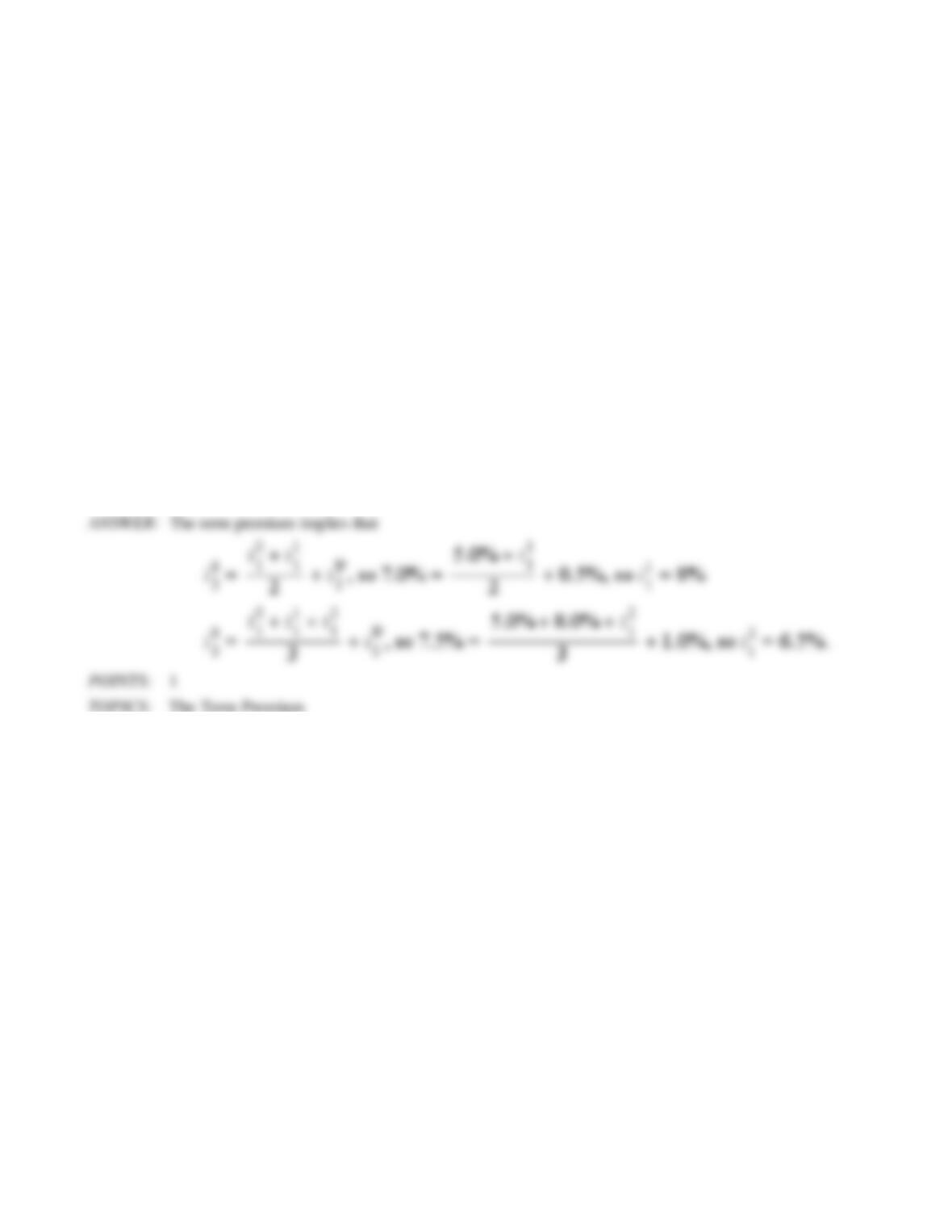
56. Consider the bond market to be in equilibrium according to our complete theory of the term structure of interest
rates. You observe the following interest rates available today on bonds with differing times to maturity. (You may
ignore transactions costs.)
Time to maturity Yield to maturity
1 year 5.0%
2 years 7.0%
3 years 7.5%
The term premium for the two-year bond is the extra yield to maturity paid on a two-year bond compared with
buying two separate one-year bonds (one today and another after one year). You believe that the term premium on
the two-year bond is 0.5 percent.
The term premium for the three-year bond is the extra yield to maturity paid on a three-year bond compared with
buying three separate one-year bonds (one today, another after one year, and another after two years). You believe
that the term premium on the three-year bond is 1.0 percent.
Given your beliefs about the term premiums on two-year and three-year bonds, calculate the interest rates on one-
year bonds that you expect to prevail one year from now and two years from now. In other words, what do you
expect to be the yield to maturity on a one-year bond one year from now and what do you expect to be the yield to
maturity on a one-year bond two years from now? Explain and show all your work.
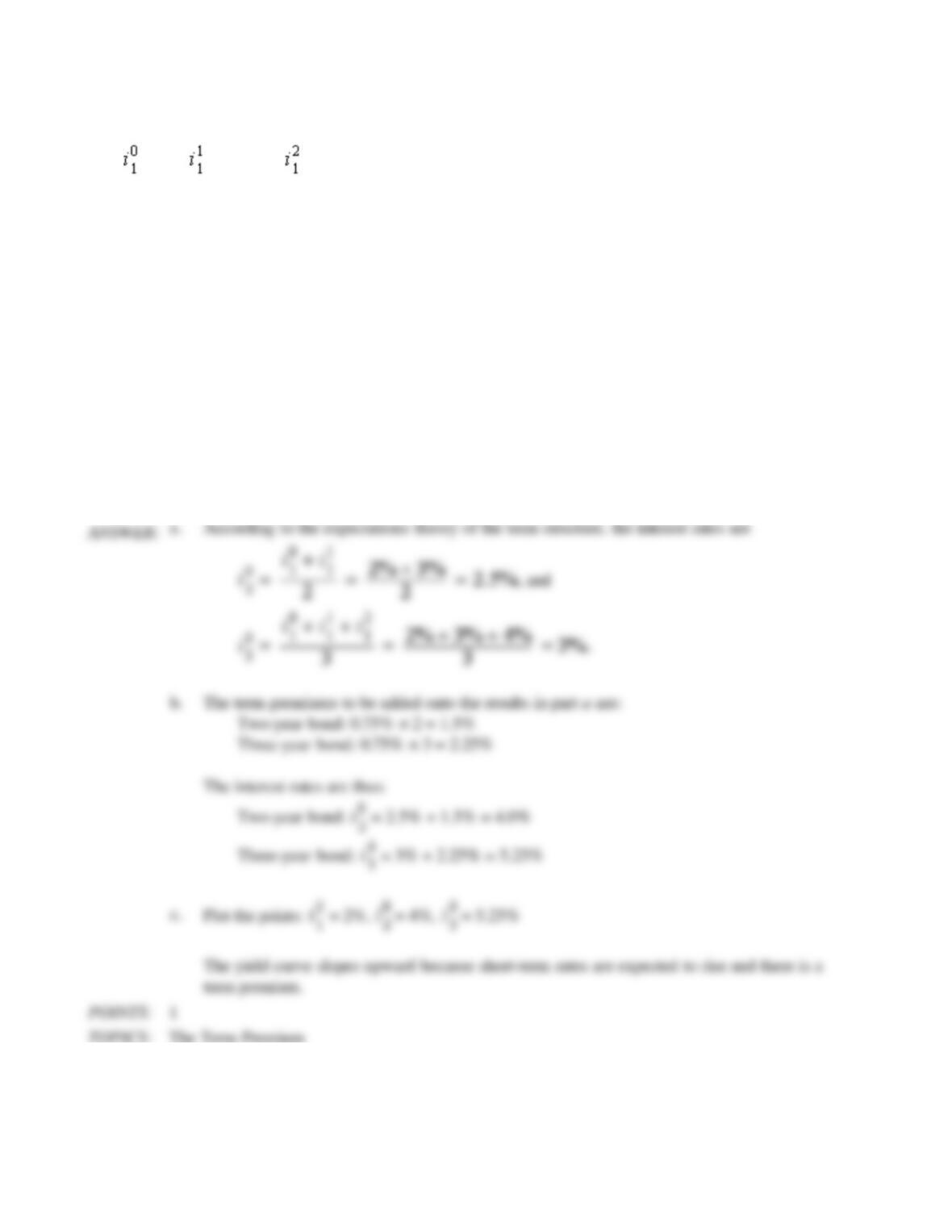
57. Consider the bond market to be in equilibrium according to our complete theory of the term structure of interest
rates. The current interest rate on one-year bonds is 2 percent, and you believe, as does everyone in the market, that
in one year the interest rate on one-year bonds will be 3 percent, and in two years, the interest rate on one-year
bonds will be 4 percent. That is, using our standard notation,
= 2%, = 3%, and = 4%.
Assume that there is no term premium on a one-year bond.
a. According to the expectations theory of the term structure of interest rates, what will the
interest rate be today on a two-year bond and a three-year bond?
Suppose the term premium equals 0.75 percent × the number of years to maturity, for the 2-year bond and the 3-
year bond.
b. Calculate the interest rate today on the two-year bond and the three-year bond, incorporating
the term premium.
Draw the yield curve for today, using the values you calculated in part b. Your drawing
c. should show three points and should be drawn reasonably to scale, showing the values on
each axis of each point plotted. Explain briefly (in one or two sentences) why the yield curve
has the shape it does.
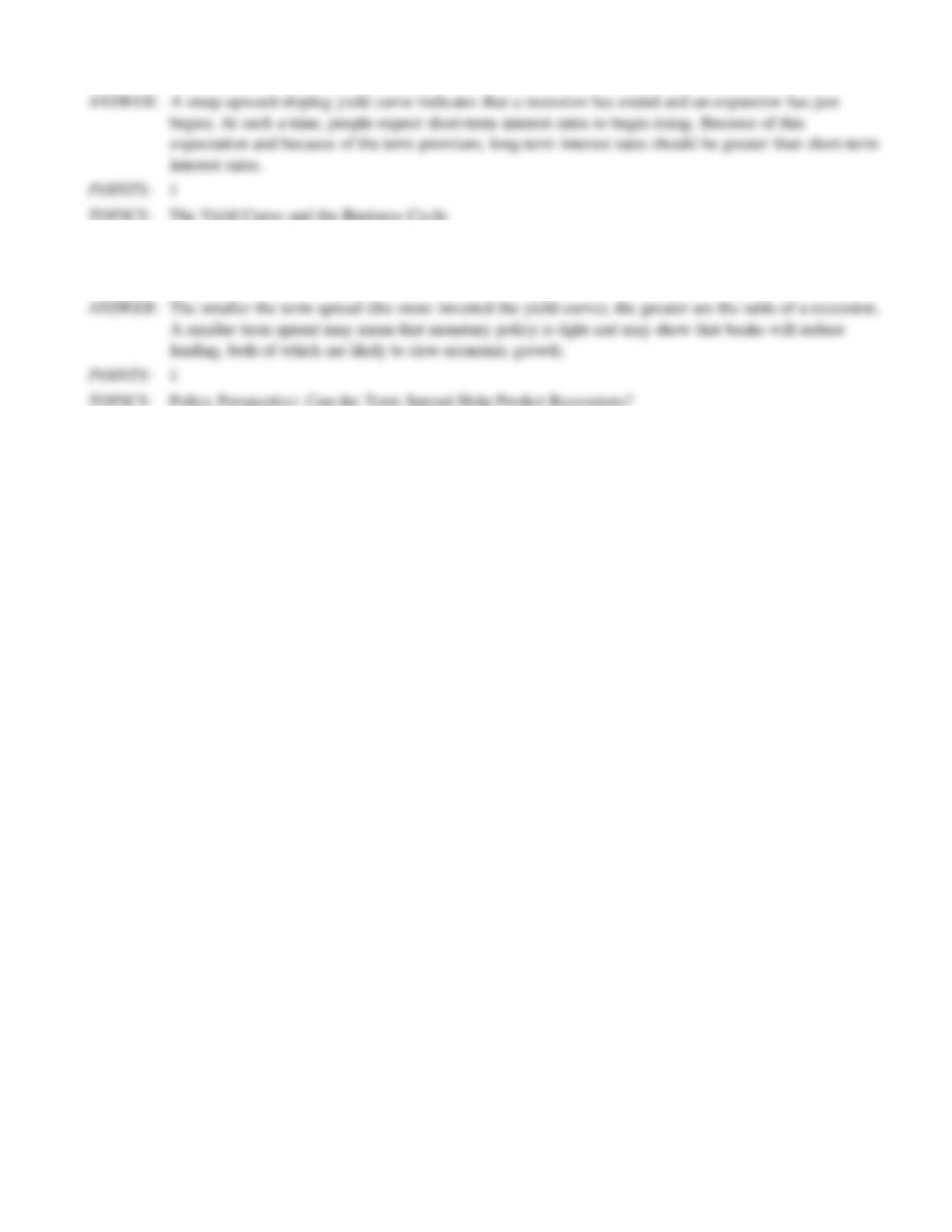
58. What do steep upward-sloping yield curves indicate about the business cycle?
59. Explain how an economist could use the slope of the yield curve to analyze the probability that a recession will occur.
Explain why the spread may matter.