Chapter 05 – Understanding Risk
61. A risk-neutral investor:
A. Highly values diversification
62. An investor practicing hedging would be most likely to:
A. Avoid the stock market and focus on bonds
63. Hedging is possible only when investments have:
D. The same risk premiums
Chapter 05 – Understanding Risk
64. An investor who diversifies by purchasing a 50-50 mix of two stocks that are not perfectly
positively correlated will find that the standard deviation of the portfolio is:
A. The sum of the standard deviations of the two individual stocks
65. Which of the following statements is false?
D. Diversification allocates savings across more than one asset
66. Systematic risk:
Chapter 05 – Understanding Risk
67. The Russian wheat crop fails, driving up wheat prices in the U.S. This is an example of:
D. Quantifiable risk
68. If the returns of two assets are perfectly positively correlated, an investor who puts half of
his/her savings into each will:
A. Reduce risk
69. In order to benefit from diversification, the returns on assets in a portfolio must:
A. Be perfectly positively correlated
Chapter 05 – Understanding Risk
70. The main reason for diversification for an investor is:
D. To gain from the greater returns that come from greater risk
71. If ABC Inc. and XYZ Inc. have returns that are perfectly positively correlated:
A. Adding XYZ Inc to a portfolio that consists of only ABC Inc. will reduce risk.
72. If an investment offered an expected payoff of $100 with $0 variance, you would know
that:
D. Half of the time the payoff is $200 and the other half it is $50
Chapter 05 – Understanding Risk
73. The fact that not everyone places all of his/her savings in U.S. Treasury bonds indicates
that:
74. Hedging risk and spreading risk are two ways to:
D. Match up perfectly positively correlated assets
75. Sometimes spreading has an advantage over hedging to lower risk because:
D. Spreading does not affect expected returns
Chapter 05 – Understanding Risk
76. Spreading involves:
D. Building a portfolio of assets whose returns move together
77. Investing in a mutual fund made up of hundreds of stocks of different companies is an
example of all of the following except:
A. Spreading risk
78. An automobile insurance company that writes millions of policies is practicing a form of:
A. Mutual fund
Chapter 05 – Understanding Risk
79. An automobile insurance company on average charges a premium that:
A. Equals the expected loss from each driver
D. Approaches 1 as the number of assets increases
81. In investment matters, generally young workers compared to older workers will:
D. Be more risk-averse
Chapter 05 – Understanding Risk
82. The variance of a portfolio containing n assets:
D. Does not change in a predictable way when n increases
83. The expected return from a portfolio made up equally of two assets that move perfectly
opposite of each other would have a standard deviation equal to:
A. 1.0
84. A life insurance company can make profits because individual life spans:
D. Individual life spans are perfectly negatively correlated
Chapter 05 – Understanding Risk
5-29
85. An individual who is risk-averse:
A. Never takes risks
86. A portfolio of assets has lower risk than holding one asset, but the same expected return
and higher transaction costs. Which of the following statements is most correct?
A. The portfolio is attractive to people who are risk-averse and risk-neutral, but not to risk
Short Answer Questions
Chapter 05 – Understanding Risk
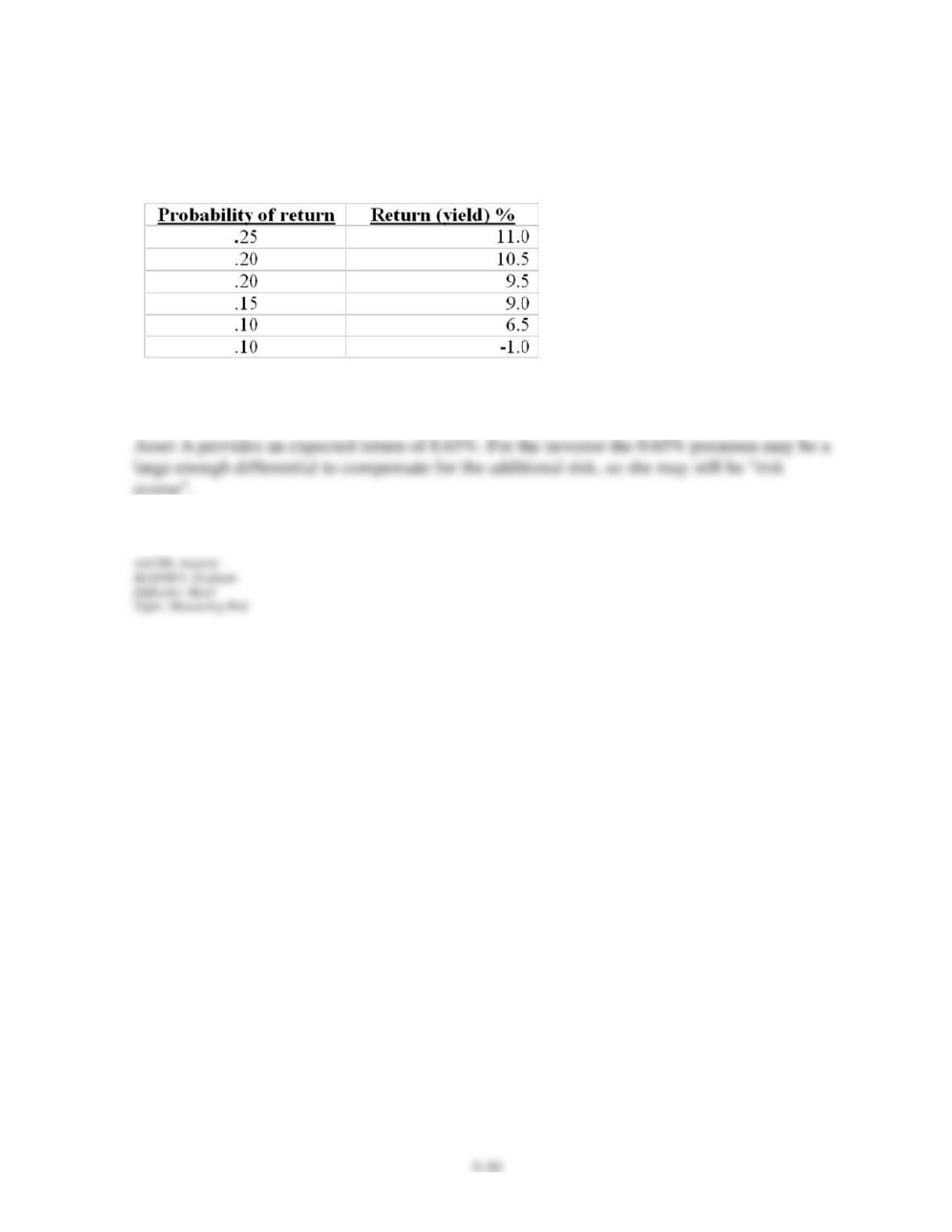
87. An individual faces two alternatives for an investment: Asset A has the following
probability return schedule:
Asset B has a certain return of 8.0%. If the individual selects asset A does she violate the
principle of risk aversion? Explain.
Chapter 05 – Understanding Risk
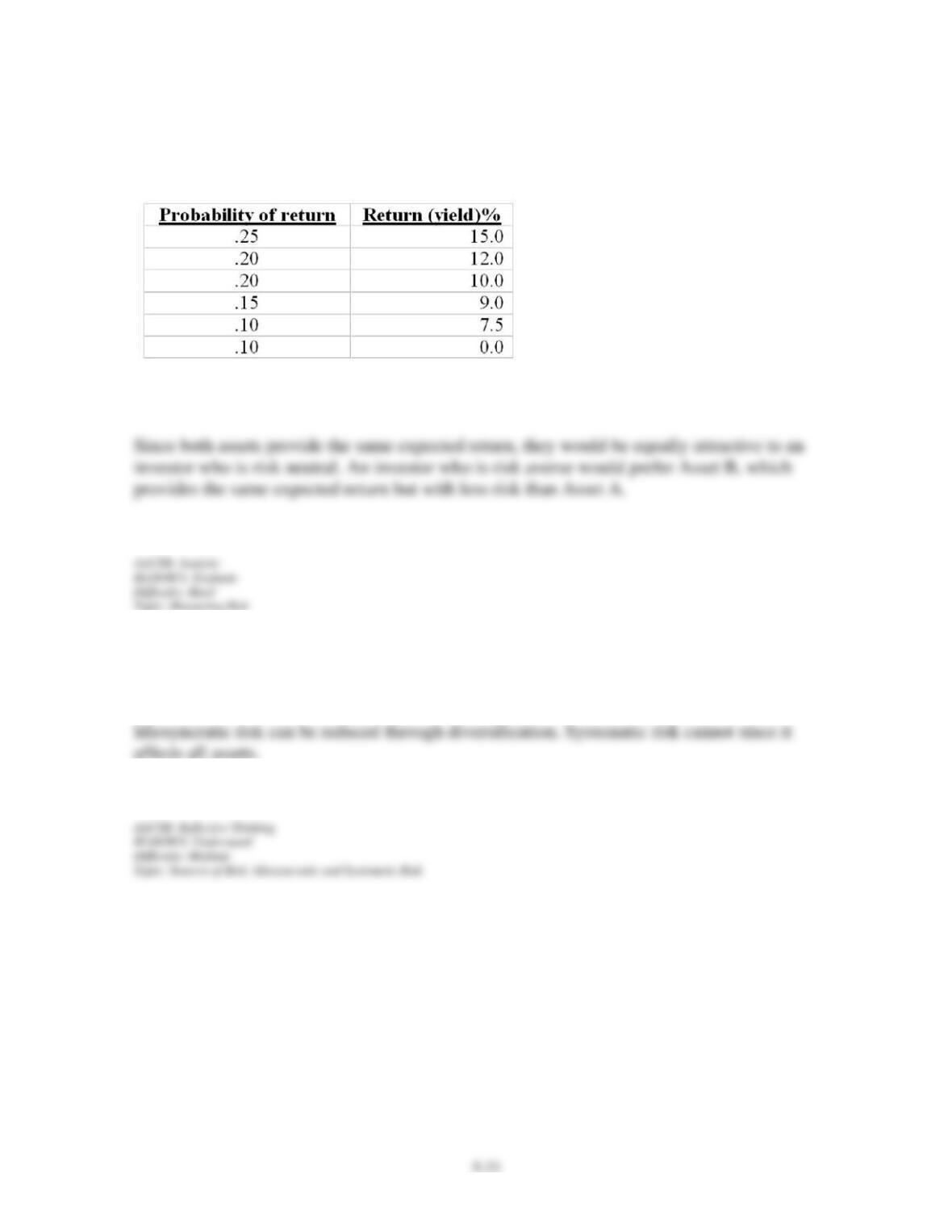
88. An individual faces two alternatives for an investment. Asset ‘A’ has the following
probability of return schedule:
Asset ‘B’ has a certain return of 10.25%. If this individual selects asset ‘A’ does it imply she is
risk averse? Explain.
89. Explain why returns on assets compensate for systematic risk but not for idiosyncratic
risk.
Chapter 05 – Understanding Risk
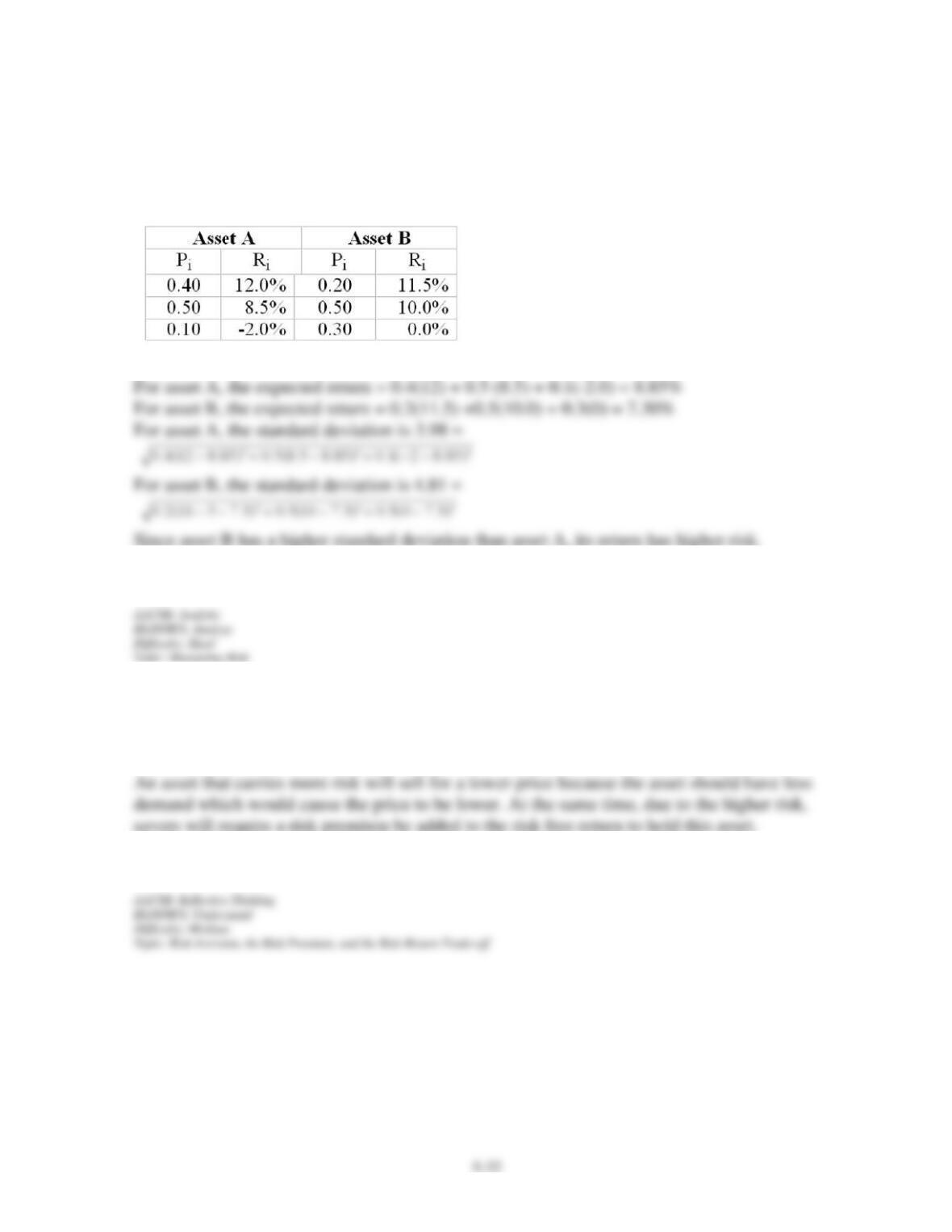
90. Consider the following two assets with probability of return = Pi and return = Ri.
Calculate the expected return for each and the standard deviation. Which one carries the
greatest risk? Why?
91. Explain why an asset that carries more risk should sell for a lower price but offer a higher
expected return.
Chapter 05 – Understanding Risk
92. Explain why casinos will find professional gamblers participating in the various games of
chance even though these professionals know the odds are in favor of the house and against
them.
93. What is the expected value of a $100 bet on a flip of a fair coin, where heads pays double
and tails pays zero?
94. An individual owns a $100,000 home. She determine that her chances of suffering a fire in
any given year to be 1/1000 (0.001). She correctly calculates her expected loss in any year to
be $100. Explain why this really isn’t a good way to measure her potential for loss.