42. Consider a coupon bond that pays $100 every year and repays its principal amount of $1,000 at the end of four
years. If the annual rate of discount is 8 percent, the present value of the bond is
a. $671.01.
b. $1,066.24
c. $1,134.20.
d. $1,250.00.
43. Consider a coupon bond that pays $150 every year and repays its principal amount of $1,500 at the end of five years.
If the annual rate of discount is 7 percent, the present value of the bond is approximately
a. $214.29.
b. $808.39.
c. $1,684.50.
d. $1,742.52.
44. Consider a one–year coupon bond that has a present value of $2,000. If the annual rate of discount is 5 percent, and
the payment made at the end of each year is $140, the principal amount to be repaid at the end of one year is
a. $1,234.65.
b. $1,363.32.
c. $1,960.00.
d. $2,000.00.
45. Consider a two-year coupon bond that has a present value of $10,000. If the annual rate of discount is 3 percent, and
the payment made at the end of each year is $250, the principal amount to be repaid at the end of two years is
a. $10,101.50.
b. $10,300.00.
c. $13,333.33.
d. $13,583.33.
46. If the annual rate of interest in a market is 12%, the monthly rate of discount will equal
a. 1%.
b. 12%.
c. 24%.
d. 144%.
47. Consider the returns on four investment options: A, B, C, and D. All four investment options require the same
principal amount, and the returns on the investments are considered over the same time frame. The present value of
the return on investment A is greater than the present value of the return on investment B, which is greater than the
present value of the return on investment C. The present value of the return on investment D is the lowest. A
rational investor will choose to invest in:
a. option A.
b. option B.
c. option C.
d. option D.
48. According to the theory underlying the present-value formula, would a rational individual prefer to receive (a) $75
one year from now, (b) $85 two years from now, or (c) $90 three years from now, or would he be indifferent
between all three choices? Assume that the relevant annual market interest rate is 10 percent and will remain at 10
percent for the next three years?
a. He will prefer $75 one year from now. b.
He will prefer $85 two years from now. c.
He will prefer $90 three years from now.
d. He will be indifferent between all three choices.
49. According to the theory underlying the present-value formula, would a rational individual prefer to receive (a) $75
one year from now, (b) $85 two years from now, or (c) $90 three years from now, or would he be indifferent
between all three choices? Assume that the relevant annual market interest rate is 20 percent and will remain at 20
percent for the next three years?
a. He will prefer $75 one year from now. b.
He will prefer $85 two years from now. c.
He will prefer $90 three years from now.
d. He will be indifferent between all three choices.
50. Your favorite magazine, Fun with Present Value, offers you four different subscription deals for the next four
years. It has guaranteed its current and future subscription rates, as shown below. Which will you take, if your
annual rate of discount is 6 percent and you want to get the magazine for four years?
a. A one-year subscription for $24, followed by a one-year renewal each year for $24 each year.
b. A two-year subscription for $45, followed by a two-year renewal for $48.
c. A three-year subscription for $72, followed by a one–year renewal for $24.
d. A four-year subscription for $89.
51. A rise in the annual interest rates will cause a.
the principal amount of a bond to increase. b.
the principal amount of a bond to decrease. c.
the present value of a bond to decrease.
d. the present value of a bond to increase.
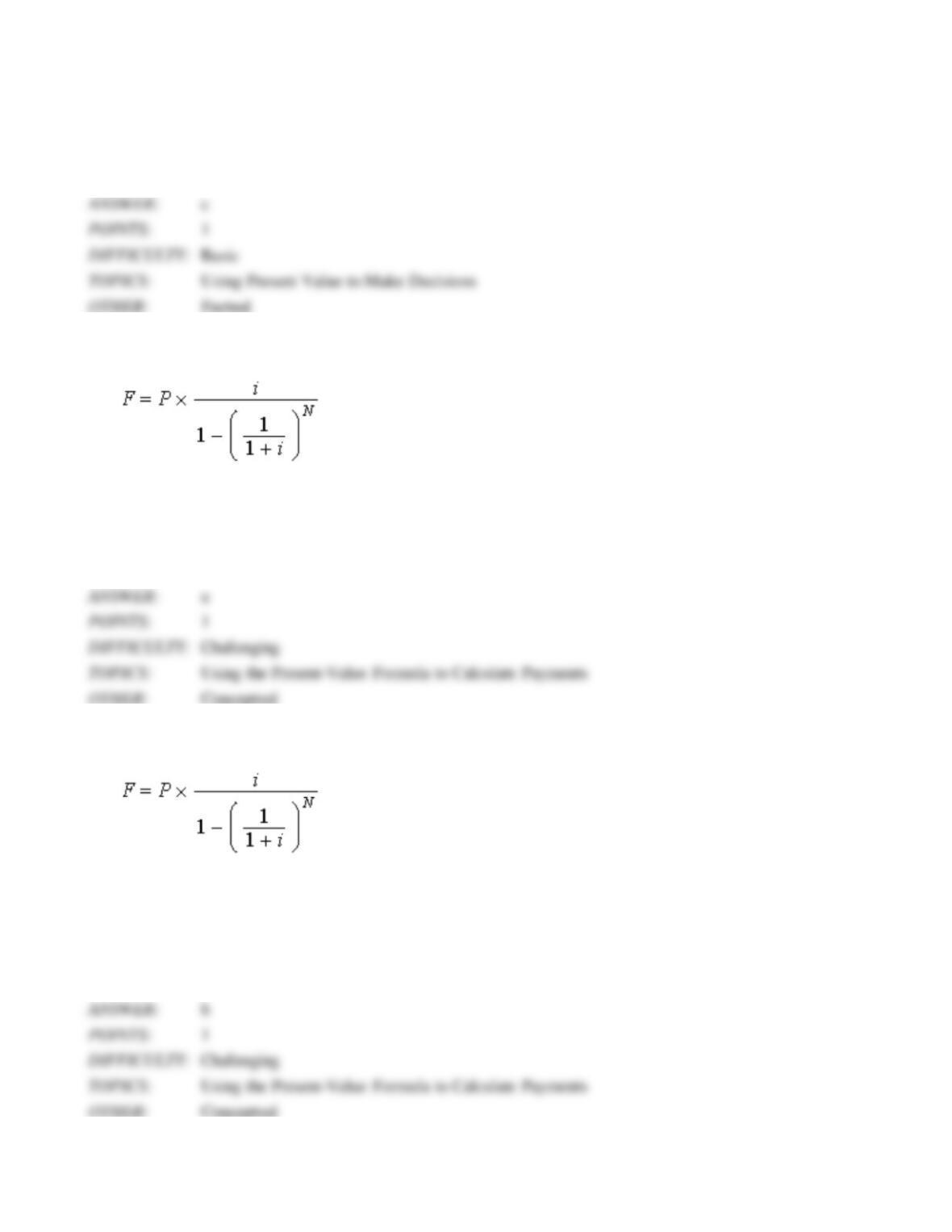
52. Suppose you take out a car loan of $10,000 for 3 years at an annual interest rate of 8 percent, with payments to be
made monthly. What will be the approximate monthly payments? The relevant formula is:
.
a. $313.36.
b. $323.36.
c. $853.45.
d. $3,880.34.
53. Suppose you take out a home equity loan of $100,000 for 5 years at an annual interest rate of 5 percent, with
payments to be made monthly. What will the approximate monthly payments be? The relevant formula is:
.
a. $1,320.71
b. $1,887.12
c. $1,924.79
d. $5,282.82
54. Past return refers to the
a. highest annual return that a security has produced in the past.
b. mode of the annual returns that a security has produced in the past.
c. average of the annual returns that a security has produced in the past.
d. median of the annual returns that a security has produced in the past.
55. You are considering buying a discount bond that costs $1,000 today and pays you $1,200 in one year. However,
there is a 10 percent chance that the company issuing the bond will go bankrupt and not pay you your interest or
return your principal. What is the expected return on the bond?
a. 20 percent.
b. 10 percent.
c. 8 percent.
d. −4 percent.
56. John spends $4,000 on a perpetuity that pays $150 each year. The yield to maturity of this perpetuity is
a. 1.5%.
b. 3.75%.
c. 6.2 %.
d. 15%.
57. According to the Truth–in–Savings Act, the interest rate that banks are required to report when you deposit money in
an account is known as
a. capital-gains yield.
b. annual percentage yield.
c. current yield.
d. total return.
58. Consider a one–year discount bond that pays $2,000 one year from now. If the annual rate of discount is 3 percent,
calculate the present value of the bond.
59. Consider a one–year discount bond that has a present value of $3,000. If the annual rate of discount is 5 percent,
calculate the future value of the bond (the amount the bond pays in one year).
60. Consider a perpetuity that pays $300 every year. If the rate of discount is 6 percent, calculate the present value of
the bond.
61. Consider a fixed-payment security that pays $250 at the end of every year for eight years. If the annual rate of
discount is 3 percent, calculate the present value of the bond.
62. Consider a coupon bond that pays $150 every year and repays its principal amount of $2,000 at the end of six years.
If the annual rate of discount is 7.5 percent, what is the present value of the bond?
63. Consider a coupon bond that pays $350 every year and repays its principal amount of $5,000 at the end of four
years. If the annual rate of discount is 6 percent, what is the present value of the bond?
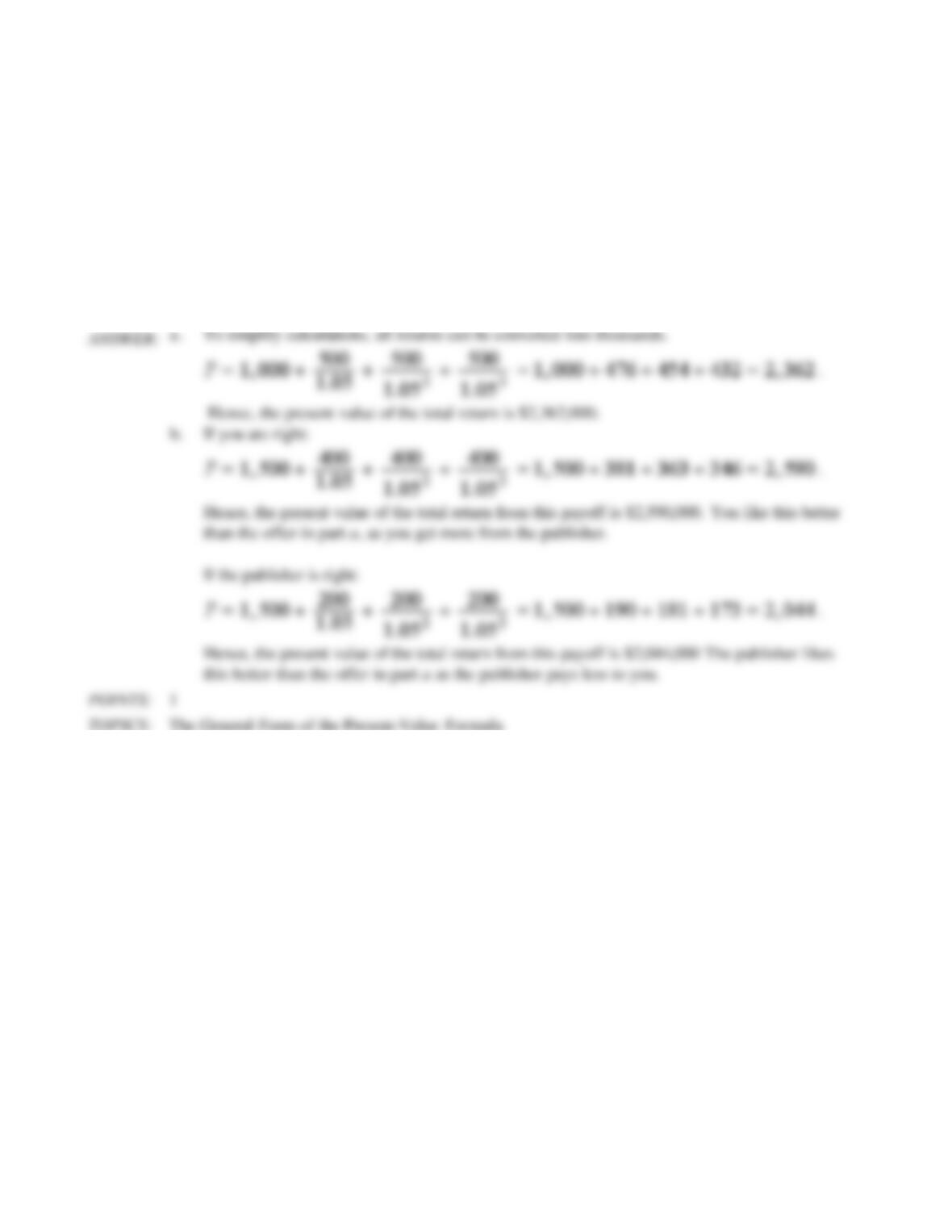
64. Answer the questions below.
You are negotiating a book deal for your newest novel in which an economist single-handedly
a. saves the world. The publisher offers to pay you an advance of $1 million today plus $500,000
at the end of each of the next three years. What is the present value of these payments,
given the annual rate of discount is 5 percent? Show your work.
You counter the publisher’s offer with a counteroffer that will pay you $1.5 million today plus
$5 per book sold in each of the next three years. You think you will sell 80,000 books each
b. year in the next three years, but the publisher thinks you will only sell 40,000 books each year.
Explain why both you and the publisher like this counteroffer better than the deal in part a.
Show your work.
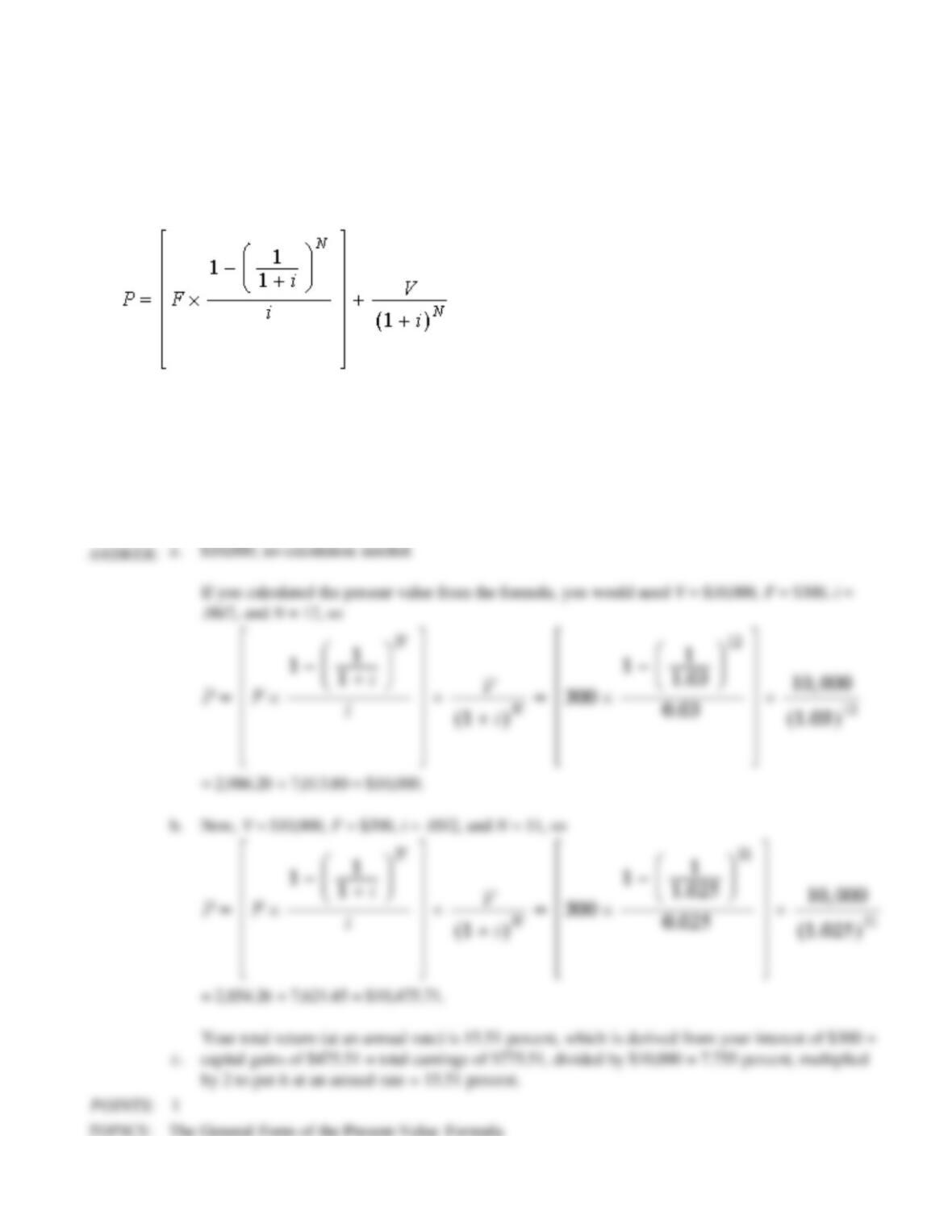
65. Answer the questions below.
You buy a government bond that pays interest twice a year. The interest payment is $300
a. each six months. The bond matures in six years. The face value of the bond is $10,000. The
annual market interest rate is 6 percent. What is the present value of the bond? Show your
work.
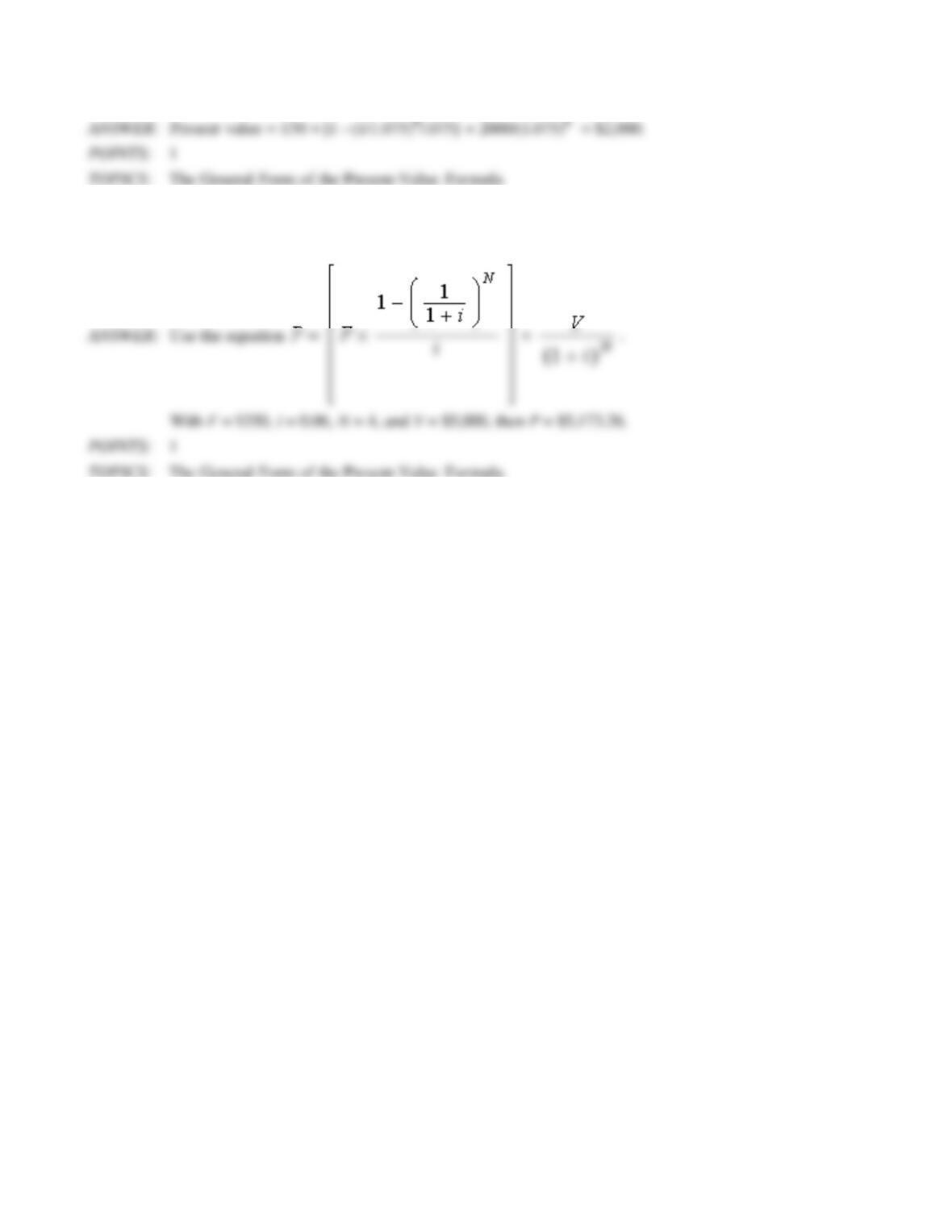
A formula that may be useful to you is:
.
After six months go by, you receive the first interest payment of $300. The annual market
b. interest rate has declined to 5 percent and you decide to sell the bond. What is the bond’s
present value when you sell it? Show your work.
c. What is your total return from owning the bond for six months (expressed at an annual rate,
in percentage points, with two decimals)? Show your work.
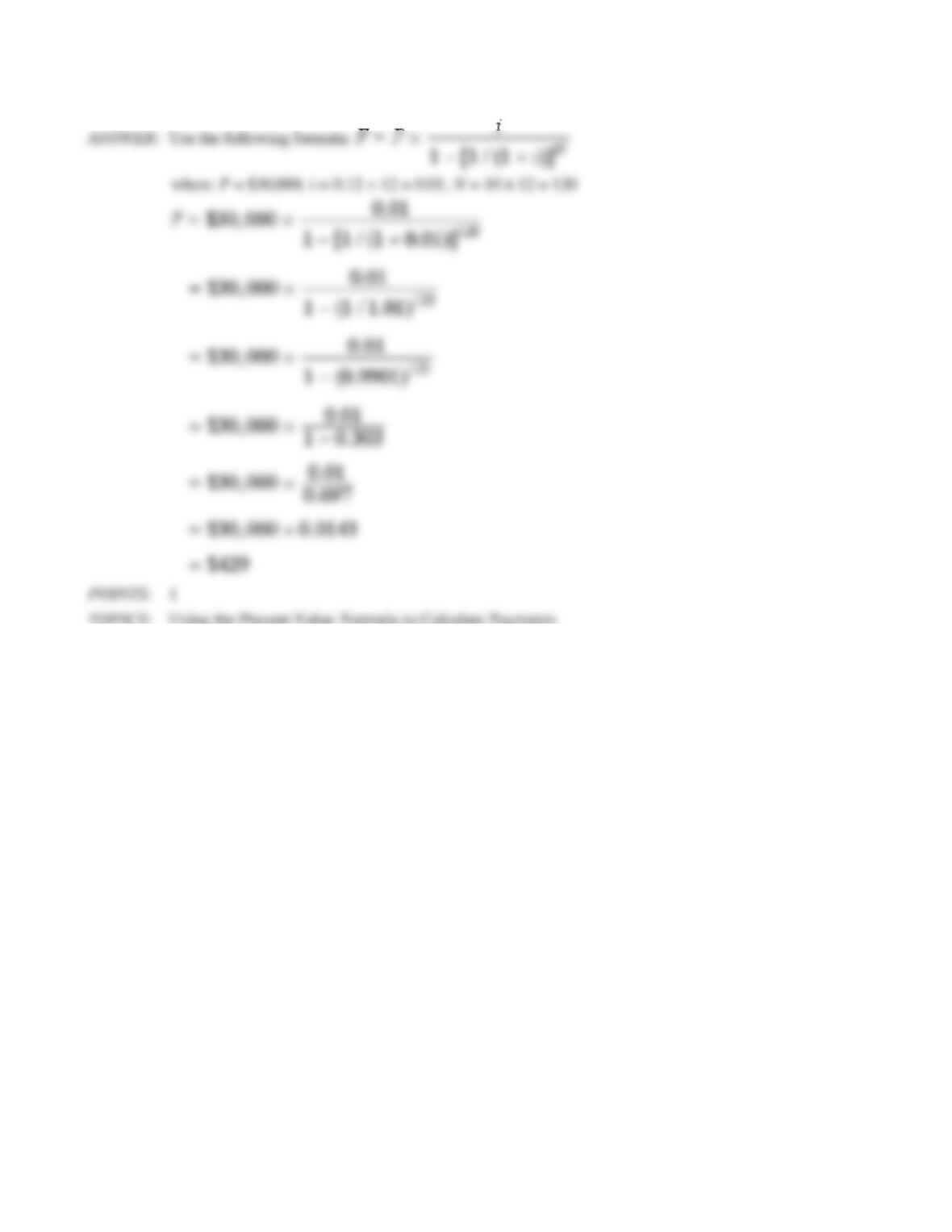
66. You borrow $30,000 for 10 years to pay tuition and fees. The annual interest rate is 12 percent. What monthly
payment would be required to pay off the loan?
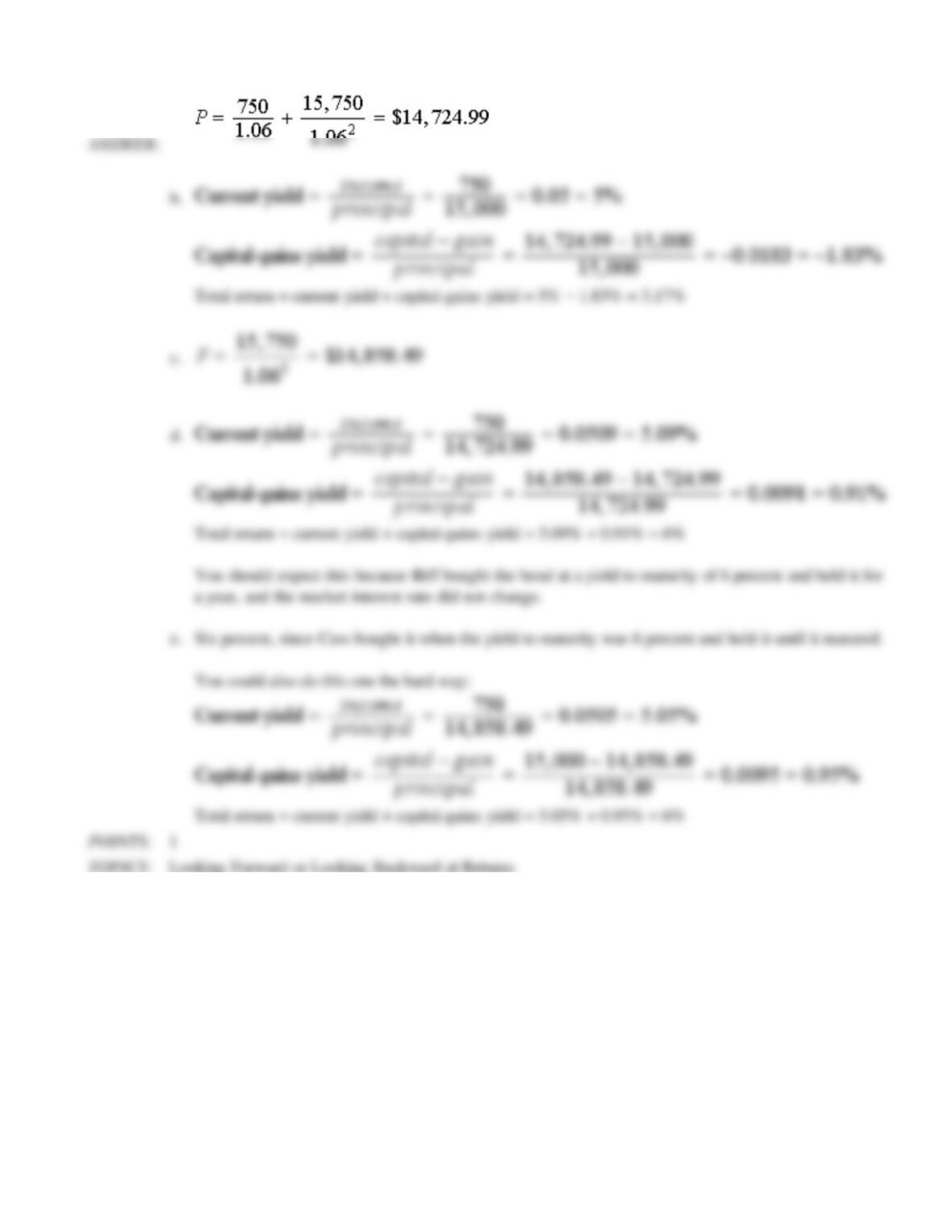
67. On September 1, 2012, Al buys a bond for $15,000 that makes coupon payments of $750 after each of the following
three years and returns its principal of $15,000 at the end of the three years. In other words, it is a standard coupon
bond with a 5 percent annual interest rate making payments once each year.
On September 1, 2013, Al receives his first coupon payment of $750. At that time, the market interest rate on bonds
like Al’s has risen to 6 percent. Al sells his bond to Biff at that time, for a price equal to the present value of the
bond’s payments.
a. How much does Biff pay Al for the bond?
b. Calculate Al’s current yield, capital-gains yield, and total return for the year.
On September 1, 2014, Biff receives a coupon payment of $750. The market interest rate on bonds like his remains 6
percent. Biff sells his bond to Cass at that time, for a price equal to the present value of the bond’s payments.
c. How much does Cass pay Biff for the bond?
d. Calculate Biff’s current yield, capital-gains yield, and total return for the year.
On September 1, 2015, Cass receives a coupon payment of $750 and the principal of $15,000. Over the course of
the year (between September 1, 2014, and September 1, 2015), the market interest rate on bonds like his rose to 7
percent. But Cass decided to keep the bond.
e. What is Cass’s total return for the year?
Explain and show all your work for each part.
a.
68. On February 1, 2013, Janet buys a bond for $10,000 that makes coupon payments of $600 after each of the following
two years and returns its principal of $10,000 at the end of the second year. In other words, it is a standard coupon
bond with a 6 percent annual interest rate making payments once each year.
On February 1, 2014, Janet receives her first coupon payment of $600. At that time, the market interest rate on
bonds like hers has fallen to 4 percent. She sells her bond to Justin at that time, for a price equal to the present value
of the bond’s payments.
a. How much does Justin pay Janet for the bond?
Both Janet and Justin have tax rates of 30 percent on interest income and 20 percent on capital gains. (Note that if
someone has a capital loss, you may assume that he or she can reduce taxes by the amount of the capital loss times
the tax rate of 20 percent.)
b. Calculate Janet’s after-tax rate of return for the past year (from Feb. 1, 2013, to Feb. 1,
2014).
Justin holds onto the bond from February 1, 2014, to February 1, 2015, so it matures and he receives the second
coupon payment and the principal.
c. What is Justin‘s after-tax rate of return for the year from Feb. 1, 2014, to Feb. 1, 2015?
Explain and show all your work for each part. You may assume, of course, that the market works and does not
malfunction.
a. The bond has one year left to maturity, which pays interest of $600 and repays principal of