Chapter 04 – Future Value, Present Value, and Interest Rates
Multiple Choice Questions
1. A promise of a $100 payment to be received one year from today is:
A. More valuable than receiving the payment today
2. The future value of $100 at a 5% per year interest rate at the end of one year is:
D. 107.50
3. Credit:
D. First became popular due to the writings of Aristotle
Chapter 04 – Future Value, Present Value, and Interest Rates
4. Which of the following expresses 5.65%?
A. 0.565
D. 0.485
6. Which of the following expresses 5.5%?
A. 0.0055
Chapter 04 – Future Value, Present Value, and Interest Rates
7. If the interest rate is zero, a promise to receive a $100 payment one year from now is:
A. More valuable than receiving $100 today
8. If a saver has a positive rate of time preference then the present value of $100 to be
received 1 year from today is:
A. more than $100
9. Which of the following best expresses the proceeds a lender receives from a one-year
simple loan when the annual interest rate equals i?
Chapter 04 – Future Value, Present Value, and Interest Rates
10. Suppose Tom receives one-year loan from ABC Bank for $5000.00. At the end of the
year, Tom repays $5400.00 to ABC Bank. Assuming the simple calculation of interest, the
interest rate on Tom’s loan was:
D. 20%
11. Suppose Mary receives an $8,000 loan from First National Bank. Mary repays $8,480 to
First National Bank at the end of one year. Assuming the simple calculation of interest, the
interest rate on Mary’s loan was:
12. An investor deposits $400 into a bank account that earns an annual interest rate of 8%.
Based on this information, how much interest will he earn during the second year alone?
A. $25.60
Chapter 04 – Future Value, Present Value, and Interest Rates
4-5
13. Compound interest means that:
D. Interest rates will rise on larger loans
14. Which of the following best expresses the payment a saver receives for investing their
money for two years?
15. Suppose a family wants to save $60,000 for a child’s tuition. The child will be attending
college in 18 years. For simplicity, assume the family is saving for a one-time college tuition
payment. If the interest rate is 6%, then about how much does this family need to deposit in
D. $57,000
Chapter 04 – Future Value, Present Value, and Interest Rates
16. Which of the following best expresses the payment a lender receives for lending money
for three years?
D. FV/ (1 + i)3
17. Suppose Paul borrows $4000 for one year from his grandfather who charges Paul 7%
interest. At the end of the year Paul will have to repay his grandfather:
D. $4,820
Chapter 04 – Future Value, Present Value, and Interest Rates
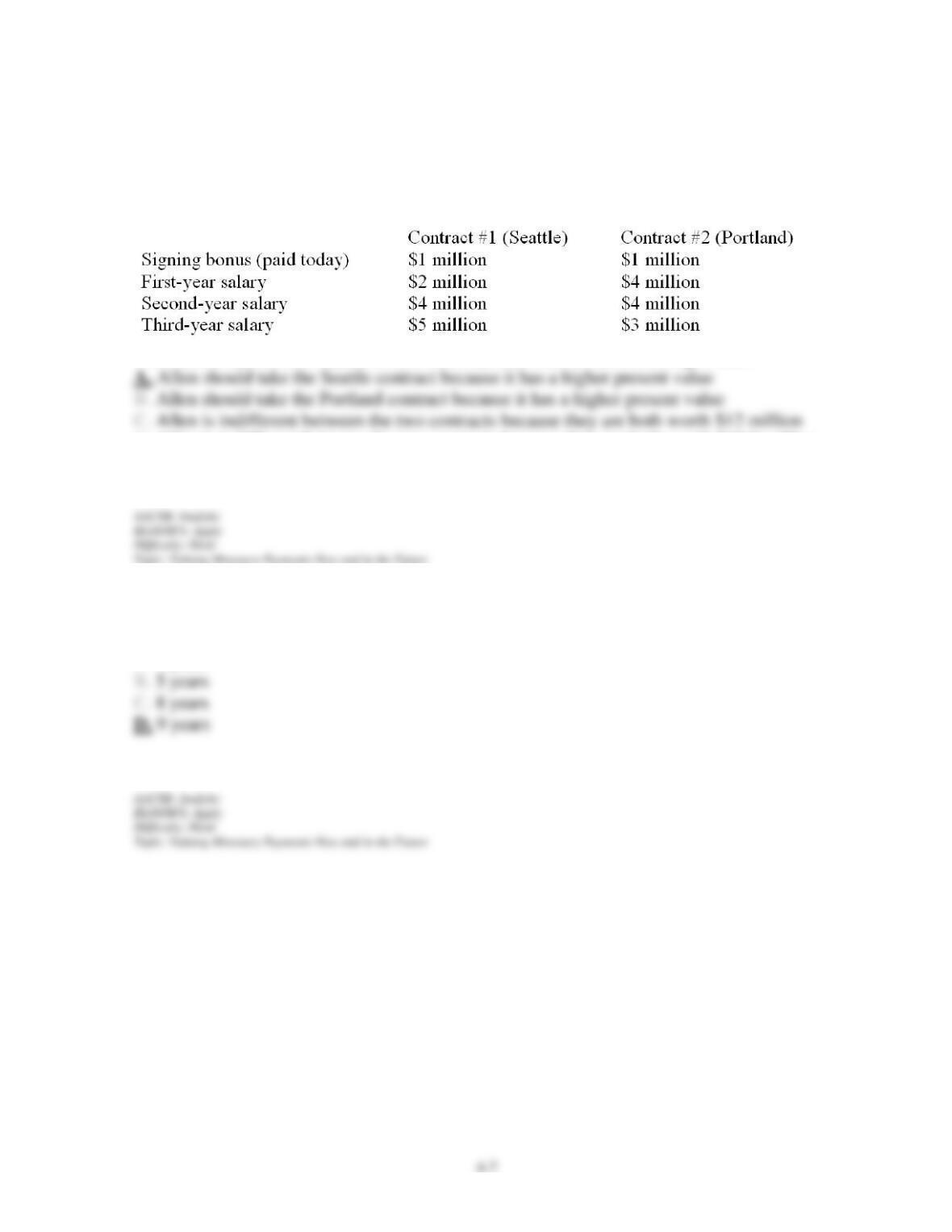
18. Suppose that Ray Allen, a basketball player for the Seattle Supersonics, will become a
free agent at the end of this NBA season. Suppose that Allen is considering two possible
contracts from different teams. Note that the salaries are paid at the end of EACH year.
The interest rate is 10%. Based on this information, which of the following is true?
D. Allen is indifferent between the two contracts because they are both worth $10.9 million
19. Farou invests $2,000 at 8% interest. About how long will it take for Farou to double his
investment (e.g., to have $4,000)?
A. 4 years
Chapter 04 – Future Value, Present Value, and Interest Rates
20. A lender is promised a $100 payment (including interest) one year from today. If the
lender has a 6% opportunity cost of money, he/she should be willing to accept what amount
today?
A. $100.00
21. A saver knows that if she put $95 in the bank today she will receive $100 from the bank
one year from now, including the interest she will earn. What is the interest rate she is
earning?
A. 5.10%
22. Tom deposits funds in his savings account at the bank which is paying 3.5% interest. If he
keeps his funds in the bank for one year he will have $155.25. What amount is Tom
depositing?
D. $147.50
Chapter 04 – Future Value, Present Value, and Interest Rates
23. Mary deposits funds into a CD at her bank. The CD has an annual interest of 4.0%. If
Mary leaves the funds in the CD for two years she will have $540.80. What amount is Mary
depositing?
A. $520.00
24. Mary deposits funds into a CD at her bank. The CD has an annual interest of 4.0%. If
Mary leaves the funds in the CD for two years she will have $540.80. Assuming no penalties
for withdrawing the funds early, what amount would Mary have at the end of one year?
A. $521.60
25. Sharon deposits $150.00 in her savings account at the bank. At the end of one year she has
D. 5.63%
Chapter 04 – Future Value, Present Value, and Interest Rates
26. The value of $100 left in a savings account earning 5% a year, will be worth what amount
after ten years?
27. The value of $100 left in a certificate of deposit for four years that earns 4.5% annually
will be:
D. $145.00
28. The future value of $100 that earns 10% annually for n years is best expressed by which
of the following?
Chapter 04 – Future Value, Present Value, and Interest Rates
29. The future value of $200 that is left in account earning 6.5% interest for three years is best
expressed by which of the following?
30. Which of the following best expresses the future value of $100 left in a savings account
D. $100(1.035)3/2
31. Which of the following best expresses the present value of $500 that you have to wait four
years and three months to receive?
A. ($500/4.25) x (1+i)
Chapter 04 – Future Value, Present Value, and Interest Rates
32. If 10% is the annual rate, considering compounding, the monthly rate is:
A. 0.0833%
33. What is the future value of $1000 after six months earning 12% annually?
A. $1050.00
34. In reading the national business news, you hear that mortgage rates increased by 50 basis
points. If mortgage rates were initially at 6.5%, what are they after this increase?
D. 56.5%
Chapter 04 – Future Value, Present Value, and Interest Rates
35. One hundred basis points could be expressed as:
D. 0.10%
36. The decimal equivalent of a basis point is:
D. 0.01
37. According to the rule of 72:
D. The interest rate divided by the number of years invested will always equal 72%
Chapter 04 – Future Value, Present Value, and Interest Rates
38. The rule of 72 says that at 6% interest $100 should become $200 in about:
A. 72 months
39. What is the present value of $200 promised two years from now at 5% annual interest?
A. $190.00
40. What is the present value of $100 promised one year from now at 10% annual interest?
A. $89.50
Chapter 04 – Future Value, Present Value, and Interest Rates
D. $520.00
42. The higher the future value of the payment:
D. The lower the present value because the interest rate must fall
D. The higher must be the interest rate
Chapter 04 – Future Value, Present Value, and Interest Rates
44. The lower the interest rate, i:
A. The lower is the present value
45. Doubling the future value will cause:
A. The present value to fall by half
46. Doubling the future value will cause:
D. The interest rate, i, to decrease
Chapter 04 – Future Value, Present Value, and Interest Rates
47. The present value and the interest rate have:
D. No relationship
48. At any fixed interest rate, an increase in time, n, until a payment is made:
A. Increases the present value
49. A change in the interest rate:
A. Has a smaller impact on the present value of a payment to be made far into the future than
on one to be made sooner
Chapter 04 – Future Value, Present Value, and Interest Rates
50. A monthly growth rate of 0.5% is an annual growth rate of:
A. 6.00%
51. A monthly growth rate of 0.6% is an annual growth rate of:
A. 7.20%
52. A monthly interest rate of 1% is a compounded annual rate of:
A. 12.00%
Chapter 04 – Future Value, Present Value, and Interest Rates
53. An investment has grown from $100.00 to $130.00 or by 30% over four years. What
annual increase gives a 30% increase over four years?
54. An investment grows from $100.00 to $150.00 or 50% over five years. What annual
increase gives a 50% increase over five years?
A. 12.00%
55. The “coupon rate” is:
D. The total amount of interest payments made on a bond as a percentage of the amount
borrowed
Chapter 04 – Future Value, Present Value, and Interest Rates
56. Higher savings usually requires higher interest rates because:
D. Of the rule of 72
57. The internal rate of return of an investment is:
A. The same as return on investment
58. If the internal rate of return from an investment is more than the opportunity cost of
funds:
D. The firm should only make part of the investment and wait to see if interest rates decrease