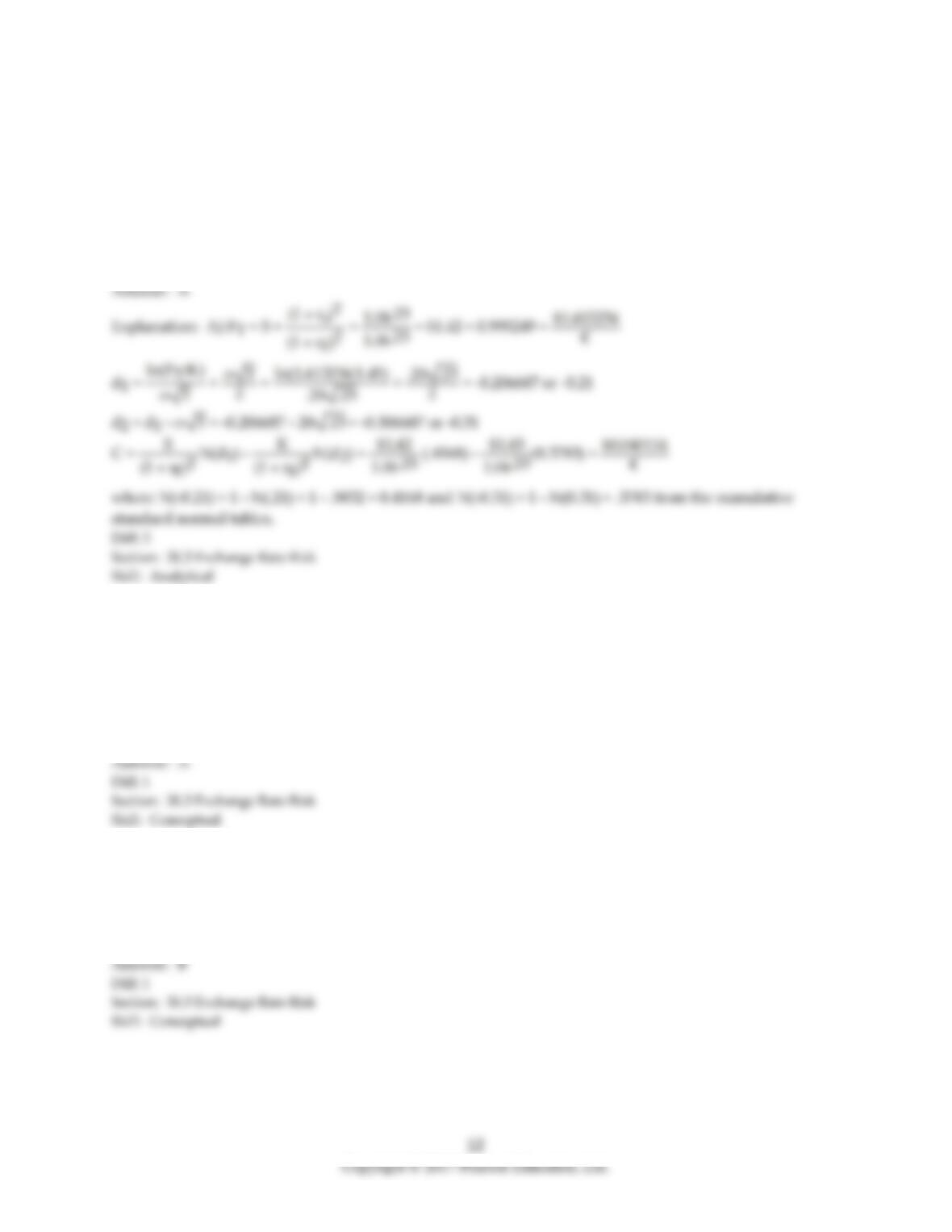
2) Suppose the current exchange rate is $1.42/€, the interest rate in the United States is 4.0%, the interest
rate in the EU is 6%, and the volatility of the $/€ exchange rate is 20%. Using the Black-Scholes
formula, the price of a three–month European call option on the Euro with a strike price of $1.45/€ will
be closest to:
A) $0.040/€
B) $0.059/€
C) $0.078/€
D) $0.097/€
3) Like most foreign exchange rates, the dollar/euro rate is a floating rate, which means it changes
constantly depending on the quantity supplied and demanded for each currency in the market. The
supply and demand for each currency is driven directly by all of the following factors EXCEPT:
A) relative inflation.
B) firms trading goods.
C) investors trading securities.
D) the actions of central banks in each country.
4) A currency forward contract specifies all of the following EXCEPT:
A) the amount of currency to exchange.
B) the spot exchange rate.
C) the delivery date on which the exchange will take place.
D) the currencies to be exchanged.
5) The cash-and-carry strategy consists of all of the following simultaneous trades EXCEPT:
A) borrow euros today using a one-year loan with the interest rate r€.
B) exchange the euros for dollars today at the spot exchange rate S $/€.
C) purchase a forward contract to convert $ to €.
D) invest the dollars today for one year at the interest rate r$.
6) Which of the following statements is FALSE?
A) The most common method firms use to reduce the risk that results from changes in exchange rates is
to hedge the transaction using currency forward contracts.
B) Fluctuating exchanges rates cause a problem known as the importer—exporter dilemma for firms
doing business in international markets.
C) Exchange rate risk naturally arises whenever transacting parties use different currencies: Both of the
parties will be at risk if exchange rates fluctuate.
D) Because the supply and demand for currencies varies with global economic conditions, exchange
rates are volatile.
7) Which of the following statements is FALSE?
A) The covered interest parity equation states that the difference between the forward and spot
exchange rates is related to the interest rate differential between the currencies.
B) By entering into a currency forward contract, a firm can lock in an exchange rate in advance and
reduce or eliminate its exposure to fluctuations in a currency’s value.
C) When the interest rate differs across countries, investors have an incentive to borrow in the low–
interest rate currency and invest in the high interest rate currency.
D) A currency forward is usually written between two firms, and it fixes a currency exchange rate for a
transaction that will occur at a future date.
8) Which of the following statements is FALSE?
A) Currency options allow firms to lock in a future exchange rate; currency forward contracts allow
firms to insure themselves against the exchange rate moving beyond a certain level.
B) Generally speaking, cash-and-carry strategies are used primarily by large banks, which can borrow
easily and face low transaction costs.
C) Currency options, like stock options, give the holder the right—but not the obligation—to exchange
currency at a given exchange rate.
D) Many managers want the firm to benefit if the exchange rate moves in their favor, rather than being
stuck paying an above-market rate.
9) Which of the following statements regarding currency options is FALSE?
A) Firms often prefer forward contracts to currency options if the transaction they are hedging might
not take place.
B) Currency options are another method that firms commonly use to manage exchange rate risk.
Currency options, like stock options, give the holder the right—but not the obligation—to exchange
currency at a given exchange rate.
C) Currency forward contracts allow firms to lock in a future exchange rate; currency options allow
firms to insure themselves against the exchange rate moving beyond a certain level.
D) Many managers want the firm to benefit if the exchange rate moves in their favor, rather than being
stuck paying an above-market rate.
10) In December 2005, the spot exchange rate for the British Pound was $1.7188/£. Suppose that at the
same time the one-year interest rate in the United States was 4.85% and the one-year interest rate in
Great Britain was 3.15%. Based on these rates, what forward exchange rate is consistent with no
arbitrage?
A) $1.6909/£
B) $1.7471/£
C) $1.1163/£
D) $2.6464/£
11) In December 2005, the spot exchange rate for the British Pound was $1.7188/£ and the one-year
forward rate was $1.8675/£. Suppose that at the same time Luther Industries entered into a contract to
purchase goods with a price of £375,000 to be delivered in one year. Simultaneously Luther entered into
a one-year forward contract to purchase £375,000. At the time the contract payment was due, the spot
exchange rate was $1.9975/£. What is the amount of the payment in U.S. dollars that Luther Industries
paid?
A) $700,312.50
B) $644,550.00
C) $749,062.50
D) $200,803.20
12) In June 2016, the spot exchange rate for the British Pound was $1.4255/£ . Suppose that at the same
time Luther Industries entered into a contract to purchase goods with a price of £400,000 to be delivered
in one year. There is a one-year option call contract available to Luther which will allow the company
to purchase £10,000 for $1.50/£. If Luther purchases 40 option contracts, and the spot rate at the time the
contract is due is $1.8725/£, how much will Luther pay for the goods?
A) $570,200.00
B) $266,666.70
C) $600,000.00
D) $749,000.00
13) In June 2016, the spot exchange rate for the British Pound was $1.4255/£ . Suppose that at the same
time Luther Industries entered into a contract to purchase goods with a price of £400,000 to be delivered
in one year. There is a one-year call option contract available to Luther which will allow the company
to purchase £10,000 for $1.50/£. If Luther purchases 40 option contracts, and the spot rate at the time the
contract is due is $1.3465/£, how much will Luther pay for the goods?
A) $570,200.00
B) $538,600.00
C) $600,000.00
D) $749,000.00
14) In December 2005, the spot exchange rate for the British Pound was $1.7188/£. Suppose that at the
same time the one-year interest rate in the United States was 4.85% and the one-year interest rate in
Great Britain was 3.15%. Based on these rates, what forward exchange rate is consistent with no
arbitrage.
15) In December 2005, the spot exchange rate for the British Pound was $1.7188/£ and the one-year
forward rate was $1.8675/£. Suppose that at the same time Luther Industries entered into a contract to
purchase goods with a price of £375,000 to be delivered in one year. Simultaneously Luther entered into
a one-year forward contract to purchase £375,000. What is the amount of the payment in U.S. dollars
that Luther Industries will have to make in one year to pay for their goods?
30.4 Interest Rate Risk
Use the following information to answer the question(s) below.
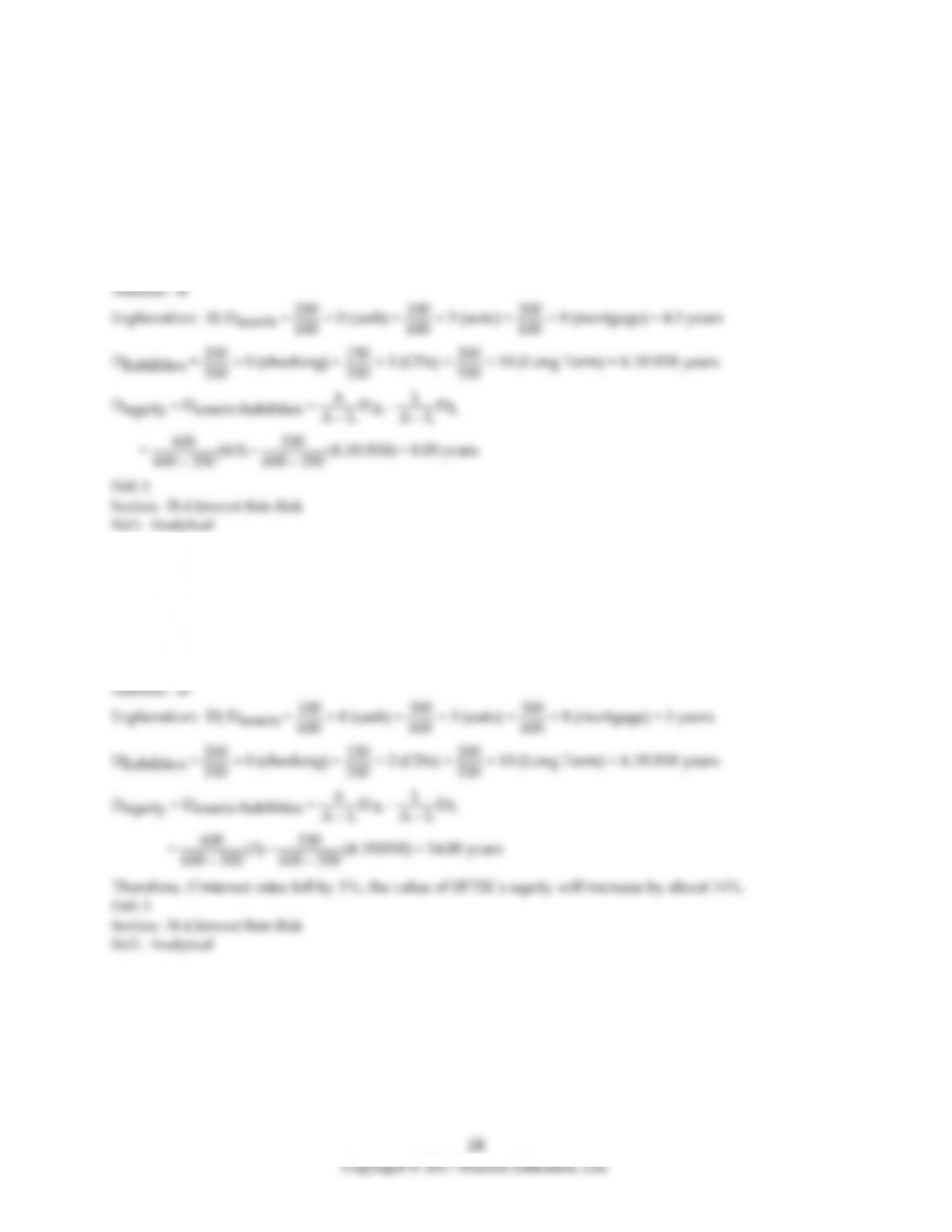
You are a risk manager for Security First Trust Savings and Loan (SFTSL). SFTSL’s balance sheet is as
follows (in millions of dollars):
The duration of the auto loans is three years and the duration of the mortgages is eight years. Both cash
reserves and checking and savings have zero duration. The CDs have a duration of two years and the
long-term financing has a ten year duration.
1) The duration of SFTSL’s equity is closest to:
A) 6 years
B) 8 years
C) 10 years
D) 14 years
2) Because of a new program called Kash for Klunkers, SFTSL experiences a rash of auto loan
prepayments, reducing the size of the auto loan portfolio from $200 million to $100 million and
increasing the cash reserves to $200 million. After these prepayments, the duration of SFTSL’s equity is
closest to:
A) 6 years
B) 8 years
C) 10 years
D) 14 years
3) If interest rates are currently 5%, but fall to 4%, your estimate of the approximate change in SFTSL
equity is closest to:
A) 8% decrease
B) 12% decrease
C) 8% increase
D) 14% increase
4) Which of the following statements is FALSE?
A) We can measure a firm’s sensitivity to interest rates by computing the duration of its balance sheet.
B) Just as the interest rate sensitivity of a single cash flow increases with its maturity, the interest rate
sensitivity of a stream of cash flows increases with its duration.
C) By restructuring the balance sheet to increase its duration, we can hedge the firm’s interest rate risk.
D) A firm’s market capitalization is determined by the difference in the market value of its assets and its
liabilities.
5) Which of the following statements is FALSE?
A) As interest rates change, the market values of the securities and cash flows in the portfolio change as
well, which in turn alters the weights used when computing the duration as the value–weighted average
maturity.
B) The duration of a portfolio of investments is the simple average of the durations of each investment
in the portfolio.
C) Adjusting a portfolio to make its duration neutral is sometimes referred to as immunizing the
portfolio, a term that indicates it is being protected against interest rate changes.
D) When the durations of a firm’s assets and liabilities are significantly different, the firm has a duration
mismatch.
6) Which of the following statements is FALSE?
A) Interest rate swaps are an alternative means of modifying the firm‘s interest rate risk exposure
without buying or selling assets.
B) A portfolio with a negative duration is called a duration-neutral portfolio or an immunized portfolio,
which means that for small interest rate fluctuations, the value of equity should remain unchanged.
C) Maintaining a duration-neutral portfolio will require constant adjustment as interest rates change.
D) A duration-neutral portfolio is only protected against interest rate changes that affect all yields
identically.
7) Which of the following statements is FALSE?
A) The swap contract—like forward and futures contracts—is typically structured as a “zero-cost”
security.
B) An interest rate swap is a contract entered into with a bank, much like a forward contract, in which
the firm and the bank agree to exchange the coupons from two different types of loans.
C) In a standard interest rate swap, one party agrees to pay coupons based on a fixed interest rate in
exchange for receiving coupons based on the prevailing market interest rate during each coupon period.
D) If short-term interest rates were to fall while long-term rates remained stable, then short-term
securities would fall in value relative to long-term securities, despite their shorter duration.
8) Which of the following statements is FALSE?
A) Corporations use interest rate swaps routinely to alter their exposure to interest rate fluctuations.
Firms can use interest rate swaps with duration-hedging strategies.
B) The value of a swap, while initially zero, will fluctuate over time as interest rates change.
C) An interest rate that adjusts to current market conditions is called a floating rate.
D) When interest rates rise, the swap’s value will rise for the party receiving the fixed rate; conversely, it
will fall for the party paying the fixed rate.
9) What is the duration of a five-year zero-coupon bond?
A) 2.5 Years
B) 1 Year
C) 5 Years
D) 0 Years
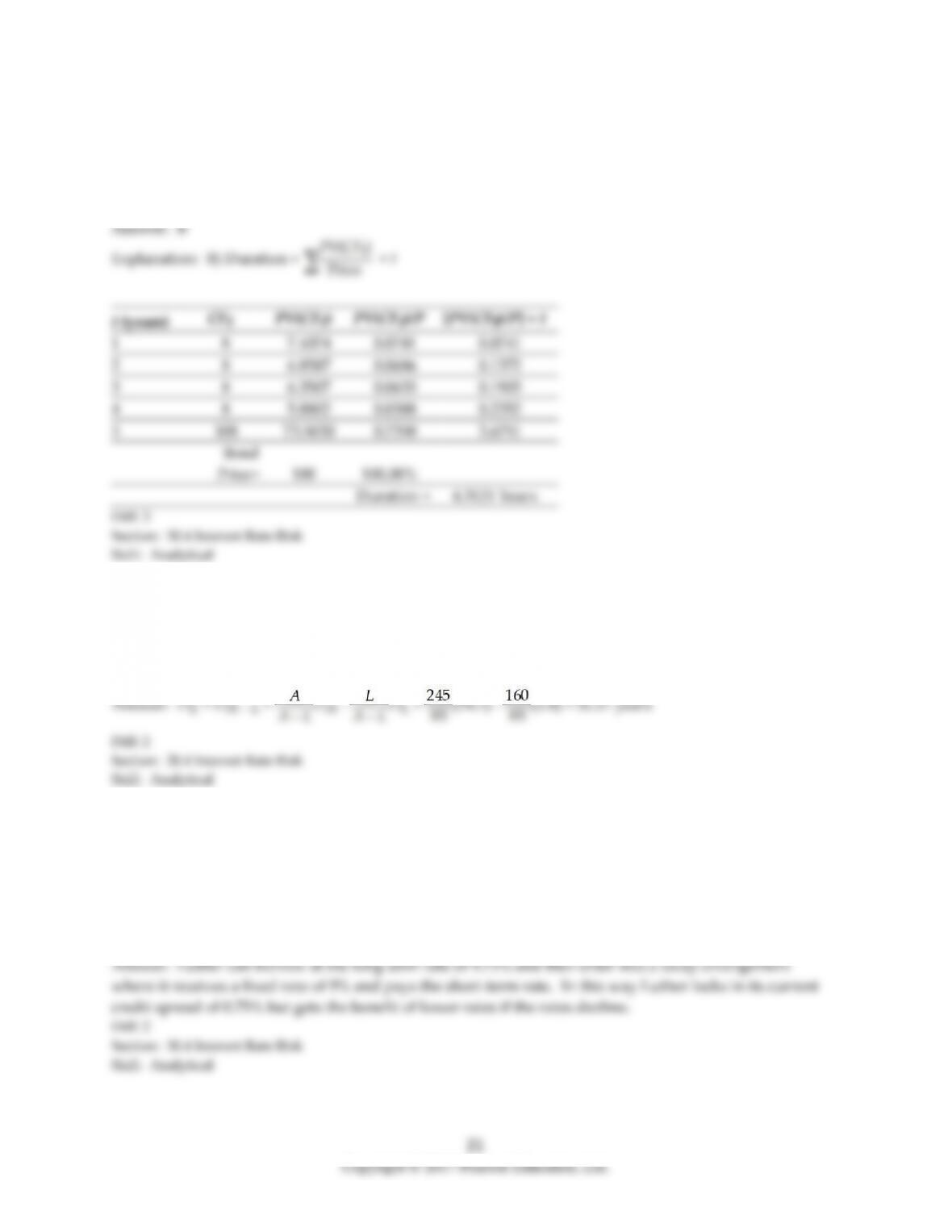
10) The duration of a five-year bond with 8% annual coupons trading at par is closest to:
A) 2.5 Years
B) 4.3 Years
C) 5.0 Years
D) 6.2 Years
11) The Century 22 fund has invested in a portfolio of mortgaged backed securities that has a current
market value of $245 million. The duration of this portfolio of mortgaged back securities is 14.7 years.
The fund has borrowed to purchase these securities, and the current value of its liabilities (i.e., the
current value of the bonds Century 22 has issued) is $160 million. The duration of these liabilities is 5.4
years. What is the initial duration of the equity for the Century 22 fund?
12) Luther Industries needs to borrow $50 million in cash. Currently long–term AAA rates are 9%.
Luther can borrow at 9.75% given its current credit rating. Luther is expecting interest rates to fall over
the next few years, so it would prefer to borrow at the short-term rates and refinance after rates have
dropped. Luther management is afraid, however, that its credit rating may fall which could greatly
increase the spread the firm must pay on new borrowings. How can Luther benefit from the expected
decline in future interest rates without exposure to the risk of the potential future changes to its credit
ratings bring?