19) Assume that Martin pays no premium to acquire Luther. Calculate Martin’s price–earnings (P/E)
ratio both pre and post merger.
28.4 Valuation and the Takeover Process
Use the following information to answer the question(s) below.
Rearden Metal has earnings per share of $2. It has 10 million shares outstanding and is trading at $20
per share. Rearden Metal is thinking of buying Associated Steel, which has earnings per share of $1.25, 4
million shares outstanding, and a price per share of $15. Rearden Metal will pay for Associated Steel by
issuing new shares. There are no expected synergies from the transaction.
1) If Rearden offers an exchange ratio such that, at current pre-announcement share prices for both
firms, the offer represents a 20% premium to buy Associated Steel, then the price per share of the
combined corporation after the merger will be closest to:
A) $19.12
B) $20.00
C) $26.00
D) $17.20
2) If Rearden offers an exchange ratio such that, at current pre-announcement share prices for both
firms, the offer represents a 20% premium to buy Associated Steel, then the price per share of the
Rearden immediately after the announcement will be closest to:
A) $15.00
B) $17.20
C) $18.60
D) $19.10
3) If Rearden offers an exchange ratio such that, at current pre-announcement share prices for both
firms, the offer represents a 20% premium to buy Associated Steel, then the price per share of
Associated Steel immediately after the announcement will be closest to:
A) $15.00
B) $17.20
C) $18.60
D) $19.10
4) If Rearden offers an exchange ratio such that, at current pre-announcement share prices for both
firms, the offer represents a 20% premium to buy Associated Steel, then actual premium Rearden will
pay will be closest to:
A) 14.7%
B) 18.0%
C) 20.0%
D) 22.4%

5) Taggart Transcontinental and Phoenix-Durango have entered into a stock swap merger agreement
whereby Taggart will pay a 30% premium over Phoenix-Durango’s premerger price. If Taggart’s
premerger price per share was $15 and Phoenix–Durango’s was $30, then the exchange ratio that
Taggart will offer is closest to:
A) 0.4:1
B) 1.8:1
C) 2.0:1
D) 2.6:1
6) Consider the following equation:
<
The term A in this equation refers to:
A) the premerger, or standalone, value of the acquirer.
B) new shares to pay for the target.
C) the value of the synergies created by the merger.
D) the premerger (standalone) value of the target.
7) Consider the following equation:
<
The term S in this equation refers to:
A) the premerger (standalone) value of the target.
B) the premerger, or standalone, value of the acquirer.
C) the value of the synergies created by the merger.
D) new shares to pay for the target.

8) Consider the following equation:
<
The term x in this equation refers to:
A) the value of the synergies created by the merger.
B) the premerger, or standalone, value of the acquirer.
C) new shares to pay for the target.
D) the premerger (standalone) value of the target.
9) Consider the following equation:
<
The term T in this equation refers to:
A) the premerger, or standalone, value of the acquirer.
B) the value of the synergies created by the merger.
C) the premerger (standalone) value of the target.
D) new shares to pay for the target.
10) Which of the following statements is FALSE?
A) The method of payment (cash or stock) affects how the value of the target’s assets is recorded for tax
purposes and it affects the combined firm’s financial statements for financial reporting.
B) The combined firm must mark up the value assigned to the target’s assets on the financial statements
by allocating the purchase price to target assets according to their fair market value.
C) Any goodwill created in a merger deal can be amortized for tax purposes over 15 years.
D) Many transactions are carried out as acquisitive reorganizations under the tax code. These structures
allow the target shareholders to defer their tax liability on the part of the payment made in acquirer
stock but they do not allow the acquirer to step up the book value of the target assets.
11) Which of the following statements is FALSE?
A) Any acquirer shares received in full or partial exchange for target shares triggers an immediate tax
liability for target shareholders.
B) In a friendly takeover, the target board of directors supports the merger, negotiates with potential
acquirers, and agrees on a price that is ultimately put to a shareholder vote.
C) How the acquirer pays for the target affects the taxes of both the target shareholders and the
combined firm.
D) If the acquirer purchases the target assets directly (rather than the target stock), then it can step up
the book value of the target’s assets to the purchase price.
12) Which of the following statements regarding risk arbitrage is FALSE?
A) Once a tender offer is announced, the uncertainty about whether the takeover will succeed reduces
the volatility of the stock price. This uncertainty creates an opportunity for investors to speculate on the
outcome of the deal without bearing the risk of volatility.
B) Traders known as risk-arbitrageurs, who believe that they can predict the outcome of a deal, take
positions based on their beliefs.
C) A potential profit arises from the difference between the target’s stock price and the implied offer
price, and is referred to as the merger-arbitrage spread.
D) It is not true arbitrage because there is a risk that the deal will not go through. If the takeover did not
ultimately succeed, the risk-arbitrageur would eventually have to unwind his position at whatever
market prices prevailed.
13) Which of the following statements is FALSE?
A) Once the acquirer has completed the valuation process, it is in the position to make a tender offer –
that is, a public announcement of its intention to purchase a large block of shares for a specified price.
B) If we view the pre–bid market capitalization as the stand-alone value of the target, then from the
bidder’s perspective, the takeover is a positive-NPV project only if the synergies created do not exceed
the premium it pays.
C) Purchasing a corporation usually constitutes a very large capital investment decision, so it requires a
more accurate estimate of value that includes careful analysis of both operational aspects of the firm and
the ultimate cash flows the deal will generate.
D) A stock-swap merger is a positive-NPV investment for the acquiring shareholders if the share price
of the merged firm (the acquirer’s share price after the takeover) exceeds the premerger price of the
acquiring firm.
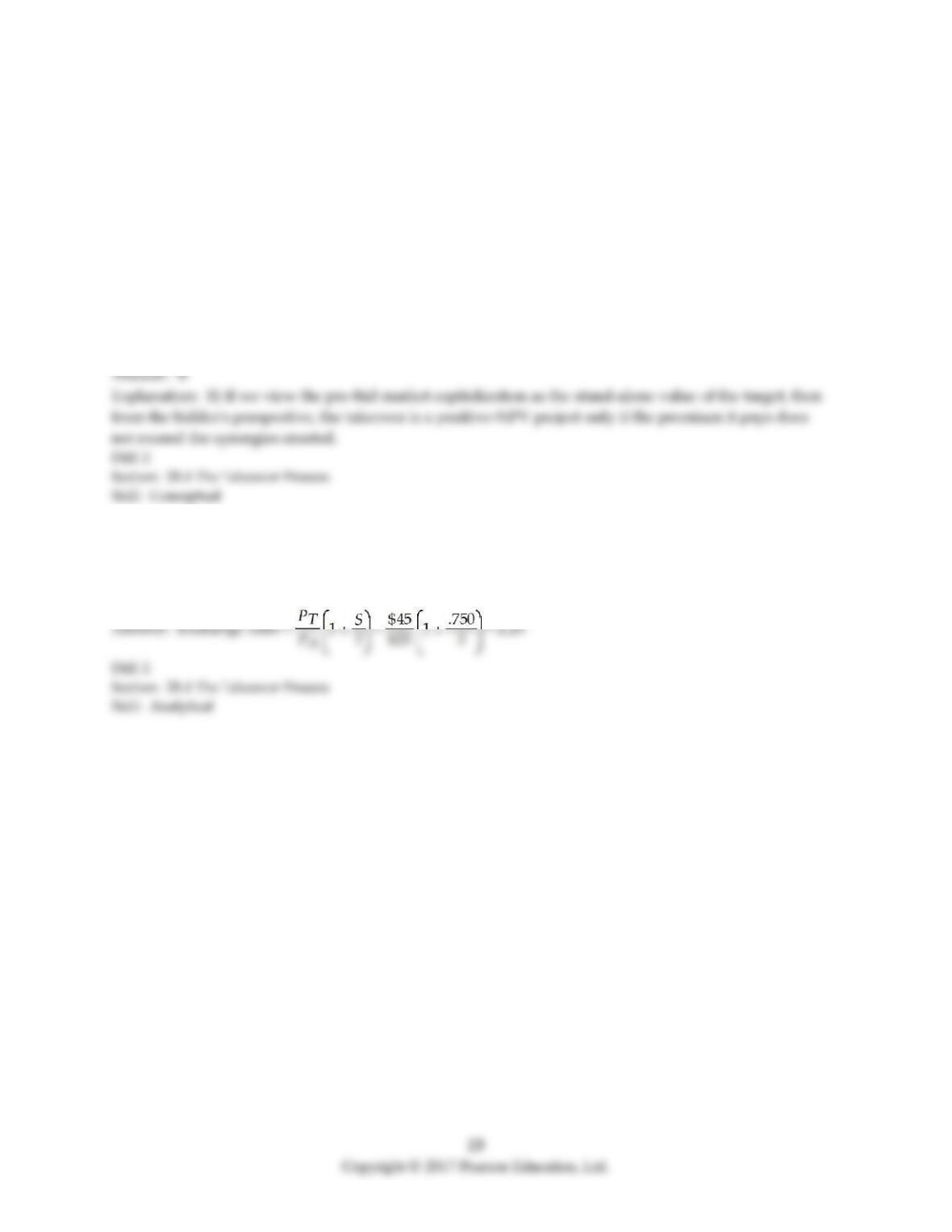
14) KT corporation has announced plans to acquire MJ corporation. KT is trading for $45 per share and
MJ is trading for $25 per share, with a premerger value for MJ of $3 billion dollars. If the projected
synergies from the merger are $750 million, what is the maximum exchange ratio that KT could offer in
a stock swap and still generate a positive NPV?

28.5 Takeover Defenses
1) A rights offering that gives existing target shareholders the right to buy shares in either the target or
the acquirer at a deeply discounted price once certain conditions are met is called a:
A) golden parachute.
B) poison pill.
C) classified board.
D) white knight.
2) A situation where every director serves a three-year term and the terms are staggered so that only
one-third of the directors are up for election each year is called a:
A) white knight.
B) classified board.
C) poison pill.
D) golden parachute.
3) When a hostile takeover appears to be inevitable, a target company will sometimes look for another,
friendlier company to acquire it called a:
A) poison pill.
B) classified board.
C) golden parachute.
D) white knight.
4) An extremely lucrative severance package that is guaranteed to a firm’s senior managers in the event
that the firm is taken over and the managers are let go is called a:
A) golden parachute.
B) white knight.
C) poison pill.
D) classified board.
5) Which of the following statements regarding poison pills is FALSE?
A) Companies with poison pills are harder to take over, and when they are taken over, the premium
that existing shareholders receive for their stock is higher.
B) Because a poison pill increases the cost of a takeover, all else equal, a target company must be in
better shape to justify the expense of waging a takeover battle.
C) Poison pills also increase the bargaining power of the target firm when negotiating with the acquirer
because poison pills make it difficult to complete the takeover without the cooperation of the target
board.
D) By adopting a poison pill, a company effectively entrenches its management by making it much
more difficult for shareholders to replace bad managers, thereby potentially destroying value.
6) What is a white knight?
7) Which of the following statements regarding recapitalization as a takeover defense is FALSE?
A) Another defense against a takeover is a recapitalization, in which a company changes its capital
structure to make itself less attractive as a target.
B) Restructuring itself can produce efficiency gains, often removing the principal motivation for the
takeover in the first place.
C) By increasing leverage on its own, the target firm can reap the benefit of the interest tax shields.
D) In many cases, a substantial portion of the synergy gains that an acquirer anticipates from a takeover
are savings from a decrease in leverage as well as other cost reductions.
28.6 Who Gets the Value Added from a Takeover?
Use the following information to answer the question(s) below.
You work for a leveraged buyout firm and are evaluating a potential buyout of Associated Steel.
Associated Steel’s stock price is $15 and it has 10 million shares outstanding. You believe that if you buy
the company and replace its management, its value will increase by 50%. You are planning on doing a
leveraged buyout of Associated Steel, and will offer $20 per share for control of the company.
1) Assuming you get 50% control of Associated Steel, then the price of the non–tendered shares will be
closest to:
A) $12.50
B) $15.00
C) $17.50
D) $20.00
2) Regarding your tender offer, shareholders will:
A) not tender their shares since the post LBO price is higher than the offer price.
B) not tender their shares since the post LBO price is higher than the current price.
C) tender their shares since the post LBO price is higher than the offer price.
D) tender their shares since the post LBO price is lower than the current price.
3) Assuming you get 50% control of Associated Steel, then your gain from this transaction will be closest
to:
A) $50.0 million
B) $65 million
C) $75 million
D) $125 million
4) Which of the following statements is FALSE?
A) SEC rules make it difficult for investors to buy much more than about 10% of a firm in secret. After
an acquirer acquires such an initial stake in the target, called a toehold, they would have to make their
intentions public by informing investors of his large stake.
B) With the availability of both the freezeout merger and the leveraged buyout as acquisition strategies,
most of the value added accrues to the acquiring shareholders.
C) The laws on tender offers allow the acquiring company to freeze existing shareholders out of the
gains from merging by forcing non-tendering shareholders to sell their shares for the tender offer price.
D) Premiums in LBO transactions are often quite substantial—while they can avoid the free-rider
problem acquirers must still get board approval to overcome other defenses such as poison pills, as well
as outbid other potential acquirers.
5) You work for a levered buyout firm and are evaluating a potential buyout of Boogle Inc. Boogle‘s
stock price is $18, and it has 3 million shares outstanding. You believe that if you buy the company and
replace its dismal management team, its value will increase by 50%. You are planning on doing a
levered buyout of Boogle and will offer $25 per share for control of the company. Assuming you get
50% control, what will your gain from the transaction be?