
Corporate Finance, 4e, Global Edition (Berk / DeMarzo)
Chapter 26 Working Capital Management
26.1 Overview of Working Capital
Consider the following information for the question(s) below.
Hammond Motors had sales of $35 million in 2009 with a cost of goods sold of $20 million. A simplified
balance sheet for Hammond appears below (amounts in $ million):
Assets
Liabilities and Equity
Cash
1.6
Accounts Payable
1.8
Accounts Receivable
4.2
Notes Payable
3.2
Inventory
3
Accruals
1.5
Current Assets
8.8
Total Current Liabilities
6.5
Long-term Debt
4
Net Property, Plant and Equipment
8.2
Total Liabilities
10.5
Stockholders’ Equity
6.5
Total Assets
17
Total Liabilities and Stockholders’ Equity
17
1) Hammond’s net working capital in 2009 is closest to:
A) $2.3 million
B) $3.8 million
C) $6.5 million
D) $10.5 million
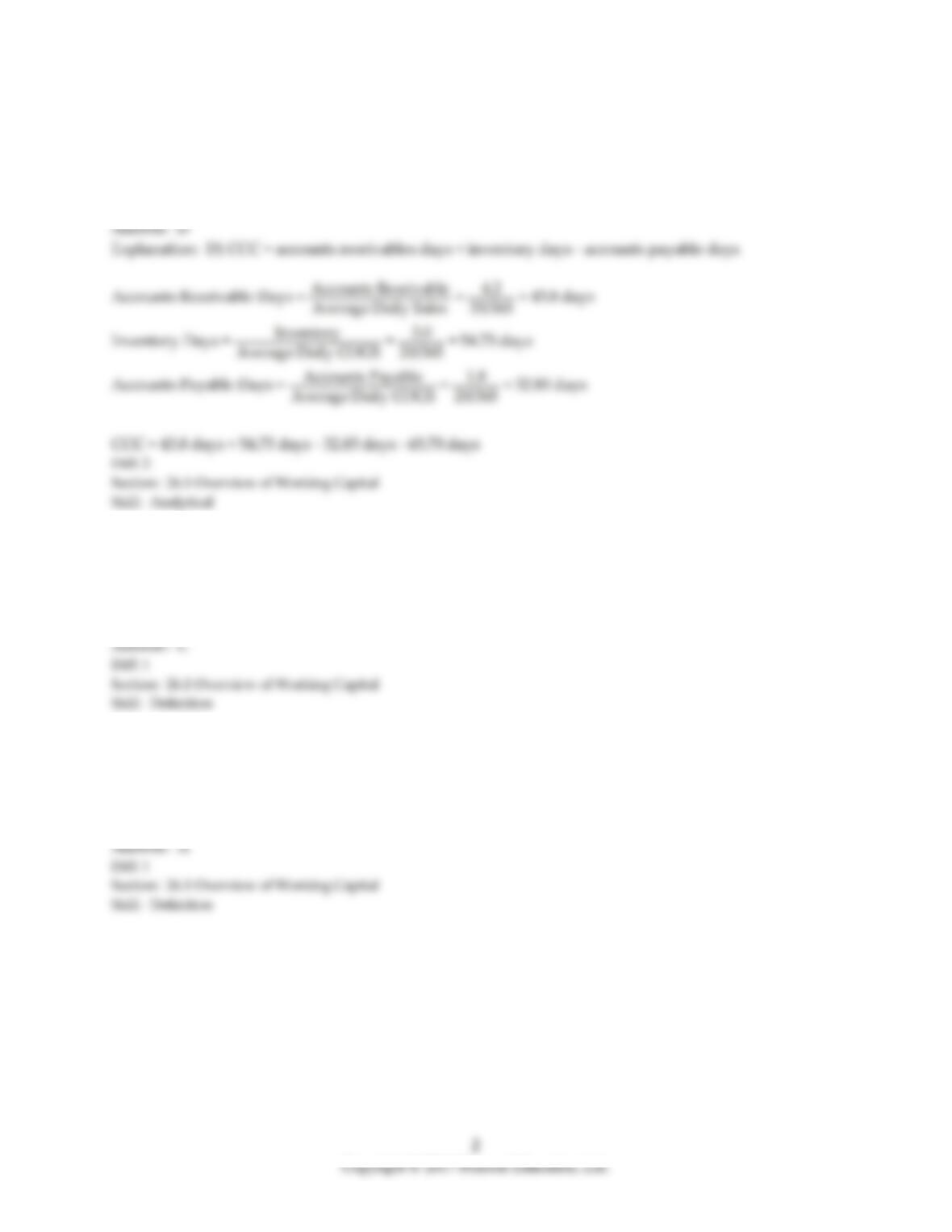
2) Hammond’s cash conversion cycle in 2009 is closest to:
A) 22 days
B) 44 days
C) 58 days
D) 66 days
3) The difference between a firm’s operating cycle and its cash cycle is:
A) there is no difference between the cash and operating cycles.
B) its account receivable days.
C) its accounts payable days.
D) its inventory days.
4) The cash conversion cycle (CCC) is defined as:
A) Inventory Days + Accounts Receivable Days – Accounts Payable Days.
B) Inventory Days – Accounts Receivable Days – Accounts Payable Days.
C) Inventory Days + Accounts Receivable Days + Accounts Payable Days.
D) Inventory Days + Accounts Payable Days – Accounts Receivable Days.
5) Which of the following statements is FALSE?
A) The main components of net working capital are cash, inventory, receivables, and payables.
B) The firm’s cash cycle is the average length of time between when a firm originally purchases its
inventory and when it receives the cash back from selling its product.
C) Working capital includes the cash that is needed to run the firm on a day-to-day basis. It does not
include excess cash, which is cash that is not required to run the business and can be invested at a
market rate.
D) If the firm pays cash for its inventory, the firm’s operating cycle is identical to the firm’s cash cycle.
6) Which of the following statements is FALSE?
A) A firm’s cash cycle is the length of time between when the firm pays cash to purchase its initial
inventory and when it receives cash from the sale of the output produced from that inventory.
B) The longer a firm’s cash cycle, the more working capital it has, and the more cash it needs to carry to
conduct its daily operations.
C) Most firms buy their inventory on credit, which increases the amount of time between the cash
investment and the receipt of cash from that investment.
D) Any reduction in working capital requirements generates a positive free cash flow that the firm can
distribute immediately to shareholders.
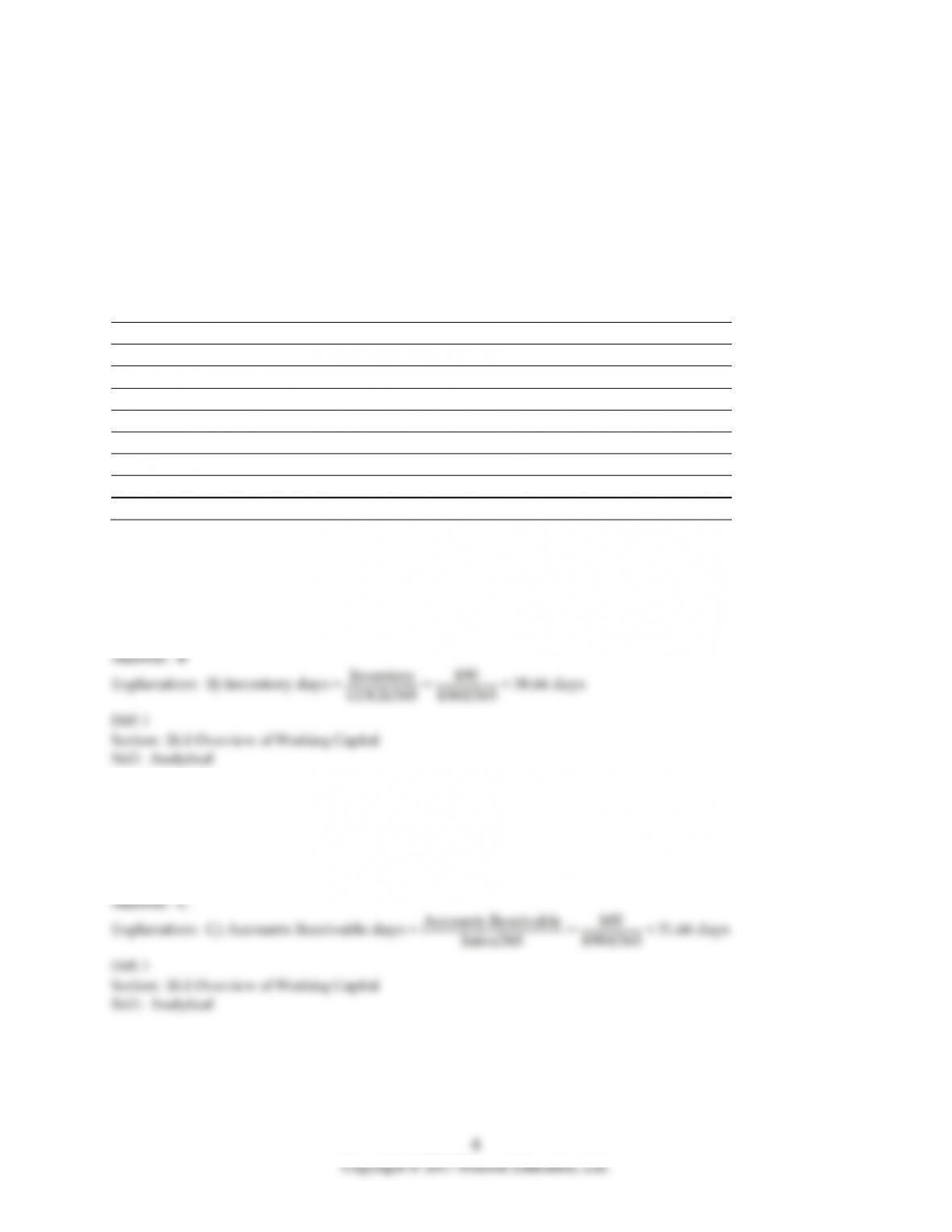
Use the table for the question(s) below.
Luther Industries had sales of $980 million and a cost of goods sold of $560 million in 2006. A
simplified balance sheet for the firm appears below:
Luther Industries
Balance Sheet
As of December 31, 2006
(millions of dollars)
Assets
Liabilities and Equity
Cash
25
Accounts payable
60
Accounts receivable
85
Notes payable
425
Inventory
90
Accruals
45
Total current assets
200
Total current liabilities
530
Net plant, property, and equipment
6100
Long term debt
2725
Total assets
6300
Total liabilities
3255
Common equity
3045
Total liabilities and equity
6300
7) Luther’s Inventory days is closest to:
A) 32 days
B) 59 days
C) 39 days
D) 42 days
8) Luther’s Accounts Receivable days is closest to:
A) 42 days
B) 39 days
C) 32 days
D) 59 days
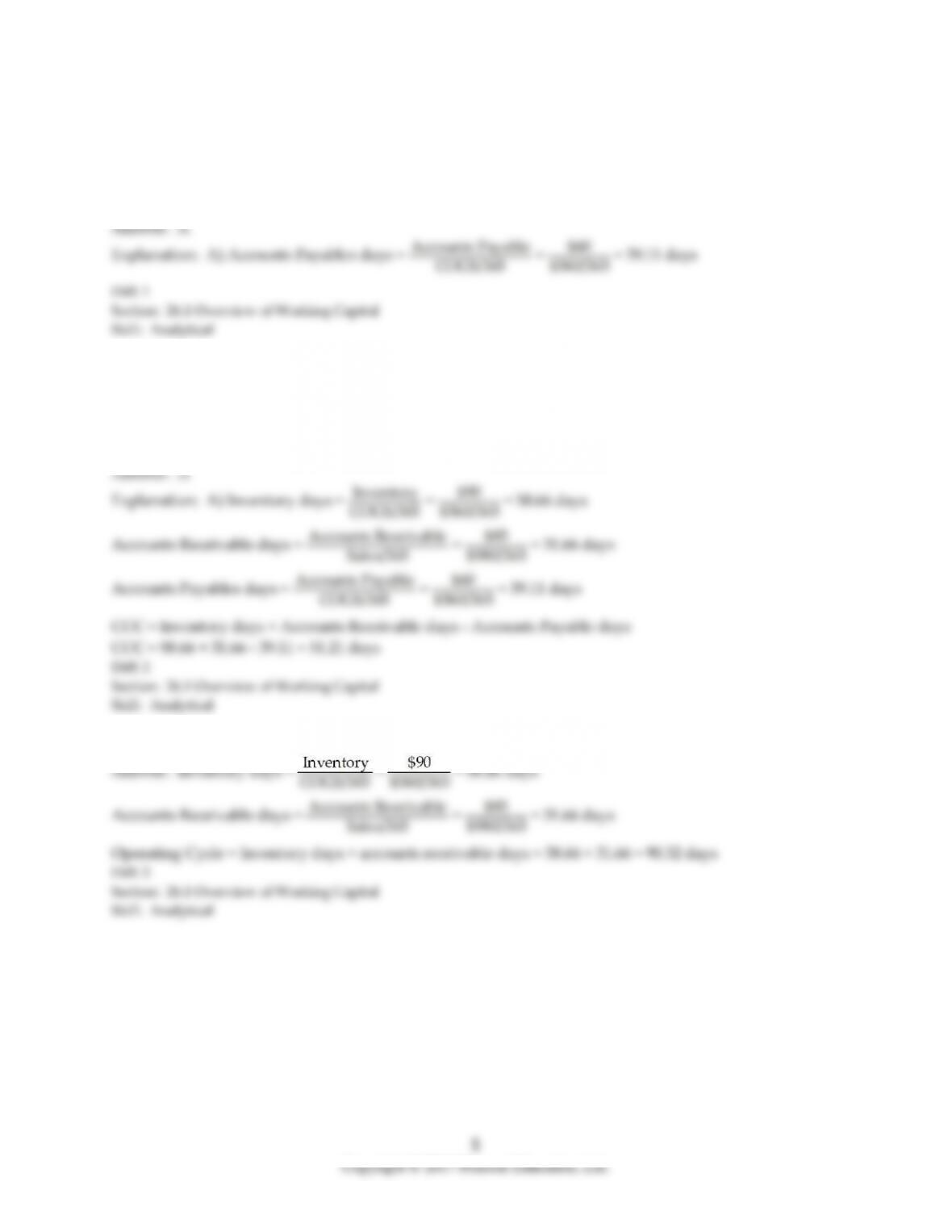
9) Luther’s Accounts Payable days is closest to:
A) 39 days
B) 32 days
C) 59 days
D) 42 days
10) Luther’s cash conversion cycle is closest to:
A) 51 days
B) 66 days
C) 71 days
D) 129 days
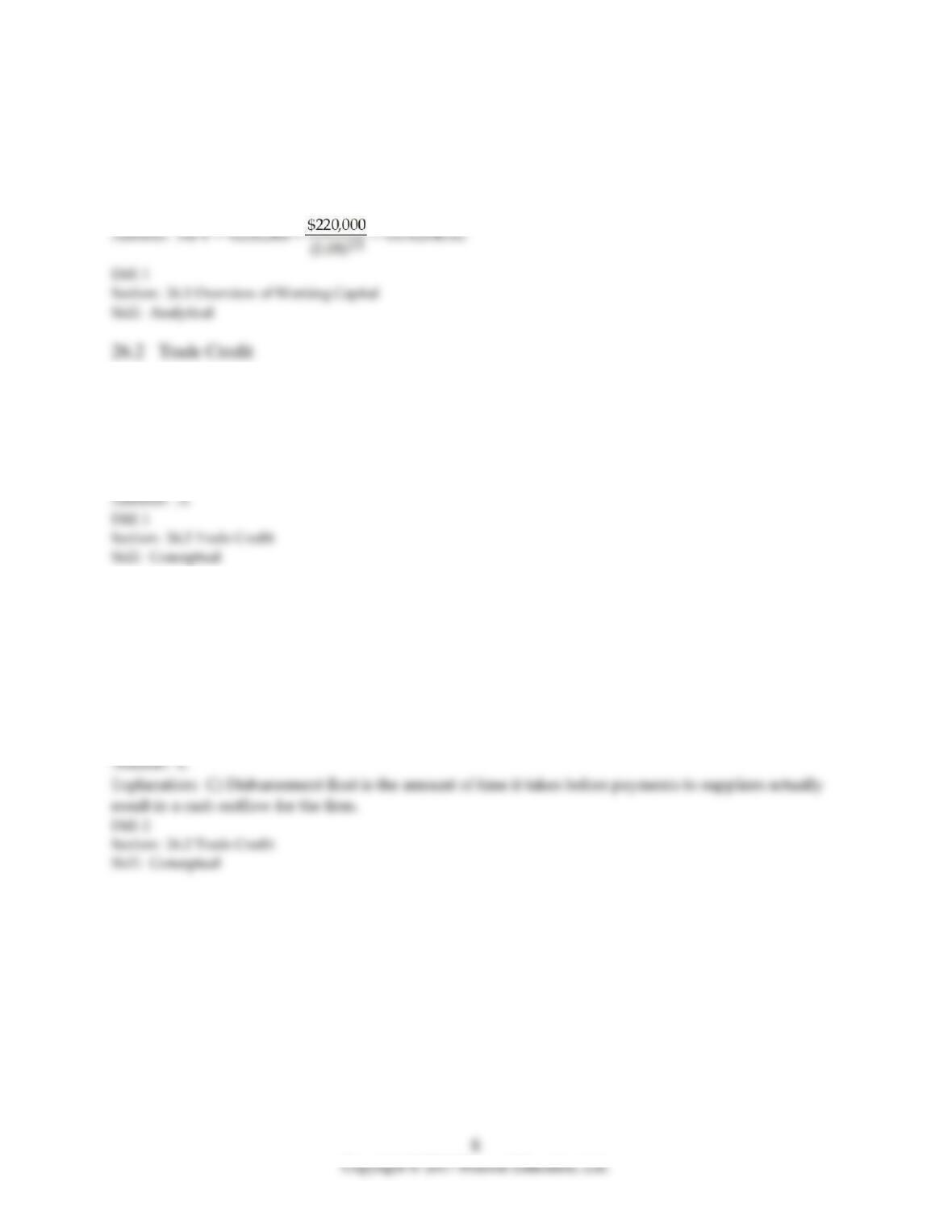
11) Calculate the number of days in Luther‘s Operating Cycle.
12) KT Enterprises would like to construct and operate a new ice skating rink. In addition to the capital
expenditures on the rink, management estimates that the project will require an investment today of
$220,000 in net working capital. The firm will recover the investment in net working capital fifteen
years from today, when management anticipates closing the rink. The discount rate for this type of cash
flow is 8% per year. Calculate the present value of the cost of working capital for the ice skating rink.
1) Collection float is made up of all of the following EXCEPT:
A) disbursement float.
B) processing float.
C) mail float.
D) availability float.
2) Which of the following statements is FALSE?
A) Under the Modigliani-Miller assumptions of perfect capital markets, the amounts of payables and
receivables are irrelevant.
B) One factor that contributes to the length of a firm’s receivables and payables is the delay between the
time a bill is paid and the cash is actually received.
C) Collection float is the amount of time it takes before payments to suppliers actually result in a cash
outflow for the firm.
D) The credit that the firm is extending to its customer is known as trade credit.
3) Which of the following statements is FALSE?
A) The Check Clearing for the 21st Century Act (Check 21), which became effective on October 28, 2004,
eliminated the disbursement float due to the check-clearing process.
B) Trade credit is, in essence, a loan from the selling firm to its customer.
C) The accounts receivable balance represents the amount that a firm owes its suppliers for goods that it
has received but for which it has not yet paid.
D) Providing financing at below-market rates is an indirect way to lower prices for only certain
customers.
4) The term 2/10 net 30 means:
A) If the invoice is paid within 10 days a 2% discount can be taken. If the invoice is paid between 11
and 29 days a 1% discount can be taken. After 30 days the full invoice is due.
B) If the invoice is paid within 2 days a 10% discount can be taken, otherwise the full invoice is due in 30
days.
C) If the invoice is paid within 2 days a 10% discount can be taken, otherwise a 2% discount can be
taken if the invoice is paid in 30 days.
D) If the invoice is paid within 10 days a 2% discount can be taken, otherwise the full invoice is due in
30 days.
5) Your firm purchases goods from its supplier on terms of 1/10, net 30. The effective annual cost to
your firm if it chooses not to take advantage of the trade discount offered is closest to:
A) 16.8%
B) 44.6%
C) 20.1%
D) 13.0%
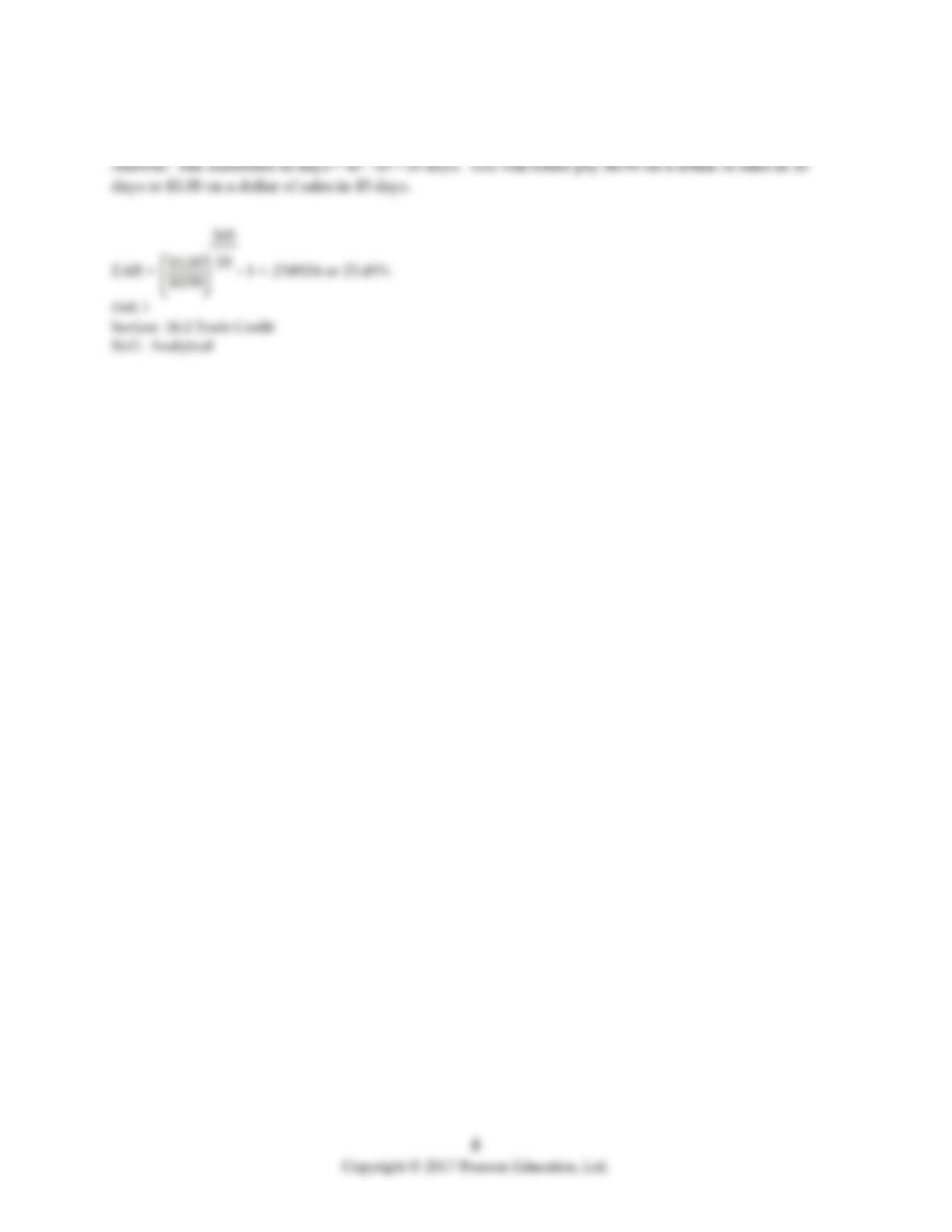
6) Your firm purchases goods from its supplier on terms of 2/10, net 45. Calculate the effective annual
cost to your firm if it chooses not to take advantage of the trade discount offered.
26.3 Receivables Management
Use the following information for the question(s) below.
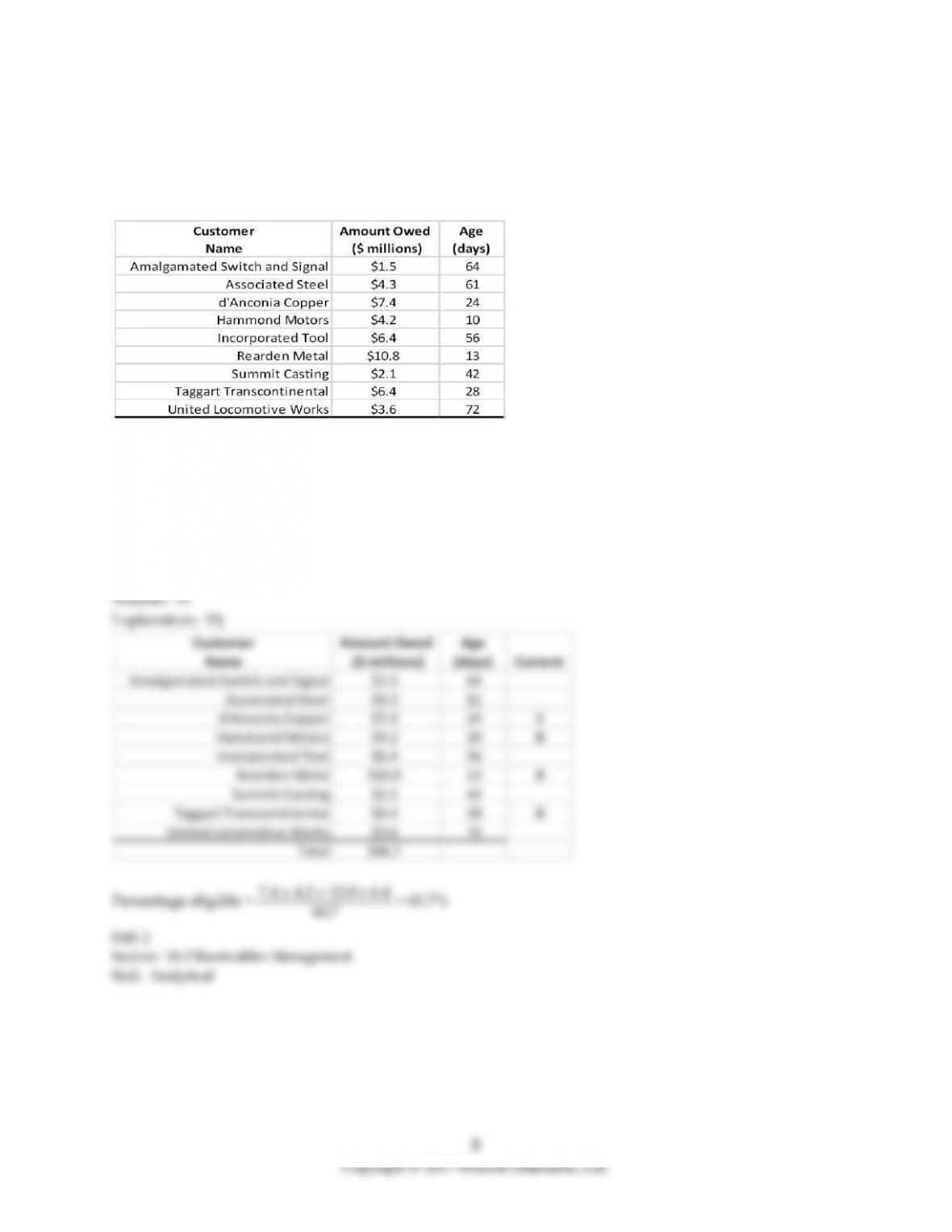
Wyatt Oil has the following accounts on its books:
Wyatt extends credit on terms of 1/15, net 30.
1) The percentage of Wyatt’s receivables that are current is closest to:
A) 32.1%
B) 38.3%
C) 42.2%
D) 61.7%
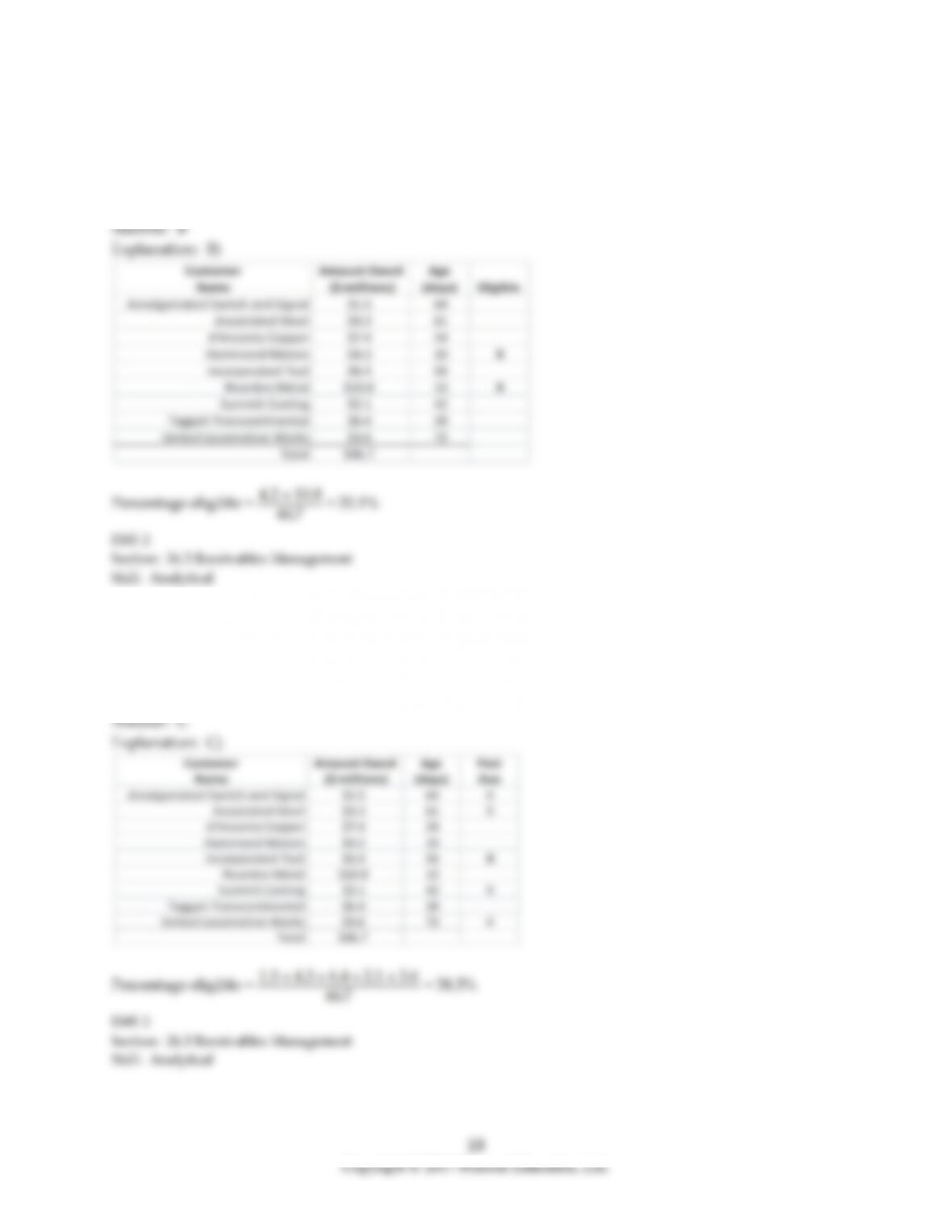
2) The percentage of Wyatt’s receivables that are still eligible to take the discount is closest to:
A) 20.1%
B) 32.1%
C) 38.3%
D) 42.2%
3) The percentage of Wyatt’s receivables that are past due is closest to:
A) 20.1%
B) 32.1%
C) 38.3%
D) 42.2%
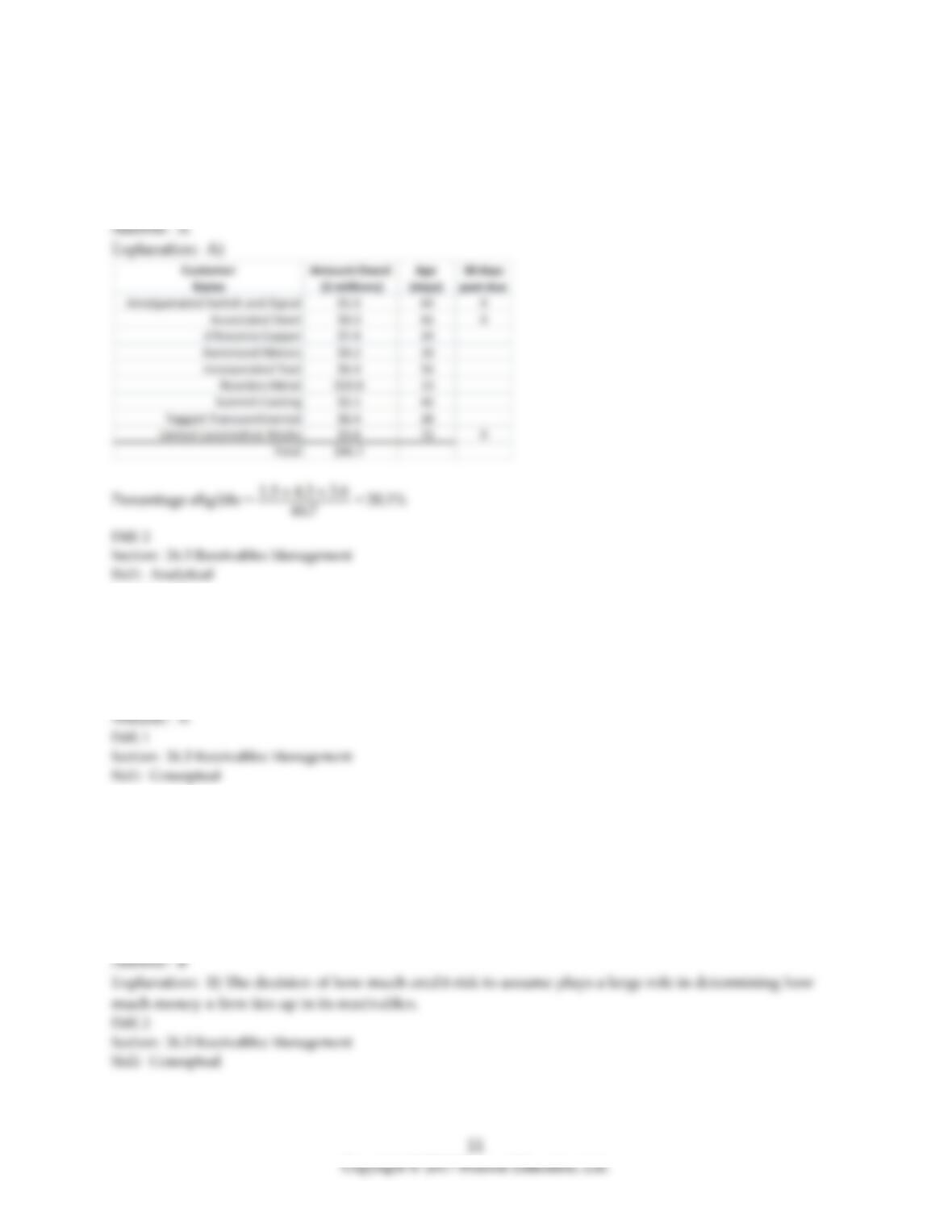
4) The percentage of Wyatt’s receivables that are more than 30 days past due is closest to:
A) 20.1%
B) 32.1%
C) 38.3%
D) 42.2%
5) Which one of the following is NOT one of the three steps involved in establishing a credit policy?
A) Establishing credit payment patterns
B) Establishing credit standards
C) Establishing a collection policy
D) Establishing credit terms
6) Which of the following statements is FALSE?
A) After a firm decides on its credit standards, it must next establish its credit terms.
B) The decision of how much credit risk to assume plays a large role in determining how much money a
firm ties up in its payables.
C) Knowledge of the payments pattern is also useful for forecasting the firm’s working capital
requirements.
D) An aging schedule categorizes accounts by the number of days they have been on the firm’s books.
7) Which of the following statements is FALSE?
A) The aging schedule is also sometimes augmented by analysis of the payments pattern, which
provides information on the percentage of monthly sales that the firm collects in each month after the
sale.
B) Because accounts receivable days can be calculated from the firm’s financial statement, outside
investors commonly use this measure to evaluate a firm’s credit management policy.
C) If the aging schedule gets “top-heavy”—that is, if the percentages in the upper half of the schedule
begin to increase—the firm will likely need to revisit its credit policy.
D) Seasonal sales patterns may cause the number calculated for the accounts receivable days to change
depending on when the calculation takes place.
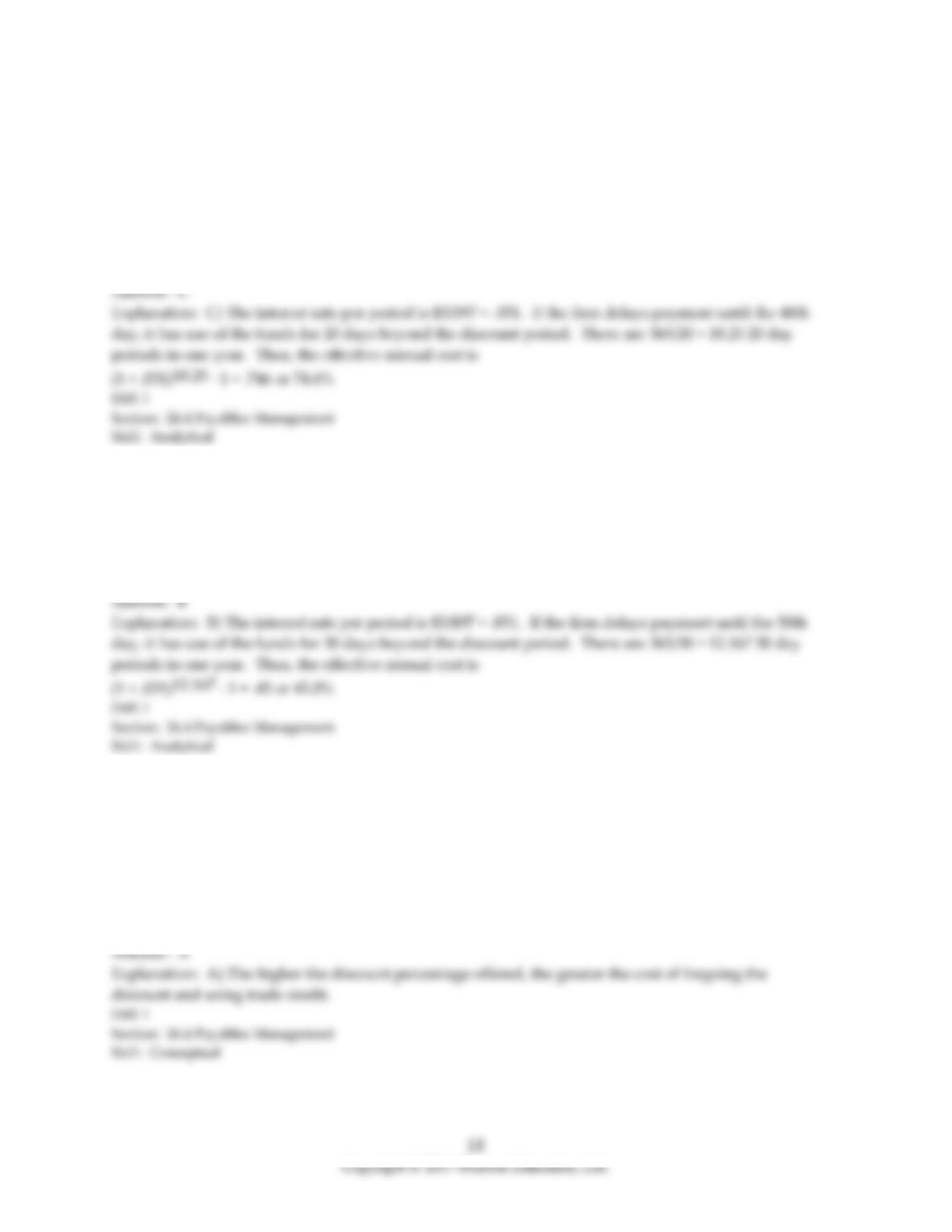
8) Luther Industries bills its accounts on terms of 2/10, net 30. The firm’s accounts receivable include
$250,000 that has been outstanding for 10 or fewer days, $375,000 outstanding for 11 to 30 days, $70,000
outstanding for 31 to 40 days, $35,000 outstanding for 41 to 50 days, $20,000 outstanding for 51 to 60
days, and $8000 outstanding for more than 60 days. Prepare an aging schedule for Luther Industries.
26.4 Payables Management
1) Wyatt Oil purchases goods from its suppliers on terms 3/20 net 40. The effective annual cost to Wyatt
if they do not take the discount and pay on day 40 is closest to:
A) 18%
B) 45%
C) 75%
D) 82%
2) Wyatt Oil purchases goods from its suppliers on terms 3/20 net 40. The effective annual cost to
Wyatt if they do not take the discount and pay on day 50 is closest to:
A) 18%
B) 45%
C) 75%
D) 82%
3) Which of the following statements is FALSE?
A) The lower the discount percentage offered, the greater the cost of forgoing the discount and using
trade credit.
B) A firm should choose to borrow using accounts payable only if trade credit is the cheapest source of
funding.
C) A firm should always pay on the latest day allowed.
D) A firm should strive to keep its money working for it as long as possible without developing a bad
relationship with its suppliers or engaging in unethical practices.
4) Which of the following statements is FALSE?
A) Similar to the situation with its accounts receivable, a firm should monitor its accounts payable to
ensure that it is making its payments at an optimal time.
B) Some firms ignore the payment due period and pay later, in a practice referred to as pushing the
accounts payable.
C) Suppliers may react to a firm whose payments are always late by imposing terms of cash on delivery
(COD) or cash before delivery (CBD).
D) If the accounts payable outstanding is 40 days and the terms are 2/10, net 30, the firm can conclude
that it generally pays late and may be risking supplier difficulties.
5) Your firm purchases goods from its supplier on terms of 1/10, net 30. The effective annual cost to
your firm if it chooses not to take advantage of the trade discount offered and stretches the accounts
payable to 45 days is closest to:
A) 13.0%
B) 11.1%
C) 15.9%
D) 20.1%
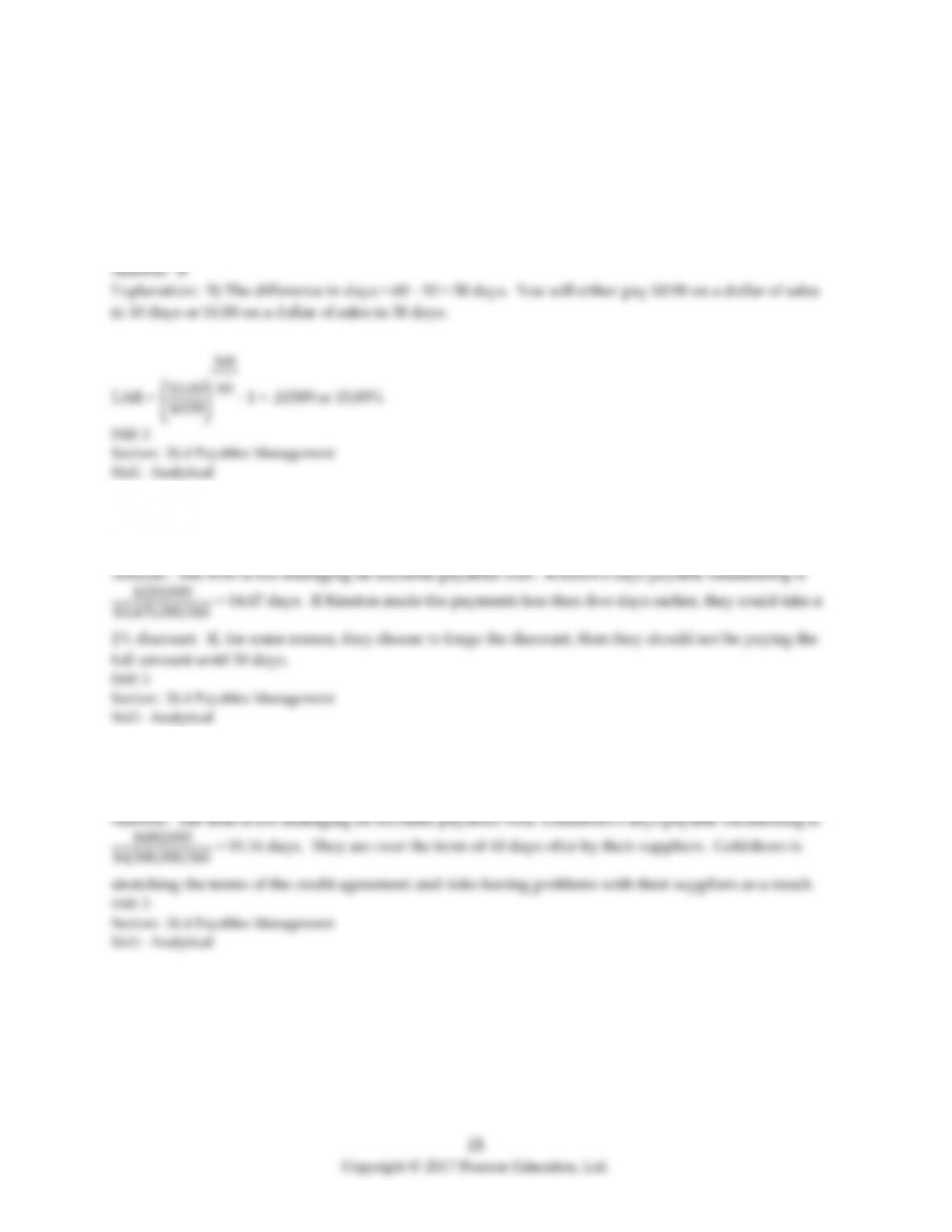
6) Your firm purchases goods from its supplier on terms of 2/10, net 40. The effective annual cost to
your firm if it chooses not to take advantage of the trade discount offered and stretches the accounts
payable to 60 days is closest to:
A) 20.1%
B) 15.9%
C) 13.0%
D) 11.1%
7) Kinston Industries has an average accounts payable balance of $220,000. Its annual cost of goods sold
is $5,475,000, and it receives terms of 2/10, net 30 from its suppliers. Kinston chooses to forgo this
discount. Is Kinston managing its accounts payables well?
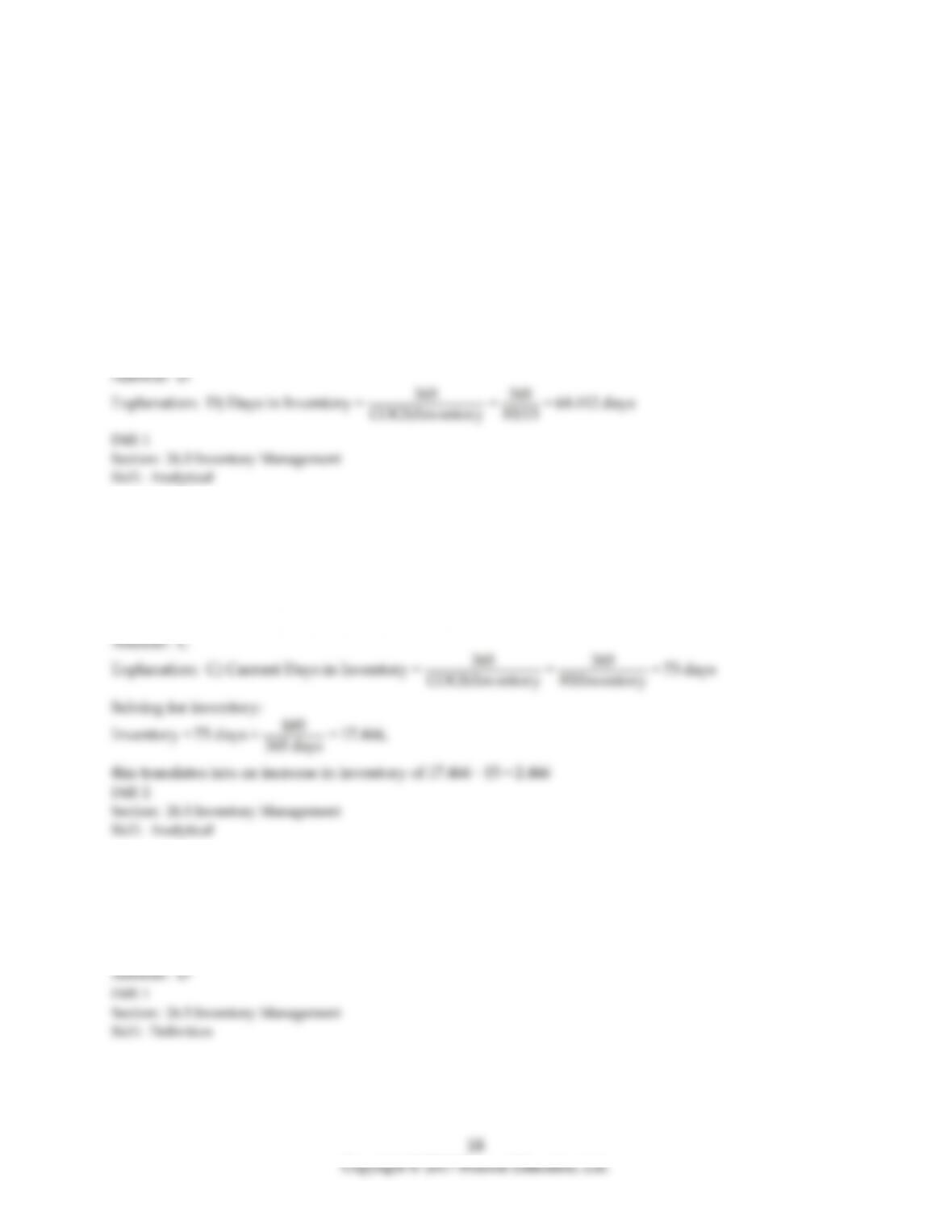
8) Goldsboro Industries has an average accounts payable balance of $680,000. Its annual cost of goods
sold is $4,500,000, and it receives terms of 1/10, net 40 from its suppliers. Goldsboro chooses to forgo
this discount. Is Goldsboro managing its accounts payables well?
26.5 Inventory Management
Use the following information to answer the question(s) below:
Rearden Metal (RM) had $120 million in sales in 2009. Its cost of goods sold was $85, and its average
inventory balance was $15 million.
1) The average number of inventory days outstanding for Rearden is closest to:
A) 6 days
B) 8 days
C) 37 days
D) 64 days
2) The industry average days of inventory is 75 days. The amount that Rearden would have to
increase/decrease its inventory in order to match the industry average is closest to:
A) decrease inventory by 2.2 million
B) increase inventory by 2.2 million
C) increase inventory by 2.5 million
D) increase inventory by 4.2 million
3) Which of the following is NOT a direct cost associated with inventory?
A) Acquisition costs
B) Order costs
C) Carrying costs
D) Stock out costs
4) Which of the following statements is FALSE?
A) Under the Modigliani-Miller assumptions of perfect capital markets, the amount of inventory is
irrelevant.
B) Unlike trade credit, inventory represents one of the required factors of production.
C) It is the firm’s financial manager who must arrange for the financing necessary to support the firm’s
inventory policy and who is responsible for ensuring the firm’s overall profitability.
D) Inventory management receives extensive coverage in courses on operations management.
5) Which of the following statements is FALSE?
A) Firms may hold inventory because factors such as seasonality in demand mean that customer
purchases do not perfectly match the most efficient production cycle.
B) Inventory helps minimize the risk that the firm will not be able to obtain an input it needs for
production.
C) If a firm holds too much inventory, stock-outs, the situation when a firm runs out of product, may
occur, leading to lost sales.
D) Because excessive inventory uses cash, efficient management of inventory increases firm value.
6) Describe “just-in-time” inventory management.

26.6 Cash Management
1) Which of the following money market investments is a short-term debt obligation of the U.S.
government?
A) Treasury Bill
B) Repurchase Agreement
C) Commercial Paper
D) Certificates of Deposit (CD)
E) Banker’s Acceptance
2) Which of the following money market investments is short-term debt issued by a bank with a
minimum denomination of $100,000?
A) Treasury Bill
B) Banker’s Acceptance
C) Repurchase Agreement
D) Commercial Paper
E) Certificates of Deposit (CD)
3) Which of the following money market investments is essentially a loan arrangement wherein the
investor buys securities from the securities dealer, with an agreement to sell the securities back to the
dealer at a later date for a specified higher price?
A) Certificates of Deposit (CD)
B) Commercial Paper
C) Banker’s Acceptance
D) Repurchase Agreement
E) Treasury Bill
4) Which of the following money market investments is a draft typically used in international trade,
which is written by the borrower and guaranteed by the bank on which the draft is drawn?
A) Treasury Bill
B) Repurchase Agreement
C) Certificates of Deposit (CD)
D) Banker’s Acceptance
E) Commercial Paper
5) Which of the following money market investments is a short-term, unsecured debt obligation issued
by a large corporation, with a minimum denomination of $25,000?
A) Banker’s Acceptance
B) Commercial Paper
C) Repurchase Agreement
D) Certificates of Deposit (CD)
E) Treasury Bill
6) The amount of cash a firm needs to be able to pay its bills is sometimes referred to as a(n):
A) operating balance.
B) compensating balance.
C) transactions balance.
D) precautionary balance.
7) The amount of cash a firm holds to counter the uncertainty surrounding its future cash needs is
known as a(n):
A) speculative balance.
B) compensating balance.
C) operating balance.
D) precautionary balance.
8) What is a compensating balance?