Corporate Finance, 4e, Global Edition (Berk / DeMarzo)
Chapter 25 Leasing
25.1 The Basics of Leasing
1) Which of the following statements is FALSE?
A) A lease is a contract between two parties: the lessee and the lessor.
B) Most leases involve little or no upfront payment.
C) The lessee is the owner of the asset, who is entitled to the lease payments in exchange for lending the
asset.
D) At the end of the contract term, the lease specifies who will retain ownership of the asset and at what
terms.
2) Which of the following statements is FALSE?
A) In a direct lease, the lessor is the manufacturer (or a primary dealer) of the asset.
B) The lease specifies any cancellation provisions, the options for renewal and purchase, and the
obligations for maintenance and related servicing costs.
C) If a firm already owns an asset it would prefer to lease, it can arrange a sale and leaseback
transaction.
D) With many leases, the lessor provides the initial capital necessary to purchase the asset, and then
receives and retains the lease payments.
3) Which of the following statements is FALSE?
A) In a leveraged lease, the lessor borrows from a bank or other lender to obtain the initial capital for
the purchase, using the lease payments to pay interest and principal on the loan.
B) In some circumstances, the lessor is not an independent company but rather a separate business
partnership, called a special-purpose entity (SPE), which is created by the lessor for the sole purpose of
obtaining the lease.
C) In a direct lease, the lessor is not the manufacturer, but is often an independent company that
specializes in purchasing assets and leasing them to customers.
D) SPEs are commonly used in synthetic leases, which are designed to obtain specific accounting and
tax treatment.
4) A lease that gives the lessee the option to purchase the asset at its fair market value at the termination
of the lease is called a:
A) fair market value cap lease.
B) fair market value lease.
C) $1.00 out lease.
D) fixed price lease.
5) A lease where ownership of the asset transfers to the lessee at the end of the lease for a nominal cost
is called a:
A) fair market value cap lease.
B) fixed price lease.
C) $1.00 out lease.
D) fair market value lease.
6) A lease where the lessee has the option to purchase the asset at the end of the lease for a set price that
is set upfront in the lease contract is called a:
A) fixed price lease.
B) $1.00 out lease.
C) fair market value lease.
D) fair market value cap lease.
7) A lease where the lessee can purchase the asset at the minimum of its fair market value and a fixed
price is called a:
A) $1.00 out lease.
B) fixed price lease.
C) fair market value lease.
D) fair market value cap lease.
8) Which of the following statements is FALSE?
A) Because we are getting the entire asset when we purchase it with the loan, the loan payments are
higher than the lease payments.
B) In a perfect market, the cost of leasing and then purchasing the asset is equivalent to the cost of
borrowing to purchase the asset.
C) With a lease we are financing the entire cost of the asset, with a standard loan we are financing only
the cost of the economic depreciation of the asset during its life.
D) The amount of the lease payment will depend on the purchase price, the residual value, and the
appropriate discount rate for the cash flows.
9) Which of the following statements is FALSE?
A) Absent market imperfections, leases represent another form of zero-NPV financing available to a
firm, and the Modigliani-Miller propositions apply: Leases neither increase nor decrease firm value, but
serve only to divide the firm’s cash flows and risks in different ways.
B) In a perfect market, the cost of leasing is equivalent to the cost of purchasing and reselling the asset.
C) Each lease agreement can be tailored to fit the precise nature of the asset and the needs of the parties
at hand.
D) Features of leases will be priced as part of the lease payment. Terms that give valuable options to the
lessee lower the amount of the lease payments, whereas terms that restrict these options will raise them.
10) Which of the following statements is FALSE?
A) Leases may include early cancellation options that allow the lessee to end the lease early (perhaps for
a fee).
B) The cost of the lease will depend on the asset’s residual value, which is its book value at the end of
the lease.
C) Leases may allow the lessee to trade in and upgrade the equipment to a newer model at certain
points in the lease.
D) Leases may contain buyout options that allow the lessee to purchase the asset before the end of the
lease term.
Use the information for the question(s) below.
Suppose the purchase price of a bulldozer is $90,000, its residual value in four years is certain to be
$15,000, and there is no risk that the lessee will default on the lease. Assume that capital markets are
perfect and the risk-free interest rate is 6% APR with monthly compounding.
11) The monthly lease payments for a four year lease of the bulldozer are closest to:
A) $1870
B) $1825
C) $1750
D) $2115
12) Suppose that instead of leasing the bulldozer, the company is considering purchasing a bulldozer
outright by borrowing the purchase price using a four-year annuity loan. The monthly loan payments
for a four year loan to purchase the bulldozer are closest to:
A) $2115
B) $1825
C) $1870
D) $1750
13) Calculate the monthly lease payments for a four year $1.00 out lease of the bulldozer.
14) Calculate the monthly lease payments for a four year fixed price lease that allows the lessee to buy
the bulldozer at the end of the lease for $8000.
25.2 Accounting, Tax, and Legal Consequences of Leasing
1) The lease is treated as a capital lease (financial lease) for the lessee and must be listed on the firm’s
balance sheet if it satisfies any of the following conditions EXCEPT:
A) the lease contains an option to purchase the asset at its fair market value.
B) the present value of the minimum lease payments at the start of the lease is 90% or more of the asset’s
fair market value.
C) the title to the property transfers to the lessee at the end of the lease term.
D) the lease term is 75% or more of the estimated economic life of the asset.
2) A lease will be treated as a non-tax lease if it satisfies any of the following conditions EXCEPT:
A) the property may be acquired at the fair market value of the asset at the time when the option may
be exercised.
B) some portion of the lease payments is specifically designated as interest or its equivalent.
C) the lessee receives ownership of the asset on completion of all lease payments.
D) the total amount that the lessee is required to pay for a relatively short period of use constitutes an
inordinately large proportion of the total value of the asset.
3) Which of the following statements regarding operating leases is FALSE?
A) They are also called finance leases.
B) The lease is viewed as a rental for accounting purposes.
C) The lessee reports the entire lease payment as an operating expense.
D) They are disclosed in the footnotes of the lessee’s financial statements.
4) Which of the following statements regarding capital leases is FALSE?
A) Because capital leases increase the apparent leverage on the firm’s balance sheet, firms sometimes
prefer to have a lease categorized as an operating lease to keep it off the balance sheet.
B) The firm does not report the present value of the future lease payments as a liability on the balance
sheet.
C) The asset acquired is listed on the lessee’s balance sheet, and the lessee incurs depreciation expenses
for the asset.
D) They are viewed as an acquisition for accounting purposes.
5) Which of the following statements is FALSE?
A) The decision to lease is often driven by real-world market imperfections related to leasing’s
accounting, tax, and legal treatment.
B) When publicly traded firms disclose leasing transactions in their financial statements, they must
follow the recommendations of the Financial Accounting Standards Board (FASB).
C) In its Statement of Financial Accounting Standards No. 13 (FAS13), the FASB provides specific
criteria that distinguish a true tax lease from a non-tax lease.
D) The categories used to report leases on the financial statements affect the values of assets on the
balance sheet, but they have no direct effect on the cash flows that result from a leasing transaction.
6) Which of the following statements is FALSE?
A) If the lease is deemed to be a true lease, the firm is assumed to have effective ownership of the asset
and the asset is protected against seizure.
B) Although the legal ownership of the asset resides with the lessor, in a non-tax lease the lessee
receives the depreciation deductions.
C) The treatment of leased property in bankruptcy will depend on whether the lease is classified as a
security interest or a true lease by the bankruptcy judge.
D) In a non-tax lease, the interest portion of the lease payment is interest income for the lessor.
7) Which of the following statements regarding leases and bankruptcy is FALSE?
A) Operating and true tax leases are generally viewed as true leases by the courts, whereas capital and
non-tax leases are more likely to be viewed as a security interest.
B) By retaining ownership of the asset, the lessor has the right to repossess it if the lease payments are
not made, even if the firm seeks bankruptcy protection.
C) If a lease contract is characterized as a true lease in bankruptcy, the lessor is in a somewhat superior
position than a lender if the firm defaults.
D) If the lease is classified as a true lease in bankruptcy, then the lessee retains ownership rights over
the asset.
8) Which of the following statements regarding leases and taxes is FALSE?
A) In a non-tax lease, the lessee can deduct the interest portion of the lease payments as an interest
expense.
B) In a true tax lease, the lease payments are treated as revenue for the lessor.
C) In a true tax lease, the lessee receives the depreciation deductions associated with the ownership of
the asset.
D) The IRS separates leases into two broad categories: true tax leases and non-tax leases.
Use the table for the question(s) below.
Luther Industries currently has the following balance sheet (in thousands of dollars):
Assets
Liabilities
Cash
$500
Debt
$4500
Property, Plant, and Equipment
$7000
Equity
$3000
Total Assets
$7500
Total Debt plus Equity
$7500
Luther is about to add a new fleet of delivery trucks. The price of the fleet is $1.5 million.
9) If Luther acquires the new fleet of delivery trucks using a capital lease, Luther‘s Debt to Equity ratio
will be closest to:
A) 0.66
B) 1.5
C) 0.80
D) 2.0
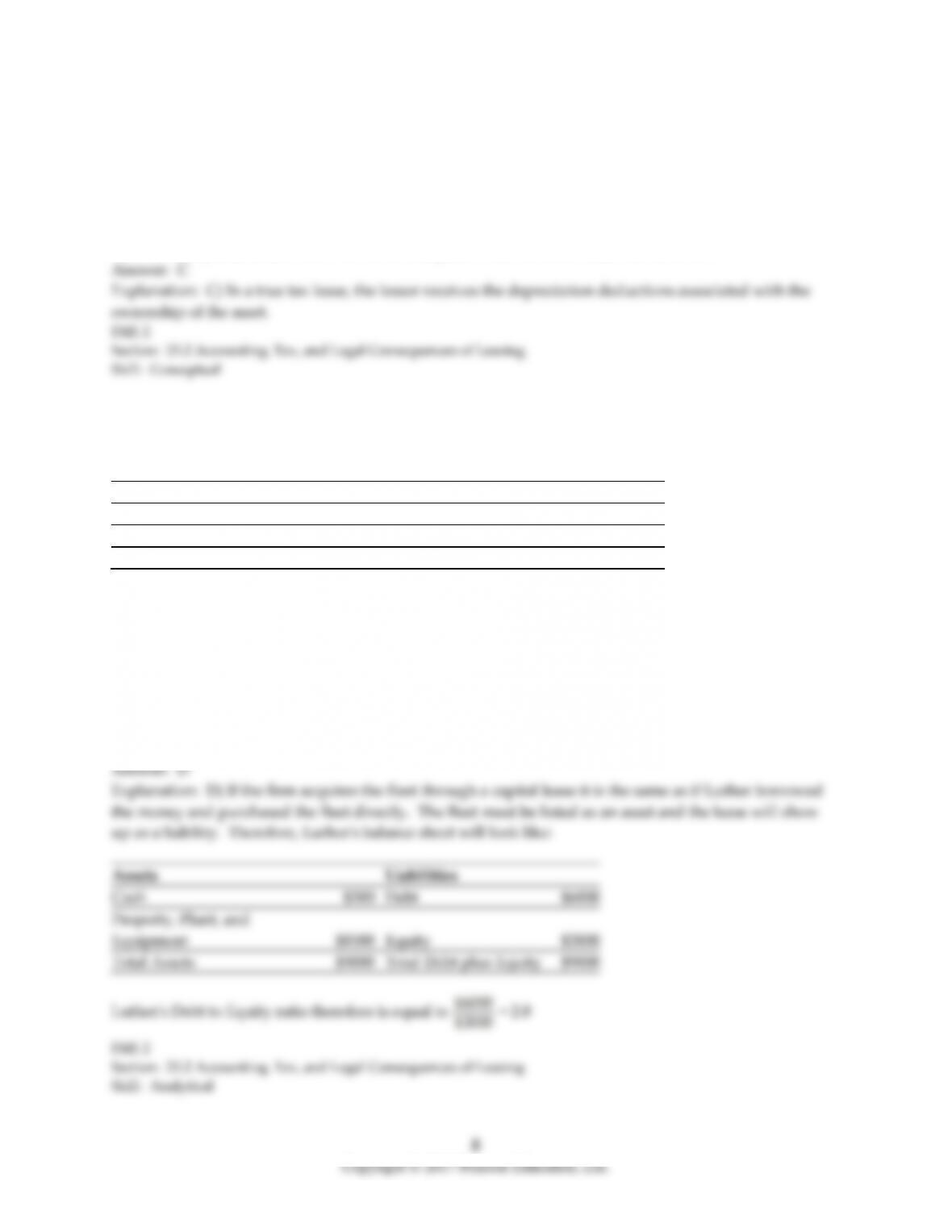
Cash
Debt
Equipment
Equity
Total Assets
Total Debt plus Equity
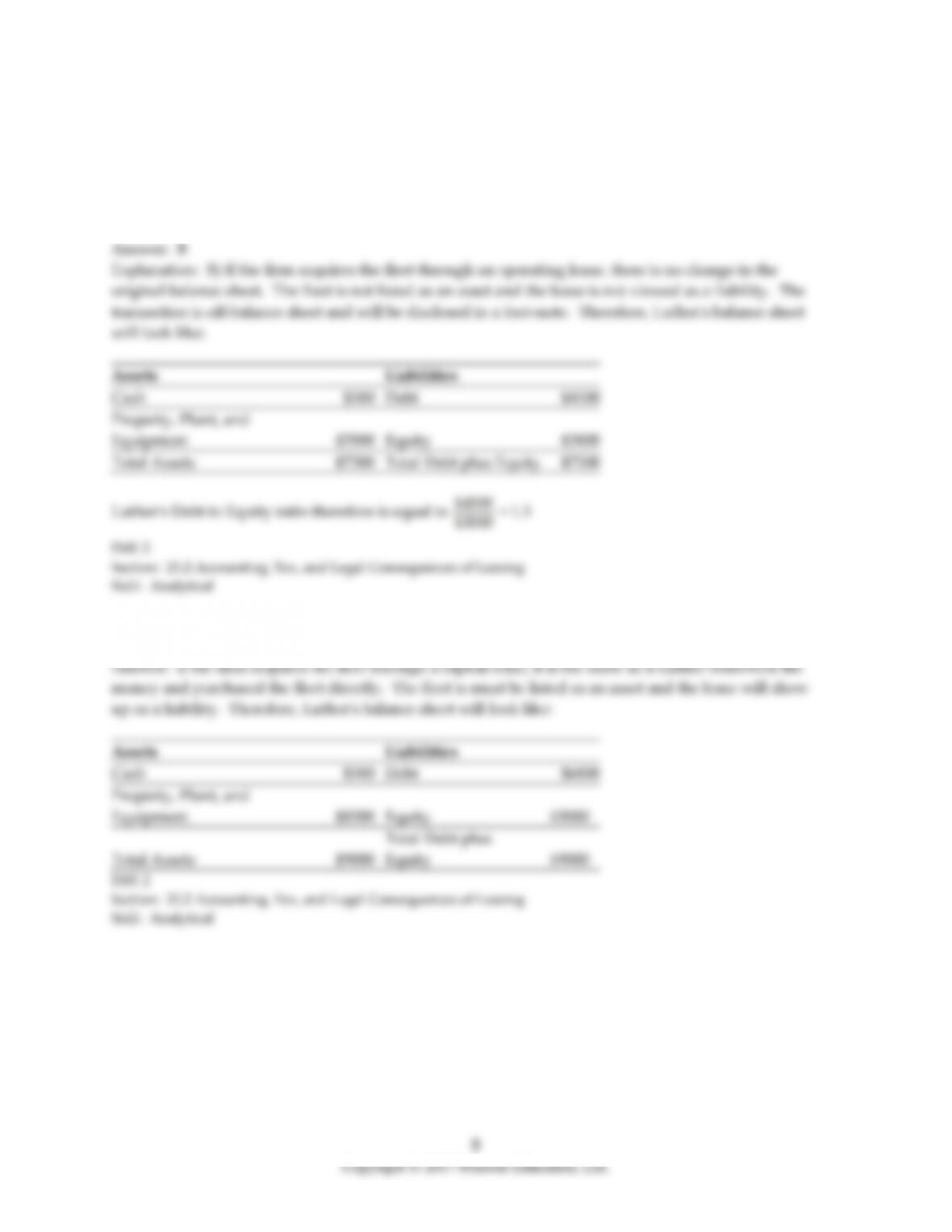
10) If Luther acquires the new fleet of delivery trucks using an operating lease, Luther’s Debt to Equity
ratio will be closest to:
A) 2.0
B) 1.5
C) 0.80
D) 0.66
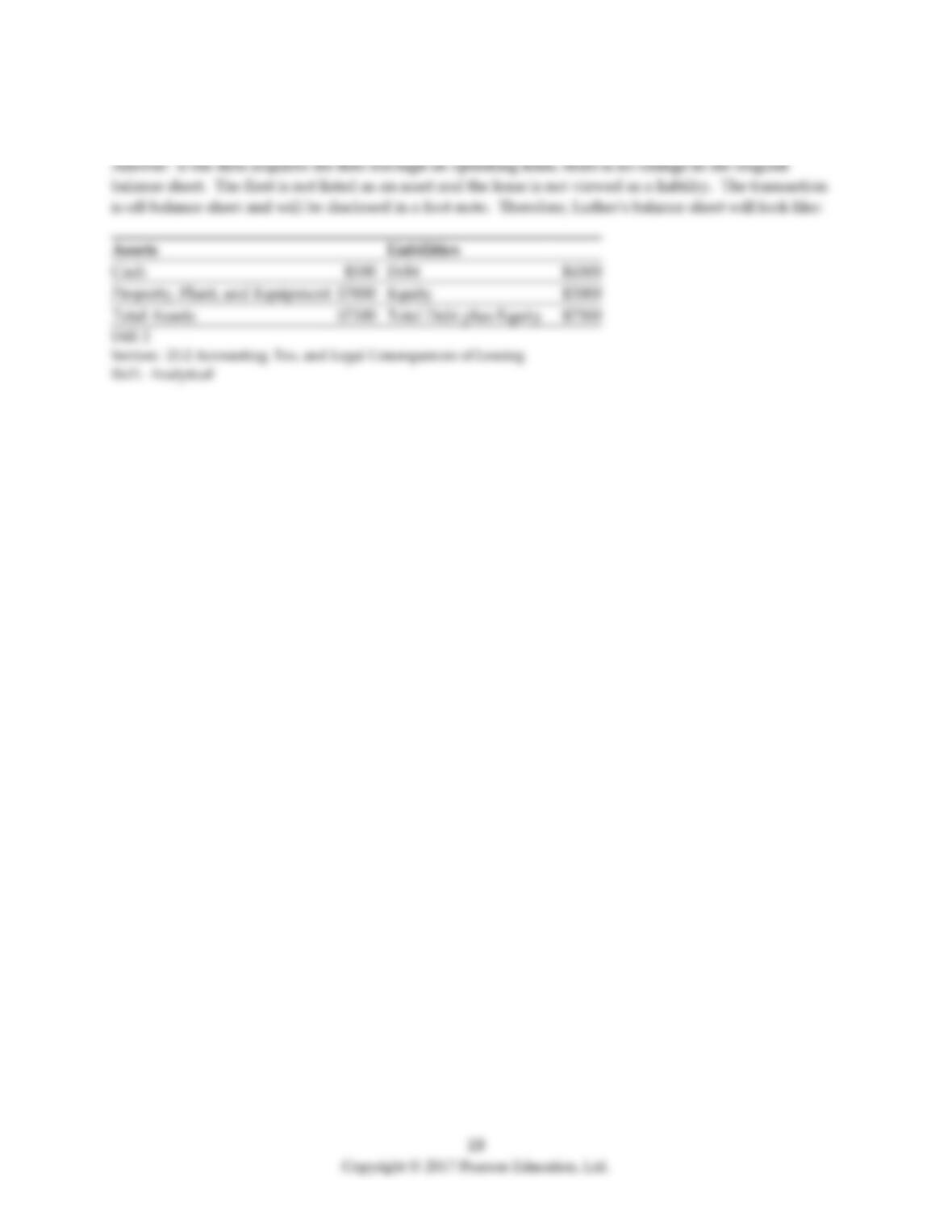
11) What will Luther‘s balance sheet look like if they acquire the new fleet of delivery trucks using a
capital lease?
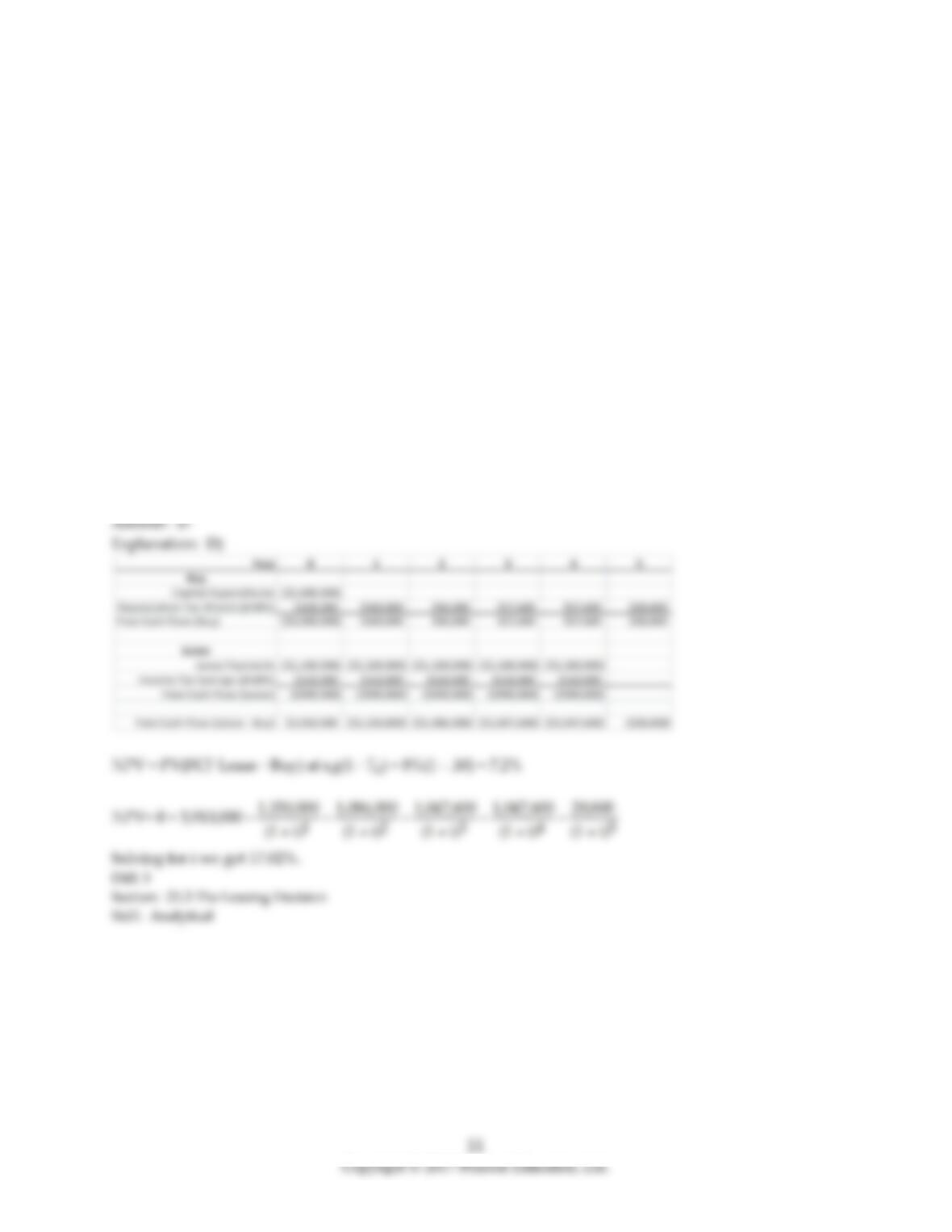
12) What will Luther‘s balance sheet look like if they acquire the new fleet of delivery trucks using an
operating lease?
25.3 The Leasing Decision
Use the following information to answer the question(s) below.
Rearden Metal is considering the purchase of a new blast furnace costing a total of $5 million dollars.
This furnace will qualify for accelerated depreciation: 20% can be expense immediately, followed by
32%, 19.2%, 11.52%, 11.52% and 5.76% over the next five years. However, because of Rearden’s
substantial tax loss carry forwards, Rearden estimates its marginal tax rate to be only 10% over the next
five years. Since Rearden will get very little tax benefit from the depreciation expense, they consider
leasing the furnace instead. Suppose that Rearden and the lessor face the same 8% borrowing rate, but
the lessor has a 40% marginal tax rate. Assume that the furnace is worthless after five years, the lease
term is five years, and a lease would qualify as a true tax lease.
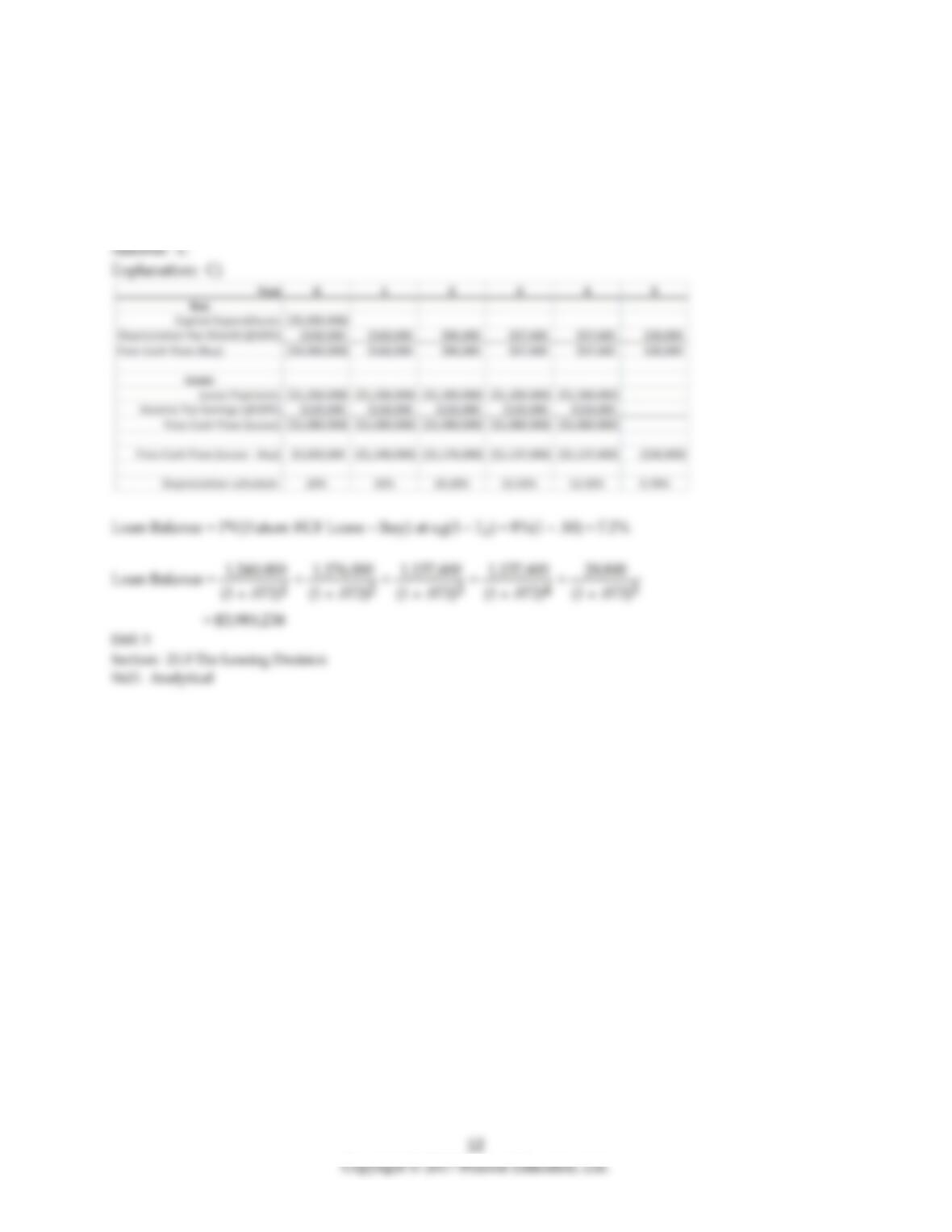
1) Assuming that Rearden’s annual lease payments are $1.1 million, then the effective after-tax lease
borrowing rate is closest to:
A) 8.0%
B) 12.8%
C) 15.4%
D) 17.0%
2) Assuming that Rearden’s annual lease payments are $1.2 million, then the amount of the lease–
equivalent loan is closest to:
A) $3.8 million
B) $3.9 million
C) $4.0 million
D) $4.2 million
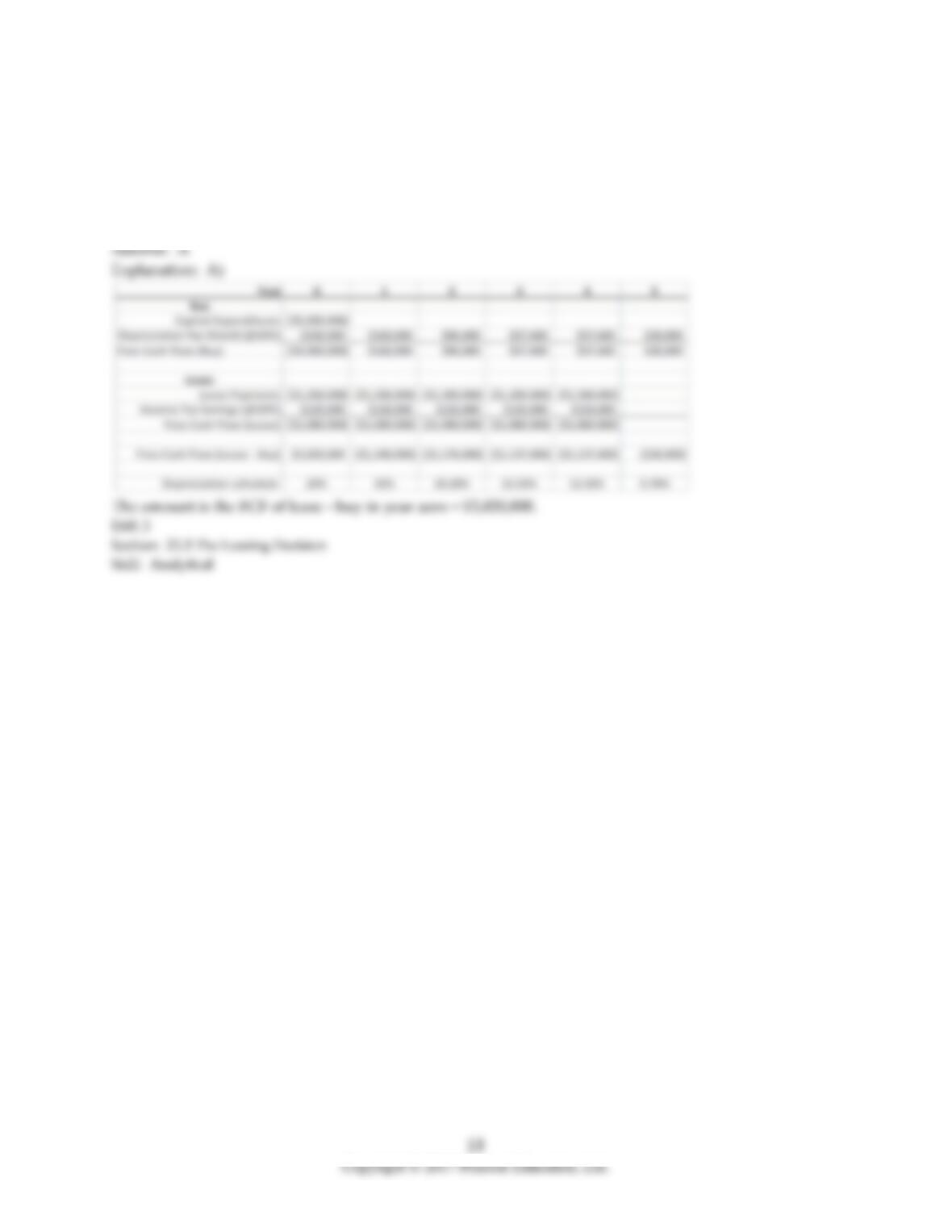
3) Assuming that Rearden’s annual lease payments are $1.2 million, then the amount of the savings in
year 0 from leasing is closest to:
A) $3.8 million
B) $3.9 million
C) $4.0 million
D) $4.2 million